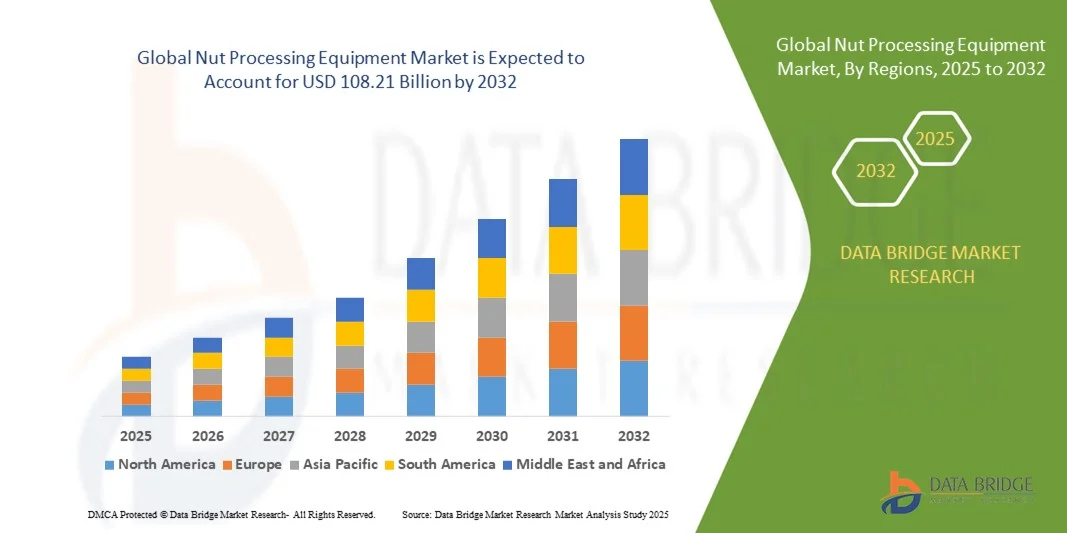
Nut Processing Equipment Market Size
- The global nut processing equipment market size was valued at USD 59.78 billion in 2024 and is expected to reach USD 108.21 billion by 2032, at a CAGR of 7.7% during the forecast period
- The market growth is largely fueled by increasing mechanization and technological advancements in nut processing equipment, enabling higher efficiency, precision, and consistency across various stages of nut handling, from shelling and roasting to grinding and packagings
- Furthermore, rising demand for value-added nut products, including roasted nuts, nut butters, and flavored snacks, is driving processors to adopt advanced, automated, and integrated equipment solutions. These trends are accelerating the modernization of nut processing facilities, thereby significantly boosting the market’s growth
Nut Processing Equipment Market Analysis
- Nut processing equipment, encompassing machinery for shelling, roasting, sorting, grinding, coating, and packaging, is becoming increasingly essential in both industrial and small-scale operations due to its ability to improve product quality, reduce labor dependency, and enhance operational efficiency
- The escalating demand for nut processing solutions is primarily driven by rising global consumption of nuts and nut-based products, increasing health-conscious and plant-based diets, and the need for high-throughput, reliable, and precise machinery across commercial processing units
- Asia-Pacific dominated the nut processing equipment market with a share of 42.5% in 2024, due to growing nut production, rising demand for value-added nut products, and a strong presence of processing equipment manufacturers
- North America is expected to be the fastest growing region in the nut processing equipment market during the forecast period due to rising consumption of nuts and nut-based products, increasing industrialization of food processing, and demand for high-efficiency machinery
- Automatic segment dominated the market with a market share of 57.8% in 2024, due to the industry’s shift toward fully integrated, high-capacity systems that reduce labor costs and improve consistency. Automatic nut processing lines enhance production speed, minimize human error, and ensure better hygiene control, aligning with food safety regulations. Their deployment is expanding among large-scale producers seeking scalability and precision in multi-step processing
Report Scope and Nut Processing Equipment Market Segmentation
|
Attributes |
Nut Processing Equipment Key Market Insights |
|
Segments Covered |
|
|
Countries Covered |
North America
Europe
Asia-Pacific
Middle East and Africa
South America
|
|
Key Market Players |
|
|
Market Opportunities |
|
|
Value Added Data Infosets |
In addition to the insights on market scenarios such as market value, growth rate, segmentation, geographical coverage, and major players, the market reports curated by the Data Bridge Market Research also include in-depth expert analysis, pricing analysis, brand share analysis, consumer survey, demography analysis, supply chain analysis, value chain analysis, raw material/consumables overview, vendor selection criteria, PESTLE Analysis, Porter Analysis, and regulatory framework. |
Nut Processing Equipment Market Trends
Adoption of Automated Nut Processing Equipment
- The nut processing equipment market is experiencing significant growth due to the rising adoption of automated systems that enhance production efficiency, quality control, and safety. Automation minimizes manual intervention, reducing labor costs while improving output consistency in high-volume nut processing facilities across the globe
- For instance, TOMRA Food has introduced advanced optical sorting equipment for nuts, which uses laser and camera technology to detect and remove defective kernels with high precision. Similarly, Bühler Group offers fully automated roasting and paste production systems that integrate quality monitoring to maintain uniform product standards
- Integration of automation into shelling, roasting, slicing, and grinding processes enables manufacturers to meet increasing global demand while ensuring compliance with stringent food safety regulations. Automated equipment reduces operational downtime through predictive maintenance and real-time production monitoring, enhancing overall productivity
- The push for automation is also driven by the surge in demand for specialty and value-added nut products such as flavored roasted nuts, nut-based spreads, and gluten-free flour. Automated systems allow for precise recipe execution, temperature control, and ingredient mixing, improving product innovation and reducing waste
- Manufacturers are investing in flexible automation solutions that can adapt to multiple nut varieties. This capability supports diversified product lines and helps companies respond to shifting consumer preferences in both domestic and export markets. The versatility of modern automated systems strengthens competitiveness in the global food processing industry
- The trend towards adopting automated nut processing equipment is reshaping industry operations by combining efficiency, precision, and flexibility. Manufacturers embracing this technology are positioned to meet evolving market demands with higher profitability, improved quality assurance, and reduced resource consumption across product categories
Nut Processing Equipment Market Dynamics
Driver
Rising Demand for Value-Added Nut Products
- The growing popularity of value-added nut products such as snack mixes, seasoned roasted nuts, and nut-based spreads is fueling demand for specialized processing equipment. Consumers increasingly seek differentiated offerings that deliver taste variety, convenience, and health benefits, prompting manufacturers to expand production capabilities
- For instance, Bühler Group’s customized roasting and chopping equipment has enabled premium nut brands to produce consistent and high-quality seasoned products for retail and food service sectors. This illustrates the role of advanced machinery in driving innovation and market growth within this segment
- Nut processing equipment allows for enhanced precision in flavor application, roasting profiles, and particle sizing, ensuring product uniformity while reducing waste. Such capabilities are essential for maintaining quality standards and meeting consumer expectations for premium nut-based products
- Growing global awareness of nuts as a healthy source of proteins, vitamins, and healthy fats is encouraging manufacturers to develop innovative formats such as energy bars, plant-based spreads, and gluten-free flours. Equipment designed for multifunctional processing supports these diversified applications
- Rising investment in equipment that delivers efficiency, speed, and flexibility is enabling producers to meet increasing demand while consistently maintaining product quality and safety. The convergence of market expansion, product variety, and consumer health trends underscores the strategic importance of value-added nut product production capabilities
Restraint/Challenge
High Cost of Advanced Machinery
- The high initial investment required for advanced nut processing machinery remains a significant barrier for smaller manufacturers and emerging market players. Specialized systems that integrate automation, quality monitoring, and multifunctional capabilities often demand substantial capital expenditure compared to conventional equipment
- For instance, processors adopting Bühler’s high-capacity roasting lines or TOMRA’s optical sorting machines face considerable costs due to complex assembly requirements, precision engineering, and sophisticated sensor integration. These expenses can deter smaller enterprises from entering the automated segment
- Advanced machinery requires high-quality materials, precision machining, and rigorous testing to ensure long-term reliability and compliance with food safety standards. This adds to the overall manufacturing cost, further increasing the financial burden for buyers
- Maintenance and operational costs for sophisticated machinery are also higher due to the need for skilled technicians, specialized spare parts, and regular calibration to maintain processing accuracy. These ongoing expenses can reduce profitability in low-margin production environments
- Addressing the challenge of high machinery costs through financing options, shared-use facilities, and modular equipment designs could expand access for smaller producers. Achieving cost efficiencies in manufacturing and deployment will be critical to increasing the adoption rate of advanced nut processing systems globally
Nut Processing Equipment Market Scope
The market is segmented on the basis of product type, nut type, operation mode, application, finished product, and distribution channel.
- By Product Type
On the basis of product type, the nut processing equipment market is segmented into conveyors, cleaning equipment, drying equipment, sorting equipment, shelling equipment, dehulling equipment, separating equipment, calibrating equipment, cutting equipment, grading equipment, roasting equipment, coating/seasoning equipment, packaging equipment, and others. The shelling equipment segment dominated the market with the largest revenue share in 2024, attributed to the growing demand for high-efficiency machinery that ensures precision in removing shells while minimizing nut breakage. Shelling equipment plays a crucial role in maintaining nut integrity and enhancing processing yields, especially in high-volume production environments. Its popularity is reinforced by the rising automation of nut processing facilities and advancements in sensor-based shelling technology that optimize throughput and product quality.
The roasting equipment segment is projected to witness the fastest growth rate from 2025 to 2032, driven by the rising demand for value-added nut products and increasing consumer preference for roasted snacks. Roasting enhances flavor, texture, and shelf life, encouraging nut processors to adopt advanced, energy-efficient roasting systems with precise temperature control. Growing demand from snack manufacturers and the expansion of flavored nut varieties are further fueling the adoption of roasting machinery across both small-scale and industrial setups.
- By Nut Type
On the basis of nut type, the market is segmented into almond, walnut, pistachio, peanut, pecan, hazelnut, cashew, and others. The peanut segment dominated the market in 2024, supported by its large-scale production, affordability, and versatile use in snacks, spreads, and confectionery products. Peanut processing requires a range of equipment—from shelling to roasting and coating—making it the most commercially significant category. Its dominance is also underpinned by strong export demand and large consumption across emerging markets.
The almond segment is anticipated to record the fastest CAGR from 2025 to 2032, driven by increasing global consumption of almond-based products in dairy alternatives, bakery items, and health snacks. Rising health awareness and the growth of vegan and plant-based diets have expanded almond product applications, prompting processors to invest in advanced equipment for shelling, slicing, and roasting to meet quality and safety standards.
- By Operation Mode
On the basis of operation mode, the market is divided into automatic and semi-automatic. The automatic segment dominated the market with the largest share of 57.8% in 2024, owing to the industry’s shift toward fully integrated, high-capacity systems that reduce labor costs and improve consistency. Automatic nut processing lines enhance production speed, minimize human error, and ensure better hygiene control, aligning with food safety regulations. Their deployment is expanding among large-scale producers seeking scalability and precision in multi-step processing.
The semi-automatic segment is projected to witness the fastest growth from 2025 to 2032, driven by rising adoption among small and medium enterprises due to cost efficiency and ease of maintenance. These systems offer flexibility for producers processing multiple nut types and batch sizes, making them ideal for developing regions where full automation remains cost-prohibitive.
- By Application
On the basis of application, the nut processing equipment market is segmented into cleaning, roasting, shelling, cracking, drying, separating, cutting, grading, coating/seasoning, packaging, and others. The shelling application dominated the market in 2024, primarily due to its critical role in maintaining nut quality and efficiency during large-scale processing. Modern shelling machines integrate automated sensors to ensure uniform separation and minimal kernel loss, which enhances overall profitability for processors.
The roasting application is expected to witness the fastest growth during the forecast period, supported by increasing consumer demand for ready-to-eat and flavored nut products. Continuous roasting systems with real-time temperature monitoring and energy-saving designs are gaining popularity among snack manufacturers seeking consistent quality and reduced operational costs.
- By Finished Product
On the basis of finished product, the market is segmented into roasted, granular, and pasty. The roasted segment dominated the market in 2024, driven by strong consumer preference for roasted nuts due to their enhanced taste, aroma, and nutritional appeal. The expansion of snack food industries and retail brands offering roasted nut mixes has further boosted demand for efficient roasting and flavoring equipment.
The pasty segment is projected to register the fastest growth rate from 2025 to 2032, fueled by the rising consumption of nut-based spreads such as peanut butter, almond butter, and hazelnut pastes. Growing demand for plant-based and protein-rich spreads has encouraged manufacturers to invest in high-performance grinding and mixing equipment that ensure smooth texture and consistent quality.
- By Distribution Channel
On the basis of distribution channel, the market is segmented into direct and retail. The direct segment held the largest market share in 2024, attributed to manufacturers’ preference for direct sales to industrial food processors and snack producers, ensuring bulk transactions and long-term supply partnerships. Direct distribution enables better control over pricing, customization, and after-sales service, which are vital for large-scale buyers.
The retail segment is anticipated to grow at the fastest CAGR from 2025 to 2032, driven by the rising availability of compact nut processing machines for small businesses, cafes, and artisanal producers. Increasing e-commerce penetration and the growth of specialized equipment suppliers online are supporting retail channel expansion globally.
Nut Processing Equipment Market Regional Analysis
- Asia-Pacific dominated the nut processing equipment market with the largest revenue share of 42.5% in 2024, driven by growing nut production, rising demand for value-added nut products, and a strong presence of processing equipment manufacturers
- The region’s cost-effective manufacturing landscape, increasing investments in food processing infrastructure, and expanding exports of processed nuts are accelerating market growth
- Availability of skilled labor, favorable government policies, and rapid industrialization across developing economies are contributing to higher adoption of advanced nut processing equipment
China Nut Processing Equipment Market Insight
China held the largest share in the Asia-Pacific nut processing equipment market in 2024, owing to its leadership in nut production and processing. Strong industrial infrastructure, government support for food processing expansion, and extensive export capabilities for processed nuts are major growth drivers. Increasing adoption of automation and modern processing lines in both domestic and commercial facilities further strengthens market demand.
India Nut Processing Equipment Market Insight
India is witnessing the fastest growth in the Asia-Pacific region, fueled by rising nut cultivation, expanding food processing industries, and increasing adoption of automated processing solutions. Government initiatives promoting “Make in India” and modernization of food processing units are driving investments in nut processing equipment. Growing exports of nuts and nut-based products and rising demand for value-added products contribute to robust market expansion.
Europe Nut Processing Equipment Market Insight
The Europe market is growing steadily, supported by high-quality standards, regulatory compliance, and increasing demand for processed and packaged nuts. Investments in sustainable and energy-efficient processing equipment, coupled with strong R&D capabilities, are enhancing operational efficiency. The focus on premium and specialty nut products is further boosting demand for advanced processing solutions.
Germany Nut Processing Equipment Market Insight
Germany’s market is driven by its leadership in high-precision food processing, strong industrial base, and emphasis on innovation. The country’s well-established R&D networks and partnerships between academic institutions and equipment manufacturers foster continuous improvements in nut processing machinery. Demand is particularly strong for automated shelling, roasting, and coating systems catering to industrial-scale processors.
U.K. Nut Processing Equipment Market Insight
The U.K. market is supported by a mature food processing sector, rising demand for packaged and value-added nut products, and increased focus on automation. Investments in R&D, modernization of processing lines, and collaboration between manufacturers and technology providers are boosting the adoption of advanced nut processing equipment.
North America Nut Processing Equipment Market Insight
North America is projected to grow at the fastest CAGR from 2025 to 2032, driven by rising consumption of nuts and nut-based products, increasing industrialization of food processing, and demand for high-efficiency machinery. Technological advancements, automation trends, and reshoring of manufacturing units are further supporting market expansion.
U.S. Nut Processing Equipment Market Insight
The U.S. accounted for the largest share in the North America market in 2024, underpinned by its robust nut production, strong R&D capabilities, and extensive adoption of automated processing equipment. Focus on innovation, quality, and operational efficiency is driving the deployment of advanced machinery for shelling, roasting, grinding, and packaging, solidifying the country’s leading position in the region.
Nut Processing Equipment Market Share
The nut processing equipment industry is primarily led by well-established companies, including:
- JBT Corporation (U.S.)
- Key Technology (U.S.)
- Bühler AG (Switzerland)
- Lewis M. Carter Manufacturing, LLC (U.S.)
- The Middleby Corporation (U.S.)
- Modern Process Equipment Corporation (U.S.)
- SKOURAS Inc. (Greece)
- TabrizKar (Iran)
- Grossi Fabrications Inc. (U.S.)
- TOMRA (Norway)
- Kadioglu Machines (Turkey)
- JEM Equipment (U.S.)
- AC Horn Manufacturing (U.S.)
- Savage Equipment (U.S.)
- Wizard Manufacturing (U.S.)
- Momtazan Ind. Co. (Iran)
- Elias Nottas & Co. (BIONOT) (Greece)
- Maseto Technologies SLU (Spain)
- Ghazarian Welding Inc. (U.S.)
- BORRELL USA Corp. (U.S.)
Latest Developments in Global Nut Processing Equipment Market
- In September 2025, TOMRA Food introduced its advanced 4C optical sorting machine specifically engineered for nut and IQF processing sectors, offering superior precision, detection accuracy, and flexibility. The technology incorporates high-resolution cameras and intelligent algorithms to identify and remove foreign materials with exceptional consistency. This innovation represents a major leap toward smart automation and digitalized quality control, enabling nut processors to improve yield, minimize product loss, and ensure compliance with global food safety standards. The system’s adaptability to different nut types also enhances operational efficiency and scalability across large processing facilities
- In June 2025, Côte d’Ivoire initiated local assembly of cashew processing and spare parts machinery through a strategic partnership with Cashew Machines Vietnam (CMV), supported by comprehensive technician training programs. This development marks a significant milestone in the localization of nut processing infrastructure within West Africa. By reducing dependency on imported equipment, the initiative helps lower procurement costs, accelerate installation timelines, and improve machine maintenance capabilities. The move also supports local job creation and strengthens the regional value chain, positioning Côte d’Ivoire as a growing hub for cashew processing technology in the African market
- In April 2025, Key Technology and PPM Technologies jointly unveiled a fully integrated nut processing line combining advanced systems for sorting, roasting, seasoning, grading, and packaging. This end-to-end modular solution delivers improved process continuity, energy efficiency, and product uniformity while significantly reducing manual handling. The integration of automation at each stage of nut processing enables producers to achieve higher throughput and better quality control, addressing the rising global demand for ready-to-eat and value-added nut products. This innovation also reflects the market’s growing preference for turnkey solutions that simplify operations and maximize return on investment
- In March 2025, MEKONG Tech Group launched a new automatic cashew shelling machine designed to meet increasing end-user requirements for precision and productivity. The machine features enhanced automation capabilities, ensuring consistent shell removal with minimal kernel damage and lower labor involvement. Its deployment allows processors to streamline large-scale operations and achieve superior yield rates while maintaining product quality standards. This development reflects the growing trend of modernization in nut processing facilities, especially in Asia-Pacific, where automation is transforming the competitive landscape
- In January 2025, EssEmm Corporation introduced the Cosmos nut butter grinder, a high-performance system engineered for grinding peanuts, cashews, sesame seeds, and various other nuts and seeds into fine pastes. The machine’s precision grinding mechanism delivers consistent texture and smoothness, catering to the increasing consumer demand for nut-based spreads and protein-rich plant products. Its versatility and ease of operation make it ideal for both small-scale and industrial manufacturers, supporting expansion in the health-conscious and vegan food sectors. This launch strengthens EssEmm’s footprint in the value-added nut processing equipment market and promotes innovation in the production of premium nut-derived products

- Interactive Data Analysis Dashboard
- Company Analysis Dashboard for high growth potential opportunities
- Research Analyst Access for customization & queries
- Competitor Analysis with Interactive dashboard
- Latest News, Updates & Trend analysis
- Harness the Power of Benchmark Analysis for Comprehensive Competitor Tracking
Global Nut Processing Equipment Market, Supply Chain Analysis and Ecosystem Framework
To support market growth and help clients navigate the impact of geopolitical shifts, DBMR has integrated in-depth supply chain analysis into its Global Nut Processing Equipment Market research reports. This addition empowers clients to respond effectively to global changes affecting their industries. The supply chain analysis section includes detailed insights such as Global Nut Processing Equipment Market consumption and production by country, price trend analysis, the impact of tariffs and geopolitical developments, and import and export trends by country and HSN code. It also highlights major suppliers with data on production capacity and company profiles, as well as key importers and exporters. In addition to research, DBMR offers specialized supply chain consulting services backed by over a decade of experience, providing solutions like supplier discovery, supplier risk assessment, price trend analysis, impact evaluation of inflation and trade route changes, and comprehensive market trend analysis.
Data collection and base year analysis are done using data collection modules with large sample sizes. The stage includes obtaining market information or related data through various sources and strategies. It includes examining and planning all the data acquired from the past in advance. It likewise envelops the examination of information inconsistencies seen across different information sources. The market data is analysed and estimated using market statistical and coherent models. Also, market share analysis and key trend analysis are the major success factors in the market report. To know more, please request an analyst call or drop down your inquiry.
The key research methodology used by DBMR research team is data triangulation which involves data mining, analysis of the impact of data variables on the market and primary (industry expert) validation. Data models include Vendor Positioning Grid, Market Time Line Analysis, Market Overview and Guide, Company Positioning Grid, Patent Analysis, Pricing Analysis, Company Market Share Analysis, Standards of Measurement, Global versus Regional and Vendor Share Analysis. To know more about the research methodology, drop in an inquiry to speak to our industry experts.
Data Bridge Market Research is a leader in advanced formative research. We take pride in servicing our existing and new customers with data and analysis that match and suits their goal. The report can be customized to include price trend analysis of target brands understanding the market for additional countries (ask for the list of countries), clinical trial results data, literature review, refurbished market and product base analysis. Market analysis of target competitors can be analyzed from technology-based analysis to market portfolio strategies. We can add as many competitors that you require data about in the format and data style you are looking for. Our team of analysts can also provide you data in crude raw excel files pivot tables (Fact book) or can assist you in creating presentations from the data sets available in the report.