


What is the Nutraceutical Products Market Size and Growth Rate?
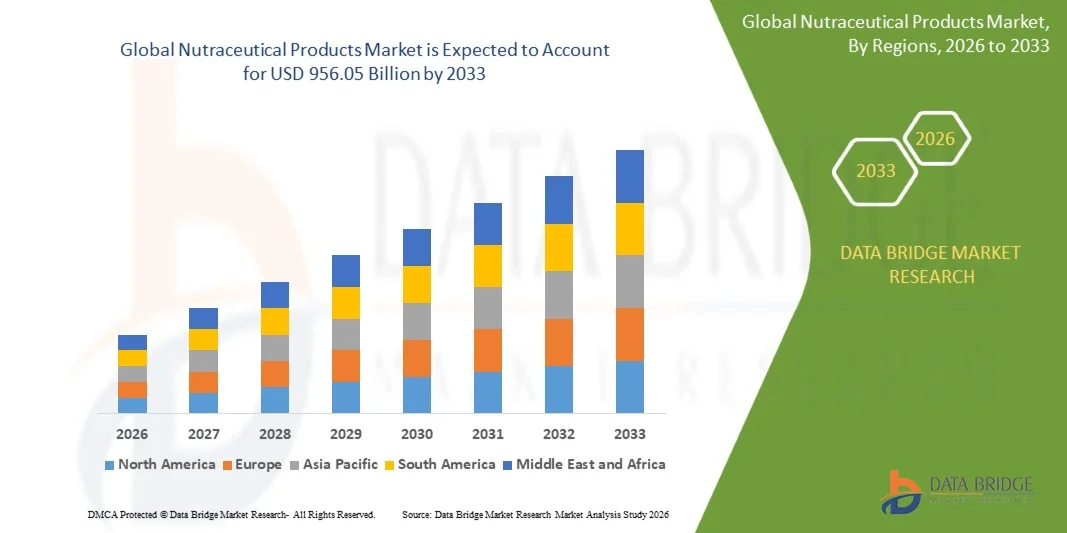
- As per Data Bridge Market Research analysis, the Nutraceutical Products market was valued at USD 536.06 billion in 2025 and is projected to reach USD 956.05 billion by 2033, growing at a CAGR of 7.50% from 2026 to 2033.
- The market is experiencing sustained expansion as a result of increasing consumer awareness regarding preventive healthcare, balanced nutrition, and overall wellness. Nutraceuticals, which combine the benefits of nutrition and pharmaceuticals, have gained significant traction as consumers actively seek products that support immunity, improve vitality, and reduce the risk of chronic diseases.
- The global nutraceutical products market has evolved significantly, with consumers becoming more ingredient-conscious and demanding products that deliver specific health benefits. The shift toward proactive health management and personalized nutrition has further stimulated product innovation, with brands developing targeted formulations catering to diverse health needs such as weight management, heart health, digestive health, immunity boosting, and cognitive function.
Market Size & Forecast
- Global Market Value (2025): USD 536.06 Billion
- Expected Market Value (2033): USD 956.05 Billion
- Forecast CAGR (2026 to 2033): 7.50%
- Leading Region in 2025: North America
- Fastest Growing Region: Asia Pacific
What are the Major Takeaways of the Nutraceutical Products Market?
- North America dominated the global nutraceutical products market with the largest revenue share of 38.42% in 2025, supported by high consumer awareness, strong purchasing power, and a well-established healthcare infrastructure.
- Asia-Pacific is expected to be the fastest-growing region at a CAGR of 8.84% from 2026 to 2033, fueled by rapid urbanization, changing dietary habits, rising health consciousness, and increasing disposable incomes across countries such as China, India, and Japan.
- The functional foods segment led the product type category with a 38.00% share in 2025, driven by increasing consumer preference for fortified and enriched products that deliver targeted health benefits beyond basic nutrition.
- Functional beverages are the fastest-growing product segment, projected to register a CAGR of 8.92%, reflecting the surge in demand for convenient, on-the-go nutritional solutions.
- The dietary supplements segment accounted for a 29.00% revenue share in 2025, supported by widespread consumer adoption of vitamins, minerals, botanicals, and protein supplements for preventive healthcare.
- The tablets and capsules segment dominated the formulation category with a 47.38% share in 2025, preferred by consumers for their convenience, precise dosing, and established trust in traditional supplement formats.
- The online distribution channel is the fastest-growing segment, with a CAGR of 9.45%, driven by the expansion of e-commerce platforms and direct-to-consumer models that enhance product accessibility and consumer engagement.
Report Scope and Nutraceutical Products Market Segmentation
|
Attributes |
Nutraceutical Products Key Market Insights |
|
Segments Covered |
|
|
Countries Covered |
North America
Europe
Asia-Pacific
Middle East and Africa
South America
|
|
Key Market Players |
|
|
Market Opportunities |
|
|
Value Added Data Infosets |
In addition to the insights on market scenarios such as market value, growth rate, segmentation, geographical coverage, and major players, the market reports curated by the Data Bridge Market Research also include in-depth expert analysis, pricing analysis, brand share analysis, consumer survey, demography analysis, supply chain analysis, value chain analysis, raw material/consumables overview, vendor selection criteria, PESTLE Analysis, Porter Analysis, and regulatory framework. |
What is the Key Trend in the Nutraceutical Products Market?
- The nutraceutical products market is undergoing a significant transformation as consumers increasingly prioritize preventive wellness and personalized nutrition, with companies leveraging AI, biomarker testing, and digital health platforms to create tailored solutions.
- For instance, in 2025, brands are moving toward tailored nutrition solutions using the "three p's": private label, plant-based, and personalization, with companies using genetic testing and wearable device data to offer customized supplement recommendations.
- The market is witnessing increased adoption of innovative dosage forms, including gummies, bars, and munchies, which are expected to record the highest CAGR owing to their high market attraction and consumer-friendly formats.
- For instance, Sirio Pharma Co., Ltd. manufactures nutraceutical gummies with attractive colors, flavors, and textures containing vitamins, omega-3s, and minerals with non-GMO ingredients.
- Sustainability and transparency are becoming core focuses, with manufacturers introducing eco-friendly packaging and clean-label formulations to cater to environmentally conscious consumers.
- The convergence of nutraceuticals with digital health platforms and wearable devices is accelerating innovation, with AI-powered tools offering tailored health recommendations and enhancing customer engagement.
What are the Key Drivers of the Nutraceutical Products Market?
- The growing prevalence of chronic diseases such as obesity, diabetes, and cardiovascular disorders is a primary driver, with consumers increasingly turning to nutraceutical products as a preventive measure to maintain long-term health and well-being.
- The aging global population is significantly driving market growth, with the geriatric population (aged 60+) projected to reach 2.1 billion by 2050, leading to increased demand for products targeting bone health, cognitive function, and immune support.
- Rising health consciousness and the growing focus on preventive healthcare are significantly boosting market growth, with the global shift from reactive treatment toward preventive healthcare driving demand for dietary supplements and functional foods.
- The expansion of e-commerce and digital health platforms has made nutraceutical products more accessible to a broader consumer base, revolutionizing how consumers discover and regularly purchase products.
- The rising popularity of fitness and wellness trends has significantly boosted demand for nutraceuticals among athletes and fitness enthusiasts, with protein supplements, energy drinks, and fortified foods becoming integral components of active lifestyles.
- With the nutraceutical industry increasingly relying on innovation and digital platforms to drive growth, nutraceutical products will remain indispensable for meeting evolving consumer health and wellness needs.
Which Factors are Challenging the Growth of the Nutraceutical Products Market?
- Regulatory challenges and the lack of standardized guidelines serve as a significant restraint, with ambiguity surrounding guidelines and the prevalence of low-quality benchmarks in the nutraceutical sector remaining major hurdles.
- Quality control and product integrity issues pose significant challenges, with the industry facing issues such as adulteration and substandard quality that undermine consumer trust and product efficacy.
- For instance, the industry faces supply chain complexities due to trade tariffs affecting ingredients sourced from Canada, Mexico, and China, with tariff imposition directly associated with ingredient shortages and cost increases.
- High research and development costs and complex regulatory landscapes create barriers for market entry and expansion, while consumer skepticism regarding product efficacy remains a challenge for manufacturers.
- The high capital investment and recurring operational costs associated with nutraceutical product development continue to restrict adoption, particularly among small and medium-sized manufacturers, slowing market penetration in price-sensitive regions.
How is the Nutraceutical Products Market Segmented?
The Nutraceutical Products market is segmented on the basis of product type, source, dosage form, and distribution channel.
- By Product Type
On the basis of product type, the global nutraceutical products market is segmented into dietary supplements, functional foods, functional beverages, and others. The dietary supplements segment dominated the market with a 29.00% share in 2025, supported by widespread consumer adoption of vitamins, minerals, botanicals, and protein supplements for preventive healthcare and overall wellness. Increasing consumer awareness regarding immunity, digestive health, and sports nutrition is further reinforcing the leading position of this segment.
The functional beverages segment is projected to register the fastest growth at a CAGR of 11.30% from 2026 to 2035, driven by rising demand for convenient, on-the-go nutritional solutions and growing consumer preference for fortified drinks targeting specific health benefits. Advances in clean-label formulations and functional ingredient innovations are accelerating segment expansion.
- By Source
On the basis of source, the global nutraceutical products market is segmented into vitamins & minerals, botanicals & herbal extracts, amino acids & peptides, probiotics & prebiotics, omega-3 fatty acids, and others. The vitamins & minerals segment led the market with a 39.00% share in 2025, driven by the essential role of micronutrients in preventive healthcare, immune support, and overall well-being. Established consumer trust, widespread availability, and strong clinical evidence supporting vitamin and mineral supplementation are reinforcing the dominance of this segment.
The probiotics & prebiotics segment is expected to witness the fastest growth at a CAGR of 12.10% from 2026 to 2033, driven by increasing consumer awareness regarding gut health, digestive wellness, and the growing scientific evidence linking microbiome balance to immunity and overall health. Rising demand for functional foods and supplements targeting digestive health is accelerating the adoption of probiotic and prebiotic formulations.
- By Dosage Form
On the basis of dosage form, the global nutraceutical products market is segmented into tablets, capsules, powders, liquids & syrups, gummies, and others. The capsules/tablets segment dominated the market with a 52.00% share in 2025, preferred by consumers for their convenience, precise dosing, longer shelf life, and established trust in traditional supplement formats. Ease of manufacturing, cost-effectiveness, and widespread availability across retail channels are further reinforcing the leading position of this segment.
The gummies segment is expected to witness the fastest growth at a CAGR of 14.30% from 2026 to 2033, driven by increasing consumer preference for palatable, chewable alternatives, particularly among younger demographics and those seeking enjoyable supplement experiences. Attractive packaging, wide flavor variety, and innovative formulations are accelerating the adoption of gummy-based nutraceutical products.
- By Distribution Channel
On the basis of distribution channel, the global nutraceutical products market is segmented into supermarkets/hypermarkets, pharmacies & drugstores, online retail, specialty stores, and others. The supermarkets/hypermarkets segment dominated the market with a 34.00% share in 2025, supported by wide product availability, consumer convenience, and strong retail presence across developed and emerging economies. Established supply chains, attractive in-store promotions, and growing consumer preference for one-stop shopping experiences are reinforcing the leading position of this segment.
The online retail segment is expected to witness the fastest growth at a CAGR of 14.00% from 2026 to 2035, driven by the rapid expansion of e-commerce platforms, direct-to-consumer models, and increasing consumer preference for convenient home delivery and digital shopping experiences. Enhanced product accessibility, personalized recommendations, subscription-based models, and seamless integration with digital health tools are accelerating the adoption of online distribution channels.
Which Region Holds the Largest Share of the Nutraceutical Products Market?
- North America dominated the global nutraceutical products market with the largest revenue share of 35.74% in 2025, accounting for approximately USD 191.09 billion of the total market value. This regional dominance is supported by high consumer awareness, advanced healthcare infrastructure, strong demand for dietary supplements and functional foods, and the presence of leading market players.
- The region also benefits from robust regulatory frameworks, high healthcare expenditure, and the growing adoption of preventive healthcare practices among consumers. Increasing focus on personalized nutrition and wellness continues to strengthen North America's leadership position in the global market.
U.S. Nutraceutical Products Market Insight
The U.S. nutraceutical products market is experiencing steady growth, supported by rising consumer focus on health and wellness, increasing prevalence of lifestyle-related diseases, and growing adoption of dietary supplements and functional foods. Increasing investments in product innovation and growing demand for clean-label, plant-based, and organic nutraceutical products are contributing to market growth. Furthermore, integration of AI-powered personalization and digital health platforms is improving product efficacy and consumer engagement, positioning the U.S. as a key innovation hub in the nutraceutical products industry.
Canada Nutraceutical Products Market Insight
The Canada nutraceutical products market is expanding steadily due to the country's high health consciousness, advanced healthcare infrastructure, and increasing adoption of natural health products and dietary supplements. Health-conscious consumers, sports nutrition enthusiasts, and aging populations are increasingly utilizing nutraceuticals for preventive healthcare, immune support, and overall wellness. Continuous advancements in formulation technologies, sustainable sourcing, and clean-label product development, along with strong government support for natural health products, are further driving market growth in Canada.
Asia-Pacific Nutraceutical Products Market Insight
The Asia-Pacific nutraceutical products market is expected to witness rapid growth, driven by increasing urbanization, rising disposable incomes, and growing health awareness across countries such as China, India, and Japan. Growing prevalence of lifestyle-related diseases, rising adoption of dietary supplements, and increasing demand for functional foods and beverages are supporting regional market expansion. Additionally, the growing presence of domestic nutraceutical manufacturers and expanding e-commerce platforms is accelerating market penetration across commercial and consumer sectors.
Japan Nutraceutical Products Market Insight
The Japan nutraceutical products market is witnessing consistent growth due to rising investments in functional food innovation, healthy aging initiatives, and preventive healthcare solutions. Pharmaceutical companies, food manufacturers, and research institutes are increasingly developing high-quality nutraceuticals targeting specific health concerns such as digestive health, immunity, and cognitive function. Moreover, increasing integration of probiotics, omega-3 fatty acids, and botanical extracts, along with the country's focus on longevity and healthy aging, are further contributing to market growth.
China Nutraceutical Products Market Insight
The China nutraceutical products market is growing rapidly, driven by increasing urbanization, expanding middle-class population, and rising government focus on preventive healthcare and public health education. Growing adoption of dietary supplements, traditional Chinese medicine-based nutraceuticals, and functional beverages across commercial, pharmaceutical, and wellness sectors is significantly boosting market demand. In addition, rising investments in product innovation, increasing awareness regarding health and wellness, and rapid e-commerce expansion are positioning China as one of the fastest-growing markets for nutraceutical products globally.
India Nutraceutical Products Market Insight
The India nutraceutical products market is experiencing robust growth, supported by increasing health consciousness, rising incidence of lifestyle diseases, and growing demand for affordable and accessible nutritional solutions. The country's strong heritage in Ayurveda and traditional medicine systems, combined with increasing adoption of modern nutraceutical formulations, is driving market expansion. Additionally, the rapid growth of e-commerce platforms, direct-to-consumer models, and government initiatives promoting preventive healthcare are further accelerating nutraceutical adoption across urban and semi-urban populations.
Which are the Top Companies in Nutraceutical Products Market?
The Nutraceutical Products industry is primarily led by well-established companies, including:
- Nestlé S.A. (Switzerland)
- Abbott Laboratories (U.S.)
- Bayer AG (Germany)
- Haleon Group of Companies (U.K.)
- Glanbia plc (Ireland)
- Koninklijke DSM N.V. (Netherlands)
- Amway Corporation (U.S.)
- Herbalife Nutrition Ltd. (U.S.)
- GNC Holdings Inc. (U.S.)
- USANA Health Sciences, Inc. (U.S.)
- NOW Foods (U.S.)
- Nature's Bounty Co. (U.S.)
- Pfizer Inc. (U.S.)
- Procter & Gamble (U.S.)
- Unilever Plc (U.K.)
What are Latest Developments in Nutraceutical Products Market?
- In August 2026, Koninklijke DSM N.V. announced the expansion of its production capacity for vitamins and nutritional ingredients to meet growing demand from dietary supplement manufacturers globally. The expansion includes state-of-the-art manufacturing facilities designed to produce high-quality, sustainable ingredients for the nutraceutical industry.
- In July 2026, Nestlé Health Science acquired a leading personalized nutrition platform, strengthening its position in the rapidly growing personalized nutrition segment. The acquisition enables Nestlé to offer customized nutraceutical solutions based on individual health data and genetic profiles.
- In June 2026, Glanbia plc launched a new line of plant-based protein supplements targeting the growing vegan and vegetarian consumer segment. The new products feature clean-label formulations and sustainable packaging, aligning with consumer demand for environmentally friendly nutrition solutions.
- In May 2026, Abbott Laboratories introduced a new range of gummy vitamins for adults and children, expanding its presence in the rapidly growing gummy supplements market. The new products feature clinically backed formulations and appealing flavors designed to improve supplement adherence.
- In April 2026, Bayer AG announced a strategic partnership with a leading digital health company to develop integrated nutraceutical and digital health solutions. The partnership aims to combine Bayer's expertise in nutritional science with digital health technologies to provide personalized health recommendations.
- In March 2026, Haleon Group of Companies launched a new line of functional beverages targeting immune support and digestive health. The products feature scientifically validated ingredients including probiotics, prebiotics, and vitamins.

- Interactive Data Analysis Dashboard
- Company Analysis Dashboard for high growth potential opportunities
- Research Analyst Access for customization & queries
- Competitor Analysis with Interactive dashboard
- Latest News, Updates & Trend analysis
- Harness the Power of Benchmark Analysis for Comprehensive Competitor Tracking
Global Nutraceutical Products Market, Supply Chain Analysis and Ecosystem Framework
To support market growth and help clients navigate the impact of geopolitical shifts, DBMR has integrated in-depth supply chain analysis into its Global Nutraceutical Products Market research reports. This addition empowers clients to respond effectively to global changes affecting their industries. The supply chain analysis section includes detailed insights such as Global Nutraceutical Products Market consumption and production by country, price trend analysis, the impact of tariffs and geopolitical developments, and import and export trends by country and HSN code. It also highlights major suppliers with data on production capacity and company profiles, as well as key importers and exporters. In addition to research, DBMR offers specialized supply chain consulting services backed by over a decade of experience, providing solutions like supplier discovery, supplier risk assessment, price trend analysis, impact evaluation of inflation and trade route changes, and comprehensive market trend analysis.
Data collection and base year analysis are done using data collection modules with large sample sizes. The stage includes obtaining market information or related data through various sources and strategies. It includes examining and planning all the data acquired from the past in advance. It likewise envelops the examination of information inconsistencies seen across different information sources. The market data is analysed and estimated using market statistical and coherent models. Also, market share analysis and key trend analysis are the major success factors in the market report. To know more, please request an analyst call or drop down your inquiry.
The key research methodology used by DBMR research team is data triangulation which involves data mining, analysis of the impact of data variables on the market and primary (industry expert) validation. Data models include Vendor Positioning Grid, Market Time Line Analysis, Market Overview and Guide, Company Positioning Grid, Patent Analysis, Pricing Analysis, Company Market Share Analysis, Standards of Measurement, Global versus Regional and Vendor Share Analysis. To know more about the research methodology, drop in an inquiry to speak to our industry experts.
Data Bridge Market Research is a leader in advanced formative research. We take pride in servicing our existing and new customers with data and analysis that match and suits their goal. The report can be customized to include price trend analysis of target brands understanding the market for additional countries (ask for the list of countries), clinical trial results data, literature review, refurbished market and product base analysis. Market analysis of target competitors can be analyzed from technology-based analysis to market portfolio strategies. We can add as many competitors that you require data about in the format and data style you are looking for. Our team of analysts can also provide you data in crude raw excel files pivot tables (Fact book) or can assist you in creating presentations from the data sets available in the report.













