


Nutritional Analysis for Bakery Products Market Overview
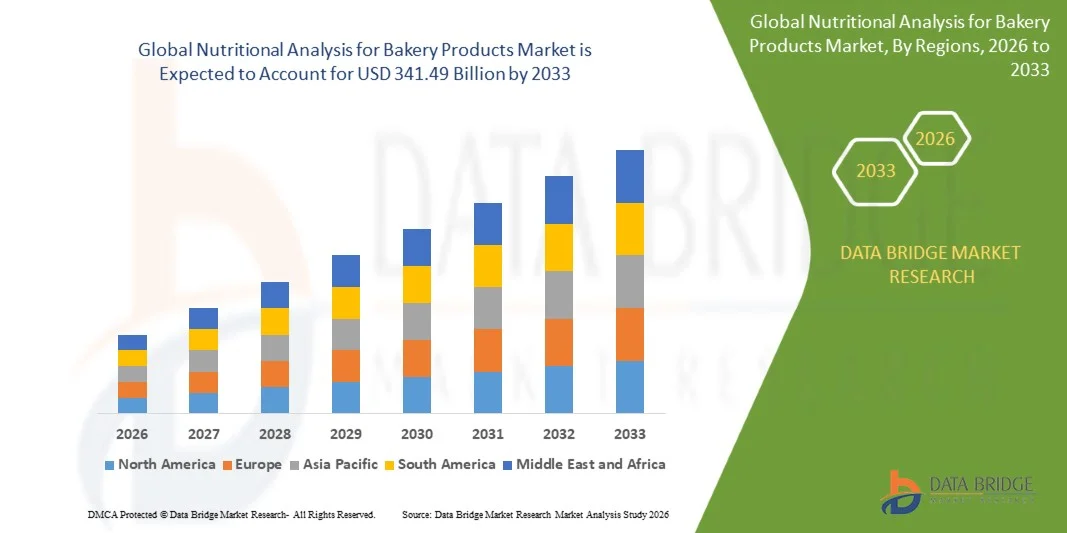
The Nutritional Analysis for Bakery Products Market was valued at USD 253.40 billion in 2025 and is projected to reach USD 341.49 billion by 2033, growing at a CAGR of 3.80% from 2026 to 2033. The market is experiencing consistent growth driven by rising demand for healthier bakery products, increasing consumer awareness of nutrition and ingredient transparency, and growing demand for clean-label and fortified baked goods. The expanding prevalence of lifestyle-related disorders such as obesity, diabetes, and cardiovascular diseases is encouraging consumers to opt for bakery products with improved nutritional profiles, including reduced sugar, low-fat, high-fiber, and protein-enriched formulations. Food manufacturers are increasingly adopting advanced nutritional analysis technologies to optimize product formulation, ensure regulatory compliance, and meet evolving labeling standards.
The growing application of digital food analysis tools, laboratory testing, and AI-driven nutritional profiling is enabling precise control over calorie content, macronutrients, and micronutrients in bakery products. Rising demand for functional bakery items fortified with vitamins, minerals, probiotics, and plant-based ingredients is further supporting market expansion. Increasing regulatory focus on food labeling transparency in regions such as North America and Europe is pushing manufacturers to adopt accurate nutritional analysis systems. The rapid growth of the packaged food and bakery industry, particularly in urban markets, is also contributing to higher adoption of nutritional testing solutions. Expanding investment in food R&D and product innovation is strengthening demand for advanced analysis tools. Overall, the shift toward health-focused bakery consumption and precision nutrition is driving steady global market growth.
Key Market Trends & Insights
- North America dominated the Nutritional Analysis for Bakery Products Market with the largest revenue share of 34.18% in 2025, supported by strict food safety and labeling regulations, high consumer awareness regarding nutritional transparency, and strong adoption of advanced food testing and analytical technologies across bakery manufacturers and laboratories.
- The product labelling segment dominated the market with a 46.72% revenue share in 2025, driven by mandatory nutritional disclosure requirements across packaged bakery products.
- Asia-Pacific is expected to be the fastest-growing region at a CAGR of 7.5% from 2026 to 2033, fueled by rising packaged bakery consumption, rapid urbanization, expanding food testing infrastructure, and increasing regulatory emphasis on standardized nutritional labeling in countries such as China, India, and Japan.
- The Sugar Profile segment is expected to be the fastest-growing parameter, projected to register a CAGR of 8.1%, driven by increasing health concerns related to diabetes and obesity, along with rising demand for low-sugar and sugar-free bakery formulations.
- The Product Labeling segment dominated the market with a revenue share of 46.73% in 2025, supported by mandatory compliance requirements, increasing packaged bakery consumption, and strong demand for transparent nutritional information among consumers.
- The New Product Development segment is expected to be the fastest-growing objective category, projected to grow at a CAGR of 7.9%, driven by increasing R&D investments by bakery manufacturers focused on clean-label, fortified, and health-oriented bakery innovations.
Market Size & Forecast
- Global Market Value (2025): USD 253.40 Billion
- Expected Market Value (2033): USD 341.49 Billion
- Forecast CAGR (2026–2033): 3.80%
- Leading Region in 2025: North America
- Fastest Growing Region: Asia-Pacific
Report Scope and Nutritional Analysis for Bakery Products Market Segmentation
|
Attributes |
Nutritional Analysis for Bakery Products Key Market Insights |
|
Segments Covered |
|
|
Countries Covered |
North America · U.S. · Canada · Mexico Europe · Germany · France · U.K. · Netherlands · Switzerland · Belgium · Russia · Italy · Spain · Turkey · Rest of Europe Asia-Pacific · China · Japan · India · South Korea · Singapore · Malaysia · Australia · Thailand · Indonesia · Philippines · Rest of Asia-Pacific Middle East and Africa · Saudi Arabia · U.A.E. · South Africa · Egypt · Israel · Rest of Middle East and Africa South America · Brazil · Argentina · Rest of South America |
|
Key Market Players |
• Cargill, Incorporated (U.S.) |
|
Market Opportunities |
· Expansion of clean-label and health-focused bakery products · Growth in regulatory standardization and mandatory nutritional labeling across emerging economies · Increasing adoption of AI-driven food analytics and automated laboratory testing technologies |
|
Value Added Data Infosets |
In addition to the insights on market scenarios such as market value, growth rate, segmentation, geographical coverage, and major players, the market reports curated by the Data Bridge Market Research also include in-depth expert analysis, geographically represented company-wise production and capacity, network layouts of distributors and partners, detailed and updated price trend analysis and deficit analysis of supply chain and demand. |
Nutritional Analysis for Bakery Products Market Trends
Trend: Growth in Clean-Label and Precision Nutrition in Bakery Products
The global bakery industry is witnessing strong adoption of nutritional analysis solutions driven by increasing demand for clean-label, low-sugar, high-fiber, and fortified bakery products. Consumers are increasingly prioritizing transparency in ingredient composition, leading manufacturers to invest in advanced nutritional profiling technologies. Studies indicate that over 60% of global consumers actively check nutritional labels before purchasing packaged food products, significantly influencing bakery reformulation strategies. Food companies are integrating laboratory testing, chromatography systems, and AI-based nutrient analysis tools to accurately measure calories, sugar content, protein levels, and micronutrient composition. Rising demand for functional bakery products enriched with vitamins, probiotics, and plant-based proteins is further accelerating adoption. Regulatory frameworks such as FDA Nutrition Labeling and European Food Information Regulations (EU FIC) are enforcing stricter compliance requirements. Expansion of health-focused bakery categories such as keto, gluten-free, and diabetic-friendly products is reshaping product innovation. Overall, precision nutrition is becoming a core competitive factor in bakery manufacturing.
Nutritional Analysis for Bakery Products Market Dynamics
Key Market Driver: Rising Demand for Health-Oriented Bakery Consumption and Regulatory Labeling Compliance
The increasing global burden of obesity, diabetes, and cardiovascular diseases is a major driver of the nutritional analysis for bakery products market. According to the WHO, more than 1 billion people worldwide are affected by obesity, significantly increasing demand for healthier bakery alternatives. Governments across North America and Europe have implemented strict labeling regulations requiring detailed disclosure of calories, sugar, fat, and allergen content. This has led bakery manufacturers to adopt advanced analytical testing systems to ensure compliance and accuracy. Growing consumption of packaged bakery products, which accounts for over 40% of total bakery sales in developed markets, is further driving demand for nutritional profiling solutions. Expansion of industrial bakery production and fortified food product lines is strengthening market growth. Increasing consumer preference for transparency and clean-label claims is pushing manufacturers to invest in food testing laboratories and digital nutrition databases. Rising adoption of AI-based food composition analysis tools is improving efficiency and accuracy in nutrient reporting. Overall, health awareness and regulatory pressure are significantly accelerating market expansion.
Key Restraint/Challenge: High Cost and Technical Complexity of Advanced Nutritional Testing System
A major challenge in the global market is the high cost and complexity of advanced nutritional analysis technologies. Laboratory-based testing systems such as HPLC, mass spectrometry, and near-infrared spectroscopy require significant capital investment, often exceeding hundreds of thousands of dollars for setup and maintenance. Small and medium bakery manufacturers face difficulties in adopting such systems due to limited budgets and technical expertise. In addition, frequent updates in food labeling regulations across different regions increase compliance complexity and operational costs. Variability in raw ingredient composition also creates challenges in achieving consistent nutritional accuracy across batches. Lack of standardized global testing protocols further complicates cross-border product labeling. Limited access to advanced food testing laboratories in developing regions restricts market penetration. Skilled workforce shortages in food analytics and laboratory operations add further constraints. Overall, cost and complexity barriers continue to limit widespread adoption among smaller producers.
Key Market Opportunity: Expansion of AI-Driven Nutritional Analytics and Smart Food Testing System
The integration of artificial intelligence, machine learning, and automation in food testing is creating significant growth opportunities in the bakery nutrition analysis market. AI-powered systems can rapidly analyze ingredient composition, predict nutritional outcomes, and optimize product formulations in real time. Smart laboratory platforms are reducing testing time by up to 30–50%, improving efficiency for large-scale bakery manufacturers. The growing adoption of digital food composition databases and cloud-based nutritional analysis platforms is enabling centralized compliance management. Increasing investment in food tech startups focused on precision nutrition and automated labeling solutions is accelerating innovation. Expansion of connected laboratory systems integrated with IoT sensors is enhancing data accuracy and traceability. Rising demand for personalized nutrition and functional bakery products is further supporting advanced analytics adoption. Governments in developed economies are encouraging digital transformation in food safety and labeling compliance systems. Overall, AI-driven nutritional analysis is emerging as a transformative opportunity for improving efficiency, accuracy, and product innovation in the bakery industry.
Nutritional Analysis for Bakery Products Market Scope
The Nutritional Analysis for Bakery Products market is segmented on the basis of parameter and objective.
- By Parameter
On the basis of parameter, the Nutritional Analysis for Bakery Products Market is segmented into vitamin profile, mineral profile, fat profile, moisture, proteins, total dietary fiber, sugar profile, cholesterol, and calories. The vitamin profile segment dominated the market with a 28.46% revenue share in 2025, driven by increasing regulatory emphasis on micronutrient disclosure and rising consumer demand for fortified bakery products. Food manufacturers are increasingly investing in advanced analytical testing to ensure accurate labeling of vitamins such as A, D, and B-complex in bakery formulations. The growing trend of health-conscious consumption and clean-label bakery products is further strengthening demand for vitamin-based nutritional analysis. Regulatory frameworks in North America and Europe mandating detailed nutritional labeling are significantly supporting segment growth. In addition, increasing adoption of laboratory-based spectroscopy and chromatography techniques is improving accuracy in vitamin detection. Rising product innovation in fortified bread, biscuits, and gluten-free bakery items is expanding testing requirements. Growing collaboration between food testing laboratories and bakery manufacturers is accelerating adoption. Increasing R&D in functional bakery products is also contributing to segment dominance. The expansion of automated food testing platforms is improving efficiency and scalability. Overall, vitamin profiling remains the most critical parameter in bakery nutritional analysis due to its regulatory and consumer relevance.
The sugar profile segment is expected to register the fastest growth with a CAGR of 7.8% from 2026 to 2033, driven by rising global concerns over sugar consumption and obesity-related health issues. Governments across multiple regions are enforcing stricter sugar labeling regulations, including front-of-pack labeling initiatives. Bakery manufacturers are increasingly reformulating products to reduce added sugars and comply with sugar taxation policies. Growing demand for low-sugar and sugar-free bakery products is significantly boosting testing requirements. Advanced analytical techniques such as HPLC are being widely adopted for precise sugar quantification. Increasing awareness of diabetes and metabolic disorders is further driving demand for sugar profiling. Food companies are investing in R&D to develop alternative sweeteners, increasing testing complexity. Expansion of clean-label and keto-friendly bakery products is accelerating adoption. Regulatory scrutiny from agencies such as FDA and EFSA is reinforcing compliance-driven testing. Overall, sugar profiling is emerging as the fastest-growing segment due to health-driven reformulation trends.
- By Objective
On the basis of objective, the Nutritional Analysis for Bakery Products Market is segmented into product labelling, new product development, and regulation compliance. The product labelling segment dominated the market with a 46.72% revenue share in 2025, driven by mandatory nutritional disclosure requirements across packaged bakery products. Governments worldwide are enforcing strict labeling laws requiring accurate declaration of calories, fats, sugars, and micronutrients. Bakery manufacturers rely heavily on nutritional analysis to ensure compliance with evolving labeling standards such as FDA Nutrition Facts and EU Food Information Regulations. Increasing consumer demand for transparency in food content is further supporting segment growth. Rising popularity of packaged and processed bakery goods is expanding labeling requirements. Automation in food testing laboratories is improving labeling accuracy and turnaround time. Growing retail penetration of branded bakery products is reinforcing compliance needs. Expansion of e-commerce food sales is increasing demand for standardized nutritional information. Increasing audits and inspections by regulatory authorities are strengthening adoption. Overall, labeling remains the dominant objective due to regulatory necessity and consumer transparency trends.
The new product development segment is expected to grow at the fastest CAGR of 8.1% from 2026 to 2033, driven by rapid innovation in functional and fortified bakery products. Manufacturers are increasingly using nutritional analysis to optimize ingredient composition and develop healthier formulations. Rising demand for high-protein, low-carb, gluten-free, and vegan bakery products is accelerating R&D activity. Food companies are leveraging advanced analytics to improve taste, texture, and nutritional balance. Growing competition in the bakery industry is pushing brands toward continuous innovation. Increasing use of plant-based ingredients is creating new testing requirements. Integration of AI and data analytics in food formulation is enhancing development efficiency. Expansion of health-focused consumer segments is supporting innovation-led growth. Rising investment in bakery startups is further driving demand for nutritional insights. Overall, new product development is emerging as the fastest-growing objective due to strong innovation pipelines.
Nutritional Analysis for Bakery Products Market Regional Analysis
North America dominated the Nutritional Analysis for Bakery Products Market with the largest revenue share of 34.18% in 2025, supported by strict food safety and labeling regulations, high consumer awareness regarding nutritional transparency, and strong adoption of advanced food testing and analytical technologies across bakery manufacturers and laboratories. The region has a well-established food testing infrastructure, with widespread use of chromatography, spectroscopy, and automated nutritional profiling systems to ensure compliance with FDA and other regulatory standards. Increasing demand for clean-label, fortified, and functional bakery products is further driving the need for precise nutritional analysis. In addition, strong presence of major bakery brands and food testing service providers is accelerating market growth. Rising health consciousness among consumers, particularly regarding sugar, fat, and calorie intake, is reinforcing demand for accurate product labeling. Growth in packaged bakery consumption and expansion of quality assurance practices across food supply chains are further strengthening regional dominance. Continuous innovation in food analytics technologies and AI-based testing platforms is also enhancing efficiency and accuracy in nutritional assessment.
U.S. Nutritional Analysis for Bakery Products Market Insight
The U.S. Nutritional Analysis for Bakery Products market is witnessing strong growth due to stringent FDA labeling regulations, increasing consumer demand for transparent food composition, and high adoption of advanced laboratory testing solutions. The country’s well-developed food processing industry and strong presence of bakery manufacturers are driving extensive use of nutritional profiling tools for product development and compliance. Rising demand for low-sugar, high-protein, and gluten-free bakery products is further increasing testing requirements. In addition, growing investment in food safety technologies and automation in analytical laboratories is improving efficiency and scalability. The expansion of clean-label trends and increasing health awareness are also encouraging manufacturers to invest in precise nutritional analysis systems. Strong R&D activity in functional bakery formulations continues to support market expansion.
Europe Nutritional Analysis for Bakery Products Market Insight
The Europe Nutritional Analysis for Bakery Products market remains a major contributor to global revenue, driven by stringent EU food labeling regulations, strong emphasis on food quality standards, and increasing demand for healthier bakery products. Countries across the region have strict compliance frameworks requiring detailed nutritional disclosure, including sugar, fat, and micronutrient content. The widespread adoption of advanced analytical instruments and laboratory testing services supports accurate nutritional profiling. Rising consumer preference for organic, fortified, and reduced-sugar bakery products is further boosting demand. Increasing focus on food safety and traceability across supply chains is strengthening market adoption. In addition, strong presence of bakery manufacturers and food testing laboratories continues to support regional growth. Technological advancements in automated testing and AI-based nutritional analysis are further improving efficiency and precision.
U.K. Nutritional Analysis for Bakery Products Market Insight
The U.K. Nutritional Analysis for Bakery Products market is experiencing steady growth, driven by rising demand for packaged bakery goods and strict compliance with UK food labeling regulations. Increasing consumer awareness regarding calorie, sugar, and fat intake is pushing manufacturers to adopt precise nutritional testing solutions. The country’s strong bakery industry and presence of leading retail chains are contributing to consistent demand for product labeling and compliance testing. In addition, growing adoption of laboratory automation and digital food testing platforms is enhancing efficiency. Rising popularity of healthier bakery alternatives such as low-sugar and high-fiber products is further accelerating testing requirements. Expansion of food innovation centers and R&D investments in functional bakery formulations are also supporting market growth.
Germany Nutritional Analysis for Bakery Products Market Insight
The Germany Nutritional Analysis for Bakery Products market is expanding steadily due to strict EU compliance standards, strong food manufacturing base, and high consumer demand for transparent nutritional labeling. Bakery manufacturers in Germany are increasingly investing in advanced analytical technologies to ensure compliance with regulatory frameworks and meet rising consumer expectations for healthier food options. Growth in organic and functional bakery products is increasing demand for detailed nutritional profiling. The country’s strong laboratory infrastructure and focus on food quality assurance are further supporting market expansion. In addition, increasing adoption of automated testing systems and digital food analysis tools is improving accuracy and efficiency in nutritional reporting.
Asia-Pacific Nutritional Analysis for Bakery Products Market Insight
The Asia-Pacific Nutritional Analysis for Bakery Products market is expected to witness rapid growth, driven by rising packaged bakery consumption, rapid urbanization, expanding food testing infrastructure, and increasing regulatory emphasis on standardized nutritional labeling in countries such as China, India, and Japan. Growing middle-class population and increasing health awareness are boosting demand for transparent food labeling. Governments across the region are strengthening food safety regulations, further driving adoption of nutritional analysis solutions. Expansion of bakery manufacturing and processed food industries is also supporting market growth. In addition, increasing investments in laboratory infrastructure and food quality testing systems are accelerating regional adoption. Rising demand for fortified and convenience bakery products is further contributing to market expansion.
Japan Nutritional Analysis for Bakery Products Market Insight
The Japan Nutritional Analysis for Bakery Products market is witnessing consistent growth due to strong food safety regulations, high consumer awareness, and increasing demand for precision-based nutritional labeling. The country’s advanced food manufacturing sector and strong focus on quality control are driving adoption of sophisticated analytical technologies. Rising consumption of functional bakery products enriched with vitamins, minerals, and dietary fibers is further increasing testing requirements. Additionally, integration of automation and digital laboratory systems is improving efficiency in nutritional analysis. Japan’s aging population is also contributing to demand for health-oriented bakery products, supporting continued market expansion.
China Nutritional Analysis for Bakery Products Market Insight
The China Nutritional Analysis for Bakery Products market is growing rapidly, driven by increasing urbanization, expanding packaged food consumption, and strengthening food safety regulations. Government initiatives focused on improving food quality standards and nutritional labeling compliance are significantly boosting demand for analytical testing solutions. Rising health awareness among consumers is increasing preference for low-sugar and fortified bakery products. The rapid expansion of domestic bakery manufacturers and food testing laboratories is further supporting market growth. In addition, increasing adoption of advanced analytical technologies and automation in food testing processes is improving accuracy and efficiency. Strong investment in food safety infrastructure continues to position China as one of the fastest-growing markets globally.
Nutritional Analysis for Bakery Products Market Share
The Nutritional Analysis for Bakery Products industry is primarily led by well-established companies, including:
- Cargill, Incorporated (U.S.)
- Archer Daniels Midland Company (ADM) (U.S.)
- Eurofins Scientific (Luxembourg)
- SGS SA (Switzerland)
- Bureau Veritas (France)
- Intertek Group plc (U.K.)
- ALS Limited (Australia)
- Mérieux NutriSciences Corporation (U.S.)
- TÜV SÜD (Germany)
- Neogen Corporation (U.S.)
- Symbio Laboratories (Australia)
- Microbac Laboratories Inc. (U.S.)
- Covance Inc. (Labcorp) (U.S.)
- AsureQuality (New Zealand)
- Eurofins Food Testing (Global Division)
- Silliker Inc. (U.S.)
- SGS India Pvt Ltd (India)
- Agilent Technologies Inc. (U.S.)
- Thermo Fisher Scientific Inc. (U.S.)
- PerkinElmer Inc. (U.S.)
- Waters Corporation (U.S.)
- Nestlé S.A. (Switzerland)
- General Mills Inc. (U.S.)
- Kellogg Company (U.S.)
- Mondelez International (U.S.)
- Kerry Group plc (Ireland)
- Tate & Lyle plc (U.K.)
- DuPont Nutrition & Biosciences (U.S.)
- Novozymes A/S (Denmark)
- DSM-Firmenich (Netherlands)
- Bureau Veritas India (India)
- Intertek India Pvt Ltd (India)
- ALS India Pvt Ltd (India)
- Merieux NutriSciences India (India)
- TUV Nord Group (Germany)
Latest Developments in Nutritional Analysis for Bakery Products Market
- In January 2021, the U.S. Food and Drug Administration (FDA) updated its Food Labeling Regulations guidance, reinforcing requirements for accurate declaration of nutrients such as added sugars, dietary fiber, and trans fats on packaged bakery products. The update emphasized stricter compliance monitoring and improved consistency in Nutrition Facts labeling across processed food categories, including baked goods. This regulatory reinforcement increased demand for advanced nutritional testing and laboratory validation services across the United States bakery industry
- In March 2022, Eurofins Scientific expanded its food testing capabilities in North America and Europe, enhancing its analytical services for nutritional profiling, including sugar analysis, vitamin quantification, and allergen detection in bakery products. The expansion included upgraded chromatography and mass spectrometry systems to support rising demand for clean-label and fortified bakery product verification. This development strengthened Eurofins’ position as a leading global food testing service provider supporting bakery manufacturers
- In September 2022, SGS SA launched enhanced nutritional labeling and food composition testing services for processed food manufacturers, including bakery producers. The upgraded services focused on high-precision macronutrient and micronutrient analysis using advanced laboratory instrumentation. SGS also emphasized compliance support for FDA, EU EFSA, and Codex Alimentarius standards, enabling bakery companies to meet evolving global labeling requirements
- In February 2023, Nestlé announced expansion of its global nutrition and food science research capabilities, focusing on sugar reduction, fiber enrichment, and micronutrient fortification across bakery and cereal-based products. The initiative included increased use of advanced nutritional profiling techniques to support product reformulation and healthier bakery offerings aligned with global public health guidelines. This development reinforced the role of nutritional analysis in product innovation and reformulation strategies
- In June 2023, Intertek Group plc enhanced its global food testing laboratory network, introducing improved analytical solutions for nutritional labeling verification in baked goods and processed foods. The expansion included advanced spectroscopy-based nutrient detection systems to improve accuracy in calorie, fat, and protein measurement. This initiative supported increasing global demand for regulatory compliance and clean-label bakery products
- In October 2023, the European Food Safety Authority (EFSA) reinforced updated guidance on nutrition labeling and health claims, particularly for processed bakery products containing high sugar and fat content. The regulation strengthened requirements for scientifically validated nutritional data, driving increased reliance on accredited laboratory testing and third-party validation services across Europe’s bakery sector
- In April 2024, Thermo Fisher Scientific introduced upgraded analytical solutions for food composition testing, including advanced chromatography and mass spectrometry systems designed for precise nutrient profiling in processed foods. These solutions improved detection of vitamins, minerals, and sugar compounds in bakery formulations, enabling higher accuracy in nutritional labeling and regulatory compliance
- In August 2024, Danone expanded its global nutritional science and product reformulation programs, focusing on sugar reduction and improved fiber content in bakery-adjacent food products. The initiative relied heavily on advanced nutritional analysis tools to optimize formulations while maintaining taste and texture, reflecting growing consumer demand for healthier baked goods
- In January 2025, the U.S. FDA intensified enforcement of front-of-pack nutritional labeling transparency initiatives, encouraging clearer disclosure of sugar, calorie, and sodium content in packaged bakery products. This regulatory push increased adoption of advanced nutritional analysis systems among bakery manufacturers and food testing laboratories across North America

- Interactive Data Analysis Dashboard
- Company Analysis Dashboard for high growth potential opportunities
- Research Analyst Access for customization & queries
- Competitor Analysis with Interactive dashboard
- Latest News, Updates & Trend analysis
- Harness the Power of Benchmark Analysis for Comprehensive Competitor Tracking
Global Nutritional Analysis For Bakery Products Market, Supply Chain Analysis and Ecosystem Framework
To support market growth and help clients navigate the impact of geopolitical shifts, DBMR has integrated in-depth supply chain analysis into its Global Nutritional Analysis For Bakery Products Market research reports. This addition empowers clients to respond effectively to global changes affecting their industries. The supply chain analysis section includes detailed insights such as Global Nutritional Analysis For Bakery Products Market consumption and production by country, price trend analysis, the impact of tariffs and geopolitical developments, and import and export trends by country and HSN code. It also highlights major suppliers with data on production capacity and company profiles, as well as key importers and exporters. In addition to research, DBMR offers specialized supply chain consulting services backed by over a decade of experience, providing solutions like supplier discovery, supplier risk assessment, price trend analysis, impact evaluation of inflation and trade route changes, and comprehensive market trend analysis.
Data collection and base year analysis are done using data collection modules with large sample sizes. The stage includes obtaining market information or related data through various sources and strategies. It includes examining and planning all the data acquired from the past in advance. It likewise envelops the examination of information inconsistencies seen across different information sources. The market data is analysed and estimated using market statistical and coherent models. Also, market share analysis and key trend analysis are the major success factors in the market report. To know more, please request an analyst call or drop down your inquiry.
The key research methodology used by DBMR research team is data triangulation which involves data mining, analysis of the impact of data variables on the market and primary (industry expert) validation. Data models include Vendor Positioning Grid, Market Time Line Analysis, Market Overview and Guide, Company Positioning Grid, Patent Analysis, Pricing Analysis, Company Market Share Analysis, Standards of Measurement, Global versus Regional and Vendor Share Analysis. To know more about the research methodology, drop in an inquiry to speak to our industry experts.
Data Bridge Market Research is a leader in advanced formative research. We take pride in servicing our existing and new customers with data and analysis that match and suits their goal. The report can be customized to include price trend analysis of target brands understanding the market for additional countries (ask for the list of countries), clinical trial results data, literature review, refurbished market and product base analysis. Market analysis of target competitors can be analyzed from technology-based analysis to market portfolio strategies. We can add as many competitors that you require data about in the format and data style you are looking for. Our team of analysts can also provide you data in crude raw excel files pivot tables (Fact book) or can assist you in creating presentations from the data sets available in the report.













