


What is the Night Vision System (NVS) Vehicle Intelligence System Market Size and Growth Rate?
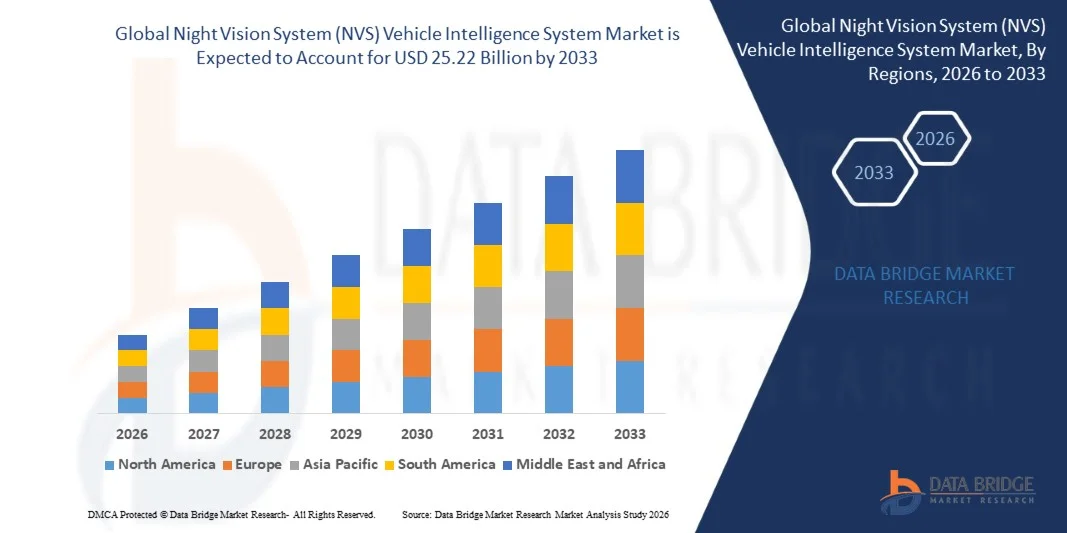
- As per Data Bridge Market Research analysis, the night vision system (NVS) vehicle intelligence system market was valued at USD 6.19 billion in 2025 and is projected to reach USD 25.22 billion by 2033, growing at a CAGR of 19.20% from 2026 to 2033.
- The market is experiencing consistent growth driven by rising demand for luxury vehicles, increasing awareness of strict safety regulations, and the increasing number of road accidents, while rising infrastructure development and increasing vehicle production are also identified as major market drivers.
- The increasing number of road accidents globally, combined with the growing demand for enhanced visibility in low-light conditions, is supporting adoption of NVS technologies. Advanced imaging sensors provide real-time information to drivers and detect potential obstacles beyond the reach of standard headlights, while the rising trend of autonomous cars and increasing technological advancement are creating further opportunities for market growth.
Market Size & Forecast
- Global Market Value (2025): USD 6.19 Billion
- Expected Market Value (2033): USD 25.22 Billion
- Forecast CAGR (2026–2033): 19.20%
- Leading Region in 2025: North America
- Fastest Growing Region: Asia Pacific
What are the Major Takeaways of the Night Vision System (NVS) Vehicle Intelligence System Market?
- North America dominated the night vision system (NVS) vehicle intelligence system market with the largest revenue share of 36.42% in 2025, supported by strong adoption of connected vehicles, advanced driver assistance technologies, and intelligent transportation infrastructure.
- Asia-Pacific is expected to be the fastest-growing region at a CAGR of 11.8% from 2026 to 2033, fueled by rising automotive production and increasing digital transformation in transportation systems, particularly across China, Japan, South Korea, and India.
- The passenger cars segment led the market with a 58.27% share in 2025, driven by increasing adoption of advanced safety and vehicle intelligence technologies in passenger vehicles
- Commercial vehicles are the fastest-growing vehicle type, projected to register a CAGR of 12%, reflecting the surge in demand for enhanced visibility and safety in trucks, buses, and other commercial vehicles.
- The computer vision segment dominated the technology category with a 35% revenue share in 2025, led by its ability to enable vehicles to interpret images and identify pedestrians, animals, vehicles, and road obstacles
- Sensor accounted for 44.16% of the market share in 2025, preferred by manufacturers and fleet operators due to its ability to enable real-time environmental sensing, enhanced safety monitoring, and advanced driver assistance functionalities.
- The drowsiness monitoring/alertness sensing system segment is the fastest-growing driver monitoring system category, with a CAGR of 14%, driven by increasing focus on driver monitoring and prevention of fatigue-related accidents.
Report Scope and Night Vision System (NVS) Vehicle Intelligence System Market Segmentation
|
Attributes |
Night Vision System (NVS) Vehicle Intelligence System Key Market Insights |
|
Segments Covered |
|
|
Countries Covered |
North America
Europe
Asia-Pacific
Middle East and Africa
South America
|
|
Key Market Players |
|
|
Market Opportunities |
|
|
Value Added Data Infosets |
In addition to the market insights such as market value, growth rate, market segments, geographical coverage, market players, and market scenario, the market report curated by the Data Bridge Market Research team includes in-depth expert analysis, import/export analysis, pricing analysis, production consumption analysis, and pestle analysis. |
What is the Key Trend in the Night Vision System (NVS) Vehicle Intelligence System Market?
- Automotive manufacturers are increasingly integrating thermal imaging and infrared night vision with ADAS and autonomous driving systems to improve pedestrian, animal, and obstacle detection in darkness, fog, glare, and other low-visibility conditions.
- For instance, in January 2026, Teledyne FLIR introduced the Tura thermal camera, an automotive-qualified LWIR camera with 640 × 512 resolution designed for ADAS and autonomous vehicles, including AEB applications; the system extends vehicle perception beyond headlights in complete darkness and adverse conditions.
- Passive thermal imaging systems are gaining importance because they detect heat signatures without relying on ambient illumination, providing more consistent perception during nighttime driving and adverse weather conditions.
- The integration of night vision with automatic emergency braking (AEB) is emerging as an important development, allowing thermal sensors to complement radar and visible-light cameras for enhanced nighttime pedestrian detection.
- Increasing use of sensor fusion is strengthening NVS capabilities, with thermal cameras being combined with visible cameras, radar, and LiDAR to improve object detection and classification for advanced vehicle perception.
- Automotive thermal cameras are also becoming more automotive-qualified and compact, supporting integration into mainstream ADAS and autonomous vehicle platforms rather than remaining limited to premium applications.
What are the Key Drivers of the Night Vision System (NVS) Vehicle Intelligence System Market?
- The increasing emphasis on vehicle safety and pedestrian protection is driving demand for night vision systems capable of detecting road users beyond the illumination range of conventional headlights.
- For instance, in January 2024, Valeo and Teledyne FLIR announced a collaboration and first contract to deliver ASIL-B thermal-imaging technology for night-vision ADAS, supporting improved detection of pedestrians and other road users in low-light conditions
- Growing adoption of ADAS and autonomous vehicles is further increasing demand for thermal and infrared sensing technologies that can maintain environmental perception under challenging lighting conditions.
- Stricter pedestrian automatic emergency braking requirements are encouraging automakers to evaluate additional sensing technologies that can improve nighttime detection and braking performance.
- The increasing number of road accidents and nighttime visibility challenges is strengthening demand for technologies that provide drivers and automated systems with earlier warnings of pedestrians, animals, and roadway obstacles.
- For instance, in January 2025, Teledyne FLIR and VSI Labs demonstrated a thermal-imaging-based automatic pedestrian detection system, showing how thermal sensing can complement conventional vehicle sensors to improve pedestrian safety in nighttime conditions.
- Advances in infrared sensors, thermal imaging, image processing, and sensor fusion are improving detection range, accuracy, and compatibility with modern vehicle intelligence platforms.
Which Factors are Challenging the Growth of the Night Vision System (NVS) Vehicle Intelligence System Market?
- High system costs remain a major challenge because automotive night vision requires sophisticated thermal cameras, infrared sensors, high-resolution imaging components, and dedicated processing systems.
- For instance, in January 2026, Vantrue introduced the Pilot 2 at CES 2026, combining a thermal-imaging camera with a dashcam and display system at an expected price of around USD 600, illustrating the additional hardware and integration required to bring thermal night vision to vehicles outside factory-installed premium systems.
- The relatively high cost of thermal imaging technology limits adoption in mid-range and economy vehicles, with NVS systems remaining more prevalent in premium and luxury vehicle applications.
- Integration with existing ADAS architectures, vehicle electronics, and safety systems increases development complexity and can raise installation and validation costs for automakers.
- Thermal imaging systems also face technical limitations, including lower image resolution than conventional cameras and challenges associated with sensor integration, which can restrict their use as a standalone perception technology.
- For instance, in April 2025, a research study evaluated infrared vision systems for emergency vehicles and identified the need for cost-effective retrofitting of existing fleets, demonstrating that the expense and integration requirements of IR-based driver-assistance systems remain important barriers to wider deployment.
- The need to achieve automotive-grade reliability, functional-safety compliance, and consistent performance across darkness, fog, glare, rain, and other environmental conditions adds to development and testing requirements.
How is the Night Vision System (NVS) Vehicle Intelligence System Market Segmented?
The night vision system (NVS) vehicle intelligence system market is segmented on the basis of vehicle type, technology, component, advanced driver assistance and driver monitoring systems.
- By Vehicle Type
On the basis of vehicle type, the NVS vehicle intelligence system market is segmented into passenger cars, commercial vehicles, and others. The passenger cars segment dominated the market with an estimated 58.27% share in 2025, driven by increasing adoption of advanced safety and vehicle intelligence technologies in passenger vehicles. These systems improve visibility and help detect pedestrians, animals, and obstacles under low-light conditions. Growing consumer awareness regarding vehicle safety is encouraging automotive manufacturers to integrate night vision technologies into passenger vehicles. Increasing availability of premium safety features and advancements in thermal and infrared imaging are further supporting adoption. The growing production of connected and intelligent passenger vehicles is creating additional demand for advanced perception systems.
The commercial vehicles segment is projected to register the fastest growth at 12% CAGR from 2026 to 2033, driven by increasing demand for enhanced visibility and safety in trucks, buses, and other commercial vehicles. Commercial vehicles frequently operate during nighttime and challenging weather conditions, increasing the importance of advanced driver assistance technologies. Night vision systems provide additional information about pedestrians, animals, and road hazards beyond the illumination range of conventional headlights. Increasing adoption of ADAS technologies across commercial fleets is creating opportunities for thermal and infrared sensing systems. Fleet operators are increasingly focused on reducing accidents, improving driver awareness, and enhancing operational safety. The expansion of logistics, transportation, and long-haul freight activities is expected to further support adoption.
- By Technology
On the basis of technology, the NVS vehicle intelligence system market is segmented into machine learning, computer vision, sensor fusion, and cloud computing. The computer vision segment dominated the market with an estimated share of 35% in 2025, supported by its ability to enable vehicles to interpret images and identify pedestrians, animals, vehicles, and road obstacles. Advanced image-processing technologies improve the ability of vehicle systems to interpret nighttime environments and support driver assistance. Computer vision processes information from cameras and thermal sensors to provide real-time information to drivers and vehicle intelligence systems. Increasing development of automated driving technologies is strengthening demand for sophisticated visual perception capabilities. Continuous improvements in artificial intelligence-based image recognition are improving object detection and classification.
The sensor fusion segment is projected to register the fastest growth at 13% CAGR from 2026 to 2033, driven by increasing integration of information from thermal cameras, visible-light cameras, radar, LiDAR, and other vehicle sensors. Sensor fusion enables vehicle intelligence systems to combine complementary information and improve environmental perception. Thermal imaging provides useful information in darkness, while radar and cameras contribute additional information for object recognition and distance measurement. Combining multiple sensing technologies improves detection reliability under challenging weather and lighting conditions. Increasing development of autonomous vehicles is further accelerating demand for multi-sensor perception architectures. The integration of sensor fusion with ADAS and automated driving systems is creating opportunities for more accurate and robust nighttime object detection.
- By Component
On the basis of component, the NVS vehicle intelligence system market is segmented into sensor, analog ICs, processor, and memory. The sensor segment dominated the market with an estimated share of 44.16% in 2025, as sensors represent the primary hardware used to capture information from the vehicle's surrounding environment. Thermal and infrared sensors enable detection of heat signatures and objects that may not be clearly visible through conventional headlights. Increasing demand for enhanced nighttime visibility is encouraging automotive manufacturers to integrate advanced sensing technologies into vehicle safety systems. Improvements in sensor resolution, detection range, size, and automotive qualification are supporting broader integration. Sensors provide critical input to ADAS and vehicle intelligence platforms for real-time perception. Increasing adoption of autonomous and semi-autonomous driving technologies is further strengthening demand for advanced automotive sensors.
The processor segment is projected to register the fastest growth at 13% CAGR from 2026 to 2033, supported by increasing requirements for real-time processing of high volumes of sensor and image data. Modern NVS systems require processors capable of rapidly analyzing thermal images and combining information from multiple vehicle sensors. Increasing deployment of AI-based object detection and classification is raising computational requirements within vehicle intelligence platforms. Advanced processors enable low-latency processing required for driver assistance and automated driving functions. Growing use of sensor fusion is also increasing demand for high-performance automotive computing platforms. Continuous advancements in automotive semiconductor technologies are improving processing capabilities while supporting more compact and efficient system architectures.
- By Driver Monitoring Systems
On the basis of advanced driver assistance and driver monitoring systems, the NVS vehicle intelligence system market is segmented into adaptive cruise control system, blind spot detection system, park assist system, traffic jam assist system, and drowsiness monitoring/alertness sensing system. The blind spot detection system segment dominated the market with an estimated share of 39.74% in 2025, supported by increasing demand for technologies that improve driver awareness of vehicles and objects that may be difficult to detect through conventional mirrors. Integration of advanced sensors and imaging technologies provides additional information around the vehicle. Growing adoption of ADAS in passenger and commercial vehicles is strengthening demand for blind spot monitoring capabilities. Increasing regulatory attention toward vehicle safety is also encouraging automakers to deploy advanced driver-assistance functions. Sensor-based detection helps drivers make safer lane-change and maneuvering decisions.
The drowsiness monitoring/alertness sensing system segment is projected to register the fastest growth at 14% CAGR from 2026 to 2033, driven by increasing focus on driver monitoring and prevention of fatigue-related accidents. Driver-monitoring technologies assess indicators of driver attention and alertness and provide warnings when reduced attentiveness is detected. Increasing adoption of advanced driver assistance and semi-automated driving technologies is increasing the importance of monitoring driver readiness. Regulatory and safety initiatives are also encouraging automakers to introduce systems that address driver distraction and fatigue. Integration with cameras, sensors, and intelligent processing platforms is improving monitoring capabilities. Increasing commercial fleet safety requirements are creating additional opportunities for driver-monitoring technologies.
Which Region Holds the Largest Share of the Night Vision System (NVS) Vehicle Intelligence System Market?
- North America dominated the night vision system (NVS) vehicle intelligence system market with the largest revenue share of 36.42% in 2025, supported by strong adoption of connected vehicles, advanced driver assistance technologies, and intelligent transportation infrastructure.
- The region also benefits from increasing investments in automotive safety technologies, advanced vehicle electronics, and intelligent transportation systems, along with growing demand for enhanced nighttime visibility and pedestrian detection capabilities. The increasing focus on reducing road accidents and improving overall vehicle safety continues to strengthen North America’s leadership position in the global market.
U.S. Night Vision System (NVS) Vehicle Intelligence System Market Insight
The U.S. night vision system (NVS) vehicle intelligence system market is witnessing strong growth due to increasing emphasis on advanced vehicle safety, driver-assistance technologies, and enhanced nighttime visibility. The country has a significant safety need for improved nighttime detection, as 76% of pedestrian fatalities in 2021 occurred in collisions when it was dark, according to the National Highway Traffic Safety Administration. This supports demand for technologies capable of improving pedestrian and obstacle detection under low-light conditions. In addition, the U.S. automotive market is increasingly incorporating advanced sensing and intelligent safety technologies, supporting demand for vehicle intelligence systems.
Asia-Pacific Night Vision System (NVS) Vehicle Intelligence System Market Insight
The Asia-Pacific night vision system (NVS) vehicle intelligence system market is expected to witness rapid growth, driven by expanding automotive production, increasing adoption of intelligent connected vehicles, and rising investments in advanced mobility technologies across China, Japan, and India. In 2025, China accounted for nearly 55% of new-car sales being electric, while India’s electric car sales increased 75% year-on-year, reaching 165,000 units, reflecting the region’s rapid shift toward technologically advanced vehicles. In addition, China selected 20 cities and city clusters in 2024 for vehicle-road-cloud integration pilot programs, supporting the development of connected and intelligent vehicle infrastructure.
Japan Night Vision System (NVS) Vehicle Intelligence System Market Insight
The Japan night vision system (NVS) vehicle intelligence system market is witnessing consistent growth due to the country’s long-standing focus on advanced vehicle safety technologies, intelligent mobility, and driver-assistance systems. Japan’s Ministry of Land, Infrastructure, Transport and Tourism has operated its Advanced Safety Vehicle (ASV) program for more than 30 years, promoting the development, practical application, and widespread adoption of technologies that support safer driving. Moreover, Japan provides government support for advanced safety equipment in commercial vehicles, including pedestrian-detection collision mitigation braking systems and advanced lighting, supporting demand for sophisticated sensing and vehicle intelligence technologies
China Night Vision System (NVS) Vehicle Intelligence System Market Insight
The China night vision system (NVS) vehicle intelligence system market is growing rapidly, driven by expanding automotive production, increasing intelligent connected vehicle adoption, and strong government support for smart transportation technologies. China remained the world’s largest electric vehicle market in 2025, with more than 13 million electric cars sold and nearly 55% of new-car sales being electric, demonstrating the rapid integration of advanced automotive technologies. In addition, 20 cities and city clusters were selected for vehicle-road-cloud integration pilots in 2024, including Beijing, Shanghai, Guangzhou, Shenzhen, and Chongqing, strengthening the ecosystem for connected vehicles, sensors, and intelligent vehicle systems
U.K. Night Vision System (NVS) Vehicle Intelligence System Market Insight
The U.K. night vision system (NVS) vehicle intelligence system market is experiencing steady growth, supported by increasing adoption of advanced driver assistance systems, vehicle safety technologies, and intelligent mobility solutions. In 2024, the U.K. government tested advanced emergency braking systems on three commercial heavy goods vehicles, with all three systems successfully completing the required functional tests and demonstrating regulatory compliance. Furthermore, the government stated that ADAS testing would continue through 2024 and 2025, demonstrating continued regulatory attention toward advanced vehicle safety technologies and supporting the development of intelligent vehicle systems.
Germany Night Vision System (NVS) Vehicle Intelligence System Market Insight
The Germany night vision system (NVS) vehicle intelligence system market is expanding steadily due to the country’s strong automotive manufacturing base, advanced technological capabilities, and continued development of intelligent vehicle systems. Germany produced approximately 4.15 million passenger cars domestically in 2025, representing a 2% increase from the previous year and demonstrating the country’s substantial automotive production ecosystem. In addition, the country’s large automotive manufacturing base provides a strong environment for integrating advanced sensors, driver-assistance technologies, and vehicle intelligence systems into next-generation vehicles, supporting demand for technologies designed to improve safety and nighttime visibility.
Which are the Top Companies in Night Vision System (NVS) Vehicle Intelligence System Market?
The night vision system (NVS) vehicle intelligence system industry is primarily led by well-established companies, including:
- Teledyne Technologies Incorporated, (U.S.)
- Valeo (France)
- Continental AG (Germany)
- Robert Bosch GmbH (Germany)
- Autoliv AB (Sweden)
- Gentex Corporation (U.S.)
- ZF Friedrichshafen AG (Germany)
- Aptiv PLC (Ireland)
- Magna International Inc. (Canada)
- DENSO CORPORATION (Japan)
- Visteon Corporation (U.S.)
- Panasonic Corporation (Japan)
- Sony Semiconductor Solutions Corporation (Japan)
- Infineon Technologies AG (Germany)
- Semiconductor Components Industries, LLC (U.S.)
- KYOCERA Corporation (Japan)
- Hitachi, Ltd. (Japan)
- Mobileye (Israel)
- Seeing Machines (Australia)
- Ambarella, Inc. (U.S.)
What are Latest Developments in Night Vision System (NVS) Vehicle Intelligence System Market?
- In July 2025, Continental announced a new night vision camera as part of its innovations for IAA Mobility 2025, designed to significantly improve image quality and enhance visibility in challenging driving conditions. The new camera represents continued development of automotive vision technology for improved vehicle safety and perception, supporting the integration of advanced camera-based systems into next-generation vehicles. This development highlights the increasing focus on improving nighttime visibility and vehicle intelligence through advanced imaging technologies.
- In January 2024, Valeo and Teledyne FLIR announced an agreement and their first contract for thermal imaging technology for automotive safety systems, targeting the development of ASIL-B thermal imaging technology for night vision ADAS. The system is designed to complement Valeo’s sensor portfolio and use its ADAS software stack to support functions including automatic emergency braking at night for passenger and commercial vehicles, as well as autonomous vehicles
- In October 2022, Kyocera announced the development of an Automotive Night Vision System featuring white and near-infrared light diodes integrated into a single GaN laser device. The system combines RGB-NIR sensors with Kyocera’s proprietary Image-Fusion AI Recognition Technology to improve object recognition. Its headlight can emit both white RGB and near-infrared light along the same optical axis, enabling enhanced recognition of objects during nighttime and other low-visibility conditions.
- In February 2022, Teledyne FLIR highlighted its thermal-camera technology for the new nighttime testing requirements being introduced for vehicle safety ratings, demonstrating how thermal imaging can support automakers in improving nighttime pedestrian detection. The technology was positioned to complement conventional automotive sensing systems by providing thermal information in low-light conditions, supporting advanced pedestrian detection and automatic emergency braking applications.
- In February 2021, Teledyne FLIR announced that its thermal technology was being used in Veoneer’s fourth-generation Night Vision System, offered as an option on the all-new 2021 Cadillac Escalade. The FLIR Boson-based thermal camera provided a wider field of view and four times greater resolution than the previous generation, extending road coverage and improving situational awareness. The system incorporated pedestrian and animal detection capabilities and displayed the thermal image to the driver through the vehicle’s large OLED display.

- Interactive Data Analysis Dashboard
- Company Analysis Dashboard for high growth potential opportunities
- Research Analyst Access for customization & queries
- Competitor Analysis with Interactive dashboard
- Latest News, Updates & Trend analysis
- Harness the Power of Benchmark Analysis for Comprehensive Competitor Tracking
Data collection and base year analysis are done using data collection modules with large sample sizes. The stage includes obtaining market information or related data through various sources and strategies. It includes examining and planning all the data acquired from the past in advance. It likewise envelops the examination of information inconsistencies seen across different information sources. The market data is analysed and estimated using market statistical and coherent models. Also, market share analysis and key trend analysis are the major success factors in the market report. To know more, please request an analyst call or drop down your inquiry.
The key research methodology used by DBMR research team is data triangulation which involves data mining, analysis of the impact of data variables on the market and primary (industry expert) validation. Data models include Vendor Positioning Grid, Market Time Line Analysis, Market Overview and Guide, Company Positioning Grid, Patent Analysis, Pricing Analysis, Company Market Share Analysis, Standards of Measurement, Global versus Regional and Vendor Share Analysis. To know more about the research methodology, drop in an inquiry to speak to our industry experts.
Data Bridge Market Research is a leader in advanced formative research. We take pride in servicing our existing and new customers with data and analysis that match and suits their goal. The report can be customized to include price trend analysis of target brands understanding the market for additional countries (ask for the list of countries), clinical trial results data, literature review, refurbished market and product base analysis. Market analysis of target competitors can be analyzed from technology-based analysis to market portfolio strategies. We can add as many competitors that you require data about in the format and data style you are looking for. Our team of analysts can also provide you data in crude raw excel files pivot tables (Fact book) or can assist you in creating presentations from the data sets available in the report.













