


Nylon 66 Market Analysis
The nylon 66 market grows due to strong demand across diverse industries, driven by its superior mechanical properties that enhance manufacturing efficiency. Continuous R&D expands its applications, enabling advancements in polymer technology that fuel innovation. These developments strengthen supply chain networks through strategic collaborations, ensuring market expansion. Sustainability initiatives push manufacturers toward eco-friendly production, aligning with regulatory standards that shape industry practices. Rising industrialization further accelerates growth, prompting key players to enhance product performance for competitive advantage. Investments in automation optimize production efficiency, reducing costs while meeting evolving end-user preferences. Global trade policies influence pricing and raw material supply, impacting overall market dynamics. To maintain a strong market position, companies prioritize sustainability, operational efficiency, and technological advancements.
Nylon 66 Market Size
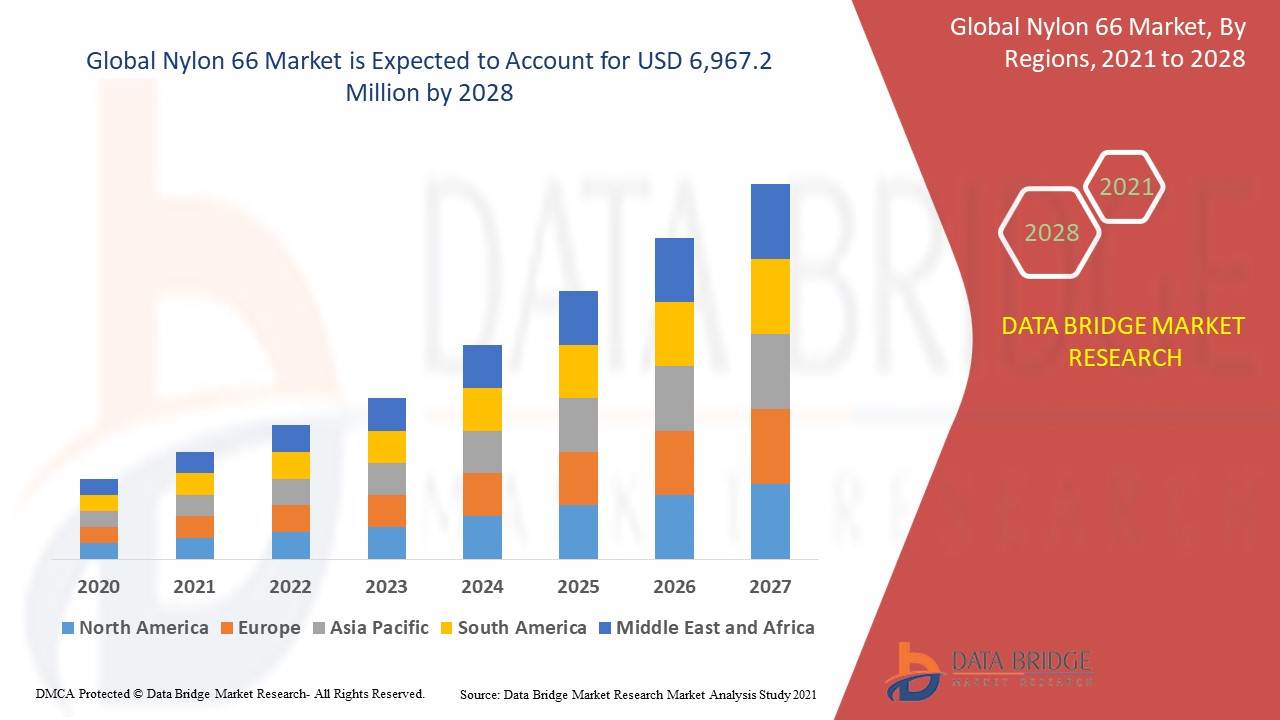
The nylon 66 market size was valued at USD 6.19 billion in 2024 and is projected to reach USD 7.84 billion by 2032, with a CAGR of 3.00% during the forecast period of 2025 to 2032. In addition to the insights on market scenarios such as market value, growth rate, segmentation, geographical coverage, and major players, the market reports curated by the Data Bridge Market Research also include import export analysis, production capacity overview, production consumption analysis, price trend analysis, climate change scenario, supply chain analysis, value chain analysis, raw material/consumables overview, vendor selection criteria, PESTLE Analysis, Porter Analysis, and regulatory framework.
Nylon 66 Market Trends
“Increasing Production of Electronic & Electrical Products”
The increasing production of electronic and electrical products is a key trend for Nylon 66 market, as its high heat resistance makes it ideal for circuit breakers and connectors. With growing electrification in automotive, its use in battery modules and wiring systems is expanding. For instance, Apple incorporates Nylon 66 in power adapters to ensure durability and heat resistance. Its excellent insulation properties enhance safety in high-voltage applications, such as EV charging stations, supporting the global shift to electric mobility. Rising investments in renewable energy further expand its use in solar panel components, reinforcing its role in sustainable energy solutions. The increasing adoption of smart devices demands strong, wear-resistant enclosures, where Nylon 66 provides superior performance. As 5G infrastructure grows, its application in communication equipment and data centres becomes more prominent. Manufacturers continue developing advanced Nylon 66 grades to meet evolving industry needs. Regulatory standards emphasize fire-resistant materials, further strengthening Nylon 66’s market position. To maintain competitiveness, companies invest in R&D, improving electrical performance and sustainability. These interconnected factors collectively reinforce Nylon 66’s expanding role in the electronic and electrical industry.
Report Scope and Nylon 66 Market Segmentation
|
Attributes |
Nylon 66 Key Market Insights |
|
Segments Covered |
|
|
Countries Covered |
U.S., Canada and Mexico in North America, Germany, France, U.K., Netherlands, Switzerland, Belgium, Russia, Italy, Spain, Turkey, Rest of Europe in Europe, China, Japan, India, South Korea, Singapore, Malaysia, Australia, Thailand, Indonesia, Philippines, Rest of Asia-Pacific (APAC) in the Asia-Pacific (APAC), Saudi Arabia, U.A.E, South Africa, Egypt, Israel, Rest of Middle East and Africa (MEA) as a part of Middle East and Africa (MEA), Brazil, Argentina and Rest of South America as part of South America |
|
Key Market Players |
BASF (Germany), Ascend Performance Materials (U.S.), Ensinger (Germany), LANXESS (Germany), Radici Partecipazioni SpA (Italy), Asahi Kasei Corporation (Japan), dsm-firmenich (Switzerland), Dow (U.S.), DuPont (U.S.), Celanese Corporation (U.S.), EMS-CHEMIE HOLDING AG (Switzerland), INVISTA (U.S.), Honeywell International Inc. (U.S.), SABIC (Saudi Arabia), LyondellBasell Industries Holdings B.V. (U.S.) |
|
Market Opportunities |
|
|
Value Added Data Infosets |
In addition to the insights on market scenarios such as market value, growth rate, segmentation, geographical coverage, and major players, the market reports curated by the Data Bridge Market Research also include import export analysis, production capacity overview, production consumption analysis, price trend analysis, climate change scenario, supply chain analysis, value chain analysis, raw material/consumables overview, vendor selection criteria, PESTLE Analysis, Porter Analysis, and regulatory framework. |
Nylon 66 Market Definition
Nylon 66 is a type of nylon or polyamide known for its exceptional mechanical properties, making it a key material across various industries. It is widely used in the textile and plastic sectors, where its durability and strength enhance product performance. As one of the most commonly used engineering thermoplastics, Nylon 66 plays a crucial role in automotive, electrical, electronics, and industrial applications. Its higher melting point allows it to withstand extreme temperatures, making it ideal for under-the-hood automotive components and high-heat industrial machinery. The material’s outstanding dimensional stability ensures minimal expansion or contraction under varying environmental conditions, increasing its reliability in precision applications. Additionally, its more compact molecular structure enhances wear resistance, improving the lifespan of components in demanding environments.
Nylon 66 Market Dynamics
Drivers
- Shift Towards Fuel-Efficient & Eco-Friendly Automobiles
The shift toward fuel-efficient and eco-friendly automobiles is driving Nylon 66 demand. Automakers seek lightweight materials to improve fuel efficiency and reduce emissions. Nylon 66’s high strength-to-weight ratio makes it ideal for vehicle weight reduction. Its superior thermal resistance enhances performance in high-temperature engine components. For instance, leading automakers use Nylon 66 in air intake manifolds and radiator end tanks. The rise of electric vehicles (EVs) further accelerates Nylon 66 adoption in battery components. Its excellent insulation properties ensure safety in high-voltage EV applications. The demand for durable, wear-resistant materials boosts its use in structural car parts. Regulatory policies promoting low-emission vehicles encourage the adoption of advanced engineering plastics. Automakers collaborate with material suppliers to develop high-performance Nylon 66 grades. Innovations in bio-based Nylon 66 support the automotive industry’s sustainability goals. These factors collectively strengthen Nylon 66’s market presence in the evolving automotive sector.
- Growth in Aerospace & Defence Applications
The growth in aerospace and defence applications is driving increased demand for Nylon 66. Aircraft manufacturers seek lightweight materials to improve fuel efficiency and structural performance. Nylon 66’s high strength-to-weight ratio makes it ideal for interior and exterior components. Its excellent thermal resistance ensures durability in high-temperature environments, such as jet engines. For instance, Boeing and Airbus use Nylon 66 in cabin interiors and seating structures. The material’s impact resistance enhances safety in military-grade protective gear and equipment. Defence applications benefit from its superior wear resistance in firearm components and ballistic vests. Its chemical resistance ensures longevity in aerospace fuel systems and hydraulic applications. The rising adoption of unmanned aerial vehicles (UAVs) further expands its use in lightweight airframes. Governments worldwide increase defence spending, fueling demand for high-performance engineering plastics. Manufacturers invest in advanced Nylon 66 grades to meet stringent aerospace and defence standards.
Opportunities
- Research and Development Activities
Research and development activities create significant growth opportunities for the Nylon 66 market. Companies continuously enhance material properties to meet evolving industry requirements, driving innovation. Advancements in polymer technology improve Nylon 66’s strength, thermal stability, and wear resistance, increasing its applications. For instance, BASF and DuPont invest in specialized formulations to enhance automotive and aerospace performance. The push for sustainability drives R&D efforts toward bio-based and recyclable Nylon 66 variants. These eco-friendly innovations align with global regulations promoting reduced environmental impact in manufacturing. Improved processing techniques enhance production efficiency, lowering costs while maintaining high material quality. The integration of nanotechnology further strengthens Nylon 66’s mechanical properties for high-performance applications. Collaborative research accelerates the development of next-generation engineering plastics, expanding its market potential. Emerging applications in 3D printing and additive manufacturing broaden its industrial usage. Continuous R&D investments reinforce market competitiveness, unlocking new opportunities across multiple industries.
- Rising Investments in Infrastructure & Construction
Rising investments in infrastructure and construction present a significant opportunity for the Nylon 66 market. Rapid urbanization increases demand for high-performance materials in structural and industrial applications. Nylon 66’s superior strength and wear resistance make it ideal for construction components. Its excellent chemical resistance enhances durability in plumbing systems, insulation, and industrial fasteners. For instance, Nylon 66 is widely used in cable ties and reinforced pipes for long-term reliability. Large-scale infrastructure projects require lightweight yet strong materials for efficient installation and maintenance. Its high thermal stability ensures performance in extreme weather conditions and heavy-duty applications. Expanding transportation networks boost its adoption in bridge supports, railway components, and safety barriers. The growing focus on sustainable construction promotes Nylon 66’s use in eco-friendly building materials. Government investments in smart city projects further drive demand for advanced engineering polymers. Manufacturers innovate Nylon 66 grades to meet evolving construction standards and environmental regulations. These developments solidify Nylon 66’s role in the future of infrastructure and construction.
Restraints/Challenges
- High Hygroscopicity & Difficulties in Controlling Moulding Process
High hygroscopicity and difficulties in controlling the moulding process act as one of the restraints on the Nylon 66 market. Nylon 66 readily absorbs moisture, which affects its mechanical strength and dimensional stability. Excess moisture leads to swelling, reducing durability in precision-engineered components. For instance, automotive fuel system parts require strict tolerances, making moisture absorption a significant restraint. High water uptake complicates storage and handling, necessitating specialized drying before processing. Inconsistent moisture levels during moulding result in defects such as warping and surface imperfections. Precise control of temperature and pressure is essential to maintaining uniform product quality. Complex moulding conditions increase production costs and extend manufacturing cycle times. Advanced techniques such as dehumidified drying and optimized mold designs help mitigate these restraints. However, maintaining consistency across large-scale production remains a significant challenge for manufacturers. Companies invest in material modifications and process innovations to improve moldability and long-term performance.
- Shortage of Raw Materials
The shortage of raw materials poses a significant challenge to the Nylon 66 market. Limited availability of key precursors such as adiponitrile and hexamethylenediamine affects production capacity. Supply chain disruptions further restrict the procurement of these essential chemical compounds. For instance, fluctuations in crude oil prices impact the cost and availability of feedstock. Reduced supply leads to increased material costs, affecting the profitability of manufacturers. Industries relying on Nylon 66 face production delays due to inconsistent raw material availability. Automotive and electronics sectors experience supply shortages, leading to extended lead times for components. Manufacturers seek alternative supply sources and invest in backward integration to stabilize production. Research into bio-based and recycled Nylon 66 aims to reduce dependence on petroleum-based inputs. However, scaling up sustainable alternatives requires significant investment and technological advancements. Addressing raw material shortages remains essential for ensuring long-term market growth and stability.
This market report provides details of new recent developments, trade regulations, import-export analysis, production analysis, value chain optimization, market share, impact of domestic and localized market players, analyses opportunities in terms of emerging revenue pockets, changes in market regulations, strategic market growth analysis, market size, category market growths, application niches and dominance, product approvals, product launches, geographic expansions, technological innovations in the market. To gain more info on the market contact Data Bridge Market Research for an Analyst Brief, our team will help you take an informed market decision to achieve market growth.
Impact and Current Market Scenario of Raw Material Shortage and Shipping Delays
Data Bridge Market Research offers a high-level analysis of the market and delivers information by keeping in account the impact and current market environment of raw material shortage and shipping delays. This translates into assessing strategic possibilities, creating effective action plans, and assisting businesses in making important decisions.
Apart from the standard report, we also offer in-depth analysis of the procurement level from forecasted shipping delays, distributor mapping by region, commodity analysis, production analysis, price mapping trends, sourcing, category performance analysis, supply chain risk management solutions, advanced benchmarking, and other services for procurement and strategic support.
Expected Impact of Economic Slowdown on the Pricing and Availability of Products
When economic activity slows, industries begin to suffer. The forecasted effects of the economic downturn on the pricing and accessibility of the products are taken into account in the market insight reports and intelligence services provided by DBMR. With this, our clients can typically keep one step ahead of their competitors, project their sales and revenue, and estimate their profit and loss expenditures.
Nylon 66 Market Scope
The market is segmented on the basis of grade, product, and application. The growth amongst these segments will help you analyze meagre growth segments in the industries and provide the users with a valuable market overview and market insights to help them make strategic decisions for identifying core market applications.
Grade
- Fiber
- Resin
Product
- Standard Grade
- Heat Stabilized Grade
- Other
Application
- Textiles
- Industrial/Machinery
- Carpets
- Automotive
- Consumer Goods & Appliances
- Carpets
- Packaging
- Films & Textiles
- Others
Nylon 66 Market Regional Analysis
The market is analysed and market size insights and trends are provided by country, grade, product, and application as referenced above.
The countries covered in the market report are U.S., Canada, Mexico in North America, Germany, Sweden, Poland, Denmark, Italy, U.K., France, Spain, Netherland, Belgium, Switzerland, Turkey, Russia, Rest of Europe in Europe, Japan, China, India, South Korea, New Zealand, Vietnam, Australia, Singapore, Malaysia, Thailand, Indonesia, Philippines, Rest of Asia-Pacific (APAC) in Asia-Pacific (APAC), Brazil, Argentina, Rest of South America as a part of South America, U.A.E, Saudi Arabia, Oman, Qatar, Kuwait, South Africa, Rest of Middle East and Africa (MEA) as a part of Middle East and Africa (MEA).
North America is expected to dominate the nylon 66 market during the forecast period of 2025-2032. This growth is driven by continuous technological innovations that enhance material performance and processing efficiency. The presence of major market players such as DuPont, BASF, and Ascend Performance Materials strengthens regional production capabilities. These companies invest heavily in research and development to improve Nylon 66’s mechanical properties, thermal resistance, and sustainability. A well-established automotive industry in North America further fuels demand for Nylon 66 in vehicle components.
Asia-Pacific region is projected to witness significant growth in the nylon 66 market during the forecast period of 2025-2032. The expansion of the automobile industry remains a key driver, with rising vehicle production in countries such as China, India, and Japan. Automakers increasingly use Nylon 66 for lightweight, durable, and heat-resistant components to enhance fuel efficiency and performance. The growing adoption of electric vehicles (EVs) in the region further accelerates demand for high-performance engineering plastics.
The country section of the report also provides individual market impacting factors and changes in regulation in the market domestically that impacts the current and future trends of the market. Data points such as down-stream and upstream value chain analysis, technical trends and porter's five forces analysis, case studies are some of the pointers used to forecast the market scenario for individual countries. Also, the presence and availability of global brands and their challenges faced due to large or scarce competition from local and domestic brands, impact of domestic tariffs and trade routes are considered while providing forecast analysis of the country data.
Nylon 66 Market Share
The market competitive landscape provides details by competitor. Details included are company overview, company financials, revenue generated, market potential, investment in research and development, new market initiatives, global presence, production sites and facilities, production capacities, company strengths and weaknesses, product launch, product width and breadth, application dominance. The above data points provided are only related to the companies' focus related to market.
Nylon 66 Market Leaders Operating in the Market Are:
- BASF (Germany)
- Ascend Performance Materials (U.S.)
- Ensinger (Germany)
- LANXESS (Germany)
- Radici Partecipazioni SpA (Italy)
- Asahi Kasei Corporation (Japan)
- dsm-firmenich (Switzerland)
- Dow (U.S.)
- DuPont (U.S.)
- Celanese Corporation (U.S.)
- EMS-CHEMIE HOLDING AG (Switzerland)
- INVISTA (U.S.)
- Honeywell International Inc. (U.S.)
- SABIC (Saudi Arabia)
- LyondellBasell Industries Holdings B.V. (U.S.)
Latest Developments in Nylon 66 Market
- In January 2023, Toray Industries introduced a recycled Nylon 66 material derived from silicone-coated airbag fabric scrap cuttings. By incorporating specific additives with resin recycled by REFINVERSE Group, the company developed a material with flowability and mechanical properties comparable to virgin Nylon 66. The introduction of high-quality recycled alternatives supports growing industry demand for eco-friendly solutions, particularly in automotive and industrial applications
- In November 2022, Celanese Corporation acquired a majority of DuPont's Mobility & Materials (M&M) business for USD 11.0 billion. By integrating DuPont’s advanced material technologies, Celanese gains a competitive edge in high-performance polymer solutions. The expanded product range and manufacturing capacity support the growing demand for Nylon 66 in lightweight, durable, and heat-resistant applications

- Interactive Data Analysis Dashboard
- Company Analysis Dashboard for high growth potential opportunities
- Research Analyst Access for customization & queries
- Competitor Analysis with Interactive dashboard
- Latest News, Updates & Trend analysis
- Harness the Power of Benchmark Analysis for Comprehensive Competitor Tracking
Global Nylon 66 Market, Supply Chain Analysis and Ecosystem Framework
To support market growth and help clients navigate the impact of geopolitical shifts, DBMR has integrated in-depth supply chain analysis into its Global Nylon 66 Market research reports. This addition empowers clients to respond effectively to global changes affecting their industries. The supply chain analysis section includes detailed insights such as Global Nylon 66 Market consumption and production by country, price trend analysis, the impact of tariffs and geopolitical developments, and import and export trends by country and HSN code. It also highlights major suppliers with data on production capacity and company profiles, as well as key importers and exporters. In addition to research, DBMR offers specialized supply chain consulting services backed by over a decade of experience, providing solutions like supplier discovery, supplier risk assessment, price trend analysis, impact evaluation of inflation and trade route changes, and comprehensive market trend analysis.
Data collection and base year analysis are done using data collection modules with large sample sizes. The stage includes obtaining market information or related data through various sources and strategies. It includes examining and planning all the data acquired from the past in advance. It likewise envelops the examination of information inconsistencies seen across different information sources. The market data is analysed and estimated using market statistical and coherent models. Also, market share analysis and key trend analysis are the major success factors in the market report. To know more, please request an analyst call or drop down your inquiry.
The key research methodology used by DBMR research team is data triangulation which involves data mining, analysis of the impact of data variables on the market and primary (industry expert) validation. Data models include Vendor Positioning Grid, Market Time Line Analysis, Market Overview and Guide, Company Positioning Grid, Patent Analysis, Pricing Analysis, Company Market Share Analysis, Standards of Measurement, Global versus Regional and Vendor Share Analysis. To know more about the research methodology, drop in an inquiry to speak to our industry experts.
Data Bridge Market Research is a leader in advanced formative research. We take pride in servicing our existing and new customers with data and analysis that match and suits their goal. The report can be customized to include price trend analysis of target brands understanding the market for additional countries (ask for the list of countries), clinical trial results data, literature review, refurbished market and product base analysis. Market analysis of target competitors can be analyzed from technology-based analysis to market portfolio strategies. We can add as many competitors that you require data about in the format and data style you are looking for. Our team of analysts can also provide you data in crude raw excel files pivot tables (Fact book) or can assist you in creating presentations from the data sets available in the report.













