


Occupancy Sensor Market Size
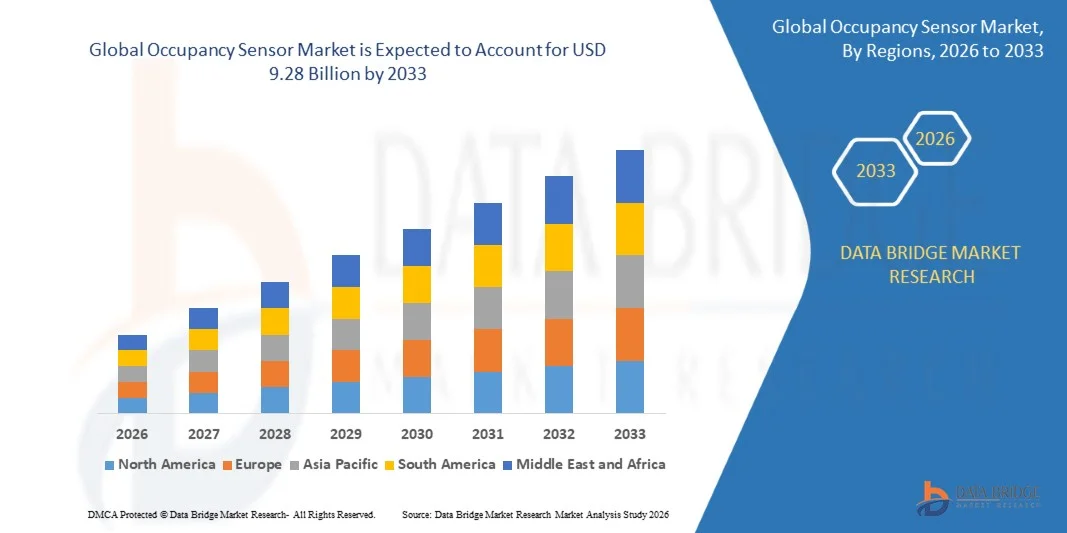
- The global occupancy sensor market size was valued at USD 82 billion in 2025and is expected to reach USD 9.28 billion by 2033, at a CAGR of 9.28% during the forecast period
- Market expansion is primarily supported by increasing demand for automated lighting and HVAC control systems across commercial, residential, and industrial facilities to reduce energy consumption and operational costs.
- In addition, growing integration of occupancy sensors in smart city projects, security systems, and workplace automation solutions is further accelerating overall market adoption globally
Occupancy Sensor Market Analysis
- Occupancy sensors, which detect human presence using technologies such as infrared, ultrasonic, microwave, and hybrid systems, play a critical role in intelligent building management by optimizing energy usage and enhancing security.
- The rising focus on sustainability and green building certifications is significantly boosting the deployment of occupancy-based automation systems in modern infrastructure.
- North America dominated the Occupancy Sensor market in 2025, accounting for approximately 36.8% of the global market share, driven by early adoption of smart infrastructure, stringent energy-efficiency regulations, and widespread implementation of building automation technologies.
- Asia-Pacific accounted and is expected to be the fastest-growing region, registering a CAGR of around 12.7% during the forecast period, fueled by rapid urbanization, increasing construction activities, smart city development initiatives, and growing investments in intelligent commercial and residential buildings across countries such as China, India, Japan, and South Korea.
- The Passive Infrared (PIR) segmentdominated the Occupancy Sensor market in 2025, capturing approximately 48.6% of total market revenue, supported by widespread deployment across offices, shopping malls, airports, educational institutions, healthcare facilities, and hospitality environments.
Report Scope and Occupancy Sensor Market Segmentation
|
Attributes |
Occupancy Sensor Key Market Insights |
|
Segments Covered |
|
|
Countries Covered |
North America · U.S. · Canada · Mexico Europe · Germany · France · U.K. · Netherlands · Switzerland · Belgium · Russia · Italy · Spain · Turkey · Rest of Europe Asia-Pacific · China · Japan · India · South Korea · Singapore · Malaysia · Australia · Thailand · Indonesia · Philippines · Rest of Asia-Pacific Middle East and Africa · Saudi Arabia · U.A.E. · South Africa · Egypt · Israel · Rest of Middle East and Africa South America · Brazil · Argentina · Rest of South America |
|
Key Market Players |
|
|
Market Opportunities |
· Integration of advanced artificial intelligence in the Occupancy Sensor Market enhances energy efficiency and user experience. · Rising demand for energy efficiency drives innovation and competition in the occupancy sensor market. |
|
Value Added Data Infosets |
In addition to the market insights such as market value, growth rate, market segments, geographical coverage, market players, and market scenario, the market report curated by the Data Bridge Market Research team includes in-depth expert analysis, import/export analysis, pricing analysis, production consumption analysis, and pestle analysis. |
Occupancy Sensor Market Trends
“Shift Toward Smart, AI-Enabled and Energy-Efficient Building Automation Systems”
- The market is witnessing a strong shift toward AI-enabled and IoT-integrated occupancy sensors that provide real-time space utilization insights and automated energy optimization.
- Increasing adoption of wireless and battery-powered sensors is enabling flexible installation and reduced infrastructure costs in smart buildings.
- Integration with smart lighting and HVAC systems is improving energy efficiency and supporting net-zero building initiatives globally.
- Growing use of cloud-based occupancy analytics platforms is helping enterprises optimize workspace utilization in hybrid work environments.
- Demand for dual-technology sensors is increasing due to improved accuracy in complex environments such as large commercial buildings and industrial facilities.
Occupancy Sensor Market Dynamics
Driver
“Rising Demand for Energy Efficiency and Smart Building Automation”
- Growing global focus on reducing energy consumption in commercial and residential buildings is driving adoption of occupancy sensors.
- Increasing implementation of smart building technologies is enabling automated control of lighting, HVAC, and security systems.
- Rising electricity costs are pushing organizations to adopt sensor-based automation for operational savings.
- Government regulations promoting energy-efficient infrastructure and green buildings are supporting market expansion.
- Rapid urbanization and smart city development projects are further accelerating deployment of occupancy sensing systems.
Restraint/Challenge
“High Installation Cost and Technical Limitations in Complex Environments”
- High upfront costs of advanced sensor systems limit adoption in cost-sensitive markets.
- Integration complexity with existing building management systems creates deployment challenges.
- Performance limitations such as false detection in crowded or highly dynamic environments reduce efficiency.
- Lack of standardization across sensor technologies affects interoperability between devices and systems.
- Maintenance and calibration requirements increase long-term operational costs for end-users.
Occupancy Sensor Market Scope
The market is segmented on the basis of Type, Connectivity, End User.
- By Type
On the basis of type, Passive Infrared (PIR) dominated the Occupancy Sensor market in 2025, accounting for approximately 52.8% of total market revenue, driven by its cost-effectiveness, high reliability, and wide adoption in commercial and residential buildings. PIR sensors are extensively used for lighting and HVAC automation due to their ability to detect motion efficiently using infrared heat signatures. Their low power consumption, easy installation, and compatibility with smart building systems make them the preferred choice across offices, retail spaces, and homes. Strong demand for energy-efficient solutions and widespread deployment in smart lighting systems further reinforces the dominance of this segment globally.
Dual Technology accounted and is expected to witness the fastest CAGR of around 13.4% during the forecast period, fueled by increasing demand for higher accuracy and reduced false detection rates in complex environments. Growing adoption in smart offices, airports, industrial facilities, and advanced building automation systems is accelerating demand globally.
- By Connectivity
On the basis of Connectivity, Wireless Connectivity dominated the Occupancy Sensor market in 2025, capturing approximately 61.3% of total market revenue, driven by easy installation, flexibility, and compatibility with modern smart building systems. Wireless sensors eliminate the need for extensive wiring, reduce installation costs, and support seamless integration with IoT platforms, smart lighting, and building automation systems.
Wired Connectivity represented and is projected to witness the fastest CAGR of around 11.9% during the forecast period, driven by increasing deployment in industrial facilities, government buildings, and mission-critical applications requiring stable, secure, and interference-free communication.
- By End User
On the basis of End User, Commercial dominated the Occupancy Sensor market with approximately 48.6% of total market revenue in 2025, driven by extensive deployment across offices, shopping malls, airports, hotels, educational institutions, healthcare facilities, and corporate buildings. Commercial facilities increasingly utilize occupancy sensors to optimize energy consumption through automated lighting, HVAC management, and security operations. Growing adoption of smart buildings and green building standards continues to support segment growth.
Residential accounted and is expected to witness the fastest CAGR of approximately 13.2% during the forecast period, fueled by rapid adoption of smart home technologies, increasing consumer preference for energy-efficient solutions, and growing integration with home automation platforms and smart assistants. Rising awareness of sustainability and declining sensor costs are further accelerating market penetration in residential applications.
Occupancy Sensor Market Regional Analysis
- North America dominated the Occupancy Sensor market with the largest revenue share of 41.9% in 2025, driven by the strong adoption of smart building technologies, high penetration of automation systems, and widespread deployment of energy-efficient infrastructure across commercial and residential spaces.
- Organizations and consumers in the region increasingly prioritize smart occupancy-based lighting, HVAC control, and security optimization, leading to extensive integration of occupancy sensors in offices, healthcare facilities, retail centers, and smart homes.
- This strong market position is further supported by high investment in IoT-enabled infrastructure, presence of leading sensor manufacturers, and rapid adoption of smart city initiatives, establishing occupancy sensors as a key component of modern building automation and energy management systems.
U.S. Occupancy Sensor Market Insight
The U.S. Occupancy Sensor market is witnessing strong growth driven by rapid adoption of smart building technologies and increasing demand for energy-efficient infrastructure across commercial, residential, and industrial spaces. Rising integration of IoT-enabled automation systems for lighting, HVAC, and security control is further supporting market expansion. In addition, strong investments in smart city projects, advanced construction activities, and the presence of leading sensor manufacturers are accelerating adoption, making occupancy sensors a key component of modern building management systems in the country.
Europe Occupancy Sensor Market Insight
The Europe Occupancy Sensor market is witnessing steady growth, supported by stringent energy efficiency regulations, increasing adoption of smart building technologies, and rising focus on sustainable infrastructure. Demand is driven by widespread integration of automation systems in commercial offices, retail spaces, and public infrastructure to reduce energy consumption and operational costs. Countries such as Germany, the U.K., and France are leading adoption due to strong smart city initiatives and growing investments in IoT-based building management systems across the region.
U.K. Occupancy Sensor Market Insight
The U.K. Occupancy Sensor market is witnessing steady growth driven by increasing adoption of smart building technologies and strong emphasis on energy efficiency across commercial and residential infrastructure. Rising demand for automated lighting, HVAC control, and security systems is boosting sensor deployment in offices, retail spaces, and public buildings. Government initiatives supporting carbon reduction and smart city development are further accelerating adoption. In addition, growing integration of IoT and wireless technologies is enhancing system efficiency and expanding market penetration across the country.
Germany Occupancy Sensor Market Insight
The Germany Occupancy Sensor market is witnessing steady growth driven by strong adoption of smart building technologies and increasing focus on energy efficiency across commercial and residential infrastructure. Demand is supported by the country’s advanced industrial base, strict energy conservation regulations, and growing integration of IoT-enabled automation systems. Rising investments in smart offices, green buildings, and intelligent lighting and HVAC control solutions are further accelerating market expansion. In addition, Germany’s emphasis on sustainability and digitalization is strengthening long-term adoption of occupancy sensors.
Asia-Pacific Occupancy Sensor Market Insight
The Asia-Pacific Occupancy Sensor market is witnessing strong growth, driven by rapid urbanization, expanding smart city projects, and increasing adoption of energy-efficient building automation systems. Rising construction activities across commercial, residential, and industrial sectors in countries like China, India, and Japan are boosting sensor deployment. Additionally, growing awareness about energy conservation and government initiatives promoting smart infrastructure are accelerating market expansion. The region is also benefiting from increasing investments in IoT technologies and modernization of building management systems.
Japan Occupancy Sensor Market Insight
The Japan Occupancy Sensor market is witnessing steady growth driven by strong adoption of smart building technologies and energy-efficient infrastructure. Increasing demand for automated lighting, HVAC control, and security systems in commercial and residential spaces is supporting market expansion. Japan’s focus on sustainability, smart cities, and advanced IoT integration further accelerates sensor deployment. Additionally, rising aging population and need for assisted living solutions are encouraging wider use of occupancy sensors in healthcare and residential environments.
India Occupancy Sensor Market Insight
The India Occupancy Sensor market is witnessing strong growth driven by rapid urbanization, increasing adoption of smart building solutions, and rising focus on energy-efficient infrastructure. Expanding commercial real estate, IT parks, and smart city projects are significantly boosting demand for automated lighting and HVAC control systems. Additionally, growing awareness about energy conservation and increasing penetration of IoT-based home automation solutions are further supporting market expansion across residential, commercial, and industrial applications in the country.
Occupancy Sensor Market Share
The Occupancy Sensor industry is primarily led by well-established companies, including:
- Schneider Electric (France)
- Honeywell International Inc. (U.S.)
- Siemens AG (Germany)
- Johnson Controls International (Ireland)
- Legrand SA (France)
- Eaton Corporation (Ireland)
- Signify N.V. (Netherlands)
- Texas Instruments Inc. (U.S.)
- Hubbell Incorporated (U.S.)
- Panasonic Corporation (Japan)
What are the Recent Developments in Global Occupancy Sensor Market?
- In May 2025, Schneider Electric expanded its partnership ecosystem with IoT and smart-building solution providers to strengthen its EcoStruxure platform, integrating advanced occupancy sensing for energy-efficient building automation and smart facility management.
- In November 2025, Honeywell announced collaboration with smart infrastructure companies to enhance AI-based occupancy detection systems, focusing on improving HVAC optimization and workplace utilization analytics in commercial buildings.
- In August 2025, Legrand strengthened its global position through strategic integration of smart building automation portfolios, expanding occupancy sensor solutions for commercial and residential smart infrastructure markets.
- In March 2026, Siemens is focusing on expanding its building technologies segment through partnerships with digital twin and IoT firms, enhancing occupancy-driven energy management systems in smart cities and industrial facilities.
- In January 2026, Johnson Controls is advancing collaborations in smart building ecosystems to integrate occupancy sensors with predictive analytics platforms, supporting automated lighting, security, and HVAC optimization in large-scale infrastructure projects.

- Interactive Data Analysis Dashboard
- Company Analysis Dashboard for high growth potential opportunities
- Research Analyst Access for customization & queries
- Competitor Analysis with Interactive dashboard
- Latest News, Updates & Trend analysis
- Harness the Power of Benchmark Analysis for Comprehensive Competitor Tracking
Data collection and base year analysis are done using data collection modules with large sample sizes. The stage includes obtaining market information or related data through various sources and strategies. It includes examining and planning all the data acquired from the past in advance. It likewise envelops the examination of information inconsistencies seen across different information sources. The market data is analysed and estimated using market statistical and coherent models. Also, market share analysis and key trend analysis are the major success factors in the market report. To know more, please request an analyst call or drop down your inquiry.
The key research methodology used by DBMR research team is data triangulation which involves data mining, analysis of the impact of data variables on the market and primary (industry expert) validation. Data models include Vendor Positioning Grid, Market Time Line Analysis, Market Overview and Guide, Company Positioning Grid, Patent Analysis, Pricing Analysis, Company Market Share Analysis, Standards of Measurement, Global versus Regional and Vendor Share Analysis. To know more about the research methodology, drop in an inquiry to speak to our industry experts.
Data Bridge Market Research is a leader in advanced formative research. We take pride in servicing our existing and new customers with data and analysis that match and suits their goal. The report can be customized to include price trend analysis of target brands understanding the market for additional countries (ask for the list of countries), clinical trial results data, literature review, refurbished market and product base analysis. Market analysis of target competitors can be analyzed from technology-based analysis to market portfolio strategies. We can add as many competitors that you require data about in the format and data style you are looking for. Our team of analysts can also provide you data in crude raw excel files pivot tables (Fact book) or can assist you in creating presentations from the data sets available in the report.













