


What is the Optical Character Recognition (OCR) Passport Reader Market Size and Growth Rate?
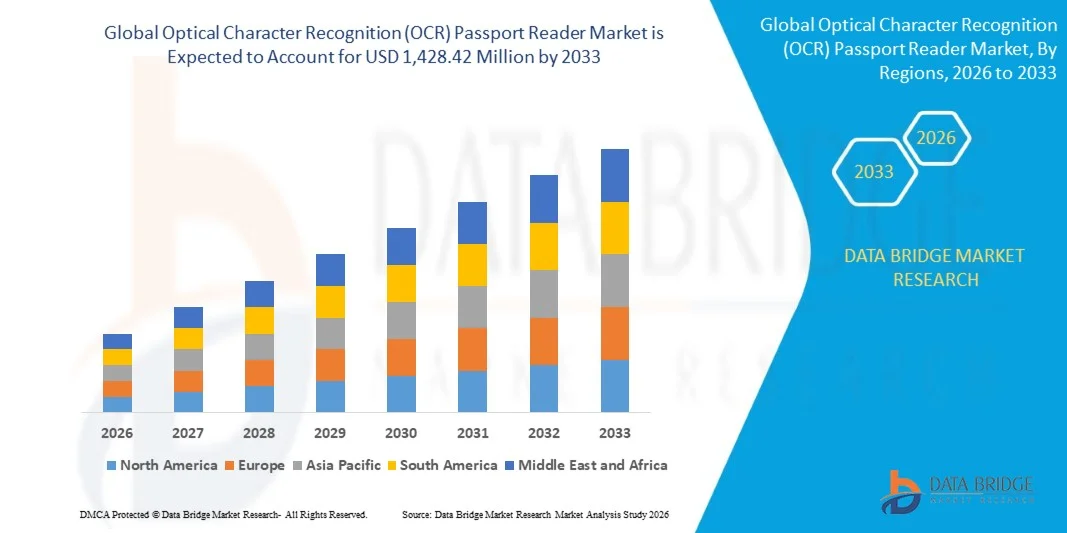
- As per Data Bridge Market Research analysis, the optical character recognition (OCR) passport reader market was valued at USD 711.64 million in 2025 and is projected to reach USD 1,428.42 million by 2033, growing at a CAGR of 9.10% from 2026 to 2033.
- The market is experiencing consistent growth driven by increasing international travel, rising demand for secure identity verification, stringent border-security requirements, and growing adoption of automated passport-reading and authentication technologies.
- The increasing need to streamline immigration and airport processing, combined with growing concerns regarding document fraud and the expansion of e-passports, is compelling governments, airports, airlines, and other organizations to adopt advanced passport-reader solutions. OCR-enabled readers are increasingly being integrated with RFID, biometrics, artificial intelligence, and automated verification systems, enabling faster, more accurate, and secure passenger processing.
Market Size & Forecast
- Global Market Value (2025): USD 711.64 Million
- Expected Market Value (2033): USD 1,428.42 Million
- Forecast CAGR (2026–2033): 9.10%
- Leading Region in 2025: North America
- Fastest Growing Region: Asia Pacific
What are the Major Takeaways of the Optical Character Recognition (OCR) Passport Reader Market?
- North America dominated the passport reader market with the largest revenue share of 37.4% in 2025, supported by stringent border-security requirements, high international travel volumes, and early adoption of advanced OCR and automated identity-verification technologies.
- Asia-Pacific is expected to be the fastest-growing region at a CAGR of 12.46% from 2026 to 2033, fueled by rising international travel, expanding airport infrastructure, and increasing investments in automated border-control systems
- The compact full-page reader segment led the market with a 40% share in 2025, driven by its ability to capture passport information across the complete document page in a single scanning operation.
- Self-service kiosk is the fastest-growing type, projected to register a CAGR of 12.4%, reflecting the surge in the increasing shift toward automated passenger processing.
- The RFID segment dominated the technology type category with a 54.23% revenue share in 2025, led by the widespread adoption of electronic passports containing embedded chips.
- Airport security accounted for 62.5% of the market share in 2025, preferred by extensive deployment of passport readers throughout international airports.
- The border control segment is the fastest-growing application category, with a CAGR of 12.6%, driven by the increasing government investment in automated border-management infrastructure.
Report Scope and Optical Character Recognition (OCR) Passport Reader Market Segmentation
|
Attributes |
Optical Character Recognition (OCR) Passport Reader Key Market Insights |
|
Segments Covered |
|
|
Countries Covered |
North America
Europe
Asia-Pacific
Middle East and Africa
South America
|
|
Key Market Players |
|
|
Market Opportunities |
|
|
Value Added Data Infosets |
In addition to the insights on market scenarios such as market value, growth rate, segmentation, geographical coverage, and major players, the market reports curated by the Data Bridge Market Research also include in-depth expert analysis, geographically represented company-wise production and capacity, network layouts of distributors and partners, detailed and updated price trend analysis and deficit analysis of supply chain and demand. |
What is the Key Trend in the Optical Character Recognition (OCR) Passport Reader Market?
- Airports and border agencies are increasingly adopting AI-enabled OCR passport readers and automated document-verification systems to accelerate passenger processing, improve recognition accuracy, and strengthen identity verification while reducing dependence on manual document inspection.
- For instance, in October 2025, the European Union began the phased rollout of its Entry/Exit System (EES) at external borders, requiring non-EU travelers to scan passports and provide fingerprints and photographs, demonstrating the shift toward automated document reading and biometric border processing.
- The growing adoption of e-passports and biometric identification systems is encouraging vendors to combine OCR document reading with RFID, facial recognition, and other authentication technologies to create faster and more secure passenger-processing workflows.
- Self-service passport kiosks and automated border-control systems are increasingly incorporating OCR readers to enable travelers to scan documents independently, reduce queues, and support faster immigration processing at high-volume international transportation hubs.
- For instance, in November 2024, Australian Border Force reported successful trials of contactless border clearance at Sydney Airport using facial recognition with Qantas crew, with the technology intended to support broader automated and passport-light border processing by 2030.
- As airports, immigration authorities, and transportation operators continue prioritizing contactless processing, biometric authentication, and automated document verification, OCR passport readers are expected to evolve toward integrated, intelligent, and multi-protocol identity-processing platforms.
What are the Key Drivers of the Optical Character Recognition (OCR) Passport Reader Market?
- The rapid growth of international air travel and cross-border passenger volumes is increasing demand for high-speed passport readers capable of automatically extracting traveler information and reducing processing times at airports and immigration checkpoints.
- For instance, in June 2024, India launched the Fast Track Immigration–Trusted Traveller Programme (FTI-TTP), using biometric-enabled e-gates at major international airports to accelerate immigration clearance for pre-verified Indian nationals and OCI cardholders. The program demonstrates growing government investment in automated passport and identity verification infrastructure.
- Governments and border-control authorities are increasingly investing in e-passports, automated border-control infrastructure, and biometric verification systems to strengthen security, combat document fraud, and improve the efficiency of immigration operations.
- For instance, in October 2025, the European Union began the progressive rollout of its Entry/Exit System (EES) across 29 European countries, requiring travelers to scan passports and provide fingerprints and facial images. The system is designed to electronically register non-EU travelers and strengthen automated identity and border-security check
- With airports and border agencies increasingly pursuing faster, more secure, and automated passenger processing, OCR passport readers will remain essential for extracting machine-readable information and supporting integrated biometric and electronic-document authentication systems.
Which Factors are Challenging the Growth of the Optical Character Recognition (OCR) Passport Reader Market?
- Advanced OCR passport readers require significant upfront investment because modern systems increasingly combine high-resolution imaging, document authentication, RFID, biometric verification, specialized software, and secure connectivity infrastructure.
- For instance, in October 2024, the European Union postponed its Entry/Exit System (EES) after Germany, France, and the Netherlands reported that their border IT systems were not ready, with the EU’s central system lacking the required stability and functionality. The delay highlights the technical complexity and infrastructure-readiness challenges associated with large-scale automated passport and biometric verification systems.
- These high costs can limit adoption among smaller airports, hotels, border facilities, and private organizations, particularly in price-sensitive developing markets where operators may lack sufficient budgets for sophisticated automated identity-verification infrastructure.
- For instance, in May 2024, electronic passport gates at major U.K. airports failed for more than four hours because of a network issue, affecting around 270 e-gates and causing passenger queues of more than three hours at Heathrow, Gatwick, Manchester, and Edinburgh. The incident demonstrates the operational and infrastructure risks of relying on interconnected automated passport-reading systems.
- The cost of system integration, cybersecurity, maintenance, software upgrades, and compliance with evolving international document standards continues to create challenges for organizations seeking to deploy large-scale OCR passport-reader infrastructure.
How is the Optical Character Recognition (OCR) Passport Reader Market Segmented?
The optical character recognition (OCR) passport reader market is segmented on the basis of type, technology, application, and sector.
- By Type
On the basis of type, the optical character recognition (OCR) passport reader market is segmented into swipe readers, self-service kiosks, compact full-page readers, and others. The compact full-page reader segment dominated the market with 40% share in 2025, owing to its ability to capture passport information across the complete document page in a single scanning operation. These readers are widely used at immigration counters, airport security checkpoints, border-control facilities, and other high-volume verification locations. Their full-page imaging capability enables efficient capture of both machine-readable and visual information from travel documents. Compact designs also allow organizations to install readers without requiring extensive counter or checkpoint modifications.
The self-service kiosk segment is projected to register the fastest growth at a CAGR of 12.4% during forecast period, driven by the increasing shift toward automated passenger processing. These kiosks allow travelers to scan passports and complete identity-verification procedures with limited staff intervention. Airports are increasingly deploying self-service systems to reduce passenger queues and improve processing capacity during peak travel periods. Integration with biometric authentication, facial recognition, and automated border-control systems is further expanding their functionality. The systems can also be updated through software to support evolving document and identity-verification requirements. Growing passenger volumes and airport investments in contactless processing are therefore expected to accelerate adoption of self-service passport-reader kiosks.
- By Technology
On the basis of technology, the passport reader market is segmented into RFID, barcode, and OCR. The RFID segment dominated the technology category with a 54.23% share in 2025, supported by widespread adoption of electronic passports containing embedded chips. RFID enables readers to communicate directly with the electronic chip and retrieve digitally stored passport information. This capability supports automated authentication and reduces dependence on manual document verification. RFID is particularly important for modern border-control and automated immigration systems where electronic passport validation is required.
The OCR segment is projected to register the fastest growth at a CAGR of 12.2% during forecast period, driven by increasing demand for rapid extraction of printed passport information. OCR technology enables readers to capture machine-readable-zone information and convert it into digital data for automated processing. It can operate alongside RFID and biometric technologies, allowing organizations to build layered identity-verification systems. Advances in imaging, artificial intelligence, and document-recognition algorithms are improving OCR accuracy and processing speed. The technology is also useful where fast document-data extraction is required without depending entirely on electronic passport chips.
- By Application
On the basis of application, the market is segmented into airport security, border control, and others. The airport security segment dominated the application category with an 62.5% share in 2025, supported by extensive deployment of passport readers throughout international airports. These systems are used to identify passengers, capture travel-document information, and support security and immigration workflows. Rising international passenger volumes are increasing the need for rapid and automated document processing at airport checkpoints. Passport readers also help reduce manual data-entry requirements and improve the consistency of passenger verification. Increasing investments in automated passenger-processing infrastructure are further strengthening demand within airport environments.
The border control segment is projected to register the fastest growth at a CAGR of 12.6% during forecast period, driven by increasing government investment in automated border-management infrastructure. Passport readers enable border authorities to capture document information rapidly and connect it with immigration and identity-verification systems. Integration with biometric technologies enables authorities to compare passport information with facial or fingerprint data. Governments are also modernizing border checkpoints to manage growing international travel while improving security and processing efficiency. Automated border-control systems are increasingly being deployed at airports, land crossings, and other international entry points.
- By Sector
On the basis of sector, the market is segmented into public and private. The public sector dominated the market with. 68.4% share in 2025, primarily because immigration authorities, border agencies, government organizations, and publicly operated airports represent major users of passport-reading infrastructure. Public-sector organizations require secure systems for immigration processing, identity verification, border management, and national-security applications. Large government procurement programs can involve substantial deployments across multiple airports and border checkpoints. The increasing modernization of immigration infrastructure is supporting continued demand for automated passport readers. Government adoption of e-passports and biometric border-control systems further strengthens the public sector's leading position.
The private sector is projected to register the fastest growth at a CAGR of 12.8% during forecast period, supported by increasing adoption of automated identity verification outside traditional government applications. Airlines, private airport operators, hotels, financial institutions, and other organizations are adopting document readers to streamline customer identification and verification. Private-sector operators increasingly require faster onboarding and secure processing of travel and identity documents. Integration with cloud platforms, biometric systems, and digital identity technologies is expanding the potential applications of passport readers. Self-service and contactless processing are also making these systems more attractive to commercial operators.
Which Region Holds the Largest Share of the Optical Character Recognition (OCR) Passport Reader Market?
- North America dominated the passport reader market with the largest revenue share of 37.4% in 2025, supported by stringent border-security requirements, high international travel volumes, and early adoption of advanced OCR and automated identity-verification technologies
- The region also benefits from strong investments in automated border-control systems, biometric authentication, e-passport validation, and self-service passenger-processing technologies, particularly across the U.S. and Canada. Growing demand for faster and more secure traveler identification, combined with modernization of airports and border checkpoints, continues to strengthen North America's leadership in the global passport-reader market.
U.S. Optical Character Recognition (OCR) Passport Reader Market Insight
The U.S. optical character recognition (OCR) passport reader market is witnessing strong growth due to rising investments in automated border-control infrastructure, airport security, and biometric identity-verification technologies. The country’s extensive international airport network, high passenger volumes, and advanced immigration infrastructure are driving demand across government, aviation, and private-sector applications. In addition, growing adoption of e-passports, automated passport readers, and self-service processing systems is accelerating deployment. Furthermore, increasing emphasis on border security, faster passenger processing, and fraud prevention is supporting the adoption of advanced OCR-enabled document-verification solutions.
Asia-Pacific Optical Character Recognition (OCR) Passport Reader Market Insight
The Asia-Pacific optical character recognition (OCR) passport reader market is expected to witness rapid growth, driven by increasing international travel, expanding airport infrastructure, and rising investments in automated immigration systems across countries such as China, India, and Japan. Growing adoption of e-passports, biometric authentication, and automated border-control technologies is supporting regional market expansion. In addition, increasing passenger volumes, modernization of international airports, and government initiatives focused on digital identity verification are accelerating demand for passport readers across the region. The growing deployment of self-service kiosks and automated border gates is further strengthening regional adoption.
Japan Optical Character Recognition (OCR) Passport Reader Market Insight
The Japan optical character recognition (OCR) passport reader market is witnessing consistent growth due to rising investments in automated immigration systems, advanced airport technologies, and secure identity-verification infrastructure. Airports and government authorities are increasingly adopting passport readers and biometric systems to streamline passenger processing and strengthen border security. Moreover, Japan’s high technology adoption, growing use of e-passports, and focus on contactless passenger processing are further contributing to market growth. Increasing integration of OCR with facial recognition and automated border-control technologies is also supporting demand for advanced passport-reading solutions.
China Optical Character Recognition (OCR) Passport Reader Market Insight
The China optical character recognition (OCR) passport reader market is growing rapidly, driven by expanding international airports, increasing passenger traffic, and rising government investment in automated border-control infrastructure. Growing adoption of biometric identification, e-passport authentication, and AI-enabled document-recognition technologies across airports and immigration facilities is significantly boosting market demand. In addition, increasing investments in smart-border infrastructure, digital identity systems, and automated passenger-processing solutions are supporting market development. Rapid modernization of transportation infrastructure and technological advancements are positioning China as one of the fastest-growing markets for passport-reader technologies in the region.
U.K. Optical Character Recognition (OCR) Passport Reader Market Insight
The U.K. optical character recognition (OCR) passport reader market is experiencing steady growth, supported by rising adoption of automated border-control systems, biometric e-gates, and advanced passenger-processing technologies. Increasing investments in airport security infrastructure and growing demand for faster, contactless immigration clearance are contributing to market growth. Furthermore, the deployment of electronic passport gates and integration of passport reading with facial-recognition technologies are improving processing efficiency and border security. The U.K.’s established aviation infrastructure and continued modernization of immigration systems are positioning the country as an important market for advanced passport-reader solutions.
Germany Optical Character Recognition (OCR) Passport Reader Market Insight
The Germany optical character recognition (OCR) passport reader market is expanding steadily due to the country’s strong aviation infrastructure, extensive international travel network, and increasing adoption of automated border-control technologies. Airports and immigration authorities are increasingly utilizing passport readers for document verification, passenger identification, and automated immigration processing. Continuous investments in e-passport authentication, biometric identification, and digital border-management systems are further driving market growth in Germany. Moreover, increasing emphasis on secure and efficient passenger processing, combined with the modernization of European border infrastructure, is supporting the adoption of advanced OCR passport-reader technologies.
Which are the Top Companies in Optical Character Recognition (OCR) Passport Reader Market?
The optical character recognition (OCR) passport reader industry is primarily led by well-established companies, including:
- Thales (France)
- ACCESS CO., LTD. (Japan)
- ARH Informatikai Zrt. (Hungary)
- Regula (Latvia)
- DESKO GmbH (Germany)
- WintoneTek (China)
- IER SAS (France)
- Veridos GmbH (Germany)
- Shenzhen Rakinda Technologies Co., Ltd. (China)
- IDEMIA GROUP (France)
- secunet Security Networks AG (Germany)
- Xperix Inc. (South Korea)
- E-Seek Inc. (U.S.)
- Markland Technology Limited (China)
- RTscan Technology Limited (China)
- Primagest,Inc. (Japan)
- Sinosecu (China)
- Neurotechnology (Lithuania)
- PrehKeyTec GmbH (Germany)
What are Latest Developments in Optical Character Recognition (OCR) Passport Reader Market?
- In October 2025, the European Union began the phased rollout of its Entry/Exit System (EES) at external borders, requiring non-EU travelers to scan their passports and provide fingerprints and facial photographs. The automated system electronically registers travelers and is designed to replace traditional passport stamping, strengthen identity verification, detect overstayers, and combat identity fraud. This development is increasing the importance of passport-scanning and automated document-verification technologies, including OCR-enabled readers, within European border-control infrastructure.
- In June 2024, India inaugurated the Fast Track Immigration–Trusted Traveller Programme (FTI-TTP) at Terminal 3 of Indira Gandhi International Airport, introducing automated e-gates that scan passengers’ passports and authenticate their biometrics before granting immigration clearance. The first phase was planned for 21 major airports, with Delhi followed by Mumbai, Chennai, Kolkata, Bengaluru, Hyderabad, Kochi, and Ahmedabad. The deployment represents a significant expansion of automated passport-reading and biometric verification infrastructure in one of the world’s rapidly growing aviation markets
- In June 2023, IDEMIA was selected by GMR Group as the technology partner for India’s DigiYatra program, providing facial-recognition technology for passenger authentication at Delhi, Hyderabad, and Goa airports. The solution was designed to make terminal entry and security clearance paperless and contactless by digitally verifying passenger identities. The development illustrates the growing integration of passport/document verification with biometric technologies and automated passenger-processing systems across major airports.
- In December 2022, India expanded the implementation of DigiYatra’s biometric boarding system following its initial launch at Delhi, Bengaluru, and Varanasi airports. The system uses facial recognition to provide contactless and paperless passenger validation across airport touchpoints, while the government planned phased implementation at additional airports. This development demonstrates the industry's movement toward automated passenger identification, where document and passport-reading technologies increasingly operate alongside biometric authentication to streamline airport processing.
- In December 2021, India reported that four Airports Authority of India airports and three joint-venture airports had completed preliminary testing of the DigiYatra biometric boarding system. The participating airports included Varanasi, Pune, Kolkata, Vijayawada, Hyderabad, Bengaluru, and Delhi, with the system planned for phased implementation beginning in 2022. The initiative demonstrated early large-scale deployment of automated passenger identity technologies and helped establish the infrastructure for contactless, digitally enabled airport processing.

- Interactive Data Analysis Dashboard
- Company Analysis Dashboard for high growth potential opportunities
- Research Analyst Access for customization & queries
- Competitor Analysis with Interactive dashboard
- Latest News, Updates & Trend analysis
- Harness the Power of Benchmark Analysis for Comprehensive Competitor Tracking
Global Ocr Passport Reader Market, Supply Chain Analysis and Ecosystem Framework
To support market growth and help clients navigate the impact of geopolitical shifts, DBMR has integrated in-depth supply chain analysis into its Global Ocr Passport Reader Market research reports. This addition empowers clients to respond effectively to global changes affecting their industries. The supply chain analysis section includes detailed insights such as Global Ocr Passport Reader Market consumption and production by country, price trend analysis, the impact of tariffs and geopolitical developments, and import and export trends by country and HSN code. It also highlights major suppliers with data on production capacity and company profiles, as well as key importers and exporters. In addition to research, DBMR offers specialized supply chain consulting services backed by over a decade of experience, providing solutions like supplier discovery, supplier risk assessment, price trend analysis, impact evaluation of inflation and trade route changes, and comprehensive market trend analysis.
Data collection and base year analysis are done using data collection modules with large sample sizes. The stage includes obtaining market information or related data through various sources and strategies. It includes examining and planning all the data acquired from the past in advance. It likewise envelops the examination of information inconsistencies seen across different information sources. The market data is analysed and estimated using market statistical and coherent models. Also, market share analysis and key trend analysis are the major success factors in the market report. To know more, please request an analyst call or drop down your inquiry.
The key research methodology used by DBMR research team is data triangulation which involves data mining, analysis of the impact of data variables on the market and primary (industry expert) validation. Data models include Vendor Positioning Grid, Market Time Line Analysis, Market Overview and Guide, Company Positioning Grid, Patent Analysis, Pricing Analysis, Company Market Share Analysis, Standards of Measurement, Global versus Regional and Vendor Share Analysis. To know more about the research methodology, drop in an inquiry to speak to our industry experts.
Data Bridge Market Research is a leader in advanced formative research. We take pride in servicing our existing and new customers with data and analysis that match and suits their goal. The report can be customized to include price trend analysis of target brands understanding the market for additional countries (ask for the list of countries), clinical trial results data, literature review, refurbished market and product base analysis. Market analysis of target competitors can be analyzed from technology-based analysis to market portfolio strategies. We can add as many competitors that you require data about in the format and data style you are looking for. Our team of analysts can also provide you data in crude raw excel files pivot tables (Fact book) or can assist you in creating presentations from the data sets available in the report.













