


Global Self-Service Kiosks Market Size
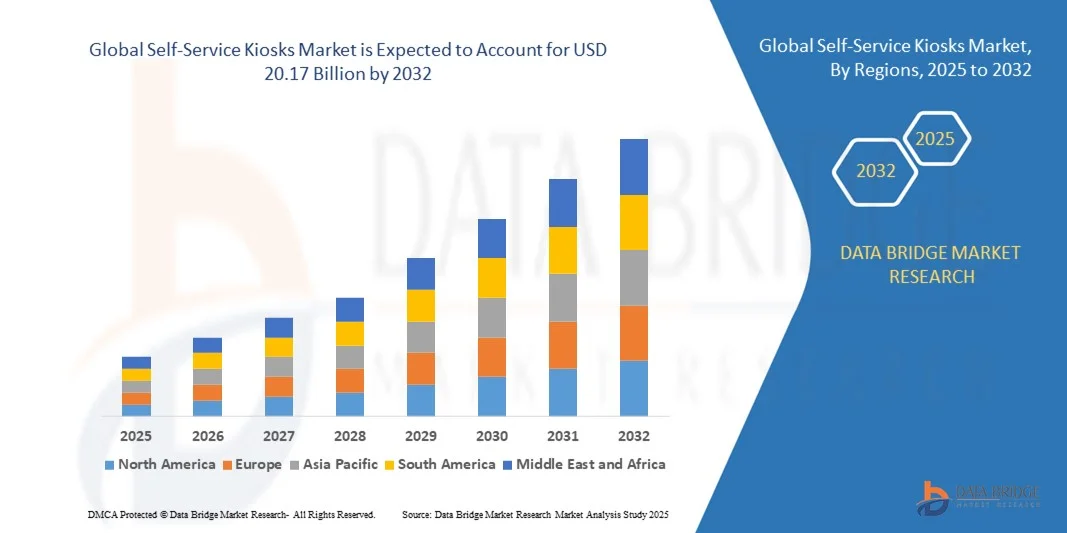
- The global self-service kiosks market size was valued at USD 13.14 billion in 2024 and is projected to reach USD 20.17 billion by 2032, growing at a CAGR of 5.50% during the forecast period.
- Market growth is primarily driven by the increasing demand for automated solutions across industries such as retail, healthcare, banking, and transportation, aimed at improving operational efficiency and customer experience.
- In addition, the need for contactless services, enhanced user convenience, and 24/7 accessibility is accelerating the deployment of self-service kiosks worldwide, reinforcing their role in digital transformation strategies across both public and private sectors.
Global Self-Service Kiosks Market Analysis
- Self-service kiosks, offering interactive digital interfaces for a range of applications including ticketing, check-in, payment, and information access, are becoming essential tools across industries such as retail, healthcare, hospitality, and transportation due to their ability to enhance user convenience, reduce operational costs, and streamline services.
- The surge in demand for self-service kiosks is primarily driven by the increasing need for contactless solutions, rising labor costs, and the growing consumer expectation for faster, more efficient service delivery.
- North America dominated the global self-service kiosks market with the largest revenue share of 38.5% in 2024, fueled by widespread technological adoption, high consumer awareness, and significant investments from major industry players, particularly in retail and QSR (quick service restaurant) sectors.
- Asia Pacificis anticipated to be the fastest-growing region during the forecast period, driven by rapid urbanization, digital infrastructure development, and the increasing integration of automation technologies across emerging economies like China and India.
- The Hardware segment dominated the market with the largest share of 53.7% in 2024, owing to the high demand for kiosk terminals, touchscreen displays, printers, card readers, and biometric systems
Report Scope and Global Self-Service Kiosks Market Segmentation
|
Attributes |
Self-Service Kiosks Key Market Insights |
|
Segments Covered |
|
|
Countries Covered |
North America
Europe
Asia-Pacific
Middle East and Africa
South America
|
|
Key Market Players |
|
|
Market Opportunities |
|
|
Value Added Data Infosets |
In addition to the insights on market scenarios such as market value, growth rate, segmentation, geographical coverage, and major players, the market reports curated by the Data Bridge Market Research also include in-depth expert analysis, pricing analysis, brand share analysis, consumer survey, demography analysis, supply chain analysis, value chain analysis, raw material/consumables overview, vendor selection criteria, PESTLE Analysis, Porter Analysis, and regulatory framework. |
Global Self-Service Kiosks Market Trends
Enhanced Convenience Through AI and Voice Integration
- A major and accelerating trend in the global Self-Service Kiosks Market is the increasing integration of artificial intelligence (AI) and voice-controlled technologies, enhancing the way users interact with kiosks across various industries such as retail, healthcare, and transportation. This integration is driving a shift toward more personalized, efficient, and intuitive user experiences.
- For Instance, AI-powered kiosks in retail environments can now analyze customer behavior in real time to recommend products or promotions, while voice-enabled kiosks allow users to engage hands-free—ideal for quick service restaurants or accessibility-focused installations. Companies like NCR Corporation and Diebold Nixdorf are investing in smart kiosks that integrate voice assistants for natural language interaction.
- AI also enables features such as predictive maintenance, facial recognition, and adaptive user interfaces that respond to user preferences and behaviors. In healthcare, kiosks equipped with AI can pre-screen patients using symptom-checking algorithms, while in banking, voice-integrated kiosks support secure and convenient transactions.
- The integration of voice control is particularly valuable in high-traffic or hygiene-sensitive environments, where contactless interaction is preferred. Through platforms like Amazon Alexa or Google Assistant, kiosks can now respond to user commands, guide users through services, or even complete tasks such as check-ins or payments.
- This convergence of AI, voice control, and kiosk technology is not only improving operational efficiency but also reshaping user expectations for speed, personalization, and accessibility. Companies such as KIOSK Information Systems and Meridian Kiosk are developing next-generation solutions with embedded AI and voice support to meet these rising expectations.
- As businesses prioritize digital transformation and customer experience, the demand for smart kiosks with seamless AI and voice integration is expanding rapidly across sectors—positioning these technologies at the core of the next evolution in self-service innovation.
Global Self-Service Kiosks Market Dynamics
Driver
Growing Need Due to Rising Demand for Automation and Contactless Services
- The rising need for automated and contactless solutions across industries such as retail, banking, hospitality, and healthcare is a major driver for the global Self-Service Kiosks Market. Businesses are increasingly turning to kiosks to streamline operations, reduce labor dependency, and improve customer experience.
- For instance, in March 2024, Diebold Nixdorf launched its next-generation kiosk systems designed for unattended retail environments, integrating biometric authentication and AI-powered personalization. Such innovations by leading players are helping meet the growing expectations for speed, safety, and efficiency.
- In a post-pandemic world, concerns around hygiene and efficiency have accelerated the adoption of touchless or minimal-contact kiosk interfaces, such as voice commands, facial recognition, and QR code scanning, particularly in sectors like quick service restaurants (QSRs) and hospitals.
- Moreover, the increasing digital literacy and penetration of smartphones globally are driving users to prefer self-service interfaces, which offer 24/7 availability, reduced wait times, and personalized service delivery.
- The integration of kiosks with broader digital ecosystems—including mobile apps, cloud analytics, and CRM systems—also enhances data collection and operational efficiency for businesses. This, combined with cost-saving potential and labor optimization, is significantly boosting kiosk adoption in both developed and emerging markets.
Restraint/Challenge
Data Security, Maintenance Challenges, and High Initial Investment
- Despite their benefits, self-service kiosks face concerns around data security and maintenance, especially in sectors dealing with sensitive user information such as healthcare and banking. The connectivity and data processing features of kiosks make them potential targets for cyberattacks, including data breaches and system manipulation.
- For instance, kiosks that process payments or personal data must comply with strict regulations like PCI DSS and HIPAA, and failure to ensure robust security can lead to operational and reputational damage.
- Additionally, hardware malfunctions, software glitches, and the need for regular updates and maintenance pose logistical and financial burdens, particularly for small and medium-sized enterprises (SMEs).
- The high upfront costs associated with purchasing, installing, and customizing kiosks—especially those with advanced features like AI, biometrics, or cloud integration—can deter adoption among businesses with limited budgets.
- While modular and cloud-based kiosk solutions are helping reduce these barriers, widespread adoption still depends on cost-efficiency, reliable support infrastructure, and ongoing investments in security protocols and user privacy.
- Addressing these challenges through scalable solutions, improved cybersecurity measures, and lower-cost kiosk alternatives will be critical to unlocking further growth in the global self-service kiosks market.
Global Self-Service Kiosks Market Scope
The market is segmented on the basis of offering, type, verticals, and location.
- By Offering
Based on offering, the global self-service kiosks market is segmented into Hardware, Software, and Services. The Hardware segment dominated the market with the largest share of 53.7% in 2024, owing to the high demand for kiosk terminals, touchscreen displays, printers, card readers, and biometric systems. Hardware components form the physical backbone of kiosks and are essential across all deployment scenarios, from retail to healthcare. Innovations in touchscreen durability, energy efficiency, and modular kiosk design are supporting broader adoption.
The Software segment is projected to witness the fastest CAGR of 21.8% from 2025 to 2032, driven by the rising need for intuitive user interfaces, backend integration, AI-based personalization, and remote management systems. As businesses increasingly seek to enhance user engagement, streamline operations, and gather customer insights, demand for customizable and secure kiosk software platforms is rapidly expanding.
- By Type
On the basis of type, the global self-service kiosks market is segmented into Information, Transaction, Ticketing, Check-In, Self-Order, and Others (including photo printing and interactive kiosks). The Transaction segment dominated the market with the largest market share of 29.8% in 2024, driven by the increasing demand for self-checkout systems in retail, banking, and QSR environments. These kiosks streamline payments, reduce queues, and enhance customer satisfaction by offering fast, secure, and user-friendly transaction capabilities.
The Self-Order segment is projected to witness the fastest CAGR of 22.4% from 2025 to 2032, particularly in the foodservice industry, where QSRs and fast-casual restaurants are rapidly deploying self-order kiosks to improve order accuracy, reduce wait times, and optimize staffing. The growing preference for personalized dining experiences and the integration of AI for upselling are further propelling growth in this segment.
- By Vertical
On the basis of vertical, the global self-service kiosks market is segmented into banking, financial services & insurance (bfsi), transportation, travel & hospitality, retail and quick service restaurants (qsrs), entertainment, healthcare, and others (including government offices and educational institutions). The Retail and QSR segment held the largest revenue share of 34.5% in 2024, driven by the increasing demand for self-service checkouts, digital menus, and interactive customer engagement tools. Retailers and foodservice providers are leveraging kiosks to increase throughput, reduce labor costs, and improve the in-store experience.
The Healthcare segment is expected to witness the fastest CAGR of 23.1% from 2025 to 2032, fueled by the adoption of patient check-in kiosks, telemedicine interfaces, and self-payment solutions. As hospitals and clinics embrace digital transformation, kiosks are becoming integral to improving patient flow, minimizing administrative burden, and enhancing service accessibility.
- By Location
On the basis of location, the global self-service kiosks market is segmented into Indoor and Outdoor kiosks. The Indoor segment dominated the market with the largest market share of 68.4% in 2024, driven by widespread deployment in retail stores, airports, hospitals, banks, and fast-food chains. Indoor kiosks are often used in climate-controlled environments, reducing maintenance and improving hardware longevity. Their integration with advanced display technologies and marketing software adds value by enabling data-driven advertising and customer engagement.
The Outdoor segment is projected to grow at the fastest CAGR of 21.5% from 2025 to 2032, as demand increases for durable, weather-resistant kiosks in transportation hubs, parking lots, fuel stations, and government service points. Technological advancements in touchscreen durability, temperature control, and waterproofing are supporting broader outdoor deployment.
Global Self-Service Kiosks Market Regional Analysis
- North America dominated the global self-service kiosks market with the largest revenue share of 38.5% in 2024, driven by increasing demand for automation across retail, banking, and healthcare sectors, along with widespread adoption of contactless service technologies.
- Businesses and institutions in the region prioritize operational efficiency, customer convenience, and digital transformation, which has accelerated the deployment of self-service kiosks in locations such as airports, fast food chains, and retail outlets.
- This high adoption rate is further fueled by advanced infrastructure, high consumer awareness, and the presence of leading kiosk manufacturers and tech companies in the region, positioning self-service kiosks as a standard solution for delivering fast, secure, and interactive user experiences.
U.S. Self-Service Kiosks Market Insight
The U.S. self-service kiosks market captured the largest revenue share of 79.2% in 2024 within North America, driven by rapid digitalization across retail, transportation, and healthcare sectors. The growing emphasis on contactless service delivery, coupled with rising labor costs, is encouraging businesses to invest in automated solutions. The U.S. market is further propelled by strong consumer preference for convenience and speed, as well as the presence of major players such as Diebold Nixdorf, NCR Corporation, and KIOSK Information Systems. The widespread integration of kiosks with cloud platforms and mobile applications is also enhancing real-time service personalization and operational efficiency.
Europe Self-Service Kiosks Market Insight
The Europe self-service kiosks market is projected to grow at a robust CAGR over the forecast period, driven by stringent regulations around hygiene and data security, as well as increasing demand for automated customer engagement solutions. Growth is prominent in sectors such as banking, hospitality, and public transportation. The adoption of kiosks in airports, hospitals, and retail chains across countries like France, Germany, and the Netherlands is accelerating. European consumers value digital experiences that are secure, efficient, and compliant with privacy standards, pushing companies to invest in advanced kiosk interfaces with multilingual support and contactless payment capabilities.
U.K. Self-Service Kiosks Market Insight
The U.K. self-service kiosks market is anticipated to grow at a notable CAGR during the forecast period, supported by the country’s rapid shift towards digital-first services in sectors like retail, healthcare, and public administration. The need to reduce physical queues and improve service delivery in high-traffic environments is driving adoption. Kiosks are increasingly being used for self-checkout, ticketing, and wayfinding in shopping centers, train stations, and clinics. The U.K.’s strong e-commerce and omnichannel retail presence further encourages investment in in-store digital kiosks to bridge the physical and online customer journey.
Germany Self-Service Kiosks Market Insight
The Germany self-service kiosks market is expected to expand at a steady CAGR, supported by the country’s focus on industrial automation, digital services, and privacy-centric technologies. Germany's emphasis on infrastructure modernization and smart city initiatives is increasing kiosk deployment in both public and private sectors. Applications such as government service kiosks, hospital check-in systems, and interactive information terminals are gaining popularity. German consumers’ preference for data privacy and functional design aligns with the market’s shift toward secure, reliable, and user-friendly kiosk solutions that can integrate with existing enterprise systems.
Asia-Pacific Self-Service Kiosks Market Insight
The Asia-Pacific self-service kiosks market is expected to grow at the fastest CAGR of 24.6% from 2025 to 2032, driven by rapid urbanization, digitization efforts, and the increasing adoption of automated solutions across retail, banking, and public infrastructure. Countries like China, India, and Japan are leading demand due to the expansion of smart cities, a rising middle class, and growing consumer comfort with self-service technology. Government initiatives promoting digital services and investments in smart transportation systems are also boosting adoption. The rise of local kiosk manufacturers offering affordable, scalable solutions is making kiosks accessible to small and mid-sized businesses across the region.
Japan Self-Service Kiosks Market Insight
The Japan self-service kiosks market is gaining momentum due to the country’s reputation for technological innovation and demand for high-efficiency service delivery. Aging demographics and labor shortages are prompting businesses to adopt kiosks for tasks such as check-ins, ordering, and information dissemination in healthcare, hospitality, and retail environments. Japanese consumers are highly receptive to tech-enabled services, especially those that offer minimal physical interaction and high convenience. Integration with IoT devices, facial recognition, and multi-language interfaces are driving further growth in the country’s kiosk market.
China Self-Service Kiosks Market Insight
The China self-service kiosks market accounted for the largest market revenue share in Asia-Pacific in 2024, supported by rapid infrastructure development, expanding retail ecosystems, and strong government backing for digital transformation. Kiosks are widely used in transportation hubs, malls, banks, and even educational institutions for services ranging from ticketing to payment processing. China’s leadership in hardware manufacturing and cost-effective kiosk production enables wide-scale deployment across public and private sectors. Local tech giants and startups alike are contributing to innovation, offering AI-powered and cloud-connected kiosks tailored to regional needs.
Global Self-Service Kiosks Market Share
The Self-Service Kiosks industry is primarily led by well-established companies, including:
- Azkoyen S.A. (Spain)
- Diebold Nixdorf Incorporated (U.S.)
- Embross Systems Pvt (Canada)
- Fuji Electric Co. Ltd. (Japan)
- Thales Group (France)
- Hitachi Payment Services Pvt Ltd (India)
- KIOSK Information Systems (U.S.)
- Olea Kiosks Inc (U.S.)
- NCR Corporation (U.S.)
- Meridian Kiosk (U.S.)
- Thales Group (France)
- Frank Mayer and Associates (U.S.)
What are the Recent Developments in Global Self-Service Kiosks Market?
- In April 2023, NCR Corporation, a global leader in automated self-service solutions, launched a strategic initiative in South Africa to expand its self-service kiosk offerings in retail and banking sectors. This move underscores NCR’s commitment to delivering innovative, reliable kiosk technology tailored to the unique needs of emerging markets. By leveraging its global expertise and cutting-edge products, NCR aims to address regional demands while reinforcing its leadership in the rapidly growing global self-service kiosks market.
- In March 2023, Diebold Nixdorf, a veteran player in financial and retail automation, introduced its next-generation interactive kiosk specifically designed for high-traffic transportation hubs and commercial environments. This advanced kiosk enhances user engagement and operational efficiency with improved touchscreens and AI-driven analytics. The launch highlights Diebold Nixdorf’s dedication to pioneering technology that improves customer experience and streamlines service delivery in critical sectors.
- In March 2023, KIOSK Information Systems successfully deployed a large-scale kiosk network as part of the Bengaluru Smart City initiative, aimed at improving public service access and urban mobility. This project utilizes state-of-the-art self-service kiosks integrated with digital payment and information systems, demonstrating KIOSK’s commitment to advancing smart city solutions. The initiative emphasizes the growing role of kiosks in creating safer, more connected urban environments.
- In February 2023, Olea Kiosks Inc., a leading provider of custom self-service kiosk solutions, announced a strategic partnership with a major real estate association to develop interactive kiosks for property listings and virtual tours. This collaboration is designed to enhance accessibility and user engagement in the real estate market, streamlining information delivery for buyers and agents alike. The initiative reflects Olea’s focus on innovation and operational excellence within niche verticals.
- In January 2023, Thales Group, a global provider of secure digital solutions, unveiled its latest self-service kiosk equipped with advanced biometric authentication at the Consumer Electronics Show (CES) 2023. This innovative kiosk offers seamless, secure access to services such as banking and government applications, supporting contactless transactions and identity verification. The launch demonstrates Thales’ commitment to integrating cutting-edge security features into user-friendly kiosk platforms, enhancing convenience and safety for end users.

- Interactive Data Analysis Dashboard
- Company Analysis Dashboard for high growth potential opportunities
- Research Analyst Access for customization & queries
- Competitor Analysis with Interactive dashboard
- Latest News, Updates & Trend analysis
- Harness the Power of Benchmark Analysis for Comprehensive Competitor Tracking
Table of Content
1 INTRODUCTION
1.1 OBJECTIVES OF THE STUDY
1.2 MARKET DEFINITION
1.3 OVERVIEW OF GLOBAL SELF-SERVICE KIOSKS MARKET
1.4 CURRENCY AND PRICING
1.5 LIMITATION
1.6 MARKETS COVERED
2 MARKET SEGMENTATION
2.1 KEY TAKEAWAYS
2.2 ARRIVING AT THE GLOBAL SELF-SERVICE KIOSKS MARKET
2.2.1 VENDOR POSITIONING GRID
2.2.2 TECHNOLOGY LIFE LINE CURVE
2.2.3 MARKET GUIDE
2.2.4 COMPANY POSITIONING GRID
2.2.5 COMAPANY MARKET SHARE ANALYSIS
2.2.6 MULTIVARIATE MODELLING
2.2.7 TOP TO BOTTOM ANALYSIS
2.2.8 STANDARDS OF MEASUREMENT
2.2.9 VENDOR SHARE ANALYSIS
2.2.10 DATA POINTS FROM KEY PRIMARY INTERVIEWS
2.2.11 DATA POINTS FROM KEY SECONDARY DATABASES
2.3 GLOBAL SELF-SERVICE KIOSKS MARKET: RESEARCH SNAPSHOT
2.4 ASSUMPTIONS
3 MARKET OVERVIEW
3.1 DRIVERS
3.2 RESTRAINTS
3.3 OPPORTUNITIES
3.4 CHALLENGES
4 EXECUTIVE SUMMARY
5 PREMIUM INSIGHTS
5.1 PORTERS FIVE FORCES MODEL
5.2 REGULATORY STANDARDS
5.3 TECHNOLOGICAL TRENDS
5.4 CASE STUDY
5.5 PRICING ANALYSIS
5.6 COMPANY COMPERATIVE ANALYSIS
6 GLOBAL SELF-SERVICE KIOSKS MARKET, BY OFFERING
6.1 OVERVIEW
6.2 HARDWARE
6.2.1 STANDALONE KIOSKS
6.2.2 COUNTERTOP KIOSKS
6.2.3 WALL MOUNT KIOSKS
6.2.4 VESA MOUNTS
6.2.5 OTHERS
6.3 SOFTWARE
6.4 SERVICES
7 GLOBAL SELF-SERVICE KIOSKS MARKET, BY TYPE
7.1 OVERVIEW
7.2 CHECK-IN KIOSKS
7.3 BILL PAYMENT KIOSKS
7.4 TICKETING KIOSKS
7.5 SELF-ORDER KIOSKS
7.6 WAYFINDING KIOSKS
7.7 OTHERS
8 GLOBAL SELF-SERVICE KIOSKS MARKET, BY IMPLEMENTATION
8.1 OVERVIEW
8.2 POINT-OF-INFORMATION
8.3 PRODUCT PROMOTION
8.4 SERVICE OR TRANSACTION
8.5 INTERNET COMMERCE
8.6 PRODUCT DISPENSING
8.7 OTHERS
9 GLOBAL SELF-SERVICE KIOSKS MARKET, BY PAYMENT MODE
9.1 OVERVIEW
9.2 CASH-BASED
9.3 CASHLESS
10 GLOBAL SELF-SERVICE KIOSKS MARKET, BY LOCATION
10.1 OVERVIEW
10.2 OUTDOOR
10.3 INDOOR
11 GLOBAL SELF-SERVICE KIOSKS MARKET, BY VERTICAL
11.1 OVERVIEW
11.2 BFSI
11.2.1 BY LOCATION
11.2.1.1. INDOOR
11.2.1.2. OUTTDOOR
11.3 TRANSPORTATION, TRAVEL, & HOSPITALITY
11.3.1 BY LOCATION
11.3.1.1. INDOOR
11.3.1.2. OUTTDOOR
11.4 RETAIL & QUICK SERVICE RESTAURANT
11.4.1 BY LOCATION
11.4.1.1. INDOOR
11.4.1.2. OUTTDOOR
11.5 HEALTHCARE
11.5.1 BY LOCATION
11.5.1.1. INDOOR
11.5.1.2. OUTTDOOR
11.6 ENTERTAINMENT
11.6.1 BY LOCATION
11.6.1.1. INDOOR
11.6.1.2. OUTTDOOR
11.7 OTHERS
12 GLOBAL SELF-SERVICE KIOSKS MARKET, BY REGION
12.1 GLOBAL SELF-SERVICE KIOSKS MARKET SEGMENTATION PROVIDED ABOVE IS REPRESENTED IN THIS CHAPTER BY COUNTRY)
12.1.1 NORTH AMERICA
12.1.1.1. U.S.
12.1.1.2. CANADA
12.1.1.3. MEXICO
12.1.2 EUROPE
12.1.2.1. GERMANY
12.1.2.2. U.K.
12.1.2.3. FRANCE
12.1.2.4. ITALY
12.1.2.5. SPAIN
12.1.2.6. THE NETHERLANDS
12.1.2.7. SWITZERLAND
12.1.2.8. TURKEY
12.1.2.9. BELGIUM
12.1.2.10. RUSSIA
12.1.2.11. NORWAY
12.1.2.12. SWEDEN
12.1.2.13. DENMARK
12.1.2.14. POLAND
12.1.2.15. FINLAND
12.1.2.16. REST OF EUROPE
12.1.3 ASIA-PACIFIC
12.1.3.1. CHINA
12.1.3.2. JAPAN
12.1.3.3. SOUTH KOREA
12.1.3.4. INDIA
12.1.3.5. SINGAPORE
12.1.3.6. AUSTRALIA
12.1.3.7. NEW ZEALAND
12.1.3.8. MALAYSIA
12.1.3.9. PHILIPPINES
12.1.3.10. THAILAND
12.1.3.11. INDONESIA
12.1.3.12. TAIWAN
12.1.3.13. VIETNAM
12.1.3.14. REST OF ASIA-PACIFIC
12.1.4 SOUTH AMERICA
12.1.4.1. BRAZIL
12.1.4.2. ARGENTINA
12.1.4.3. REST OF SOUTH AMERICA
12.1.5 MIDDLE EAST AND AFRICA
12.1.5.1. SOUTH AFRICA
12.1.5.2. EGYPT
12.1.5.3. SAUDI ARABIA
12.1.5.4. U.A.E
12.1.5.5. ISRAEL
12.1.5.6. OMAN
12.1.5.7. BAHRAIN
12.1.5.8. KUWAIT
12.1.5.9. QATAR
12.1.5.10. REST OF MIDDLE EAST AND AFRICA
12.2 KEY PRIMARY INSIGHTS: BY MAJOR COUNTRIES
13 GLOBAL SELF-SERVICE KIOSKS MARKET, COMPANY LANDSCAPE
13.1 COMPANY SHARE ANALYSIS: GLOBAL
13.2 COMPANY SHARE ANALYSIS: NORTH AMERICA
13.3 COMPANY SHARE ANALYSIS: EUROPE
13.4 COMPANY SHARE ANALYSIS: ASIA-PACIFIC
13.5 MERGERS & ACQUISITIONS
13.6 NEW PRODUCT DEVELOPMENT & APPROVALS
13.7 EXPANSIONS
13.8 REGULATORY CHANGES
13.9 PARTNERSHIP AND OTHER STRATEGIC DEVELOPMENTS
14 GLOBAL SELF-SERVICE KIOSKS MARKET, SWOT AND DBMR ANALYSIS
15 GLOBAL SELF-SERVICE KIOSKS MARKET, COMPANY PROFILE
15.1 WAVETEC
15.1.1 COMPANY SNAPSHOT
15.1.2 REVENUE ANALYSIS
15.1.3 PRODUCT PORTFOLIO
15.1.4 RECENT DEVELOPMENTS
15.2 KIOSK GROUP
15.2.1 COMPANY SNAPSHOT
15.2.2 REVENUE ANALYSIS
15.2.3 PRODUCT PORTFOLIO
15.2.4 RECENT DEVELOPMENTS
15.3 KIOSK INFORMATION SYSTEMS
15.3.1 COMPANY SNAPSHOT
15.3.2 REVENUE ANALYSIS
15.3.3 PRODUCT PORTFOLIO
15.3.4 RECENT DEVELOPMENTS
15.4 DYNATOUCH CORPORATION
15.4.1 COMPANY SNAPSHOT
15.4.2 REVENUE ANALYSIS
15.4.3 PRODUCT PORTFOLIO
15.4.4 RECENT DEVELOPMENTS
15.5 REDYRE
15.5.1 COMPANY SNAPSHOT
15.5.2 REVENUE ANALYSIS
15.5.3 PRODUCT PORTFOLIO
15.5.4 RECENT DEVELOPMENTS
15.6 ADVANCED KIOSKS
15.6.1 COMPANY SNAPSHOT
15.6.2 REVENUE ANALYSIS
15.6.3 PRODUCT PORTFOLIO
15.6.4 RECENT DEVELOPMENTS
15.7 MERIDIAN KIOSKS
15.7.1 COMPANY SNAPSHOT
15.7.2 REVENUE ANALYSIS
15.7.3 PRODUCT PORTFOLIO
15.7.4 RECENT DEVELOPMENTS
15.8 DIEBOLD NIXDORF
15.8.1 COMPANY SNAPSHOT
15.8.2 REVENUE ANALYSIS
15.8.3 PRODUCT PORTFOLIO
15.8.4 RECENT DEVELOPMENTS
15.9 AZKOYEN SA
15.9.1 COMPANY SNAPSHOT
15.9.2 REVENUE ANALYSIS
15.9.3 PRODUCT PORTFOLIO
15.9.4 RECENT DEVELOPMENTS
15.1 NCR CORPORATION
15.10.1 COMPANY SNAPSHOT
15.10.2 REVENUE ANALYSIS
15.10.3 PRODUCT PORTFOLIO
15.10.4 RECENT DEVELOPMENTS
15.11 OLEA KIOSK INC.
15.11.1 COMPANY SNAPSHOT
15.11.2 REVENUE ANALYSIS
15.11.3 PRODUCT PORTFOLIO
15.11.4 RECENT DEVELOPMENTS
15.12 THALES GROUP
15.12.1 COMPANY SNAPSHOT
15.12.2 REVENUE ANALYSIS
15.12.3 PRODUCT PORTFOLIO
15.12.4 RECENT DEVELOPMENTS
15.13 FUJI ELECTRIC CO., LTD.
15.13.1 COMPANY SNAPSHOT
15.13.2 REVENUE ANALYSIS
15.13.3 PRODUCT PORTFOLIO
15.13.4 RECENT DEVELOPMENTS
15.14 IBM
15.14.1 COMPANY SNAPSHOT
15.14.2 REVENUE ANALYSIS
15.14.3 PRODUCT PORTFOLIO
15.14.4 RECENT DEVELOPMENTS
15.15 GLORY GLOBAL SOLUTIONS
15.15.1 COMPANY SNAPSHOT
15.15.2 REVENUE ANALYSIS
15.15.3 PRODUCT PORTFOLIO
15.15.4 RECENT DEVELOPMENTS
15.16 HITACHI, LTD.
15.16.1 COMPANY SNAPSHOT
15.16.2 REVENUE ANALYSIS
15.16.3 PRODUCT PORTFOLIO
15.16.4 RECENT DEVELOPMENTS
15.17 SIELAFF GMBH & CO. KG
15.17.1 COMPANY SNAPSHOT
15.17.2 REVENUE ANALYSIS
15.17.3 PRODUCT PORTFOLIO
15.17.4 RECENT DEVELOPMENTS
15.18 EVOCA GROUP
15.18.1 COMPANY SNAPSHOT
15.18.2 REVENUE ANALYSIS
15.18.3 PRODUCT PORTFOLIO
15.18.4 RECENT DEVELOPMENTS
15.19 SLABB, INC.
15.19.1 COMPANY SNAPSHOT
15.19.2 REVENUE ANALYSIS
15.19.3 PRODUCT PORTFOLIO
15.19.4 RECENT DEVELOPMENTS
15.2 REDYREF INTERACTIVE KIOSKS
15.20.1 COMPANY SNAPSHOT
15.20.2 REVENUE ANALYSIS
15.20.3 PRODUCT PORTFOLIO
15.20.4 RECENT DEVELOPMENTS
15.21 IER SAS
15.21.1 COMPANY SNAPSHOT
15.21.2 REVENUE ANALYSIS
15.21.3 PRODUCT PORTFOLIO
15.21.4 RECENT DEVELOPMENTS
15.22 POSIFLEX TECHNOLOGY, INC.
15.22.1 COMPANY SNAPSHOT
15.22.2 REVENUE ANALYSIS
15.22.3 PRODUCT PORTFOLIO
15.22.4 RECENT DEVELOPMENTS
15.23 ADVANTECH CO., LTD
15.23.1 COMPANY SNAPSHOT
15.23.2 REVENUE ANALYSIS
15.23.3 PRODUCT PORTFOLIO
15.23.4 RECENT DEVELOPMENTS
NOTE: THE COMPANIES PROFILED IS NOT EXHAUSTIVE LIST AND IS AS PER OUR PREVIOUS CLIENT REQUIREMENT. WE PROFILE MORE THAN 100 COMPANIES IN OUR STUDY AND HENCE THE LIST OF COMPANIES CAN BE MODIFIED OR REPLACED ON REQUEST
16 CONCLUSION
17 QUESTIONNAIRE
18 RELATED REPORTS
19 ABOUT DATA BRIDGE MARKET RESEARCH

Data collection and base year analysis are done using data collection modules with large sample sizes. The stage includes obtaining market information or related data through various sources and strategies. It includes examining and planning all the data acquired from the past in advance. It likewise envelops the examination of information inconsistencies seen across different information sources. The market data is analysed and estimated using market statistical and coherent models. Also, market share analysis and key trend analysis are the major success factors in the market report. To know more, please request an analyst call or drop down your inquiry.
The key research methodology used by DBMR research team is data triangulation which involves data mining, analysis of the impact of data variables on the market and primary (industry expert) validation. Data models include Vendor Positioning Grid, Market Time Line Analysis, Market Overview and Guide, Company Positioning Grid, Patent Analysis, Pricing Analysis, Company Market Share Analysis, Standards of Measurement, Global versus Regional and Vendor Share Analysis. To know more about the research methodology, drop in an inquiry to speak to our industry experts.
Data Bridge Market Research is a leader in advanced formative research. We take pride in servicing our existing and new customers with data and analysis that match and suits their goal. The report can be customized to include price trend analysis of target brands understanding the market for additional countries (ask for the list of countries), clinical trial results data, literature review, refurbished market and product base analysis. Market analysis of target competitors can be analyzed from technology-based analysis to market portfolio strategies. We can add as many competitors that you require data about in the format and data style you are looking for. Our team of analysts can also provide you data in crude raw excel files pivot tables (Fact book) or can assist you in creating presentations from the data sets available in the report.













