


Octadecanedioic Acid Market Size
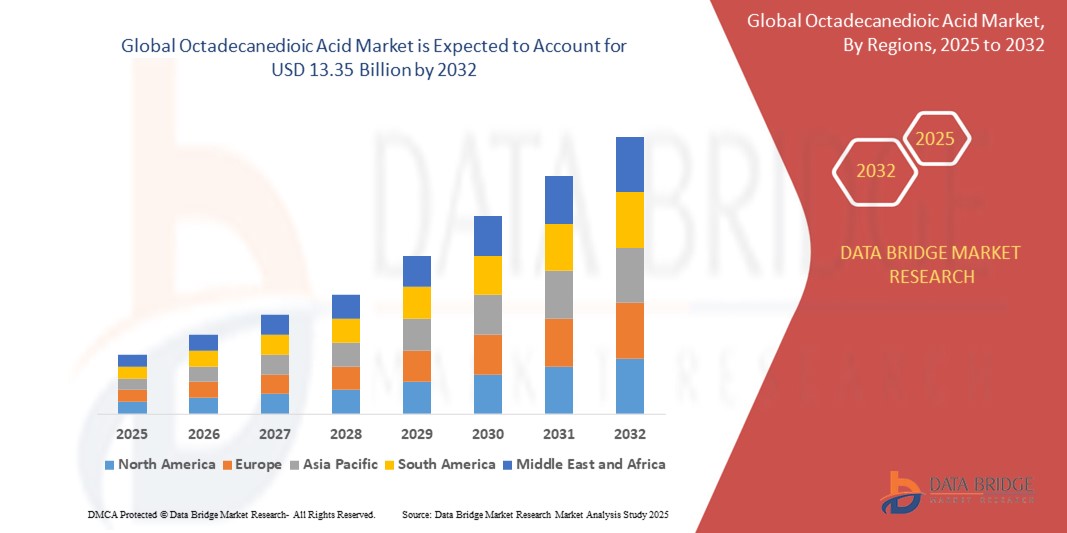
- The global octadecanedioic acid market size was valued at USD 9.39 billion in 2024 and is expected to reach USD 13.35 billion by 2032, at a CAGR of 4.50% during the forecast period
- The market growth is largely fuelled by the rising demand for sustainable and bio-based polymers across the automotive, textile, and construction industries
- Increasing applications in high-performance polyamides, lubricants, adhesives, and powder coatings are further accelerating market expansion
Octadecanedioic Acid Market Analysis
- Rising emphasis on environmentally friendly alternatives to petroleum-based dicarboxylic acids has boosted adoption in end-use industries
- Ongoing R&D in bio-based production methods, such as microbial fermentation and enzymatic synthesis, is enhancing efficiency and reducing production costs
- North America dominated the octadecanedioic acid market with the largest revenue share in 2024, fuelled by a strong presence of major chemical manufacturers and growing demand from end-use industries such as automotive, construction, and personal care
- Asia-Pacific region is expected to witness the highest growth rate in the global octadecanedioic acid market, driven by expanding industrial applications and increasing adoption of bio-based materials in countries such as China, India, and Japan.
- The microbial fermentation segment dominated the market with the largest revenue share in 2024, driven by increasing demand for sustainable production methods and growing regulatory pressure to reduce environmental impact. Microbial fermentation is widely adopted for its lower carbon footprint and ability to yield high-purity products from renewable feedstocks. Companies are increasingly investing in biotechnology-based processes to improve efficiency and align with green chemistry initiatives
Report Scope and Octadecanedioic Acid Market Segmentation
|
Attributes |
Octadecanedioic Acid Key Market Insights |
|
Segments Covered |
|
|
Countries Covered |
North America
Europe
Asia-Pacific
Middle East and Africa
South America
|
|
Key Market Players |
|
|
Market Opportunities |
|
|
Value Added Data Infosets |
In addition to the insights on market scenarios such as market value, growth rate, segmentation, geographical coverage, and major players, the market reports curated by the Data Bridge Market Research also include import export analysis, production capacity overview, production consumption analysis, price trend analysis, climate change scenario, supply chain analysis, value chain analysis, raw material/consumables overview, vendor selection criteria, PESTLE Analysis, Porter Analysis, and regulatory framework. |
Octadecanedioic Acid Market Trends
“Growing Shift Toward Bio-Based Octadecanedioic Acid in Industrial Applications”
- Rising environmental concerns and regulatory pressure are driving the shift toward bio-based ODDA over traditional petrochemical-derived alternatives
- Manufacturers are increasingly using renewable feedstocks such as vegetable oils and microbial fermentation to produce sustainable ODDA
- Bio-based ODDA is gaining popularity in sectors such as automotive and coatings due to its comparable performance and reduced carbon footprint
- Companies are investing in bio-refinery technology and fermentation advancements to scale up production efficiently
- For instance, Cathay Biotech has successfully commercialized bio-based ODDA for high-performance nylon production, supporting sustainable manufacturing
Octadecanedioic Acid Market Dynamics
Driver
“Rising Demand for High-Performance Polyamides in Automotive and Industrial Sectors”
- Octadecanedioic acid is a key ingredient in manufacturing nylon 6,18 and other long-chain polyamides used in high-stress environments
- Automotive and industrial sectors increasingly require materials that offer superior heat resistance, strength, and durability
- The push toward lightweight materials in EVs and fuel-efficient vehicles is boosting the use of ODDA-based polyamides
- Industrial applications such as powder coatings and lubricants are also driving demand due to ODDA’s chemical resilience
- For instance, the surge in electric vehicle production in China has increased the demand for durable, ODDA-based polymer parts
Restraint/Challenge
“High Production Costs and Limited Feedstock Availability”
- The bio-based production of ODDA involves costly fermentation processes and specialized biotechnologies
- Fluctuations in the supply of raw materials such as castor oil and palm oil can disrupt production and impact pricing
- Petrochemical-derived ODDA also faces volatility due to changing crude oil prices and geopolitical factors
- Limited availability of large-scale biorefinery infrastructure affects the scalability and adoption of sustainable ODDA
- For instance, inconsistent availability of castor oil in India has led to supply disruptions for bio-based ODDA manufacturers
Octadecanedioic Acid Market Scope
The market is segmented on the basis of process, type, usage, end-use industry, and application.
•By Process
On the basis of process, the octadecanedioic acid market is segmented into microbial fermentation and metathesis. The microbial fermentation segment dominated the market with the largest revenue share in 2024, driven by increasing demand for sustainable production methods and growing regulatory pressure to reduce environmental impact. Microbial fermentation is widely adopted for its lower carbon footprint and ability to yield high-purity products from renewable feedstocks. Companies are increasingly investing in biotechnology-based processes to improve efficiency and align with green chemistry initiatives.
The metathesis segment is expected to witness a fastest growth rate from 2025 to 2032, owing to advancements in metathesis catalyst technologies and its potential to process varied oleochemical feedstocks. Metathesis offers greater flexibility in feedstock selection and scalability for industrial applications, especially in markets seeking alternative routes to long-chain dicarboxylic acids.
• By Type
On the basis of type, the market is segmented into manufactured by petrochemical and manufactured by biotechnological. The manufactured by petrochemical segment accounted for the largest revenue share in 2024, owing to its established infrastructure, availability, and cost-effectiveness in high-volume industrial uses.
The manufactured by biotechnological segment is expected to witness a fastest growth rate from 2025 to 2032, driven by increasing consumer preference for bio-based materials and the growing penetration of sustainable alternatives in the automotive, cosmetics, and textile sectors.
• By Usage
On the basis of usage, the market is segmented into monomer and additive, coating, reactive diluent, toners/ink, and ingredient. The monomer and additive segment held the largest share in 2024 due to its critical role in the production of polyamides and polyesters used in high-performance applications.
The reactive diluent segment is expected to witness a fastest growth rate from 2025 to 2032, as demand increases for low-viscosity, low-VOC reactive agents in epoxy formulations used across coatings and adhesives.
• By End-Use Industry
On the basis of end-use industry, the octadecanedioic acid market is categorized into automobile, industrial, medical, construction, food service, textiles, cosmetics, and others. The automobile segment dominated the market in 2024, supported by the rising use of engineered plastics and high-performance lubricants in vehicle manufacturing.
The cosmetics segment is expected to witness a fastest growth rate from 2025 to 2032, driven by the demand for bio-based, skin-friendly emollients and thickeners in personal care formulations.
• By Application
On the basis of application, the market is segmented into polyester polyols, cosmetics, powder coating, lubricant oils, corrosion inhibitors, epoxy curing, reactive coating, epoxy esters, specialty polyesters and nylons, hot melt adhesives, specialty waxes, and polyimide ink resins. The polyester polyols segment led the market in 2024 due to its extensive use in polyurethane foams and coatings for automotive and industrial applications.
The hot melt adhesives and specialty polyesters and nylons segments is expected to witness a fastest growth rate from 2025 to 2032, as industries increasingly shift toward bio-based high-performance materials for packaging, construction, and electronics applications.
Octadecanedioic Acid Market Regional Analysis
• North America dominated the octadecanedioic acid market with the largest revenue share in 2024, fuelled by a strong presence of major chemical manufacturers and growing demand from end-use industries such as automotive, construction, and personal care
• The region benefits from advanced industrial infrastructure, robust R\&D capabilities, and increasing adoption of bio-based chemicals driven by stringent environmental regulations
• High consumer demand for sustainable and high-performance materials further supports market expansion, particularly in the U.S. where manufacturers are investing in green chemistry initiatives
U.S. Octadecanedioic Acid Market Insight
The U.S. octadecanedioic acid market held the largest share within North America in 2024, driven by its leadership in sustainable material innovation and high consumption of specialty chemicals. The country’s focus on reducing dependency on petrochemicals has accelerated the adoption of biotechnologically produced ODDA. In addition, the growing use of ODDA in automotive applications, such as in polyamides and lubricants, is propelling demand. Favorable government policies and an active startup ecosystem are also encouraging investment in bio-based chemical production.
Europe Octadecanedioic Acid Market Insight
The Europe octadecanedioic acid market is expected to witness a fastest growth rate from 2025 to 2032, led by rising demand for eco-friendly materials and strict regulatory frameworks under REACH. The market is witnessing increased use of ODDA in cosmetics, coatings, and polymers. Germany, France, and the U.K. are key contributors, supported by a mature industrial base and strong focus on reducing carbon footprint in manufacturing processes. In addition, consumer inclination towards sustainable personal care products is bolstering ODDA adoption in the region.
U.K. Octadecanedioic Acid Market Insight
The U.K. octadecanedioic acid market is expected to witness a fastest growth rate from 2025 to 2032, driven by increasing investments in renewable chemical technologies and demand for high-performance materials in industrial and consumer goods. The government's support for green technology startups and emphasis on circular economy principles are fostering the development of bio-based ODDA production. Moreover, the market is benefiting from rising usage in cosmetics and coatings due to consumer demand for non-toxic and biodegradable ingredients.
Germany Octadecanedioic Acid Market Insight
The Germany octadecanedioic acid market is expected to witness a fastest growth rate from 2025 to 2032, backed by the country’s reputation as a leader in industrial innovation and chemical manufacturing. Demand is primarily driven by the automotive and construction sectors, where ODDA is used in polyesters, lubricants, and adhesives. The presence of key global players and emphasis on green chemistry practices are encouraging wider application of ODDA. In addition, collaborations between research institutions and manufacturers are advancing bio-based production techniques in the country.
Asia-Pacific Octadecanedioic Acid Market Insight
The Asia-Pacific octadecanedioic acid market is expected to witness a fastest growth rate from 2025 to 2032, propelled by rapid industrialization, growing demand for high-performance polymers, and expanding cosmetic industries in countries such as China, India, and Japan. Government incentives for bio-based chemical production and the availability of cost-effective labor and raw materials are enhancing regional production capacity. Moreover, the increasing demand for lightweight and durable materials in automotive and textile sectors is boosting the market.
Japan Octadecanedioic Acid Market Insight
The Japan octadecanedioic acid market is expected to witness a fastest growth rate from 2025 to 2032, due to the country’s focus on innovation and sustainable development. With a well-established cosmetic and personal care industry, there is a rising demand for biodegradable and non-toxic ingredients, where ODDA finds application. In addition, the manufacturing sector’s push toward high-performance and durable materials is encouraging greater ODDA utilization in specialty polymers. Research into microbial fermentation processes is also supporting the growth of bio-based ODDA in Japan.
China Octadecanedioic Acid Market Insight
The China octadecanedioic acid market captured the largest revenue share in Asia-Pacific in 2024, attributed to the nation’s expanding industrial base and increasing demand for eco-friendly raw materials. ODDA is widely used in China’s automotive, chemical, and construction industries, and the government’s push for environmental sustainability is accelerating the shift to biotechnological production methods. The presence of large-scale manufacturing facilities and the rise in exports of specialty chemicals are also contributing to the market’s growth trajectory.
Octadecanedioic Acid Market Share
The Octadecanedioic Acid industry is primarily led by well-established companies, including:
- BASF SE (Germany)
- Elevance Renewable Sciences, Inc. (U.S.)
- Croda International Plc (U.K.)
- Cathay Biotech Inc. (China)
- TCI Chemicals (India) Pvt. Ltd. (India)
- Nanjing Chemlin Chemical Industrial Co. Ltd. (China)
- XIAMEN SINOPEG BIOTECH CO., LTD. (China)
- Hunan HuaTeng Pharmaceutical Co., Ltd. (China)

- Interactive Data Analysis Dashboard
- Company Analysis Dashboard for high growth potential opportunities
- Research Analyst Access for customization & queries
- Competitor Analysis with Interactive dashboard
- Latest News, Updates & Trend analysis
- Harness the Power of Benchmark Analysis for Comprehensive Competitor Tracking
Global Octadecanedioic Acid Market, Supply Chain Analysis and Ecosystem Framework
To support market growth and help clients navigate the impact of geopolitical shifts, DBMR has integrated in-depth supply chain analysis into its Global Octadecanedioic Acid Market research reports. This addition empowers clients to respond effectively to global changes affecting their industries. The supply chain analysis section includes detailed insights such as Global Octadecanedioic Acid Market consumption and production by country, price trend analysis, the impact of tariffs and geopolitical developments, and import and export trends by country and HSN code. It also highlights major suppliers with data on production capacity and company profiles, as well as key importers and exporters. In addition to research, DBMR offers specialized supply chain consulting services backed by over a decade of experience, providing solutions like supplier discovery, supplier risk assessment, price trend analysis, impact evaluation of inflation and trade route changes, and comprehensive market trend analysis.
Data collection and base year analysis are done using data collection modules with large sample sizes. The stage includes obtaining market information or related data through various sources and strategies. It includes examining and planning all the data acquired from the past in advance. It likewise envelops the examination of information inconsistencies seen across different information sources. The market data is analysed and estimated using market statistical and coherent models. Also, market share analysis and key trend analysis are the major success factors in the market report. To know more, please request an analyst call or drop down your inquiry.
The key research methodology used by DBMR research team is data triangulation which involves data mining, analysis of the impact of data variables on the market and primary (industry expert) validation. Data models include Vendor Positioning Grid, Market Time Line Analysis, Market Overview and Guide, Company Positioning Grid, Patent Analysis, Pricing Analysis, Company Market Share Analysis, Standards of Measurement, Global versus Regional and Vendor Share Analysis. To know more about the research methodology, drop in an inquiry to speak to our industry experts.
Data Bridge Market Research is a leader in advanced formative research. We take pride in servicing our existing and new customers with data and analysis that match and suits their goal. The report can be customized to include price trend analysis of target brands understanding the market for additional countries (ask for the list of countries), clinical trial results data, literature review, refurbished market and product base analysis. Market analysis of target competitors can be analyzed from technology-based analysis to market portfolio strategies. We can add as many competitors that you require data about in the format and data style you are looking for. Our team of analysts can also provide you data in crude raw excel files pivot tables (Fact book) or can assist you in creating presentations from the data sets available in the report.













