


Ocular Trigeminal Neuralgias Market Size
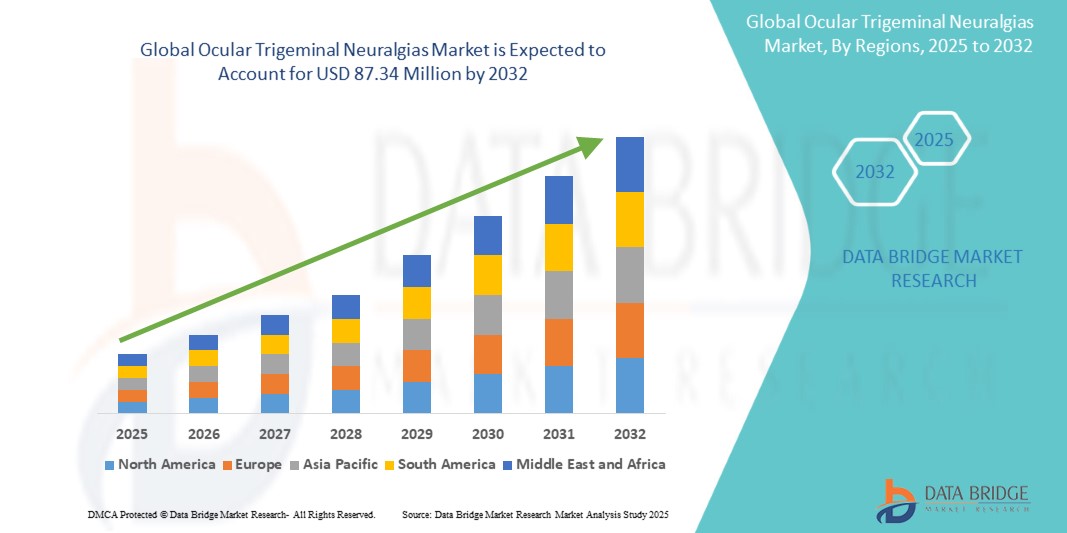
- The global ocular trigeminal neuralgias market size was valued at USD 50.23 million in 2024 and is expected to reach USD 87.34 million by 2032, at a CAGR of 7.16% during the forecast period
- The market growth is primarily driven by the increasing prevalence of neuropathic pain disorders, greater awareness of ocular-specific neuralgias, and advancements in neuroimaging for accurate diagnosis, enabling earlier detection and intervention
- Furthermore, the rising demand for specialized neurological and ophthalmic care, coupled with research into novel diagnostic approaches and patient-focused management strategies, is positioning ocular trigeminal neuralgia as a critical segment within neuropathic pain markets. These converging factors are accelerating clinical focus and resource allocation, thereby significantly boosting the market’s growth
Ocular Trigeminal Neuralgias Market Analysis
- Ocular trigeminal neuralgia, a rare but debilitating neuropathic disorder affecting the ophthalmic branch of the trigeminal nerve, is increasingly recognized as a critical neurological condition due to its severe ocular pain, impact on quality of life, and need for specialized diagnosis and management within neurology and ophthalmology settings
- The escalating demand for effective diagnosis and management of ocular trigeminal neuralgia is primarily fueled by the rising prevalence of neuropathic pain syndromes, growing awareness among healthcare providers, and advancements in neuroimaging and diagnostic criteria that facilitate early detection
- North America dominated the ocular trigeminal neuralgias market with the largest revenue share of 40% in 2024, characterized by advanced healthcare infrastructure, higher diagnosis rates, and strong research activity, with the U.S. experiencing substantial growth in clinical studies and patient referrals to neurology and ophthalmology centers specializing in rare neuralgias
- Asia-Pacific is expected to be the fastest growing region in the ocular trigeminal neuralgias market during the forecast period, driven by increasing healthcare access, expanding neurology services, and rising awareness of rare neuropathic disorders among clinicians
- Classical ocular trigeminal neuralgia segment dominated the ocular trigeminal neuralgias market with a 47.3% share in 2024, supported by its higher prevalence compared to secondary or idiopathic subtypes, and its clearer clinical profile enabling more consistent diagnosis across healthcare settings
Report Scope and Ocular Trigeminal Neuralgias Market Segmentation
|
Attributes |
Ocular Trigeminal Neuralgias Key Market Insights |
|
Segments Covered |
|
|
Countries Covered |
North America
Europe
Asia-Pacific
Middle East and Africa
South America
|
|
Key Market Players |
|
|
Market Opportunities |
|
|
Value Added Data Infosets |
In addition to the insights on market scenarios such as market value, growth rate, segmentation, geographical coverage, and major players, the market reports curated by the Data Bridge Market Research also include in-depth expert analysis, pricing analysis, brand share analysis, consumer survey, demography analysis, supply chain analysis, value chain analysis, raw material/consumables overview, vendor selection criteria, PESTLE Analysis, Porter Analysis, and regulatory framework. |
Ocular Trigeminal Neuralgias Market Trends
Rising Awareness and Advances in Neuro-Ophthalmic Diagnostics
- A significant and accelerating trend in the global ocular trigeminal neuralgias market is the rising awareness of rare neuropathic pain disorders coupled with advances in neuro-ophthalmic diagnostics such as high-resolution MRI, advanced CT scans, and ocular pain mapping technologies. These tools are enabling earlier and more accurate identification of patients
- For instance, the introduction of advanced 3D imaging and trigeminal nerve tractography allows clinicians to differentiate ocular trigeminal neuralgia from other causes of facial pain, reducing misdiagnosis rates. Similarly, academic institutions are developing AI-based diagnostic models to detect atypical ocular neuralgia presentations
- Integration of imaging technologies with digital health platforms is facilitating better patient monitoring and remote consultations, allowing physicians to track pain progression and treatment outcomes more effectively
- These advancements are not only reshaping clinical practice but also driving demand for early intervention solutions and clinical research into novel therapeutic approaches. As awareness grows among neurologists and ophthalmologists, the number of diagnosed cases is expected to rise, strengthening the market base
- Consequently, academic research collaborations and industry partnerships are expanding to develop more accurate diagnostic algorithms and targeted interventions, positioning early and precise diagnosis as a cornerstone trend in the market
- The growing demand for precise diagnostic solutions, improved patient management, and enhanced awareness campaigns is expected to accelerate adoption across hospitals, specialty clinics, and research institutes
Ocular Trigeminal Neuralgias Market Dynamics
Driver
Rising Prevalence of Neuropathic Ocular Pain and Clinical Awareness
- The increasing recognition of ocular trigeminal neuralgias as a distinct clinical entity, combined with rising cases of neuropathic ocular pain associated with trauma, surgery, or post-viral complications, is driving market demand for improved management and diagnostic solutions
- For instance, recent academic publications highlight the correlation between ocular neuralgia and post-herpetic neuralgia, prompting healthcare providers to include ocular pain assessments in routine neurology and ophthalmology practices. Such awareness initiatives are expected to support stronger market growth
- As patients increasingly seek specialized care for chronic ocular pain, demand for advanced diagnostics, referral networks, and multidisciplinary treatment approaches is expanding, pushing hospitals and specialty clinics to invest in better technologies and expertise
- Moreover, global health organizations and research groups are emphasizing rare disease registries, enabling better data collection and shaping future therapeutic research. The move towards multidisciplinary and personalized pain management is strengthening the market outlook
Restraint/Challenge
Diagnostic Complexity and Limited Treatment Awareness
- One of the major challenges in the global ocular trigeminal neuralgias market is the difficulty of accurate diagnosis, as symptoms often overlap with dry eye disease, migraines, and other facial pain syndromes. Misdiagnosis delays appropriate management and limits patient outcomes
- For instance, studies indicate that a large portion of ocular neuralgia cases are initially misclassified as surface eye disorders, delaying targeted treatment. This lack of standard diagnostic criteria continues to hinder wider clinical recognition
- Another key restraint is the limited awareness of this rare condition among general practitioners and even some ophthalmologists, restricting timely referrals to specialists. This gap contributes to underreporting and slows adoption of advanced diagnostic tools
- In addition, research and treatment development remain constrained due to limited funding for rare neuropathic disorders, reducing the pipeline of innovative therapeutic options
- Addressing these barriers requires expanding clinical education, improving diagnostic frameworks, and enhancing cross-specialty collaborations. Investment in rare disease research and integration of AI-assisted diagnostic systems will be crucial to overcoming these challenges and driving sustainable market growth
Ocular Trigeminal Neuralgias Market Scope
The market is segmented on the basis of disease type, cause, pain type, and end user.
- By Disease Type
On the basis of disease type, the ocular trigeminal neuralgias market is segmented into classical ocular trigeminal neuralgia, secondary ocular trigeminal neuralgia, and idiopathic ocular trigeminal neuralgia. Classical Ocular Trigeminal Neuralgia dominated the market in 2024 with a market share of 47.3%, owing to its higher prevalence associated with vascular compression of the trigeminal nerve. This type accounts for the largest patient pool since classical trigeminal neuralgia is the most widely diagnosed form globally, with ocular manifestations being a significant clinical burden. High awareness, advanced diagnostic imaging, and relatively established treatment approaches contribute to its market dominance. Moreover, the fact that this type often requires long-term management drives significant healthcare utilization, reinforcing its leading share.
Idiopathic Ocular Trigeminal Neuralgia is anticipated to witness the fastest growth rate during 2025–2032, driven by increasing recognition of cases where no clear anatomical or vascular cause can be established. With advances in neuroimaging and clinical neurology, idiopathic cases are being more frequently identified, creating new diagnostic opportunities. Rising research into genetic predispositions and unexplained pain syndromes also supports growth. In addition, idiopathic cases often involve complex diagnostic and therapeutic pathways, fueling demand for specialized care and expanding research attention.
- By Cause
On the basis of cause, the ocular trigeminal neuralgias market is segmented into vascular compression, demyelinating disorders, trauma/post-surgical, tumor-related, and idiopathic. Vascular compression held the largest market share in 2024, as it represents the most common etiology for trigeminal neuralgia, including ocular variants. Advanced MRI techniques have improved detection of vascular loops compressing the trigeminal nerve root, facilitating more accurate diagnoses. The dominance is further supported by the strong clinical evidence base linking vascular compression to neuralgia, as well as the availability of surgical and non-surgical interventions. A majority of cases are associated with arterial compression, making this cause the central focus in treatment strategies.
Trauma/Post-surgical is expected to register the fastest growth during the forecast period, owing to the increasing number of cranial and ophthalmic surgical interventions globally. Procedures involving the orbit or skull base can inadvertently affect trigeminal nerve branches, leading to post-surgical pain syndromes. Growing awareness of trauma-induced neuropathic ocular pain is improving recognition rates, while the rising incidence of facial trauma in accidents and sports injuries further contributes. This segment’s growth is also driven by expanding neurosurgical and ophthalmic procedure volumes in both developed and emerging markets.
- By Pain Type
On the basis of pain type, the ocular trigeminal neuralgias market is segmented into episodic and chronic. Episodic Ocular Trigeminal Neuralgia dominated the market in 2024, as most patients initially present with brief but severe episodes of stabbing or shock-such as ocular pain. Episodic pain patterns are more easily recognizable by both patients and clinicians, leading to earlier diagnosis and intervention. The distinct attack-such as nature makes it a more widely reported form, contributing to its higher prevalence. This dominance is reinforced by its higher visibility in clinical research and inclusion in diagnostic criteria, making it the more common pain subtype globally.
Chronic Ocular Trigeminal Neuralgia is projected to be the fastest-growing segment during forecast period, as untreated or recurrent episodic pain often transitions into chronic neuropathic pain states. With increasing recognition of chronic ocular pain syndromes and their impact on quality of life, this subgroup is gaining greater clinical and research attention. The growing elderly population, who are more prone to chronic pain conditions, also supports its expansion. In addition, chronic pain cases often require long-term management strategies, leading to higher healthcare utilization and treatment innovation.
- By End User
On the basis of end user, the ocular trigeminal neuralgias market is segmented into hospitals, specialty clinics, ambulatory surgical centers (ASCs), and research & academic institutes. Hospitals accounted for the largest revenue share in 2024, driven by their role as the primary point of diagnosis, imaging, and surgical management for ocular trigeminal neuralgias. Hospitals are equipped with advanced neuroimaging modalities and neurosurgical facilities, making them the preferred setting for patients with severe or refractory conditions. The dominance is also supported by the availability of multidisciplinary teams, including neurologists, ophthalmologists, and neurosurgeons, which is essential for managing complex cases. Large patient volumes and insurance coverage in hospital settings further consolidate their market leadership.
Specialty Clinics are anticipated to witness the fastest growth from 2025–2032, owing to increasing demand for personalized and outpatient-focused management of ocular trigeminal neuralgia. Neurology and ophthalmology specialty clinics are expanding globally, offering targeted diagnostics and long-term care. Patients increasingly prefer clinics due to shorter wait times, specialized expertise, and a less intimidating environment compared to large hospitals. Furthermore, the rise of pain management clinics and neurology-focused centers in emerging markets is accelerating growth, as these facilities adopt advanced diagnostic tools and non-invasive treatment options.
Ocular Trigeminal Neuralgias Market Regional Analysis
- North America dominated the ocular trigeminal neuralgias market with the largest revenue share of 40% in 2024, characterized by advanced healthcare infrastructure, higher diagnosis rates, and strong research activity
- Patients in the region benefit from specialized neurology and ophthalmology centers, greater access to MRI-based diagnostics, and early treatment availability, which has significantly improved disease recognition and management outcomes
- Supportive healthcare expenditure, ongoing clinical trials, and active research collaborations with academic institutions continue to reinforce North America’s leadership, positioning it as the hub for therapeutic advancements and innovative care in ocular trigeminal neuralgias
U.S. Ocular Trigeminal Neuralgias Market Insight
The U.S. ocular trigeminal neuralgias market captured the largest revenue share of 80.6% in 2024 within North America, fueled by strong clinical awareness and the availability of specialized neurology and ophthalmology centers. Patients increasingly seek early diagnosis due to high disease burden, while advanced imaging and neuromodulation approaches support better treatment outcomes. The country’s robust healthcare infrastructure, combined with leading pharmaceutical and medical device research, continues to drive innovation. Moreover, federal support for neurological research and a growing network of tertiary care hospitals are reinforcing the U.S. dominance in this segment.
Europe Ocular Trigeminal Neuralgias Market Insight
The Europe ocular trigeminal neuralgias market is projected to expand at a substantial CAGR during the forecast period, primarily driven by rising awareness of neuropathic facial pain and government-backed healthcare programs. Increased availability of diagnostic MRI and neurophysiological testing is encouraging earlier recognition of the disease. European patients are also benefiting from multidisciplinary pain management clinics that combine ophthalmology and neurology expertise. Demand is rising in both developed markets, such as Germany and the U.K., as well as in Eastern Europe, where access to specialized care is expanding.
U.K. Ocular Trigeminal Neuralgias Market Insight
The U.K. ocular trigeminal neuralgias market is anticipated to grow at a noteworthy CAGR during the forecast period, driven by heightened recognition of rare neuralgia conditions and patient demand for advanced care. Growing research collaborations between universities and clinical centers are accelerating knowledge of disease mechanisms. In addition, the U.K.’s national health system supports structured referral pathways, ensuring patients receive timely specialist evaluations. Concerns around quality of life and chronic facial pain are further propelling healthcare providers to adopt innovative management strategies for ocular trigeminal neuralgias.
Germany Ocular Trigeminal Neuralgias Market Insight
The Germany ocular trigeminal neuralgias market is expected to expand at a considerable CAGR during the forecast period, fueled by the country’s leadership in neurology research and emphasis on high-quality patient care. German hospitals are early adopters of advanced neuroimaging and pain-modulation therapies, enabling precise diagnostics and tailored treatments. The market is further supported by the integration of innovative therapies into academic medical centers and strong collaborations with global pharmaceutical companies. Germany’s emphasis on quality, precision, and early disease management aligns well with rising patient expectations.
Asia-Pacific Ocular Trigeminal Neuralgias Market Insight
The Asia-Pacific ocular trigeminal neuralgias market is poised to grow at the fastest CAGR of 23.5% from 2025 to 2032, driven by rising incidence of neurological conditions, increasing healthcare investments, and improving access to specialized care in countries such as China, Japan, and India. Greater awareness of neuropathic facial pain, coupled with rapid expansion of hospital infrastructure, is driving earlier diagnosis and treatment adoption. Governments promoting digital healthcare platforms and telemedicine are further supporting market penetration. As APAC becomes a hub for clinical trials, affordability and availability of therapies are expected to accelerate.
Japan Ocular Trigeminal Neuralgias Market Insight
The Japan ocular trigeminal neuralgias market is gaining momentum due to the country’s high clinical sophistication, robust healthcare system, and patient awareness of neurological disorders. Japan emphasizes precision diagnostics, with advanced neuroimaging widely available, ensuring early disease detection. Rising demand for pain management solutions, combined with the integration of AI-driven diagnostic support tools, is fostering adoption of modern therapeutic strategies. Moreover, the aging population is expected to contribute to increasing disease prevalence, further strengthening the need for specialized ocular neuralgia management in the country.
India Ocular Trigeminal Neuralgias Market Insight
The India ocular trigeminal neuralgias market accounted for the largest revenue share within Asia Pacific in 2024, attributed to its rapidly expanding healthcare infrastructure, growing middle-class population, and rising awareness of chronic pain disorders. India has become a key market for diagnostic imaging and neurology services, with both public and private hospitals increasing their focus on rare neurological conditions. Strong domestic pharmaceutical manufacturing and the government’s push for affordable healthcare are driving access to treatment. In addition, India’s growing participation in global clinical trials is enhancing patient exposure to advanced management strategies
Ocular Trigeminal Neuralgias Market Share
The ocular trigeminal neuralgias industry is primarily led by well-established companies, including:
- Pfizer Inc. (U.S.)
- Lilly USA, LLC (U.S.)
- Novartis AG (Switzerland)
- AstraZeneca (U.K.)
- Teva Pharmaceutical Industries Ltd. (Israel)
- AbbVie Inc. (U.S.)
- Ipsen Biopharm Ltd. (France)
- Grünenthal GmbH (Germany)
- Indivior PLC (U.K.)
- Amneal Pharmaceuticals LLC (U.S.)
- Sun Pharmaceutical Industries Ltd. (India)
- Aurobindo Pharma Limited (India)
- Lupin Pharmaceuticals, Inc. (India)
- Cipla Inc. (India)
- Zydus Lifesciences Limited (India)
- Dr. Reddy’s Laboratories Ltd. (India)
- Biogen Inc. (U.S.)
- Bausch Health Companies Inc. (Canada)
- Mallinckrodt Pharmaceuticals (Ireland)
- Alnylam Pharmaceuticals, Inc. (U.S.)
What are the Recent Developments in Global Ocular Trigeminal Neuralgias Market?
- In August 2025, the OneRF Trigeminal Nerve Ablation System achieved FDA 510(k) clearance, enabling its use in treating trigeminal neuralgia by creating targeted radiofrequency lesions in the trigeminal nerve. NeuroOne confirmed plans to initiate a limited commercial launch in late 2025, marking a significant milestone as the first minimally invasive device approved for this indication
- In June 2025, the Facial Pain Association (FPA), in partnership with the National Organization for Rare Disorders (NORD), officially launched the Facial Pain Registry, a global natural history study inviting participants worldwide to contribute data on neuropathic facial pain conditions, including ocular trigeminal neuralgia. This initiative provides a mobile-friendly, secure platform for patient-reported data collection to advance research and inform healthcare policy
- In April 2025, NeuroOne Medical Technologies (Eden Prairie, MN) announced the completion of its 510(k) submission to the U.S. Food and Drug Administration for the OneRF Trigeminal Nerve Ablation System. The minimally invasive device employs radiofrequency energy to ablate nerve tissue causing facial pain offering a potentially safer and more patient-comfortable alternative to existing surgical options. The company projects revenue generation from this technology late in 2025 if FDA clearance is secured
- In September 2024, industry tracking revealed that 13 pharmaceutical drugs are in development to address trigeminal neuralgia (Tic Douloureux), with additional efforts underway at universities and research institutions. While not specific to the ocular subtype, this pipeline expansion could benefit ocular trigeminal neuralgia patients through broader therapeutic options
- In October 2021, Oxford Cannabinoid Technologies Holdings plc (OCTP) signed a commercial agreement with Oz-UK Ltd to develop a cannabinoid metered-dose inhaler formulation designed to deliver cannabinoids via inhalation, aiming to provide both short- and long-term relief from neuralgias such as trigeminal neuralgia. The project includes formulation, device development, and regulatory planning, with support from VCLS for strategy and development

- Interactive Data Analysis Dashboard
- Company Analysis Dashboard for high growth potential opportunities
- Research Analyst Access for customization & queries
- Competitor Analysis with Interactive dashboard
- Latest News, Updates & Trend analysis
- Harness the Power of Benchmark Analysis for Comprehensive Competitor Tracking
Data collection and base year analysis are done using data collection modules with large sample sizes. The stage includes obtaining market information or related data through various sources and strategies. It includes examining and planning all the data acquired from the past in advance. It likewise envelops the examination of information inconsistencies seen across different information sources. The market data is analysed and estimated using market statistical and coherent models. Also, market share analysis and key trend analysis are the major success factors in the market report. To know more, please request an analyst call or drop down your inquiry.
The key research methodology used by DBMR research team is data triangulation which involves data mining, analysis of the impact of data variables on the market and primary (industry expert) validation. Data models include Vendor Positioning Grid, Market Time Line Analysis, Market Overview and Guide, Company Positioning Grid, Patent Analysis, Pricing Analysis, Company Market Share Analysis, Standards of Measurement, Global versus Regional and Vendor Share Analysis. To know more about the research methodology, drop in an inquiry to speak to our industry experts.
Data Bridge Market Research is a leader in advanced formative research. We take pride in servicing our existing and new customers with data and analysis that match and suits their goal. The report can be customized to include price trend analysis of target brands understanding the market for additional countries (ask for the list of countries), clinical trial results data, literature review, refurbished market and product base analysis. Market analysis of target competitors can be analyzed from technology-based analysis to market portfolio strategies. We can add as many competitors that you require data about in the format and data style you are looking for. Our team of analysts can also provide you data in crude raw excel files pivot tables (Fact book) or can assist you in creating presentations from the data sets available in the report.












