


What is the Offshore Lubricants Size and Growth Rate?
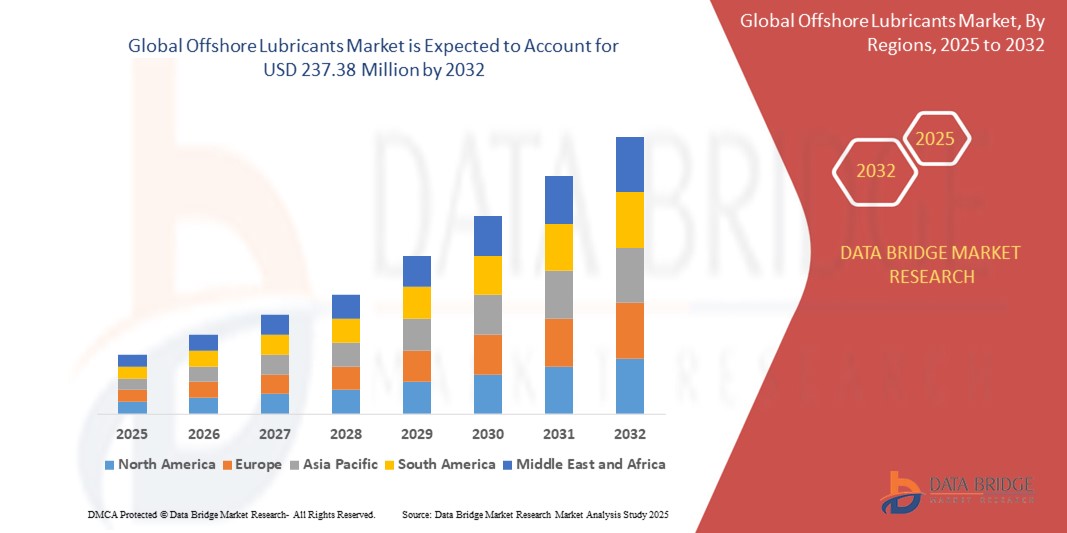
- As per Data Bridge Market Research Analysis the global offshore lubricants market size was valued at USD 180.27 million in 2024 and is expected to reach USD 237.38 million by 2032, at a CAGR of 3.50% during the forecast period
- The market growth is largely fuelled by the increasing offshore oil and gas exploration activities, rising demand for high-performance lubricants, and stringent environmental regulations promoting the use of biodegradable lubricants
- The expansion of offshore wind energy projects and marine infrastructure development is also contributing to the rising consumption of offshore lubricants
Market Size & Forecast
- Global Market Value (2024): USD 180.27 million
- Expected Market Value (2032): USD 237.38 million
- Forecast CAGR (2024–2032): 3.50%
What are the Major Takeaways of Offshore Lubricants?
- The offshore lubricants market is primarily driven by the rising global energy demand, which has led to an upsurge in offshore drilling operations in regions such as the North Sea, Gulf of Mexico, and Asia-Pacific
- Technological advancements in drilling equipment and machinery have increased the need for specialized lubricants that offer superior protection and performance under high pressure and extreme conditions
- North America dominated the offshore lubricants market with the largest revenue share of 37.9% in 2024, driven by the well-established offshore oil and gas industry, particularly in the Gulf of Mexico. The region's mature exploration infrastructure and consistent investment in offshore production support stable lubricant consumption
- Asia-Pacific region is expected to witness the highest growth rate in the global offshore lubricants market, driven by expanding offshore exploration projects, rising energy demand, and increasing investment in deep-water and ultra-deep-water drilling across countries such as China, India, and Southeast Asia
- The engine oil segment dominated the market with the largest revenue share of 41.5% in 2024, driven by its essential role in reducing friction, cooling engine components, and extending the service life of offshore equipment. Engine oils are widely used across offshore vessels and drilling rigs to ensure optimal performance under high-load and high-temperature conditions. Their proven effectiveness in maintaining reliability in harsh marine environments continues to support demand in this segment
Report Scope and Offshore Lubricants Market Segmentation
|
Attributes |
Offshore Lubricants Key Market Insights |
|
Segments Covered |
|
|
Countries Covered |
North America
Europe
Asia-Pacific
Middle East and Africa
South America
|
|
Key Market Players |
|
|
Market Opportunities |
|
|
Value Added Data Infosets |
|
What is the Key Trend in the Offshore Lubricants?
“Rising Adoption of Bio-Based and Environmentally Acceptable Lubricants (EALs)”
- Growing environmental regulations, such as the U.S. EPA’s Vessel General Permit (VGP), are encouraging the use of Environmentally Acceptable Lubricants (EALs) in offshore operations
- EALs offer high biodegradability, low toxicity, and reduced bioaccumulation, making them suitable for sensitive marine ecosystems
- Oil and gas companies are incorporating EALs to meet sustainability goals and improve compliance with international marine safety and environmental standards
- Technological advancements in bio-based formulations have enhanced the performance of EALs, making them comparable to traditional mineral-based lubricants
- For instance, ExxonMobil introduced the Mobil SHC Aware series, a line of high-performance EALs tailored for marine and offshore applications, to meet rising demand for eco-friendly solutions
Offshore Lubricants Market Dynamics
Driver
“Expansion of Deep-Water and Ultra-Deep-Water Oil Exploration”
- Declining onshore reserves and rising global energy demand are accelerating investments in offshore exploration, especially in deep-water and ultra-deep-water fields
- Offshore operations in regions such as the Gulf of Mexico, Brazil, and the North Sea are increasingly deploying advanced machinery that requires high-performance lubricants
- These lubricants must withstand extreme pressure, high salinity, and wide temperature variations, ensuring protection and reliability for critical offshore equipment
- The use of synthetic and long-lasting lubricants helps reduce maintenance frequency and downtime, contributing to cost efficiency in offshore operations
- For instance, BP’s Mad Dog Phase 2 deep-water project in the Gulf of Mexico extensively utilizes premium synthetic lubricants to enhance operational performance and equipment life
Restraint/Challenge
“Crude Oil Price Volatility and High Operational Costs”
- The offshore lubricants market is highly sensitive to fluctuations in global crude oil prices, which directly impact exploration budgets and project feasibility
- Falling oil prices often lead to delays, suspension, or cancellation of offshore projects, significantly reducing lubricant demand
- Offshore operations involve high capital and operational expenditures due to complex logistics, strict safety norms, and advanced technology requirements
- In low-price environments, companies often shift to cost-cutting strategies, including reduced lubricant usage or opting for lower-cost alternatives
- For instance, during the 2020 COVID-19 pandemic oil price collapse, multiple offshore drilling projects were postponed globally, leading to a notable decline in offshore lubricant consumption
How is the Offshore Lubricants Segmented?
The offshore lubricants market is segmented on the basis of application and end-use.
• By Application
On the basis of application, the offshore lubricants market is segmented into engine oil, hydraulic oil, gear oil, and grease. The engine oil segment dominated the market with the largest revenue share of 41.5% in 2024, driven by its essential role in reducing friction, cooling engine components, and extending the service life of offshore equipment. Engine oils are widely used across offshore vessels and drilling rigs to ensure optimal performance under high-load and high-temperature conditions. Their proven effectiveness in maintaining reliability in harsh marine environments continues to support demand in this segment.
The hydraulic oil segment is expected to witness the fastest growth rate from 2025 to 2032, driven by the increasing deployment of hydraulic systems in offshore rigs and vessels for operations such as lifting, positioning, and control. The growing preference for high-performance, anti-wear hydraulic oils that offer stability under extreme pressure and temperature is fueling segment growth. These oils are vital for ensuring smooth functioning of offshore mechanical systems and preventing unplanned equipment downtime.
• By End-Use
On the basis of end-use, the offshore lubricants market is segmented into offshore rigs, FPSOs (Floating, Production, Storage & Offloading Vessels), and OSVs (Offshore Support Vessels). The offshore rigs segment held the largest revenue share in 2024 due to the high volume of lubricant consumption across drilling equipment, engines, and hydraulic systems. These rigs operate under intense mechanical stress and require consistent lubrication to maintain efficiency and reduce equipment wear, driving substantial lubricant demand.
The FPSOs segment is expected to witness the fastest growth rate from 2025 to 2032, supported by the growing number of offshore oil production projects utilizing FPSOs for their operational flexibility and cost-efficiency. As FPSOs handle production, processing, and storage of oil on a single vessel, they require a wide range of lubricants to support multiple critical systems. The rising adoption of FPSOs in deep-water fields across Latin America, West Africa, and Southeast Asia further boosts demand in this segment.
Which Region Holds the Largest Share of the How is Offshore Lubricants Segmented?
- North America dominated the offshore lubricants market with the largest revenue share of 37.9% in 2024, driven by the well-established offshore oil and gas industry, particularly in the Gulf of Mexico. The region's mature exploration infrastructure and consistent investment in offshore production support stable lubricant consumption.
- The demand is further bolstered by stringent operational safety standards and the widespread use of high-performance synthetic and biodegradable lubricants to comply with environmental regulations.
- Technological advancements in drilling equipment and growing interest in extending equipment life cycles through predictive maintenance are also contributing to sustained lubricant demand in North America.
U.S. Offshore Lubricants Market Insight
The U.S. offshore lubricants market captured the largest revenue share of 84.7% in 2024 within North America, propelled by the country’s leadership in deep-water drilling and substantial offshore production capacity. Offshore operations in the Gulf of Mexico continue to require extensive use of engine oils, hydraulic fluids, and gear lubricants to ensure reliability and efficiency. In addition, growing exploration activities in newly leased offshore blocks and efforts to reduce unplanned downtime further amplify lubricant demand. Increasing adoption of EALs (Environmentally Acceptable Lubricants) in compliance with EPA regulations also plays a pivotal role in shaping market dynamics.
Europe Offshore Lubricants Market Insight
The Europe offshore lubricants market is expected to witness the fastest growth rate from 2025 to 2032, driven by the resurgence of offshore projects in the North Sea and continued investment in sustainable energy and oil extraction technologies. As regional governments emphasize carbon footprint reduction, the use of high-performance, environmentally friendly lubricants is gaining momentum. The region also benefits from a strong presence of major lubricant manufacturers and robust R&D support, enabling advancements in formulations tailored for offshore conditions. Europe’s focus on enhancing equipment life and minimizing maintenance costs under harsh marine environments supports growing lubricant consumption.
U.K. Offshore Lubricants Market Insight
The U.K. offshore lubricants market is expected to witness the fastest growth rate from 2025 to 2032, supported by increasing redevelopment of mature North Sea fields and extended use of existing offshore rigs. The country’s drive to balance energy security with environmental responsibility is leading to broader adoption of synthetic and biodegradable lubricants. Government incentives aimed at reviving production from aging infrastructure and improving the sustainability of offshore operations are key contributors to lubricant demand. In addition, the U.K.'s active offshore service and maintenance sector plays a crucial role in maintaining consistent lubricant usage.
Germany Offshore Lubricants Market Insight
The Germany offshore lubricants market is expected to witness the fastest growth rate from 2025 to 2032, supported by the country’s focus on innovation and sustainable practices. Though Germany has limited offshore oil production, it is a significant consumer and exporter of high-performance marine lubricants used across Europe. German manufacturers are at the forefront of developing environmentally compliant lubricant technologies that meet EU standards, making the country a critical hub for offshore lubricant R&D and supply. The country’s emphasis on green technology integration in marine and energy sectors enhances the long-term outlook.
Asia-Pacific Offshore Lubricants Market Insight
The Asia-Pacific offshore lubricants market is expected to witness the fastest growth rate from 2025 to 2032, driven by increasing offshore exploration and production in emerging economies such as China, India, and Southeast Asia. Growing investments in deep-water drilling, along with rising energy demand, are supporting expansion across the region. Government support for offshore infrastructure development and strategic exploration initiatives are fueling lubricant requirements. In addition, APAC’s role as a manufacturing base for cost-effective offshore equipment components ensures accessibility and affordability of lubricants across key end-use sectors.
Japan Offshore Lubricants Market Insight
The Japan offshore lubricants market is expected to witness the fastest growth rate from 2025 to 2032, due to increasing focus on maritime sustainability and advanced offshore technologies. Although Japan has a limited number of oil fields, it remains a critical importer and user of marine lubricants across offshore support vessels (OSVs) and FPSOs. The country’s maritime sector emphasizes operational reliability, and the adoption of high-grade lubricants that align with environmental norms is accelerating. Japan’s technological expertise and commitment to energy efficiency continue to drive lubricant consumption in offshore and marine segments.
China Offshore Lubricants Market Insight
The China offshore lubricants market held the largest revenue share in Asia-Pacific in 2024, fueled by rapid expansion of offshore oil and gas activities in the Bohai Bay, South China Sea, and East China Sea. The country is heavily investing in offshore field development and drilling infrastructure, which significantly increases the demand for engine, hydraulic, and gear oils. In addition, China’s domestic production of lubricant base oils and strong presence of local manufacturers enable cost-efficient and large-scale supply. Supportive government policies and rising adoption of digitalized offshore platforms are further accelerating lubricant usage.
Which are the Top Companies in Offshore Lubricants?
The Offshore Lubricants industry is primarily led by well-established companies, including:
- BP Plc (U.K.)
- Chevron Corporation (U.S.)
- ExxonMobil Corporation (U.S.)
- Shell Plc (Netherlands)
- TotalEnergies (France)
- Valvoline (U.S.)
- Petroliam Nasional Berhad (PETRONAS) (Malaysia)
- Lukoil (Russia)
- Idemitsu Kosan Co. Ltd (Japan)
- China Petrochemical Corporation (China)
- JX Nippon Oil & Energy Corporation (Japan)
- Gulf Oil Corporation Ltd. (U.S.)
- ENOC Company (UAE)
- Indian Oil Corporation Ltd (India)
- PetroChina Company Limited (China)
What are Latest Developments in Offshore Lubricants?
- In April 2024, Castrol, a leading global lubricant brand, introduced its updated Castrol TLX product range, specifically tailored for medium-speed four-stroke engines. This newly reformulated range is set to replace the existing Castrol TLX Xtra and TLX Plus fluids. The refreshed product line aims to accommodate a wider variety of engine types and applications, while maintaining superior engine protection, reliability, and performance
- In July 2022, Chevron Marine Lubricants proudly announced the release of its Clarity Synthetic EA Grease 0. This new product is an anhydrous calcium thickened lubricating grease formulated with biodegradable synthetic esters. It complies with the parameters outlined in the 2013 Vessel General Permit (VGP) regulations for environmentally acceptable lubricants set forth by the U.S. Environmental Protection Agency (EPA)

- Interactive Data Analysis Dashboard
- Company Analysis Dashboard for high growth potential opportunities
- Research Analyst Access for customization & queries
- Competitor Analysis with Interactive dashboard
- Latest News, Updates & Trend analysis
- Harness the Power of Benchmark Analysis for Comprehensive Competitor Tracking
Table of Content
1 INTRODUCTION
1.1 OBJECTIVES OF THE STUDY
1.2 MARKET DEFINITION
1.3 OVERVIEW OF GLOBAL OFFSHORE LUBRICANTS MARKET
1.4 CURRENCY AND PRICING
1.5 LIMITATION
1.6 MARKETS COVERED
2 MARKET SEGMENTATION
2.1 KEY TAKEAWAYS
2.2 ARRIVING AT THE GLOBAL OFFSHORE LUBRICANTS MARKET SIZE
2.3 VENDOR POSITIONING GRID
2.4 MARKETS COVERED
2.5 GEOGRAPHIC SCOPE
2.6 YEARS CONSIDERED FOR THE STUDY
2.7 RESEARCH METHODOLOGY
2.8 TECHNOLOGY LIFE LINE CURVE
2.9 MULTIVARIATE MODELLING
2.1 PRIMARY INTERVIEWS WITH KEY OPINION LEADERS
2.11 DBMR MARKET POSITION GRID
2.12 MARKET APPLICATION COVERAGE GRID
2.13 DBMR MARKET CHALLENGE MATRIX
2.14 IMPORT AND EXPORT DATA
2.15 SECONDARY SOURCES
2.16 GLOBAL OFFSHORE LUBRICANTS MARKET: RESEARCH SNAPSHOT
2.17 ASSUMPTIONS
3 MARKET OVERVIEW
3.1 DRIVERS
3.2 RESTRAINTS
3.3 OPPORTUNITIES
3.4 CHALLENGES
4 EXECUTIVE SUMMARY
5 PREMIUM INSIGHTS
5.1 RAW MATERIAL COVERAGE
5.2 PRODUCTION CONSUMPTION ANALYSIS
5.3 IMPORT EXPORT SCENARIO
5.4 TECHNOLOGICAL ADVANCEMENT BY MANUFACTURERS
5.5 PORTER’S FIVE FORCES
5.6 VENDOR SELECTION CRITERIA
5.7 PESTEL ANALYSIS
5.8 REGULATION COVERAGE
5.8.1 PRODUCT CODES
5.8.2 CERTIFIED STANDARDS
5.8.3 SAFETY STANDARDS
5.8.3.1. MATERIAL HANDLING & STORAGE
5.8.3.2. TRANSPORT & PRECAUTIONS
5.8.3.3. HARAD IDENTIFICATION
6 PRICE INDEX
7 PRODUCTION CAPACITY OVERVIEW
8 SUPPLY CHAIN ANALYSIS
8.1 OVERVIEW
8.2 LOGISTIC COST SCENARIO
8.3 IMPORTANCE OF LOGISTICS SERVICE PROVIDERS
9 CLIMATE CHANGE SCENARIO
9.1 ENVIRONMENTAL CONCERNS
9.2 INDUSTRY RESPONSE
9.3 GOVERNMENT’S ROLE
9.4 ANALYST RECOMMENDATIONS
10 GLOBAL OFFSHORE LUBRICANTS MARKET, BY TYPE, 2022-2031, USD MILLION
10.1 OVERVIEW
10.2 GREASES
10.3 OFFSHORE DIESEL ENGINES
10.4 CYLINDER OILS
10.5 SYSTEM OILS
10.6 HYDRAULIC OILS
10.7 GEAR OILS
10.8 BEARING AND CIRCULATING OILS
10.9 TURBINE OILS
10.1 TRANSMISSION OILS
10.11 HEAT TRANSFER FLUIDS
10.12 SYSTEM OIL
10.13 ENGINE OILS
10.13.1 SLOW-SPEED ENGINE OILS
10.13.2 MEDIUM-SPEED ENGINE OILS
10.13.3 HIGH-SPEED ENGINE OILS
10.13.4 DIESEL ENGINE OILS
10.13.5 OTHERS
10.14 OTHERS
11 GLOBAL OFFSHORE LUBRICANT MARKET, BY RAW MATERIAL , 2022-2031, USD MILLION
11.1 OVERVIEW
11.2 BASE OIL
11.2.1 MINERAL OIL
11.2.1.1. SILICON OIL
11.2.1.2. NAPHTHANIC OIL
11.2.1.3. PARRAFINIC OIL
11.2.2 SYNTHETIC OIL
11.3 BIO-BASED OILS
11.3.1 PLANT OIL
11.3.1.1. VEGETABLE OIL
11.3.1.2. SOYBEAN OIL
11.3.1.3. OTHERS
11.3.2 ANIMAL OIL
12 GLOBAL OFFSHORE LUBRICANTS MARKET, BY END-USER, 2022-2031, USD MILLION
12.1 OVERVIEW
12.2 OFFSHORE RIGS
12.2.1 OFFSHORE RIGS, BY TYPE
12.2.1.1. GREASES
12.2.1.2. OFFSHORE DIESEL ENGINES
12.2.1.3. CYLINDER OILS
12.2.1.4. SYSTEM OILS
12.2.1.5. HYDRAULIC OILS
12.2.1.6. GEAR OILS
12.2.1.7. BEARING AND CIRCULATING OILS
12.2.1.8. TURBINE OILS
12.2.1.9. TRANSMISSION OILS
12.2.1.10. HEAT TRANSFER FLUIDS
12.2.1.11. SYSTEM OIL
12.2.1.12. ENGINE OILS
12.2.1.13. OTHERS
12.3 FPSO (FLOATING, PRODUCTION, STORAGE AND OFFLOADING VESSELS)
12.3.1 FPSO (FLOATING, PRODUCTION, STORAGE AND OFFLOADING VESSELS), BY TYPE
12.3.1.1. GREASES
12.3.1.2. OFFSHORE DIESEL ENGINES
12.3.1.3. CYLINDER OILS
12.3.1.4. SYSTEM OILS
12.3.1.5. HYDRAULIC OILS
12.3.1.6. GEAR OILS
12.3.1.7. BEARING AND CIRCULATING OILS
12.3.1.8. TURBINE OILS
12.3.1.9. TRANSMISSION OILS
12.3.1.10. HEAT TRANSFER FLUIDS
12.3.1.11. SYSTEM OIL
12.3.1.12. ENGINE OILS
12.3.1.13. OTHERS
12.4 OFFSHORE CIVIL STRUCTURES
12.4.1 OFFSHORE CIVIL STRUCTURES, BY TYPE
12.4.1.1. GREASES
12.4.1.2. OFFSHORE DIESEL ENGINES
12.4.1.3. CYLINDER OILS
12.4.1.4. SYSTEM OILS
12.4.1.5. HYDRAULIC OILS
12.4.1.6. GEAR OILS
12.4.1.7. BEARING AND CIRCULATING OILS
12.4.1.8. TURBINE OILS
12.4.1.9. TRANSMISSION OILS
12.4.1.10. HEAT TRANSFER FLUIDS
12.4.1.11. SYSTEM OIL
12.4.1.12. ENGINE OILS
12.4.1.13. OTHERS
12.5 OSVS (OFFSHORE SUPPORT VEHICLES)
12.5.1 OSVS (OFFSHORE SUPPORT VEHICLES), BY TYPE
12.5.1.1. GREASES
12.5.1.2. OFFSHORE DIESEL ENGINES
12.5.1.3. CYLINDER OILS
12.5.1.4. SYSTEM OILS
12.5.1.5. HYDRAULIC OILS
12.5.1.6. GEAR OILS
12.5.1.7. BEARING AND CIRCULATING OILS
12.5.1.8. TURBINE OILS
12.5.1.9. TRANSMISSION OILS
12.5.1.10. HEAT TRANSFER FLUIDS
12.5.1.11. SYSTEM OIL
12.5.1.12. ENGINE OILS
12.5.1.13. OTHERS
12.6 OTHERS
12.6.1 OTHERS, BY TYPE
12.6.1.1. GREASES
12.6.1.2. OFFSHORE DIESEL ENGINES
12.6.1.3. CYLINDER OILS
12.6.1.4. SYSTEM OILS
12.6.1.5. HYDRAULIC OILS
12.6.1.6. GEAR OILS
12.6.1.7. BEARING AND CIRCULATING OILS
12.6.1.8. TURBINE OILS
12.6.1.9. TRANSMISSION OILS
12.6.1.10. HEAT TRANSFER FLUIDS
12.6.1.11. SYSTEM OIL
12.6.1.12. ENGINE OILS
12.6.1.13. OTHERS
13 GLOBAL OFFSHORE LUBRICANTS MARKET, BY GEOGRAPHY, 2022-2031, USD MILLION
GLOBAL OFFSHORE LUBRICANTS MARKET, (ALL SEGMENTATION PROVIDED ABOVE IS REPRESENTED IN THIS CHAPTER BY COUNTRY)
13.1 NORTH AMERICA
13.1.1 U.S.
13.1.2 CANADA
13.1.3 MEXICO
13.2 EUROPE
13.2.1 GERMANY
13.2.2 U.K.
13.2.3 ITALY
13.2.4 FRANCE
13.2.5 SPAIN
13.2.6 SWITZERLAND
13.2.7 RUSSIA
13.2.8 TURKEY
13.2.9 BELGIUM
13.2.10 NETHERLANDS
13.2.11 REST OF EUROPE
13.3 ASIA-PACIFIC
13.3.1 JAPAN
13.3.2 CHINA
13.3.3 SOUTH KOREA
13.3.4 INDIA
13.3.5 AUSTRALIA AND NEW ZEALAND
13.3.6 SINGAPORE
13.3.7 HONG KONG
13.3.8 TAIWAN
13.3.9 THAILAND
13.3.10 INDONESIA
13.3.11 MALAYSIA
13.3.12 PHILIPPINES
13.3.13 REST OF ASIA-PACIFIC
13.4 SOUTH AMERICA
13.4.1 BRAZIL
13.4.2 ARGENTINA
13.4.3 REST OF SOUTH AMERICA
13.5 MIDDLE EAST AND AFRICA
13.5.1 SOUTH AFRICA
13.5.2 EGYPT
13.5.3 SAUDI ARABIA
13.5.4 UNITED ARAB EMIRATES
13.5.5 ISRAEL
13.5.6 REST OF MIDDLE EAST AND AMERICA
14 GLOBAL OFFSHORE LUBRICANTS MARKET, COMPANY LANDSCAPE
14.1 COMPANY SHARE ANALYSIS: GLOBAL
14.2 COMPANY SHARE ANALYSIS: NORTH AMERICA
14.3 COMPANY SHARE ANALYSIS: EUROPE
14.4 COMPANY SHARE ANALYSIS: ASIA-PACIFIC
14.5 MERGERS & ACQUISITIONS
14.6 NEW PRODUCT DEVELOPMENT & APPROVALS
14.7 EXPANSIONS
14.8 REGULATORY CHANGES
14.9 PARTNERSHIP AND OTHER STRATEGIC DEVELOPMENTS
15 SWOT ANALYSIS
16 GLOBAL OFFSHORE LUBRICANTS MARKET- COMPANY PROFILES
16.1 BP INTERNATIONAL LIMITED
16.1.1 COMPANY SNAPSHOT
16.1.2 REVENUE ANALYSIS
16.1.3 PRODUCT PORTFOLIO
16.1.4 RECENT DEVELOPMENTS
16.2 CHEVRON CORPORATION
16.2.1 COMPANY SNAPSHOT
16.2.2 REVENUE ANALYSIS
16.2.3 PRODUCT PORTFOLIO
16.2.4 RECENT DEVELOPMENTS
16.3 EXXON MOBIL CORPORATION
16.3.1 COMPANY SNAPSHOT
16.3.2 REVENUE ANALYSIS
16.3.3 PRODUCT PORTFOLIO
16.3.4 RECENT DEVELOPMENTS
16.4 ROYAL DUTCH SHELL PLC.
16.4.1 COMPANY SNAPSHOT
16.4.2 REVENUE ANALYSIS
16.4.3 PRODUCT PORTFOLIO
16.4.4 RECENT DEVELOPMENTS
16.5 TOTAL
16.5.1 COMPANY SNAPSHOT
16.5.2 REVENUE ANALYSIS
16.5.3 PRODUCT PORTFOLIO
16.5.4 RECENT DEVELOPMENTS
16.6 LUKOIL
16.6.1 COMPANY SNAPSHOT
16.6.2 REVENUE ANALYSIS
16.6.3 PRODUCT PORTFOLIO
16.6.4 RECENT DEVELOPMENTS
16.7 AEGEAN OFFSHORE PETROLEUM NETWORK INC
16.7.1 COMPANY SNAPSHOT
16.7.2 REVENUE ANALYSIS
16.7.3 PRODUCT PORTFOLIO
16.7.4 RECENT DEVELOPMENTS
16.8 IDEMITSU KOSAN CO., LTD.
16.8.1 COMPANY SNAPSHOT
16.8.2 REVENUE ANALYSIS
16.8.3 PRODUCT PORTFOLIO
16.8.4 RECENT DEVELOPMENTS
16.9 INDIAN OIL CORPORATION LTD
16.9.1 COMPANY SNAPSHOT
16.9.2 REVENUE ANALYSIS
16.9.3 PRODUCT PORTFOLIO
16.9.4 RECENT DEVELOPMENTS
16.1 CHINA PETROLEUM & CHEMICAL CORPORATION
16.10.1 COMPANY SNAPSHOT
16.10.2 REVENUE ANALYSIS
16.10.3 PRODUCT PORTFOLIO
16.10.4 RECENT DEVELOPMENTS
16.11 H&R GROUP
16.11.1 COMPANY SNAPSHOT
16.11.2 REVENUE ANALYSIS
16.11.3 PRODUCT PORTFOLIO
16.11.4 RECENT DEVELOPMENTS
16.12 STANLEY BLACK & DECKER, INC.
16.12.1 COMPANY SNAPSHOT
16.12.2 REVENUE ANALYSIS
16.12.3 PRODUCT PORTFOLIO
16.12.4 RECENT DEVELOPMENTS
16.13 AVINOIL S.A.
16.13.1 COMPANY SNAPSHOT
16.13.2 PRODUCT PORTFOLIO
16.13.3 RECENT DEVELOPMENTS
16.14 FUCHS
16.14.1 COMPANY SNAPSHOT
16.14.2 PRODUCT PORTFOLIO
16.14.3 RECENT DEVELOPMENTS
16.15 HINDUJA GROUP LTD.
16.15.1 COMPANY SNAPSHOT
16.15.2 PRODUCT PORTFOLIO
16.15.3 RECENT DEVELOPMENTS
16.16 JXTG NIPPON OIL & ENERGY CORPORATION
16.16.1 COMPANY SNAPSHOT
16.16.2 PRODUCT PORTFOLIO
16.16.3 RECENT DEVELOPMENTS
16.17 PETRONAS LUBRICANTS INTERNATIONAL
16.17.1 COMPANY SNAPSHOT
16.17.2 PRODUCT PORTFOLIO
16.17.3 RECENT DEVELOPMENTS
16.18 VICKERS & SONS LTD.
16.18.1 COMPANY SNAPSHOT
16.18.2 PRODUCT PORTFOLIO
16.18.3 RECENT DEVELOPMENTS
16.19 WORLD FUEL SERVICES CORPORATION.
16.19.1 COMPANY SNAPSHOT
16.19.2 PRODUCT PORTFOLIO
16.19.3 RECENT DEVELOPMENTS
16.2 GAZPROMNEFT - LUBRICANTS, LTD.
16.20.1 COMPANY SNAPSHOT
16.20.2 PRODUCT PORTFOLIO
16.20.3 RECENT DEVELOPMENTS
16.21 KIMBRO OIL COMPANY
16.21.1 COMPANY SNAPSHOT
16.21.2 PRODUCT PORTFOLIO
16.21.3 RECENT DEVELOPMENTS
16.22 TOTAL LUBOFFSHORE
16.22.1 COMPANY SNAPSHOT
16.22.2 PRODUCT PORTFOLIO
16.22.3 RECENT DEVELOPMENTS
16.23 COCKETT OFFSHORE OIL
16.23.1 COMPANY SNAPSHOT
16.23.2 PRODUCT PORTFOLIO
16.23.3 RECENT DEVELOPMENTS
16.24 NAUTA ALBA
16.24.1 COMPANY SNAPSHOT
16.24.2 PRODUCT PORTFOLIO
16.24.3 RECENT DEVELOPMENTS
16.25 NORTH SEA LUBRICANTS B.V.
16.25.1 COMPANY SNAPSHOT
16.25.2 PRODUCT PORTFOLIO
16.25.3 RECENT DEVELOPMENTS
NOTE: THE COMPANIES PROFILED IS NOT EXHAUSTIVE LIST AND IS AS PER OUR PREVIOUS CLIENT REQUIREMENT. WE PROFILE MORE THAN 100 COMPANIES IN OUR STUDY AND HENCE THE LIST OF COMPANIES CAN BE MODIFIED OR REPLACED ON REQUEST
17 QUESTIONNAIRE
18 RELATED REPORTS
19 ABOUT DATA BRIDGE MARKET RESEARCH

Global Offshore Lubricants Market, Supply Chain Analysis and Ecosystem Framework
To support market growth and help clients navigate the impact of geopolitical shifts, DBMR has integrated in-depth supply chain analysis into its Global Offshore Lubricants Market research reports. This addition empowers clients to respond effectively to global changes affecting their industries. The supply chain analysis section includes detailed insights such as Global Offshore Lubricants Market consumption and production by country, price trend analysis, the impact of tariffs and geopolitical developments, and import and export trends by country and HSN code. It also highlights major suppliers with data on production capacity and company profiles, as well as key importers and exporters. In addition to research, DBMR offers specialized supply chain consulting services backed by over a decade of experience, providing solutions like supplier discovery, supplier risk assessment, price trend analysis, impact evaluation of inflation and trade route changes, and comprehensive market trend analysis.
Data collection and base year analysis are done using data collection modules with large sample sizes. The stage includes obtaining market information or related data through various sources and strategies. It includes examining and planning all the data acquired from the past in advance. It likewise envelops the examination of information inconsistencies seen across different information sources. The market data is analysed and estimated using market statistical and coherent models. Also, market share analysis and key trend analysis are the major success factors in the market report. To know more, please request an analyst call or drop down your inquiry.
The key research methodology used by DBMR research team is data triangulation which involves data mining, analysis of the impact of data variables on the market and primary (industry expert) validation. Data models include Vendor Positioning Grid, Market Time Line Analysis, Market Overview and Guide, Company Positioning Grid, Patent Analysis, Pricing Analysis, Company Market Share Analysis, Standards of Measurement, Global versus Regional and Vendor Share Analysis. To know more about the research methodology, drop in an inquiry to speak to our industry experts.
Data Bridge Market Research is a leader in advanced formative research. We take pride in servicing our existing and new customers with data and analysis that match and suits their goal. The report can be customized to include price trend analysis of target brands understanding the market for additional countries (ask for the list of countries), clinical trial results data, literature review, refurbished market and product base analysis. Market analysis of target competitors can be analyzed from technology-based analysis to market portfolio strategies. We can add as many competitors that you require data about in the format and data style you are looking for. Our team of analysts can also provide you data in crude raw excel files pivot tables (Fact book) or can assist you in creating presentations from the data sets available in the report.













