What is the Offshore Produced Water Treatment Systems Market Size and Growth Rate?
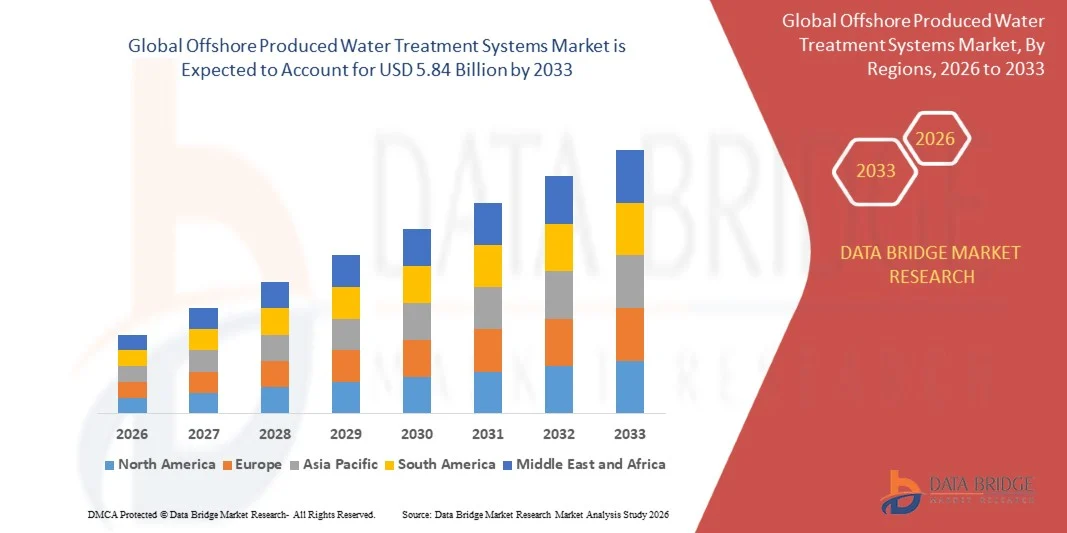
- As per Data Bridge Market Research analysis, the offshore produced water treatment systems market was valued at USD 3.20 billion in 2025 and is projected to reach USD 5.84 billion by 2033, growing at a CAGR of 7.8% from 2026 to 2033, across offshore oil and gas operations.
- The market is experiencing consistent growth driven by rising water production from maturing fields, increasing environmental compliance requirements, and expanding applications across overboard discharge, reinjection, and reuse in fixed platforms, floating units, and subsea tiebacks worldwide.
- The increasing shift toward stricter discharge limits, produced water reinjection, and compact modular treatment, combined with growing offshore development in Brazil, Guyana, and the Middle East, is supporting market adoption. Offshore produced water treatment systems are being applied across hydrocyclones, flotation units, membranes, and filters on platforms and FPSO units, helping operators remove dispersed oil and meet discharge and reinjection requirements within modern produced water treatment programs.
Market Size & Forecast
- Global Market Value (2025): USD 3.20 Billion
- Expected Market Value (2033): USD 5.84 Billion
- Forecast CAGR (2026–2033): 7.8%
- Leading Region in 2025: Europe
- Fastest Growing Region: South America
What are the Major Takeaways of the Offshore Produced Water Treatment Systems Market?
- Europe dominated the offshore produced water treatment systems market with the largest revenue share of 28.90% in 2025, supported by strict discharge limits, mature North Sea fields, and established technology suppliers and operators across the region and neighboring basins.
- South America is expected to be the fastest-growing region at a CAGR of 10.60% from 2026 to 2033, fueled by expanding FPSO deployments, deepwater developments, and growing produced water volumes in Brazil and neighboring offshore basins.
- The flotation units segment led the market with a 36.8% share in 2025, driven by extensive use for removing small dispersed oil droplets in produced water.
- Membrane systems are the fastest-growing product type, projected to register a CAGR of 10.4%, reflecting the surge in demand for polishing and reuse treatment and water injection.
- The fixed platforms segment dominated the platform category with a 52.7% revenue share in 2025, led by large installed offshore assets and platform upgrades.
- Overboard discharge accounted for 49.6% of the market share in 2025, preferred by increasing compliance with oil-in-water limits and permits.
- The national oil companies segment is the fastest-growing end-user category, with a CAGR of 8.6%, driven by increasing offshore capacity and field life extensions.
Report Scope and Offshore Produced Water Treatment Systems Market Segmentation
|
Attributes |
Offshore Produced Water Treatment Systems Key Market Insights |
|
Segments Covered |
|
|
Countries Covered |
North America
Europe
Asia-Pacific
Middle East and Africa
South America
|
|
Key Market Players |
|
|
Market Opportunities |
|
|
Value Added Data Infosets |
In addition to the insights on market scenarios such as market value, growth rate, segmentation, geographical coverage, and major players, the market reports curated by the Data Bridge Market Research also include in-depth expert analysis, geographically represented company-wise production and capacity, network layouts of distributors and partners, detailed and updated price trend analysis and deficit analysis of supply chain and demand. |
What is the Key Trend in the Offshore Produced Water Treatment Systems Market?
- Operators and suppliers are increasingly shifting toward compact, modular, and low-chemical treatment systems, combining deoiling hydrocyclones, compact flotation, and polishing technologies to meet tighter discharge standards within limited platform space and weight across new and existing assets.
- For instance, in September 2025, PolyCera was awarded the scope to deliver 10 produced water treatment units for offshore platforms operated by CNOOC, reflecting demand for packaged systems for offshore installations, as Chinese operators expand platform capacity and seek compact, locally supplied treatment solutions for new and existing assets.
- Reinjection and reuse are gaining importance, as operators look to reduce discharges, protect marine environments, and recover value from produced water where reservoir conditions allow, helping lower discharge volumes.
- Integrated treatment modules that combine produced water and seawater handling are being developed for FPSOs, helping save space and support water injection for improved oil recovery.
- For instance, in January 2026, according to SLB, its compact flotation unit technology can improve oil-in-water removal with 50% greater efficiency and a 50% smaller footprint, supporting offshore facilities with strict space limits, while EPCON Dual units achieved 27% better separation than conventional compact flotation units in North Sea testing.
- As offshore fields mature and environmental scrutiny grows, produced water treatment systems are expected to evolve from compliance equipment into optimized, digital, and increasingly circular water management platforms across regions worldwide.
What are the Key Drivers of the Offshore Produced Water Treatment Systems Market?
- Rising water cuts in mature fields are increasing produced water volumes, driving demand for treatment systems that can remove oil and solids and meet discharge or reinjection requirements across offshore installations.
- For instance, in February 2026, according to the OSPAR Commission, dispersed oil concentrations in produced water across the OSPAR area varied from 6.9 mg/l to 17.2 mg/l over 2020 to 2024, below the 30 mg/l standard, showing the value of effective treatment, even though produced water remains the main source of oil discharges.
- Stringent regulation and environmental risk assessments are encouraging operators to upgrade treatment technologies and adopt best available measures to reduce oil discharged with produced water into the sea.
- For instance, in January 2025, according to Havtil, Norway’s regulations state that oil content in discharged produced water shall not exceed 15 mg per litre as an annual weighted average and 30 mg per litre as a monthly weighted average, and operators must perform environmental risk assessments.
- With new FPSOs and offshore developments proceeding in several regions, operators are specifying compact, reliable water treatment packages from the early design stage of projects.
What Factors Are Challenging the Growth of the Offshore Produced Water Treatment Systems Market?
- Offshore treatment systems must fit tight space and weight limits, operate reliably in harsh conditions, and handle variable flow and chemistry, while capital spending can be sensitive to oil price cycles and project timing.
- For instance, in January 2026, according to the OSPAR Commission, 24 installations exceeded the 30 mg/l performance standard for dispersed oil in produced water in 2020, illustrating the operational difficulty of consistently meeting limits as fields mature and produced water volumes rise.
- Produced water composition varies by reservoir, with emulsions, chemicals, and fine droplets that can reduce separation performance and require tailored treatment and chemistry, and oil sheen may occur even when concentrations are within limits.
- Discharge and reinjection typically require permits, monitoring, and environmental risk assessments, which can lengthen project timelines and increase compliance costs for operators, particularly when regulations differ across countries and basins.
- For instance, in September 2024, according to Offshore Energies UK, a permit issued by OPRED is required for both discharge and reinjection of produced water, while the 2023 industry average of 16 mg/l dispersed oil was down from 18 mg/l, showing that compliance requires continuous monitoring, optimization, and investment in treatment performance and supporting the long-term use of reinjection where reservoirs allow.
- The combination of space limits, variable water chemistry, permitting requirements, and oil price cyclicality can constrain expansion among smaller operators, particularly where older platforms have limited capacity for new equipment or modifications.
How is the Offshore Produced Water Treatment Systems Market Segmented?
The offshore produced water treatment systems market is segmented on the basis of product, platform, application, and end user across regions.
- By Product
On the basis of product, the offshore produced water treatment systems market is segmented into flotation units, hydrocyclones, membrane systems, and others. The flotation units segment dominated the market with 36.8% share in 2025, supported by extensive use for removing small dispersed oil droplets. Compact flotation units use gas bubbles to separate fine oil from water within a small footprint and short retention time. They are widely used across fixed platforms, FPSOs, and floating units. Improvements in internal design, gas consumption, and control are further strengthening demand. Integration with deoiling hydrocyclones also enables better performance across multistage treatment trains.
The membrane systems segment is projected to register the fastest growth at a CAGR of 10.4% from 2026 to 2033, driven by increasing demand for polishing and reuse treatment. Membranes can remove fine solids, emulsified oil, and other contaminants to produce higher quality water for reinjection or reuse. Their applications include polishing, seawater and produced water blending, and water injection. Increasing focus on water quality for injectivity is creating additional demand across operators and FPSO contractors. Improvements in membrane materials, cleaning, and ceramic or polymeric designs are enhancing durability. Modular skids and combined seawater and produced water modules are also expanding commercial use across offshore projects.
- By Platform
On the basis of platform, the offshore produced water treatment systems market is segmented into fixed platforms, FPSOs & floating units, and subsea & others. The fixed platforms segment dominated the market with 52.7% share in 2025, supported by large installed offshore assets in mature basins. Fixed platforms offer a balanced combination of space, structural support, and established water handling infrastructure for high-volume operations. Their prevalence across the North Sea, Gulf, and Asia expands the potential customer base. Operators upgrade treatment trains to handle rising water cuts and tighter limits. The segment also benefits from established maintenance and retrofit programs and service contracts.
The FPSOs and floating units segment is projected to register the fastest growth at a CAGR of 9.1% from 2026 to 2033, supported by increasing deepwater developments and new floating production systems. FPSOs require compact, lightweight, and motion-tolerant treatment systems that integrate with seawater and injection systems. Operators and contractors are increasingly ordering packaged modules. Suppliers are developing combined produced water and seawater modules for water injection, including 2-in-1 modules for large FPSOs. Improved designs for vessel motion further strengthen the segment’s attractiveness. Space and weight limits remain important considerations for expansion, as does qualification of equipment for vessel motion and long design lives.
- By Application
On the basis of application, the offshore produced water treatment systems market is segmented into overboard discharge, reinjection, beneficial reuse, and others. The overboard discharge segment dominated the application category with 49.6% share in 2025, supported by increasing compliance with oil-in-water limits. Treatment ensures that discharged water meets performance standards such as 30 mg/l in the OSPAR area and 29 mg/L monthly average in U.S. regulations. Environmental goals are increasing the use of advanced treatment. Growth in offshore production further strengthens demand. Operators are also seeking systems that combine reliable oil removal, low maintenance, and compact design for continuous operation in harsh offshore conditions.
The reinjection segment is projected to register the fastest growth at a CAGR of 9.2% from 2026 to 2033, driven by increasing environmental restrictions, pressure maintenance needs, and interest in reducing discharges. Reinjected produced water must be treated to protect reservoirs and wells from solids and oil. Operators in Europe, South America, and the Middle East are expanding reinjection capacity. Rising water volumes are creating additional opportunities, as mature fields can produce about five barrels of water for every barrel of oil. Reliable filtration and monitoring make treatment systems particularly important. Supportive regulation and reservoir support needs can further improve adoption across regions.
- By End User
On the basis of end user, the offshore produced water treatment systems market is segmented into international oil companies, national oil companies, independent operators, and others. The international oil companies segment dominated the end-user category with 41.2% share in 2025, supported by increasing requirements for compliant, reliable offshore operations. Large operators specify advanced treatment to meet environmental standards across their global assets. The segment includes platform upgrades, new FPSOs, and subsea tiebacks. Increasing deepwater investment is creating further opportunities. Long project lifecycles also make reliability, service support, and total cost important considerations in procurement decisions for operators, contractors, and platform owners.
The national oil companies segment is projected to register the fastest growth at CAGR of 8.6% from 2026 to 2033, driven by increasing offshore capacity additions, field life extensions, and domestic content programs. National operators in the Middle East, Asia, and South America are investing in new platforms and water handling systems. Suppliers are expanding local partnerships and service capabilities. Closer collaboration between operators and technology providers is accelerating development of tailored solutions. Environmental commitments are further supporting adoption. Local content, cost, reliability, and long-term service support remain important considerations for deployment.
Which Region Holds the Largest Share of the Offshore Produced Water Treatment Systems Market?
- Europe dominated the offshore produced water treatment systems market with the largest revenue share of 28.90% in 2025, supported by strict discharge limits, mature North Sea fields, and established technology suppliers and operators across the region and neighboring basins.
- The region also benefits from stringent environmental regulation, advanced engineering capabilities, and the presence of leading technology suppliers and operators, along with growing focus on reinjection and risk-based produced water management. Increasing upgrades of mature platforms and strong research programs continue to strengthen Europe’s position in the global market.
Germany Offshore Produced Water Treatment Systems Market Insight
Germany’s offshore produced water treatment systems market is driven by stringent environmental requirements, offshore wastewater management needs, and demand for efficient oil removal technologies. Hydrocyclones, induced gas flotation, advanced filtration, and compact treatment systems are gaining importance for reducing hydrocarbon contamination before discharge or reinjection. Opportunities are supported by technological innovation, automated monitoring, and energy-efficient treatment solutions. However, high installation costs, limited offshore space, and operational complexity remain challenges. Suppliers offering reliable, compact, and compliant systems can strengthen their market position.
U.K. Offshore Produced Water Treatment Systems Market Insight
The U.K. offshore produced water treatment systems market is witnessing consistent growth due to rising investments in platform life extension, environmental compliance, and produced water reinjection. Operators, contractors, and regulators are increasingly focusing on dispersed oil reduction. Moreover, permitting requirements and continued reductions in dispersed oil discharges, supported by established North Sea supply chains, are further contributing to market growth in the U.K., particularly for platform life extension projects.
South America Offshore Produced Water Treatment Systems Market Insight
The South America offshore produced water treatment systems market is expected to witness rapid growth, driven by expanding FPSO deployments, deepwater developments, and increasing produced water volumes across countries such as Brazil, Guyana, and Argentina. Growing investment in pre-salt and new offshore projects is supporting regional market expansion. In addition, the region’s large operators and contractors are accelerating demand for compact water treatment and injection packages for floating units and offshore platforms, supported by long-term supply and service agreements.
Brazil Offshore Produced Water Treatment Systems Market Insight
The Brazil offshore produced water treatment systems market is growing steadily, driven by large pre-salt developments, new FPSO units, and strong demand for water injection and treatment systems. Growing use of compact modules on floating platforms is boosting market demand. In addition, the country’s major operators, shipyards, and suppliers are positioning Brazil as an important market across South America, supported by ongoing offshore field development and long-term contracts for water treatment packages.
Argentina Offshore Produced Water Treatment Systems Market Insight
Argentina’s offshore produced water treatment systems market is supported by expanding offshore hydrocarbon exploration and increasing emphasis on environmental compliance. Demand is expected for compact separation technologies, hydrocyclones, flotation units, filtration systems, and oil-in-water monitoring equipment. Offshore developments in the South Atlantic create potential opportunities for advanced treatment solutions and reinjection systems. However, high capital expenditure, complex logistics, regulatory requirements, and investment uncertainty may constrain adoption. Suppliers offering energy-efficient, reliable, and space-saving technologies can benefit as Argentina develops its offshore oil and gas resources.
Which are the Top Companies in Offshore Produced Water Treatment Systems Market?
The offshore produced water treatment systems industry is primarily led by well-established companies, including:
- SLB (U.S.)
- Veolia Environnement S.A. (France)
- Baker Hughes Company (U.S.)
- NOV Inc. (U.S.)
- Alfa Laval AB (Sweden)
- Halliburton Company (U.S.)
- Aker Solutions ASA (Norway)
- Wood plc (U.K.)
- TechnipFMC plc (U.K.)
- Xylem Inc. (U.S.)
- Parker-Hannifin Corporation (U.S.)
- Ecolab Inc. (U.S.)
- Siemens Energy AG (Germany)
- Sulzer Ltd (Switzerland)
- Danaher Corporation (Pall) (U.S.)
- Minerals Technologies Inc. (CETCO) (U.S.)
- Oil Plus Ltd. (U.K.)
- PolyCera (PSP.US, Inc.) (U.S.)
- Seatrium Limited (Singapore)
- BW Offshore Limited (Norway)
What are Latest Developments in Offshore Produced Water Treatment Systems Market?
- In July 2026, Oil Plus secured two produced water projects in Qatar worth USD 450,000, including a pre-FEED oil and water analysis for QatarEnergy to recommend a suitable produced water treatment system for two oil field redevelopments and a water injection study for the Al-Shaheen field of North Oil Company, supporting life extension and redevelopment activities.
- In January 2026, the OSPAR Commission published its report on discharges, spills, and emissions from offshore oil and gas installations for 2020 to 2024, noting that produced water remains the main contributor to oil discharges and that average dispersed oil concentrations were well below the 30 mg/l performance standard, even as the maritime area remains a mature oil and gas region.
- In September 2025, PolyCera, a brand of PSP.US, Inc., announced it had been awarded the scope to deliver 10 produced water treatment units for offshore platforms operated by the China National Offshore Oil Corporation, supporting packaged treatment capacity for offshore installations in China and extending its presence in the offshore energy sector, according to the company announcement published on 8 September 2025.
- In January 2025, Norway’s Havtil updated its Activities Regulations, with Section 60 requiring that oil content in discharged produced water not exceed 15 mg per litre as a weighted average for a calendar year and 30 mg per litre as a weighted average for a calendar month, and requiring environmental risk assessments for facilities that discharge produced water.
- In September 2024, Offshore Energies UK reported that the industry average dispersed oil concentration in produced water discharges was 16 mg/l in 2023, down from 18 mg/l, and that dispersed oil discharged with produced water had fallen by 15%, reflecting continued improvements in treatment performance, operating practices, and reinjection of produced water across the sector and the broader North Sea basin.
- Interactive Data Analysis Dashboard
- Company Analysis Dashboard for high growth potential opportunities
- Research Analyst Access for customization & queries
- Competitor Analysis with Interactive dashboard
- Latest News, Updates & Trend analysis
- Harness the Power of Benchmark Analysis for Comprehensive Competitor Tracking
Data collection and base year analysis are done using data collection modules with large sample sizes. The stage includes obtaining market information or related data through various sources and strategies. It includes examining and planning all the data acquired from the past in advance. It likewise envelops the examination of information inconsistencies seen across different information sources. The market data is analysed and estimated using market statistical and coherent models. Also, market share analysis and key trend analysis are the major success factors in the market report. To know more, please request an analyst call or drop down your inquiry.
The key research methodology used by DBMR research team is data triangulation which involves data mining, analysis of the impact of data variables on the market and primary (industry expert) validation. Data models include Vendor Positioning Grid, Market Time Line Analysis, Market Overview and Guide, Company Positioning Grid, Patent Analysis, Pricing Analysis, Company Market Share Analysis, Standards of Measurement, Global versus Regional and Vendor Share Analysis. To know more about the research methodology, drop in an inquiry to speak to our industry experts.
Data Bridge Market Research is a leader in advanced formative research. We take pride in servicing our existing and new customers with data and analysis that match and suits their goal. The report can be customized to include price trend analysis of target brands understanding the market for additional countries (ask for the list of countries), clinical trial results data, literature review, refurbished market and product base analysis. Market analysis of target competitors can be analyzed from technology-based analysis to market portfolio strategies. We can add as many competitors that you require data about in the format and data style you are looking for. Our team of analysts can also provide you data in crude raw excel files pivot tables (Fact book) or can assist you in creating presentations from the data sets available in the report.