What is the Offshore Well Intervention Services Market Size and Growth Rate?
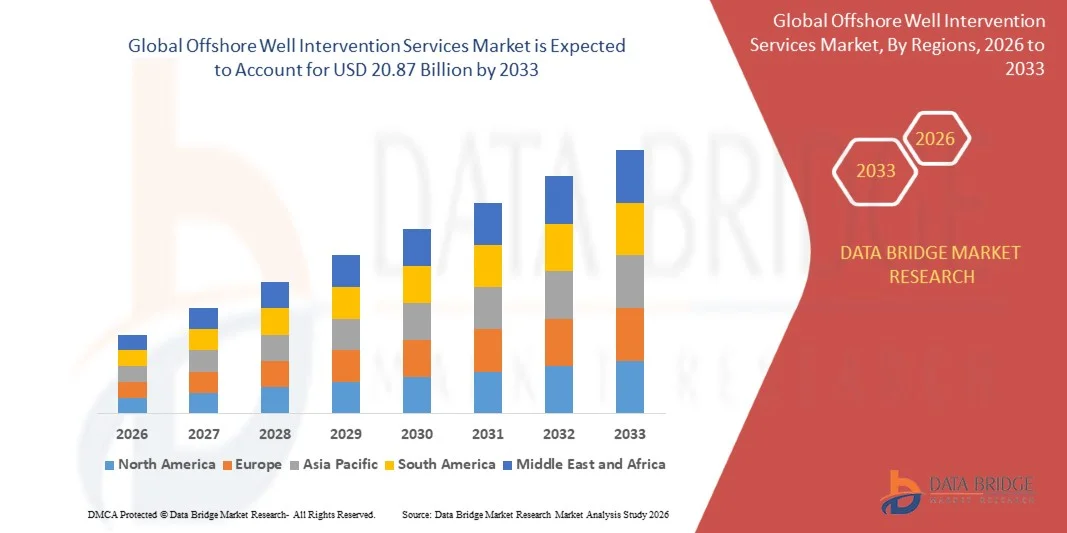
- As per Data Bridge Market Research analysis the offshore well intervention services market was valued at USD 13.00 billion in 2025 and is projected to reach USD 20.87 billion by 2033, growing at a CAGR of 6.10% from 2026 to 2033.
- The market is experiencing consistent growth driven by the escalating number of mature offshore oil and gas fields requiring maintenance and production optimization, increasing deepwater and ultra-deepwater exploration activities, and the growing preference for cost-effective intervention solutions over capital-intensive new drilling. Operators are prioritizing extending the life of existing assets and maximizing recovery rates from aging wells, which is creating sustained demand for specialized intervention services.
- The rising complexity of well designs and the need for advanced technologies to access challenging offshore reservoirs are also contributing to market expansion. Furthermore, stringent environmental regulations and the enforcement of safety standards related to offshore operations are compelling operators to adopt innovative intervention techniques to ensure well integrity, minimize environmental impact, and comply with regulatory requirements.
Market Size & Forecast
- Global Market Value (2025): USD 13.00 Billion
- Expected Market Value (2033): USD 20.87 Billion
- Forecast CAGR (2026–2033): 6.10%
- Leading Region in 2025: North America
- Fastest Growing Region: Asia-Pacific
What are the Major Takeaways of the Offshore Well Intervention Services Market?
- North America is expected to dominate the offshore well intervention services market, supported by a high concentration of mature offshore fields, particularly in the Gulf of Mexico, and significant investments in production optimization technologies.
- Asia-Pacific offshore well intervention services market is expected to witness the fastest growth rate from 2026 to 2033, supported by rising offshore exploration activities, increasing energy demand, and expanding investments in Deepwater projects across countries such as China, India, Malaysia, and Australia.
- The logging and bottom-hole survey segment dominated the market in 2025, owing to its critical role in real-time well diagnostics, reservoir evaluation, and production optimization. These services are extensively used to assess well integrity, identify production issues, and support efficient intervention planning across offshore oil and gas fields.
- The stimulation segment is projected to register the fastest growth from 2026 to 2033, driven by increasing demand to enhance production from mature offshore wells and improve hydrocarbon recovery. Growing adoption of advanced stimulation technologies, combined with rising offshore redevelopment activities, is accelerating segment expansion.
- The light intervention segment led the market in 2025, supported by its cost-effectiveness, reduced operational downtime, and widespread use for well diagnostics, maintenance, and production enhancement without requiring drilling rigs. Increasing deployment of light well intervention vessels has further strengthened segment demand.
- The heavy/workover segment is expected to experience the fastest growth from 2026 to 2033, driven by rising investments in restoring aging offshore wells, complex well repair operations, and increasing redevelopment of mature offshore assets requiring extensive intervention services.
Report Scope and Offshore Well Intervention Services Market Segmentation
|
Attributes |
Offshore Well Intervention Services Key Market Insights |
|
Segments Covered |
|
|
Countries Covered |
North America
Europe
Asia-Pacific
Middle East and Africa
South America
|
|
Key Market Players |
|
|
Market Opportunities |
|
|
Value Added Data Infosets |
In addition to the insights on market scenarios such as market value, growth rate, segmentation, geographical coverage, and major players, the market reports curated by the Data Bridge Market Research also include import export analysis, production capacity overview, production consumption analysis, price trend analysis, climate change scenario, supply chain analysis, value chain analysis, raw material/consumables overview, vendor selection criteria, PESTLE Analysis, Porter Analysis, and regulatory framework. |
What is the Key Trend in the Offshore Well Intervention Services Market?
- Offshore operators are increasingly adopting riserless light well intervention (RLWI), digital monitoring, and vessel-based intervention technologies to extend the production life of mature subsea wells while reducing costs and minimizing reliance on drilling rigs.
- For instance, in August 2025, SLB acquired Stimline Digital, a leading provider of cloud-based well intervention software, to integrate AI-powered planning, visualization, and real-time execution workflows into its well intervention portfolio. The acquisition reflects the industry's growing shift toward digitalized and data-driven offshore well intervention operations that improve efficiency, standardize workflows, and reduce intervention costs.
- Real-time well diagnostics, remotely operated systems, and advanced subsea control technologies are enabling operators to optimize intervention planning, improve production recovery, and reduce offshore operational risks.
- Oil & gas companies are increasingly integrating digital workflows, robotics, and subsea automation into intervention campaigns to maximize asset performance and minimize downtime.
- For instance, in October 2025, Oceaneering International was awarded a riserless light well intervention (RLWI) contract by bp Exploration (Caspian Sea) Ltd. for the Azeri-Chirag-Deepwater Gunashli (ACG) field, highlighting the growing preference for cost-effective vessel-based intervention solutions in deepwater operations.
- As offshore fields continue to mature and operators prioritize production optimization with lower operational costs and emissions, the adoption of advanced offshore well intervention services is expected to accelerate, reinforcing their role in maximizing recovery from existing assets.
What are the Key Drivers of the Offshore Well Intervention Services Market?
- The growing number of mature offshore oil and gas fields is significantly increasing demand for well intervention services that enhance production, restore well integrity, and extend asset life without requiring expensive drilling operations.
- For instance, in June 2024, Baker Hughes was awarded a major integrated solutions contract by Petrobras to provide workover and plug & abandonment (P&A), wireline, coiled tubing, cementing, and wellbore intervention services across Petrobras' offshore pre-salt and post-salt fields in Brazil. The multi-year contract reflects growing investment in offshore well intervention to maximize production from mature assets while improving operational efficiency.
- Offshore operators are increasingly adopting hydraulic stimulation, wireline, coiled tubing, and subsea intervention technologies to improve production efficiency while reducing operating costs.
- Service providers are investing in integrated digital solutions and vessel-based intervention capabilities that enable faster execution, improved safety, and lower carbon emissions compared with conventional rig-based operations.
- As operators seek to maximize recovery from existing offshore assets while controlling capital expenditure, offshore well intervention services will remain essential for sustaining long-term production.
Which Factors are Challenging the Growth of the Offshore Well Intervention Services Market?
- Offshore well intervention projects require high capital investment due to specialized intervention vessels, subsea equipment, remotely operated vehicles (ROVs), wireline systems, and highly skilled offshore personnel.
- These costs become even higher in deepwater and ultra-deepwater environments, limiting project viability when oil prices fluctuate or operators reduce capital expenditure.
- For instance, Oceaneering's IRIS and BORIS riserless light well intervention systems are engineered for operations in water depths of up to 10,000 feet, requiring advanced subsea infrastructure, specialized vessels, and remotely operated technologies that substantially increase project costs.
- Complex offshore logistics, stringent safety regulations, unpredictable weather conditions, and vessel availability further increase operational costs and scheduling challenges.
- The high deployment and operating costs associated with advanced offshore intervention technologies continue to restrain adoption, particularly for smaller offshore operators and marginal fields, despite the growing need to maximize production from mature assets.
How is the Offshore Well Intervention Services Market Segmented?
The offshore well intervention services market is segmented on the basis of service type, intervention type, well type and well depth.
- By Service Type
On the basis of service type, the offshore well intervention services market is segmented into logging and bottom-hole survey, stimulation, tubing/packer failure and repair, sand control, zonal isolation, artificial lift, fishing, reperforation, and others. The logging and bottom-hole survey segment dominated the market in 2025, owing to its critical role in real-time well diagnostics, reservoir evaluation, and production optimization. These services are extensively used to assess well integrity, identify production issues, and support efficient intervention planning across offshore oil and gas fields.
The stimulation segment is projected to register the fastest growth from 2026 to 2033, driven by increasing demand to enhance production from mature offshore wells and improve hydrocarbon recovery. Growing adoption of advanced stimulation technologies, combined with rising offshore redevelopment activities, is accelerating segment expansion.
- By Intervention Type
On the basis of intervention type, the offshore well intervention services market is segmented into light, medium, and heavy/workover intervention. The light intervention segment led the market in 2025, supported by its cost-effectiveness, reduced operational downtime, and widespread use for well diagnostics, maintenance, and production enhancement without requiring drilling rigs. Increasing deployment of light well intervention vessels has further strengthened segment demand.
The heavy/workover segment is expected to experience the fastest growth from 2026 to 2033, driven by rising investments in restoring aging offshore wells, complex well repair operations, and increasing redevelopment of mature offshore assets requiring extensive intervention services.
- By Well Type
On the basis of well type, the offshore well intervention services market is segmented into horizontal wells and vertical wells. The horizontal wells segment dominated the market in 2025 due to their higher production efficiency, greater reservoir contact, and increasing adoption in offshore oil and gas developments. The growing number of horizontal offshore wells has significantly increased the demand for advanced intervention services throughout the well lifecycle.
The vertical wells segment is anticipated to witness the fastest growth from 2026 to 2033, driven by continued redevelopment of mature offshore fields and increasing intervention activities in conventional reservoirs where vertical well infrastructure remains widely deployed.
- By Well Depth
On the basis of well depth, the offshore well intervention services market is segmented into shallow water, deep water (400 to 1500 m), and ultra-deep water. The deep water (400 to 1500 m) segment dominated the market in 2025, supported by growing offshore exploration and production activities, increasing investments in deepwater developments, and rising demand for intervention services to maximize production from high-value offshore assets.
The ultra-deep-water segment is projected to register the fastest growth from 2026 to 2033, driven by increasing exploration in frontier offshore basins, technological advancements in subsea intervention systems, and rising investments in ultra-deepwater oil and gas projects across regions such as the Gulf of Mexico, Brazil, and West Africa.
Which Region Holds the Largest Share of the Offshore Well Intervention Services Market?
- North America is expected to dominate the offshore well intervention services market, supported by a high concentration of mature offshore fields, particularly in the Gulf of Mexico, and significant investments in production optimization technologies.
- The region benefits from the presence of key oil and gas producers and technology companies that drive innovation and competition. The U.S. shale boom, along with growing offshore activity in the Gulf of Mexico, is a major contributor.
U.S. Offshore Well Intervention Services Market Insight
U.S. offshore well intervention services market captured the largest revenue share in 2025 within North America, driven by sustained exploration and production activities in the Gulf of Mexico. Growing investments in extending the operational life of offshore assets, increasing subsea intervention projects, and widespread adoption of rigless intervention technologies are supporting market expansion. The presence of leading oilfield service companies and continuous technological advancements further contribute to the industry's growth.
Europe Offshore Well Intervention Services Market Insight
Europe offshore well intervention services market is expected to witness significant growth from 2026 to 2033, primarily driven by increasing investments in extending the life of mature offshore fields in the North Sea. Rising focus on maximizing hydrocarbon recovery, improving well integrity, and reducing production downtime is encouraging greater adoption of advanced intervention technologies. Continued investments in offshore energy infrastructure and digital well monitoring solutions are further supporting regional market growth.
U.K. Offshore Well Intervention Services Market Insight
U.K. offshore well intervention services market is expected to witness strong growth from 2026 to 2033, driven by extensive redevelopment of mature North Sea oil and gas fields. Operators are increasingly investing in well maintenance, production enhancement, and subsea intervention activities to maximize asset performance while reducing operational costs. Growing adoption of light well intervention vessels and digital well diagnostics is further supporting market expansion.
Germany Offshore Well Intervention Services Market Insight
Germany's offshore well intervention services market is expected to witness the fastest growth rate from 2026 to 2033, supported by continued investment in maintaining and optimizing mature oil and gas assets in the North Sea. Operators are increasingly adopting light well intervention (LWI), subsea inspection, wireline, and remotely operated vehicle (ROV)-based technologies to improve production efficiency while reducing operating costs and minimizing reliance on drilling rigs. Stringent environmental regulations, advanced engineering capabilities, and a strong focus on safe, low-emission offshore operations are further encouraging the deployment of digital and vessel-based intervention solutions across offshore fields.
Asia-Pacific Offshore Well Intervention Services Market Insight
Asia-Pacific offshore well intervention services market is expected to witness the fastest growth rate from 2026 to 2033, supported by rising offshore exploration activities, increasing energy demand, and expanding investments in deepwater projects across countries such as China, India, Malaysia, and Australia. Government initiatives to enhance domestic hydrocarbon production and growing offshore field redevelopment activities are driving the adoption of advanced well intervention solutions.
China Offshore Well Intervention Services Market Insight
China offshore well intervention services market accounted for the largest market revenue share in Asia-Pacific in 2025, attributed to increasing offshore exploration activities in the South China Sea and continued investments by national oil companies in offshore production infrastructure. Rising demand for production optimization, well integrity management, and enhanced recovery techniques is supporting the growing adoption of offshore well intervention services across the country.
Japan Offshore Well Intervention Services Market Insight
Japan's offshore well intervention services market is expected to witness the fastest growth rate from 2026 to 2033, driven by offshore natural gas development, increasing well integrity management requirements, and the need to maximize production from existing offshore assets. Growing adoption of advanced wireline, coiled tubing, and digital well intervention technologies is helping operators improve operational reliability while complying with stringent safety and environmental standards. Continued investments in offshore exploration, production optimization, and technology-intensive intervention services are expected to support market growth as Japan strengthens its domestic energy security and offshore resource development efforts.
Which are the Top Companies in Offshore Well Intervention Services Market?
The offshore well intervention services industry is primarily led by well-established companies, including:
- SLB (U.S.)
- Baker Hughes Company (U.S.)
- Halliburton Company (U.S.)
- Weatherford International plc (U.S.)
- Oceaneering International, Inc. (U.S.)
- TechnipFMC plc (U.K.)
- Expro Group Holdings N.V. (U.S.)
- Helix Energy Solutions Group, Inc. (U.S.)
- Superior Energy Services, Inc. (U.S.)
- Archer Limited (U.K.)
- Welltec A/S (Denmark)
- Hunting PLC (U.K.)
- Aker Solutions ASA (Norway)

- Interactive Data Analysis Dashboard
- Company Analysis Dashboard for high growth potential opportunities
- Research Analyst Access for customization & queries
- Competitor Analysis with Interactive dashboard
- Latest News, Updates & Trend analysis
- Harness the Power of Benchmark Analysis for Comprehensive Competitor Tracking
Data collection and base year analysis are done using data collection modules with large sample sizes. The stage includes obtaining market information or related data through various sources and strategies. It includes examining and planning all the data acquired from the past in advance. It likewise envelops the examination of information inconsistencies seen across different information sources. The market data is analysed and estimated using market statistical and coherent models. Also, market share analysis and key trend analysis are the major success factors in the market report. To know more, please request an analyst call or drop down your inquiry.
The key research methodology used by DBMR research team is data triangulation which involves data mining, analysis of the impact of data variables on the market and primary (industry expert) validation. Data models include Vendor Positioning Grid, Market Time Line Analysis, Market Overview and Guide, Company Positioning Grid, Patent Analysis, Pricing Analysis, Company Market Share Analysis, Standards of Measurement, Global versus Regional and Vendor Share Analysis. To know more about the research methodology, drop in an inquiry to speak to our industry experts.
Data Bridge Market Research is a leader in advanced formative research. We take pride in servicing our existing and new customers with data and analysis that match and suits their goal. The report can be customized to include price trend analysis of target brands understanding the market for additional countries (ask for the list of countries), clinical trial results data, literature review, refurbished market and product base analysis. Market analysis of target competitors can be analyzed from technology-based analysis to market portfolio strategies. We can add as many competitors that you require data about in the format and data style you are looking for. Our team of analysts can also provide you data in crude raw excel files pivot tables (Fact book) or can assist you in creating presentations from the data sets available in the report.