


Global Oil and Fuel Filter Market Size
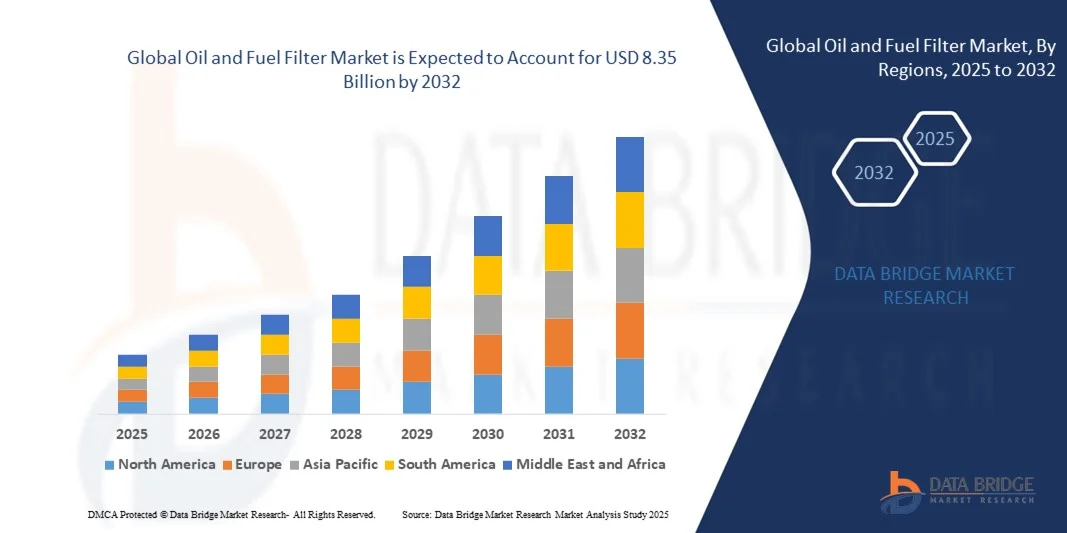
- The global oil and fuel filter market size was valued at USD 5.05 billion in 2024 and is expected to reach USD 8.35 billion by 2032, growing at a CAGR of 6.50% during the forecast period.
- The market growth is primarily driven by the increasing demand for cleaner engine performance and fuel efficiency, along with stringent environmental regulations aimed at reducing vehicle emissions across both developed and emerging economies.
- Additionally, the rising production of commercial and passenger vehicles, coupled with growing awareness about preventive vehicle maintenance, is propelling the adoption of oil and fuel filters, thus accelerating the industry's overall expansion.
Global Oil and Fuel Filter Market Analysis
- Oil and fuel filters, essential for maintaining engine health by removing contaminants from oil and fuel, are becoming increasingly critical components in both automotive and industrial machinery due to their role in enhancing engine efficiency, reducing emissions, and extending equipment lifespan.
- The growing demand for oil and fuel filters is primarily driven by rising global vehicle production, stricter emission regulations, and an increased focus on preventive maintenance in both on-road and off-road applications.
- North America dominated the global oil and fuel filter market with the largest revenue share of 33.5% in 2024, driven by the region’s strong automotive aftermarket, presence of major OEMs, and a high rate of commercial vehicle usage, particularly in the U.S., where demand is further supported by advanced logistics and transportation sectors.
- Asia-Pacific is expected to be the fastest-growing region in the global oil and fuel filter market during the forecast period, fueled by rapid industrialization, expanding vehicle fleets, and rising disposable incomes, especially in countries like China and India.
- The fuel filter segment dominated the market with the largest revenue share of 43.2% in 2024, primarily due to increasing demand for cleaner fuel delivery systems in modern internal combustion engines
Report Scope and Global Oil and Fuel Filter Market Segmentation
|
Attributes |
Oil and Fuel Filter Key Market Insights |
|
Segments Covered |
|
|
Countries Covered |
North America
Europe
Asia-Pacific
Middle East and Africa
South America
|
|
Key Market Players |
|
|
Market Opportunities |
|
|
Value Added Data Infosets |
In addition to the market insights such as market value, growth rate, market segments, geographical coverage, market players, and market scenario, the market report curated by the Data Bridge Market Research team includes in-depth expert analysis, import/export analysis, pricing analysis, production consumption analysis, and pestle analysis. |
Global Oil and Fuel Filter Market Trends
Enhanced Efficiency Through Advanced Filtration Technologies
- A significant and accelerating trend in the Global Oil and Fuel Filter Market is the adoption of next-generation filtration technologies, including nano-fiber media, synthetic filter materials, and multi-layered filtration systems. These innovations are drastically improving filtration efficiency, engine protection, and overall performance in both automotive and industrial applications.
- For instance, Donaldson’s Synteq media technology delivers superior contaminant capture and extended service life, while MANN+HUMMEL’s multi-stage filtration systems enhance diesel fuel cleanliness in modern high-pressure common-rail engines.
- These advanced filters are capable of capturing ultra-fine particles and water contaminants more effectively, significantly reducing engine wear and improving fuel combustion efficiency. Cummins’ Fleetguard filters, for example, utilize nanotechnology to maintain high efficiency even under extreme operating conditions, thereby supporting longer engine life and lower maintenance costs.
- The integration of sensors and digital monitoring systems in oil and fuel filters is also on the rise, allowing for real-time performance tracking, predictive maintenance, and data-driven service intervals. This digital transformation is particularly beneficial in commercial fleets and heavy-duty equipment, where downtime and maintenance costs have substantial operational impacts.
- Companies like Bosch and Mahle are investing in smart filtration systems that monitor pressure drops and contaminant levels, sending alerts when replacement is due—helping fleet operators improve efficiency and reduce the risk of engine damage due to delayed maintenance.
- The demand for technologically advanced oil and fuel filters is growing rapidly across automotive, construction, agriculture, and industrial sectors, as end-users seek improved fuel economy, longer service intervals, and reduced emissions to comply with increasingly stringent environmental regulations.
Global Oil and Fuel Filter Market Dynamics
Driver
Growing Need Due to Stricter Emission Regulations and Engine Protection Demands
-
The rising stringency of global emission regulations, coupled with the need for enhanced engine protection and fuel efficiency, is a significant driver of demand in the Global Oil and Fuel Filter Market. These filters play a crucial role in reducing harmful emissions by ensuring clean oil and fuel supply to engines.
- For Instance, in January 2024, Cummins Inc. introduced a new range of high-efficiency Fleetguard fuel filters designed to meet the latest EURO VI and EPA standards, with improved contaminant retention and extended service intervals. Such innovations by major players are expected to accelerate market growth.
- As automakers and fleet operators face increased pressure to meet emission targets and reduce operational costs, they are turning to advanced filtration systems to improve fuel combustion and reduce engine wear, thereby enhancing vehicle performance and longevity.
- Furthermore, the increasing global vehicle fleet—particularly in emerging economies like India, Brazil, and Southeast Asia—is boosting the replacement demand for oil and fuel filters in the aftermarket segment, making it a significant contributor to revenue growth.
- With growing awareness among consumers and fleet managers about preventive maintenance, features like extended service life, higher dirt-holding capacity, and compatibility with modern engines are driving filter upgrades across both commercial and passenger vehicle segments.
Restraint/Challenge
Concerns Regarding Counterfeit Products and High Replacement Costs
- Concerns surrounding the proliferation of counterfeit and substandard oil and fuel filters present a significant challenge to broader market adoption, particularly in price-sensitive and unregulated markets. These counterfeit products often fail to meet industry standards, leading to reduced engine performance, increased wear, and in some cases, engine failure—damaging consumer trust in filter reliability.
- For instance, various industry reports have highlighted the growing circulation of fake filters in countries across Asia-Pacific and Africa, where enforcement of quality regulations is weaker and consumer awareness is limited. These issues make buyers hesitant to invest in premium filtration solutions.
- Addressing this challenge requires stronger industry regulations, authentication mechanisms, and consumer education on the risks of using non-genuine products. Leading companies such as Bosch and Donaldson are investing in anti-counterfeit technologies like QR-code verification and tamper-proof packaging to protect brand integrity and ensure authenticity.
- Additionally, the relatively high cost of premium filters, especially those using synthetic or advanced nanofiber media, can deter adoption—particularly in developing regions where cost remains a key decision factor. While standard filters are more affordable, they often lack the longevity and protection offered by higher-end alternatives.
- Although filter prices are gradually becoming more competitive due to manufacturing scale and technological improvements, the perceived cost barrier remains for many individual vehicle owners and small fleet operators who may not recognize the long-term value of high-efficiency filtration.
- Overcoming these challenges through wider availability of certified products, affordable high-performance filter lines, and awareness campaigns will be vital to support sustainable market growth and protect engine health across vehicle classes.
Global Oil and Fuel Filter Market Scope
Oil and fuel filter market is segmented on the basis of filter type, filter media, vehicle type and distribution channel.
- By Filter Type
On the basis of filter type, the Global Oil and Fuel Filter Market is segmented into oil filters and fuel filters. The fuel filter segment dominated the market with the largest revenue share of 43.2% in 2024, primarily due to increasing demand for cleaner fuel delivery systems in modern internal combustion engines. Fuel filters play a crucial role in protecting engines from contaminants like dirt, rust, and water, which can significantly degrade engine performance. Their relevance has grown in both diesel and gasoline engines, particularly with rising regulatory emphasis on emission control and fuel efficiency.
The oil filter segment is projected to witness the fastest growth rate from 2025 to 2032, driven by the rising awareness about preventive maintenance and the increasing vehicle parc globally. Oil filters ensure engine longevity by capturing contaminants from engine oil, making them essential for performance and reducing long-term maintenance costs across both passenger and commercial vehicles.
- By Filter Media
On the basis of filter media, the Global Oil and Fuel Filter Market is segmented into cellulose, synthetic-laminated, and pure glass. The synthetic-laminated segment held the largest market revenue share of 38.7% in 2024, owing to its superior durability, higher filtration efficiency, and longer service life compared to traditional media. Synthetic filters are increasingly preferred in commercial and high-performance applications due to their ability to maintain filtration performance under extreme operating conditions and extended drain intervals.
The pure glass media segment is expected to register the fastest CAGR from 2025 to 2032, driven by its ultra-fine filtration capabilities and low flow resistance. This media is gaining traction in high-end and specialized engines where ultra-clean oil or fuel is critical. The rising demand for advanced engine protection technologies and increased R&D by manufacturers to integrate pure glass in premium filter products are propelling segment growth.
- By Vehicle Type
On the basis of vehicle type, the Global Oil and Fuel Filter Market is categorized into passenger cars, light commercial vehicles (LCVs), and heavy commercial vehicles (HCVs). The passenger car segment dominated the market with the largest share of 49.6% in 2024, driven by the rising global production and sales of passenger vehicles, particularly in emerging economies such as India, Brazil, and Southeast Asian countries. Increasing urbanization, consumer preference for personal mobility, and awareness of vehicle maintenance have further fueled demand for oil and fuel filters in this segment.
The heavy commercial vehicle (HCV) segment is expected to witness the fastest CAGR during the forecast period, owing to the growing use of HCVs in logistics, construction, and mining sectors. These vehicles operate in harsh environments and for longer durations, requiring high-efficiency filters for optimal engine performance and reliability, thereby driving the demand for premium filtration solutions in the HCV segment.
- By Distribution Channel
On the basis of distribution channel, the Global Oil and Fuel Filter Market is segmented into OEM (Original Equipment Manufacturer), Aftermarket, and others. The Aftermarket segment accounted for the largest revenue share of 54.3% in 2024, as oil and fuel filters require periodic replacement, creating consistent demand across the vehicle lifecycle. The growing vehicle parc, increasing average vehicle age, and rising consumer focus on preventive maintenance have bolstered aftermarket sales globally. Additionally, a wide network of service stations, independent repair shops, and e-commerce platforms contribute to the dominance of this channel.
The OEM segment is projected to register the fastest CAGR from 2025 to 2032, driven by increasing collaboration between filter manufacturers and automakers to integrate high-efficiency filters into new vehicle models. OEMs are also focused on developing integrated filter systems with improved performance and sustainability features, supporting long-term growth in this segment.
Global Oil and Fuel Filter Market Regional Analysis
- North America dominated the Global Oil and Fuel Filter Market with the largest revenue share of 33.5% in 2024, driven by a strong automotive aftermarket, widespread vehicle ownership, and stringent environmental regulations requiring advanced filtration systems.
- Consumers and fleet operators in the region prioritize vehicle longevity, engine performance, and compliance with emissions standards, which has led to high adoption of high-efficiency oil and fuel filters across both passenger and commercial vehicle segments.
- The presence of leading filter manufacturers, such as Donaldson, Parker-Hannifin, and Cummins, coupled with advanced distribution networks and a well-established service ecosystem, further supports market dominance. In addition, rising demand for heavy-duty filters in construction, agriculture, and logistics applications continues to fuel steady market growth across the U.S. and Canada.
U.S. Oil and Fuel Filter Market Insight
The U.S. oil and fuel filter market captured the largest revenue share of 79% in North America in 2024, driven by the country’s extensive automotive fleet, growing aftermarket demand, and stringent emission regulations. The increasing average vehicle age and emphasis on vehicle maintenance are contributing significantly to filter replacements across both passenger and commercial vehicles. Moreover, the U.S. is home to several leading manufacturers, including Donaldson, Cummins, and Parker-Hannifin, which further supports strong market penetration. Demand is also increasing in the construction and agriculture sectors, where high-performance filtration is essential for machinery efficiency and durability.
Europe Oil and Fuel Filter Market Insight
The Europe oil and fuel filter market is projected to grow at a notable CAGR during the forecast period, primarily driven by stringent emission standards, especially the Euro 6 and Euro 7 norms, and growing awareness of engine efficiency. With a highly regulated automotive sector and a strong base of OEMs and tier-1 suppliers, the region is witnessing steady demand for advanced filter technologies. Both the passenger and commercial vehicle segments contribute to the uptake of synthetic and high-efficiency filter media. Furthermore, Europe’s push towards hybrid and fuel-efficient vehicles continues to drive innovation and replacement demand in the oil and fuel filter segment.
U.K. Oil and Fuel Filter Market Insight
The U.K. oil and fuel filter market is expected to grow at a steady CAGR during the forecast period, driven by increased focus on vehicle maintenance and the growing trend toward sustainable transportation. As more consumers become aware of fuel efficiency and engine protection, the replacement rate of oil and fuel filters is on the rise. The country’s robust aftermarket infrastructure, coupled with high vehicle ownership rates, contributes to consistent demand. Additionally, the shift towards low-emission and hybrid vehicles is encouraging the use of advanced filtration systems with extended service life and superior performance.
Germany Oil and Fuel Filter Market Insight
The Germany oil and fuel filter market is set to expand at a significant CAGR over the forecast period, fueled by the country’s strong automotive manufacturing sector and focus on engineering excellence. As home to global OEMs such as Volkswagen, BMW, and Mercedes-Benz, Germany places high emphasis on emission control and engine efficiency, thus requiring high-quality filtration systems. Advanced filter media and integrated filter modules are increasingly being adopted, particularly in new vehicle production. Furthermore, a growing emphasis on sustainability is promoting the use of recyclable and longer-lasting filter materials across the automotive and industrial segments.
Asia-Pacific Oil and Fuel Filter Market Insight
The Asia-Pacific oil and fuel filter market is poised to grow at the fastest CAGR of 24% between 2025 and 2032, driven by rapid vehicle production, urbanization, and rising disposable incomes in key markets such as China, India, and Japan. Increasing awareness about vehicle maintenance and emission compliance is driving strong demand across both OEM and aftermarket channels. Governments across the region are implementing stricter environmental standards, pushing automakers and consumers to invest in high-efficiency filters. Moreover, APAC serves as a global manufacturing hub for filter components, contributing to the availability and affordability of filtration products.
Japan Oil and Fuel Filter Market Insight
The Japan oil and fuel filter market is gaining traction due to the country’s focus on precision engineering, environmental compliance, and long vehicle life cycles. Japanese consumers emphasize regular vehicle maintenance, driving steady demand in the replacement market. Additionally, Japan’s significant hybrid and fuel-efficient vehicle penetration necessitates the use of advanced filter media and compact, efficient filter designs. Manufacturers are also focusing on low-resistance filters that enhance fuel economy, in alignment with Japan’s push towards carbon neutrality and sustainable mobility solutions.
China Oil and Fuel Filter Market Insight
The China oil and fuel filter market accounted for the largest revenue share in Asia-Pacific in 2024, supported by the country’s massive automotive production and ownership base. Rapid urbanization, an expanding middle class, and increasing adoption of fuel-efficient vehicles are propelling demand for both oil and fuel filters. China’s focus on emission reduction and the growth of the aftermarket segment are contributing significantly to market expansion. Additionally, the presence of major domestic manufacturers and cost-competitive production capabilities make China a dominant player in both consumption and export of filtration systems.
Global Oil and Fuel Filter Market Share
The Oil and Fuel Filter industry is primarily led by well-established companies, including:
- Donaldson Company, Inc. (U.S.)
- MANN+HUMMEL GmbH (Germany)
- Parker-Hannifin Corporation (U.S.)
- Cummins Inc. (U.S.)
- Mahle GmbH (Germany)
- Clarcor Inc. (U.S.)
- DENSO Corporation (Japan)
- Robert Bosch GmbH (Germany)
- Sogefi SpA (Italy)
- UFI Filters Spa (Italy)
- ACDelco (U.S.)
- Fram Group (U.S.)
- Hengst SE & Co. KG (Germany)
- K&N Engineering, Inc. (U.S.)
- Champion Laboratories, Inc. (U.S.)
- Baldwin Filters (U.S.)
- WIX Filters (U.S.)
- Ryco Filters (Australia)
- Sakura Filter Industries Co., Ltd. (Indonesia)
- ALCO Filters Ltd. (Cyprus)
What are the Recent Developments in Global Oil and Fuel Filter Market?
- In May 2023, MANN+HUMMEL GmbH, a global filtration expert based in Germany, launched its new line of high-efficiency fuel filters designed to meet Euro 7 emission standards. The product line features multi-layer synthetic media that enhances fuel cleanliness and supports cleaner combustion in modern engines. This strategic product development emphasizes MANN+HUMMEL’s focus on sustainable mobility and its commitment to providing cutting-edge filtration solutions that align with evolving global emission regulations.
- In April 2023, Donaldson Company, Inc. (U.S.) announced the opening of a new manufacturing and distribution facility in Pune, India, aimed at supporting the increasing demand for oil and fuel filters across the Asia-Pacific region. The facility strengthens Donaldson's global footprint and underscores its commitment to serving key emerging markets with localized production, faster delivery times, and tailored product offerings suited to regional requirements.
- In March 2023, MAHLE GmbH (Germany) unveiled its latest dual-stage oil filter modules specifically developed for commercial vehicles operating in harsh environments. The new technology improves filtration efficiency and extends service intervals, significantly reducing maintenance costs for fleet operators. The launch supports MAHLE’s strategic push toward providing robust, long-life components for the heavy-duty transportation sector and reinforces its position in the premium filtration segment.
- In February 2023, Parker-Hannifin Corporation (U.S.) introduced its next-generation Racor fuel filtration systems, equipped with water separation and advanced contaminant monitoring technology. These filters are designed to serve both off-highway and on-road diesel applications, ensuring engine protection even in low-quality fuel environments. The innovation reflects Parker’s commitment to enhancing vehicle uptime and reliability, particularly for industrial and construction vehicles operating under demanding conditions.
- In January 2023, Bosch Automotive Aftermarket launched a campaign across Europe promoting its high-performance oil filters for passenger and light commercial vehicles. The initiative included awareness programs for workshops and end-users, emphasizing the importance of quality filters in maintaining engine health and meeting modern engine requirements. The campaign aligns with Bosch’s broader objective of supporting the independent aftermarket through premium, OE-quality filtration products.

- Interactive Data Analysis Dashboard
- Company Analysis Dashboard for high growth potential opportunities
- Research Analyst Access for customization & queries
- Competitor Analysis with Interactive dashboard
- Latest News, Updates & Trend analysis
- Harness the Power of Benchmark Analysis for Comprehensive Competitor Tracking
Data collection and base year analysis are done using data collection modules with large sample sizes. The stage includes obtaining market information or related data through various sources and strategies. It includes examining and planning all the data acquired from the past in advance. It likewise envelops the examination of information inconsistencies seen across different information sources. The market data is analysed and estimated using market statistical and coherent models. Also, market share analysis and key trend analysis are the major success factors in the market report. To know more, please request an analyst call or drop down your inquiry.
The key research methodology used by DBMR research team is data triangulation which involves data mining, analysis of the impact of data variables on the market and primary (industry expert) validation. Data models include Vendor Positioning Grid, Market Time Line Analysis, Market Overview and Guide, Company Positioning Grid, Patent Analysis, Pricing Analysis, Company Market Share Analysis, Standards of Measurement, Global versus Regional and Vendor Share Analysis. To know more about the research methodology, drop in an inquiry to speak to our industry experts.
Data Bridge Market Research is a leader in advanced formative research. We take pride in servicing our existing and new customers with data and analysis that match and suits their goal. The report can be customized to include price trend analysis of target brands understanding the market for additional countries (ask for the list of countries), clinical trial results data, literature review, refurbished market and product base analysis. Market analysis of target competitors can be analyzed from technology-based analysis to market portfolio strategies. We can add as many competitors that you require data about in the format and data style you are looking for. Our team of analysts can also provide you data in crude raw excel files pivot tables (Fact book) or can assist you in creating presentations from the data sets available in the report.













