What is the Oil and Gas Downstream Market Size and Growth Rate ?
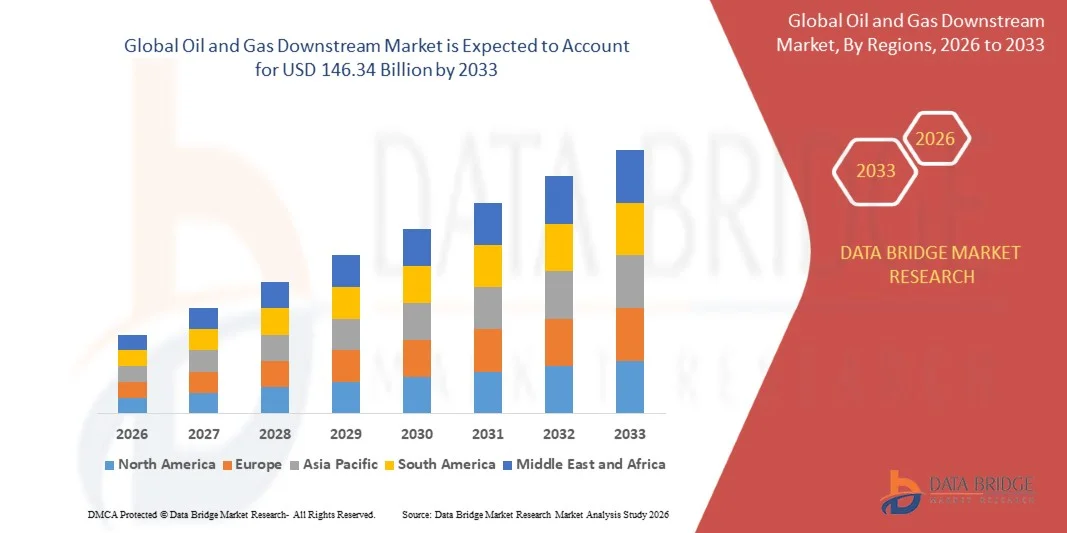
- As per Data Bridge Market Research Analysis the Oil and Gas Downstream Market size was valued at USD 105.3 billion in 2025 and is expected to reach USD 146.34 billion by 2033, at a CAGR of 4.20% during the forecast period
- Increasing global demand for refined petroleum products, rising fuel consumption across transportation and industrial sectors, expanding petrochemical production, capacity additions in refineries, and growing investments in upgrading refining and processing infrastructure are key factors driving the growth of the Oil and Gas downstream market
Market Size & Forecast
- Global Market Value (2025): USD 105.3 billion
- Expected Market Value (2033): USD 146.34 billion
- Forecast CAGR (2026–2033): 4.20%
What are the Major Takeaways of Oil and Gas Downstream Market ?
- Rising energy demand from emerging economies, expansion of refining and petrochemical complexes, increasing production of cleaner fuels, and growing investments in modernization and efficiency improvement projects are creating significant growth opportunities in the Oil and Gas downstream market
- High capital investment requirements, fluctuating crude oil prices, stringent environmental regulations, and operational complexities associated with refining and distribution are expected to act as key restraints for the growth of the Oil and Gas downstream market
- Asia-Pacific dominated the Oil and Gas downstream market with an estimated 44.2% revenue share in 2025, driven by rapid expansion of refining capacity, strong growth in fuel consumption, and large-scale investments in petrochemical and downstream infrastructure across China, India, Japan, South Korea, and Southeast Asia
- North America is projected to register the fastest CAGR of 6.95% from 2026 to 2033, driven by refinery modernization, growing petrochemical investments, and rising demand for cleaner and value-added refined products
- The distillation segment dominated the market with an estimated 42.6% revenue share in 2025, as it forms the foundational step in crude oil refining and is essential for separating crude into usable fractions such as naphtha, kerosene, and gas oil
Report Scope and Oil and Gas Downstream Market Segmentation
|
Attributes |
Oil and Gas Downstream Key Market Insights |
|
Segments Covered |
|
|
Countries Covered |
North America
Europe
Asia-Pacific
Middle East and Africa
South America
|
|
Key Market Players |
|
|
Market Opportunities |
|
|
Value Added Data Infosets |
In addition to the insights on market scenarios such as market value, growth rate, segmentation, geographical coverage, and major players, the market reports curated by the Data Bridge Market Research also include in-depth expert analysis, pricing analysis, brand share analysis, consumer survey, demography analysis, supply chain analysis, value chain analysis, raw material/consumables overview, vendor selection criteria, PESTLE Analysis, Porter Analysis, and regulatory framework. |
What is the Key Trend in the Oil and Gas Downstream Market ?
“Increasing Shift Toward Digitalization, Energy Efficiency, and Low-Carbon Refining Operations”
- The Oil and Gas downstream market is witnessing a strong shift toward digital refinery operations, driven by adoption of AI, IoT, advanced analytics, and real-time monitoring to optimize refining, distribution, and marketing activities
- Refiners are increasingly deploying smart process control systems, predictive maintenance tools, and digital twins to improve operational efficiency, reduce unplanned downtime, and enhance asset utilization
- Growing pressure to reduce emissions and operating costs is accelerating investments in energy-efficient refining technologies, hydrogen integration, and carbon capture solutions
- For instance, major downstream players such as Saudi Aramco, Shell, BP, ExxonMobil, and Reliance Industries are investing in digital refineries, advanced process automation, and low-carbon fuel production
- Rising focus on biofuels, sustainable aviation fuel (SAF), and cleaner fuel blends is reshaping downstream portfolios globally
- As regulatory scrutiny and energy transition efforts intensify, digital and low-emission downstream operations will remain a core strategic focus
What are the Key Drivers of Oil and Gas Downstream Market ?
- Rising global demand for transportation fuels, petrochemicals, and refined products, particularly across emerging economies, is supporting steady downstream expansion
- For instance, during 2024–2025, leading refiners increased capacity expansions and petrochemical integration projects to meet growing demand for plastics and specialty chemicals
- Increasing investments in refinery modernization, capacity upgrades, and complex refining units are improving yield flexibility and product quality
- Strong growth in urbanization, industrialization, and vehicle ownership across Asia-Pacific and the Middle East continues to boost fuel consumption
- Advancements in process optimization, catalyst technologies, and refinery integration are enhancing margins and operational efficiency
- Supported by long-term energy demand and petrochemical growth, the Oil and Gas Downstream market is expected to maintain stable growth momentum
Which Factor is Challenging the Growth of the Oil and Gas Downstream Market ?
- Volatility in crude oil prices significantly impacts refining margins and downstream profitability
- For instance, during 2024–2025, fluctuating feedstock prices and geopolitical tensions increased cost uncertainties for downstream operators
- Stringent environmental regulations and emission norms are raising compliance and capital expenditure requirements
- High costs associated with refinery upgrades, decarbonization technologies, and maintenance challenge smaller and mid-sized refiners
- Growing competition from renewable energy, electric vehicles, and alternative fuels is gradually affecting long-term fuel demand outlook
- To mitigate these challenges, downstream players are focusing on diversification into petrochemicals, cleaner fuels, digital optimization, and cost-efficient operations
How is the Oil and Gas Downstream Market Segmented ?
The market is segmented on the basis of refining processes, product type, distribution channel, and end use sector.
• By Refining Processes
On the basis of refining processes, the Oil and Gas downstream market is segmented into hydrocracking, distillation, catalytic cracking, and reforming. The distillation segment dominated the market with an estimated 42.6% revenue share in 2025, as it forms the foundational step in crude oil refining and is essential for separating crude into usable fractions such as naphtha, kerosene, and gas oil. Its widespread adoption across all refinery configurations and relatively lower operational complexity support its dominance.
The hydrocracking segment is expected to register the fastest growth from 2026 to 2033, driven by increasing demand for cleaner fuels, higher middle distillate yields, and flexibility in processing heavy and sour crude oils. Growing regulatory pressure for low-sulfur fuels and rising investments in refinery upgrading projects are accelerating hydrocracking capacity additions globally.
• By Product Type
Based on product type, the market is segmented into gasoline, diesel, jet fuel, and liquefied petroleum gas (LPG). The diesel segment held the largest market share of around 38.9% in 2025, supported by strong demand from commercial transportation, industrial machinery, agriculture, and power generation sectors. Diesel’s high energy density and widespread use across developing economies continue to sustain its dominance.
The jet fuel segment is projected to witness the fastest CAGR during 2026–2033, driven by recovery and expansion of global air travel, growth in cargo aviation, and rising investments in airport infrastructure. Increasing focus on sustainable aviation fuel blends is further supporting long-term growth prospects for this segment.
• By Distribution Channel
On the basis of distribution channel, the Oil and Gas downstream market is segmented into direct sales, distributors, and retail. The retail segment dominated the market with a 44.3% share in 2025, owing to extensive fuel station networks, high consumer dependency for transportation fuels, and consistent demand from individual and commercial vehicle owners. Retail outlets also benefit from value-added services and branding advantages.
The direct sales segment is expected to grow at the fastest rate over the forecast period, supported by long-term supply contracts with industrial users, airlines, shipping companies, and large fleet operators. Bulk supply agreements, pricing transparency, and reduced intermediary costs are key factors driving direct sales growth.
• By End Use Sector
Based on end use sector, the market is segmented into transportation, residential, and industrial. The transportation segment dominated the market with an estimated 46.7% revenue share in 2025, driven by high consumption of gasoline, diesel, and jet fuel across road, aviation, and marine transport. Rising vehicle ownership and freight movement continue to support demand.
The industrial segment is expected to witness the fastest growth from 2026 to 2033, fueled by increasing use of refined products in manufacturing, petrochemicals, power generation, and construction activities. Expanding industrialization in emerging economies is a key contributor to this growth trajectory.
Which Region Holds the Largest Share of the Oil and Gas Downstream Market ?
- Asia-Pacific dominated the Oil and Gas downstream market with an estimated 44.2% revenue share in 2025, driven by rapid expansion of refining capacity, strong growth in fuel consumption, and large-scale investments in petrochemical and downstream infrastructure across China, India, Japan, South Korea, and Southeast Asia. Rising demand for transportation fuels, industrial energy, and petrochemical feedstocks continues to support robust market growth
- Extensive presence of large refining hubs, integrated petrochemical complexes, and government-backed energy security initiatives are accelerating downstream expansion across the region. Growing urbanization, vehicle penetration, and industrialization further strengthen Asia-Pacific’s leadership
- Increasing focus on capacity modernization, cleaner fuel production, and integration of digital refinery technologies reinforces long-term downstream growth across Asia-Pacific
China Oil and Gas Downstream Market Insight
China is the largest contributor in Asia-Pacific, supported by massive refining capacity, strong petrochemical integration, and rising domestic fuel demand. Continuous investments in refinery upgrades, low-sulfur fuel production, and chemical feedstocks drive sustained market expansion.
India Oil and Gas Downstream Market Insight
India is witnessing strong growth driven by expanding refinery capacity, rising fuel consumption, and government initiatives supporting energy infrastructure development. Growth in transportation, industrial activity, and petrochemical demand supports downstream expansion.
Japan Oil and Gas Downstream Market Insight
Japan shows steady growth supported by advanced refining technologies, strong focus on fuel efficiency, and consistent demand from transportation and industrial sectors.
North America Oil and Gas Downstream Market
North America is projected to register the fastest CAGR of 6.95% from 2026 to 2033, driven by refinery modernization, growing petrochemical investments, and rising demand for cleaner and value-added refined products. Strong focus on operational efficiency, digital refinery solutions, and export-oriented fuel production supports accelerated growth.
U.S. Oil and Gas Downstream Market Insight
The U.S. leads regional growth with advanced refining infrastructure, strong shale-based feedstock availability, and increasing exports of refined products. Investments in refinery upgrades and petrochemical integration continue to boost market expansion.
Canada Oil and Gas Downstream Market Insight
Canada contributes steadily, supported by downstream integration with upstream resources, infrastructure development, and rising demand from industrial and transportation sectors.
Which are the Top Companies in Oil and Gas Downstream Market ?
The Oil and Gas downstream industry is primarily led by well-established companies, including:
- Reliance Industries Limited (India)
- BP Plc (U.K.)
- Saudi Aramco (Saudi Arabia)
- China National Petroleum Corporation (China)
- Chevron Corporation (U.S.)
- Indian Oil Corporation Limited (India)
- Royal Dutch Shell Plc. (U.K.)
- ExxonMobil (U.S.)
- Delek U.S. Holdings (U.S.)
- Valero Energy Corporation (U.S.)
- Marathon Petroleum Corporation (U.S.)
What are the Recent Developments in Oil and Gas Downstream Market ?
- In October 2025, Chevron Corporation completed its USD 53 billion acquisition of Hess Corporation, significantly expanding its downstream portfolio, refining integration, and global operational footprint, strengthening its long-term competitiveness and scale in the Oil and Gas Downstream Market
- In September 2025, Energy Transfer LP finalized a USD 2.3 billion acquisition of WTG Midstream, enhancing crude oil and refined product logistics across key shale-producing basins, improving supply chain efficiency and downstream distribution capabilities
- In August 2025, Veren Inc. merged with Whitecap Resources in a USD 15 billion transaction, increasing heavy-oil supply availability for North American refiners, supporting feedstock security and downstream processing stability
- In July 2025, Saudi Aramco announced a USD 8 billion expansion project adding 250,000 barrels per day capacity at its Motiva Texas facility, with a strong focus on petrochemical integration, reinforcing downstream diversification and value-added production growth

- Interactive Data Analysis Dashboard
- Company Analysis Dashboard for high growth potential opportunities
- Research Analyst Access for customization & queries
- Competitor Analysis with Interactive dashboard
- Latest News, Updates & Trend analysis
- Harness the Power of Benchmark Analysis for Comprehensive Competitor Tracking
Data collection and base year analysis are done using data collection modules with large sample sizes. The stage includes obtaining market information or related data through various sources and strategies. It includes examining and planning all the data acquired from the past in advance. It likewise envelops the examination of information inconsistencies seen across different information sources. The market data is analysed and estimated using market statistical and coherent models. Also, market share analysis and key trend analysis are the major success factors in the market report. To know more, please request an analyst call or drop down your inquiry.
The key research methodology used by DBMR research team is data triangulation which involves data mining, analysis of the impact of data variables on the market and primary (industry expert) validation. Data models include Vendor Positioning Grid, Market Time Line Analysis, Market Overview and Guide, Company Positioning Grid, Patent Analysis, Pricing Analysis, Company Market Share Analysis, Standards of Measurement, Global versus Regional and Vendor Share Analysis. To know more about the research methodology, drop in an inquiry to speak to our industry experts.
Data Bridge Market Research is a leader in advanced formative research. We take pride in servicing our existing and new customers with data and analysis that match and suits their goal. The report can be customized to include price trend analysis of target brands understanding the market for additional countries (ask for the list of countries), clinical trial results data, literature review, refurbished market and product base analysis. Market analysis of target competitors can be analyzed from technology-based analysis to market portfolio strategies. We can add as many competitors that you require data about in the format and data style you are looking for. Our team of analysts can also provide you data in crude raw excel files pivot tables (Fact book) or can assist you in creating presentations from the data sets available in the report.