What is the Oil & Gas SCADA Market Size and Growth Rate?
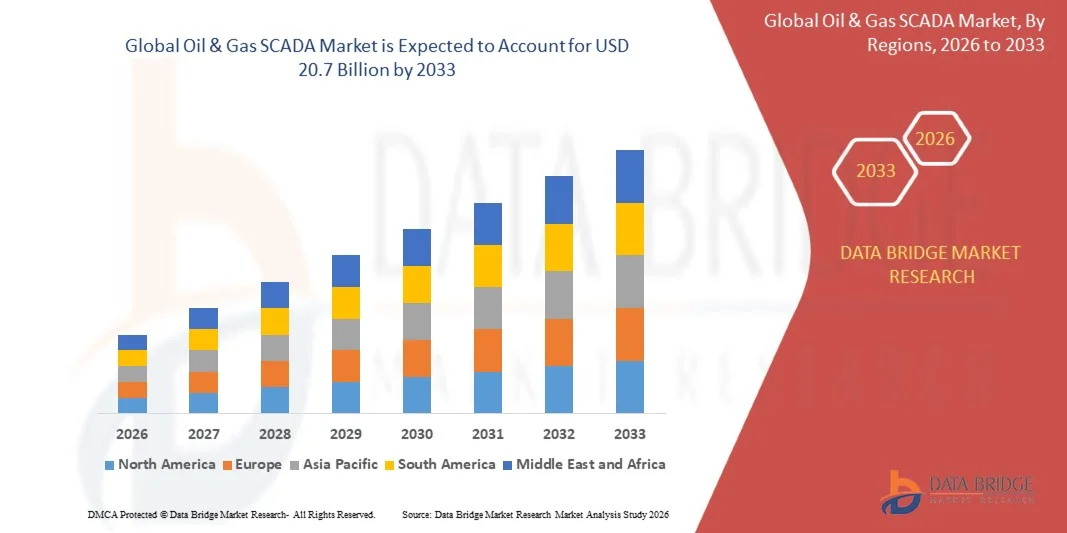
- As per Data Bridge Market Research analysis, the oil & gas SCADA was valued at USD 11.5 billion in 2025 and is projected to reach USD 20.7 billion by 2033, growing at a CAGR of 7.62% from 2026 to 2033.
- The market is expanding due to rising global energy demand, increasing natural gas consumption across power generation and industrial applications, growing energy security concerns, diversification of energy supplies, and increasing investments in LNG liquefaction, transportation, storage, and regasification infrastructure.
- Oil & gas SCADA is increasingly adopted across power generation, transportation, industrial, commercial, and other applications because of its flexibility as a globally traded energy source, lower emissions compared with coal and certain oil-based fuels, and ability to support reliable energy supply.
Market Size & Forecast
- Global Market Value (2025): USD 11.5 billion
- Expected Market Value (2033): USD 20.7 billion
- Forecast CAGR (2026–2033): 7.62%
- Leading Region in 2025: North America
- Fastest Growing Region: Asia-Pacific
What are the Major Takeaways of the Oil & Gas SCADA Market?
- North America dominated the global Oil & Gas SCADA market, accounting for a 39.4% revenue share in 2025, supported by extensive oil and gas production infrastructure, large pipeline networks, increasing automation of geographically dispersed assets, and growing demand for real-time monitoring and remote asset management.
- Asia Pacific is expected to register the fastest CAGR of 7.7% from 2026 to 2033, supported by rapid industrialization, rising energy demand, expansion of pipeline infrastructure, increasing exploration and production activities, refinery modernization, and growing investments in digitalization and automation across oil and gas operations.
- The upstream segment dominated the end-use category, accounting for a 41.2% market share in 2025 increasing adoption of digital oilfield technologies, automated drilling and production monitoring, remote operations, AI-enabled analytics, and the need to improve production efficiency and asset reliability.
- The hardware segment represents a major component category of the Oil & Gas SCADA market, supported by continued deployment of remote terminal units, programmable logic controllers, human-machine interfaces, sensors, and communication equipment across upstream, midstream, and downstream operations.
- Pipeline monitoring represents the leading application segment, accounting for a 38.4% market share in 2025 in a current Oil & Gas SCADA system dataset. Growth is supported by the expansion of natural gas transmission infrastructure, pipeline integrity requirements, leak detection, pressure monitoring, and increasing investments in digital pipeline management.
- On-premise deployment dominated the deployment category, accounting for a 62.4% market share in 2025 in the same dataset. The segment remains dominant because oil and gas operators require low-latency control, high cybersecurity, operational reliability, and greater control over mission-critical infrastructure. Cloud-based SCADA solutions are gaining adoption as operators increasingly deploy remote monitoring, centralized analytics, and cloud-connected industrial systems.
- The application segment is increasingly supported by refinery automation and production monitoring, with refinery and processing automation accounting for 18.6% of the market in 2025 in the current SCADA system dataset. Increasing refinery digitalization, process optimization, alarm management, predictive maintenance, and operational safety are supporting SCADA deployment across downstream facilities.
Report Scope and Oil & Gas SCADA Market Segmentation
|
Attributes |
Oil & Gas SCADA Key Market Insights |
|
Segments Covered |
|
|
Countries Covered |
North America
Europe
Asia-Pacific
Middle East and Africa
South America
|
|
Key Market Players |
|
|
Market Opportunities |
|
|
Value Added Data Infosets |
In addition to the market insights such as market value, growth rate, market segments, geographical coverage, market players, and market scenario, the market report curated by the Data Bridge Market Research team includes in-depth expert analysis, import/export analysis, pricing analysis, production consumption analysis, and pestle analysis. |
What is the Key Trend in the Oil & Gas SCADA Market?
- The increasing adoption of digitalization, industrial automation, AI-enabled analytics, and remote monitoring is becoming a major trend in the global oil & gas SCADA market. Oil and gas operators are increasingly integrating SCADA systems with advanced sensors, Industrial Internet of Things (IIoT), cloud platforms, and analytics tools to improve real-time visibility, optimize asset performance, reduce downtime, and strengthen operational efficiency across upstream, midstream, and downstream operations.
- The integration of artificial intelligence, machine learning, predictive analytics, and digital twins with SCADA platforms is gaining importance as operators seek to predict equipment failures, identify operational anomalies, optimize production, and improve maintenance planning. AI-enabled SCADA solutions are increasingly being used to analyze large volumes of real-time operational data generated by pipelines, wells, refineries, storage facilities, compressor stations, and other geographically dispersed assets.
- For instance, In March 2026, Honeywell commercially launched its Experion Operations Assistant, an AI-powered solution designed to provide real-time decision support and predictive intelligence for industrial operators. The solution had been piloted by Chevron and TotalEnergies, demonstrating the growing application of AI-enabled operational intelligence in the energy industry.
- Overall, the global oil & gas SCADA market is increasingly shaped by AI-enabled automation, cloud and hybrid deployment, IIoT connectivity, predictive maintenance, cybersecurity, digital twins, remote operations, and real-time asset monitoring. Oil and gas companies are therefore moving toward integrated digital control environments that combine SCADA with advanced analytics and connected industrial technologies to improve productivity, safety, asset reliability, and operational decision-making.
What are the Key Drivers of the Oil & Gas SCADA Market?
- The increasing adoption of digitalization, industrial automation, artificial intelligence, and real-time monitoring technologies is a major driver of the global oil & gas SCADA market. Oil and gas operators are increasingly deploying SCADA systems to monitor geographically dispersed wells, pipelines, compressor stations, storage facilities, terminals, and refineries. The integration of SCADA with IoT, edge computing, advanced analytics, digital twins, and AI enables operators to improve asset visibility, optimize production, reduce unplanned downtime, and strengthen operational decision-making. Siemens highlights digitalization, IoT, and AI as important technologies for improving safety, reliability, operational efficiency, and sustainability across the oil and gas value chain.
- The modernization of aging oil and gas infrastructure is further driving SCADA adoption. Many upstream, midstream, and downstream facilities continue to operate with legacy control systems, fragmented operational data, and geographically dispersed assets. SCADA modernization enables the integration of legacy PLCs, RTUs, sensors, historians, and control systems with newer digital platforms. This supports centralized monitoring, predictive maintenance, improved production visibility, and more efficient management of existing infrastructure without requiring complete replacement of installed assets.
- For instance, In June 2026, Honeywell and the MIT Center for Sustainability Science and Strategy released research on AI-enabled energy technologies. The research identified significant potential for digital and AI-enabled technologies to reduce energy production costs. This development highlights the increasing economic importance of AI and digitalization across energy operations.
- The increasing focus on cybersecurity and IT/OT convergence is creating additional demand for secure SCADA platforms. As oil and gas companies connect operational technology with enterprise IT systems, cloud platforms, remote monitoring tools, and industrial IoT devices, the need for cybersecurity, secure access, network segmentation, and continuous monitoring is increasing. SCADA vendors are therefore integrating cybersecurity capabilities into industrial automation and monitoring platforms to protect critical infrastructure.
What Factors are Challenging the Growth of the Oil & Gas SCADA Market?
- Cybersecurity risks associated with connected SCADA and operational technology (OT) systems represent a major challenge for the global oil & gas SCADA market. Increasing connectivity between SCADA, industrial control systems, remote terminal units, cloud platforms, IoT devices, and enterprise networks is expanding the potential attack surface. Oil and gas infrastructure is particularly sensitive because a successful cyberattack can disrupt production, pipeline operations, processing, and distribution.
- Legacy infrastructure and difficulties in integrating modern SCADA technologies with existing systems are limiting the pace of digital transformation. Many oil and gas facilities continue to operate equipment and control systems with long operational lifecycles, making replacement costly and technically complex. Integration of modern sensors, cloud platforms, AI, advanced analytics, and IIoT technologies with legacy PLCs, RTUs, communication networks, and control systems can create interoperability, data-standardization, and system-compatibility challenges.
- For instance, in July 2026, the International Energy Agency (IEA) and the Coalition for Disaster Resilient Infrastructure launched a joint study focused on strengthening the resilience of India's infrastructure. The initiative identified risks ranging from natural hazards to cybersecurity and highlighted the increasing importance of resilient energy infrastructure as electricity demand and electrification rise.
- Overall, the global oil & gas SCADA market is increasingly challenged by cybersecurity threats, legacy-system integration, high modernization costs, interoperability issues, communication-network dependency, skilled workforce shortages, and increasing regulatory requirements. Oil and gas operators are therefore required to balance digital transformation with operational continuity, cybersecurity, system reliability, and infrastructure resilience.
How is the Oil & Gas SCADA Market Segmented?
The global oil & gas SCADA is segmented on the basis of application, deployment type, components, and end use.
- By Application
On the basis of application, the global oil & gas SCADA market is segmented into pipeline monitoring, oil and gas production monitoring, refinery automation, and distribution management. Pipeline monitoring represents the leading application segment accounting for 38.4% of market revenue in 2025. Growth is supported by the expansion of pipeline networks, increasing requirements for real-time pressure and flow monitoring, leak detection, pipeline integrity management, and remote asset control.
Pipeline monitoring is projected to register the fastest CAGR of 6.2% from 2026 to 2033. Supported by increasing requirements for automated distribution networks, real-time asset monitoring, and remote operational control.
- By Deployment Type
On the basis of deployment type, the global oil & gas SCADA market is segmented into on-premise and cloud-based solutions. The on-premise segment accounted for a 62.42% market share in 2025, while Cloud-Based SCADA represents the fastest-growing deployment category. Growth in cloud-based solutions is supported by increasing demand for remote monitoring, centralized data management, scalable infrastructure, and integration with advanced analytics.
Cloud-Based SCADA is projected to register the fastest hypothetical CAGR of 9.1% from 2026 to 2033. Increasing adoption of remote monitoring, centralized data access, scalable infrastructure, and cloud analytics is expected to support the transition toward cloud-based SCADA architectures.
- By Components
On the basis of components, the global oil & gas SCADA market is segmented into hardware, software, and services. The hardware segment dominated with a 48.6% market share in 2025. Hardware includes RTUs, PLCs, sensors, communication equipment, and HMI systems deployed across oil and gas facilities. Software and services are gaining importance as operators increasingly adopt advanced analytics, cloud platforms, cybersecurity solutions, system integration, and remote monitoring.
Services are projected to record the highest hypothetical CAGR of 8.3% from 2026 to 2033, driven by increasing demand for system integration, maintenance, cybersecurity, modernization, and managed SCADA services.
- By End Use
On the basis of end use, the global oil & gas SCADA market is segmented into upstream, midstream, and downstream. The upstream segment dominated with a 41.2% market share in 2025. Growth is supported by increasing deployment of SCADA systems for wellhead monitoring, drilling operations, production monitoring, reservoir management, remote operations, and digital oilfield technologies. Midstream adoption is supported by pipeline transportation, compressor stations, and storage infrastructure, while downstream demand is supported by refinery automation, processing, and distribution operations.
The upstream segment is projected to register the fastest CAGR of 6.5% from 2026 to 2033 growth is supported by increasing deployment of SCADA systems for wellhead monitoring, drilling operations, production monitoring, reservoir management, remote operations, and digital oilfield technologies. Midstream adoption is supported by pipeline transportation, compressor stations, and storage infrastructure, while downstream demand is supported by refinery automation, processing, and distribution operation
Which Region Holds the Largest Share of the Oil & Gas SCADA Market?
- North America accounted for the largest share of the global oil & gas SCADA market, with a 39.4% revenue share in 2025, supported by its well-established oil and gas infrastructure, extensive pipeline networks, large-scale upstream, midstream, and downstream operations, high adoption of digitalization and automation technologies, and continuous investments in infrastructure modernization. The presence of major oil and gas producers and technology providers further supports the widespread deployment of SCADA systems for real-time monitoring, remote asset management, pipeline integrity, leak detection, and operational optimization.
- The region benefits from increasing investments in pipeline infrastructure, shale oil and gas production, offshore developments, refining facilities, and modernization of aging oil and gas assets. The U.S. represents a major contributor to regional demand, supported by extensive unconventional oil and gas production, geographically dispersed energy assets, and growing requirements for real-time monitoring and control.
U.S. Oil & Gas SCADA Market Insight
The U.S. oil & gas SCADA market is characterized by strong adoption of advanced monitoring and control systems across upstream, midstream, and downstream operations. Growth is supported by extensive shale oil and gas production, large pipeline networks, aging infrastructure modernization, and increasing adoption of remote monitoring, automation, edge computing, and advanced analytics.
Canada Oil & Gas SCADA Market Insight
The Canada oil & gas SCADA market is expected to witness steady growth, supported by extensive oil and gas production, pipeline infrastructure, and increasing investments in digital monitoring and automation technologies. The market is projected to expand at a driven by rising adoption of remote asset monitoring, predictive maintenance, pipeline integrity management, and cybersecurity solutions. Increasing deployment of cloud-enabled SCADA, Industrial Internet of Things (IIoT), and advanced analytics is expected to strengthen operational efficiency across upstream, midstream, and downstream facilities. Alberta and Saskatchewan are expected to remain key contributors to regional SCADA demand.
Asia-Pacific Oil & Gas SCADA Market Insight
The Asia-Pacific oil & gas SCADA market is expected to witness strong growth, supported by rising energy consumption, expanding oil and gas production, and increasing investments in pipelines, refineries, storage facilities, and LNG infrastructure. Rapid industrialization across China, India, Japan, South Korea, and Southeast Asia is encouraging operators to adopt SCADA systems for real-time monitoring, remote asset management, predictive maintenance, and operational optimization.
China Oil & Gas SCADA Market Insight
The China oil & gas SCADA market is expected to witness steady growth, supported by rising energy demand, expansion of domestic oil and gas production, and modernization of pipeline, refinery, storage, and distribution infrastructure. Increasing investments in digital oilfields, industrial automation, remote asset monitoring, and industrial Internet technologies are expected to strengthen SCADA adoption across upstream, midstream, and downstream operations.
Japan Oil & Gas SCADA Market Insight
The Japan oil & gas SCADA market is expected to witness steady growth, supported by modernization of aging energy infrastructure, increasing investments in pipeline monitoring, refinery automation, storage facilities, and digital asset management. The rising adoption of real-time monitoring, remote operations, industrial automation, cybersecurity solutions, and cloud-enabled SCADA platforms. Japan’s emphasis on energy security, operational efficiency, and infrastructure resilience is expected to encourage the integration of advanced SCADA technologies across upstream, midstream, and downstream facilities, particularly for refining, distribution, and energy transportation applications.
Germany Oil & Gas SCADA Market Insight
Germany represents a significant European market for oil & gas SCADA solutions, supported by its advanced industrial automation ecosystem, extensive natural gas distribution infrastructure, refinery operations, and increasing modernization of legacy control systems. Reflecting its strong position in European process automation. Demand is further supported by investments in pipeline safety, cybersecurity, predictive maintenance, real-time monitoring, and digitalization of energy infrastructure. The adoption of cloud-enabled SCADA, IIoT connectivity, and advanced analytics is expected to strengthen market growth as German operators prioritize operational efficiency, infrastructure resilience, and secure remote monitoring.
U.K. Oil & Gas SCADA Market Insight
The U.K. oil & gas SCADA market is expected to witness steady growth, supported by increasing digitalization of North Sea oil and gas operations, modernization of aging infrastructure, and rising demand for real-time monitoring and remote asset management. Within the oil and gas industry, adoption is supported by investments in digital and data technologies, with 28 U.K. continental shelf operators reporting interest in such technologies. Increasing use of AI, predictive maintenance, cybersecurity, and automation is expected to further support SCADA deployment.
Which are the Top Companies in Oil & Gas SCADA Market?
The oil & gas SCADA industry is primarily led by well-established companies, including:
- Schneider Electric (France)
- Honeywell International Inc. (U.S.)
- Siemens AG (Germany)
- Emerson Electric Co. (U.S.)
- Rockwell Automation (U.S.)
- ABB Ltd. (Switzerland)
- General Electric Company (U.S.)
- Yokogawa Electric Corporation (Japan)
- Kongsberg Gruppen (Norway)
What are Latest Developments in Oil & Gas SCADA Market?
- In August 2026, Emerson announced that BP awarded it a multi-million-dollar contract to provide automation technologies for the shah deniz compression project offshore Azerbaijan. The integrated control and safety systems will support remote operations, process control, safety shutdown, fire and gas detection, and power management for the normally unattended offshore platform.
- In June 2026, Yokogawa released an updated version of its OpreX Collaborative Information Server with improved integrated HMI capabilities, enhanced multi-vendor connectivity, and stronger security features. The development supports centralized monitoring, IT/OT integration, remote operations, and production optimization across geographically distributed facilities.
- In March 2026, Honeywell commercially launched its experion operations assistant, an AI-powered solution designed to provide real-time decision support and predictive intelligence to industrial operators. The technology combines historical and real-time operational data to help identify potential critical scenarios and reduce unplanned downtime. Chevron and TotalEnergies participated in pilot programs.
- In January 2026, ABB India completed modernization of bharat petroleum corporation limited's vadinar–bina pipeline, upgrading automation and monitoring systems through the ABB Ability SCADAvantage platform. The project included replacement of 35 RTUs, new SCADA servers, network protection, system hardening, centralized monitoring, failover capability, and disaster-recovery infrastructure.
- In November 2025, Schneider Electric introduced new OT cybersecurity functionality for its SCADAPack 470i and 474i smart RTUs. The development enables more secure management of remote RTU access using standard IT tools, addressing cybersecurity requirements for critical infrastructure including oil and gas pipelines.

- Interactive Data Analysis Dashboard
- Company Analysis Dashboard for high growth potential opportunities
- Research Analyst Access for customization & queries
- Competitor Analysis with Interactive dashboard
- Latest News, Updates & Trend analysis
- Harness the Power of Benchmark Analysis for Comprehensive Competitor Tracking
Data collection and base year analysis are done using data collection modules with large sample sizes. The stage includes obtaining market information or related data through various sources and strategies. It includes examining and planning all the data acquired from the past in advance. It likewise envelops the examination of information inconsistencies seen across different information sources. The market data is analysed and estimated using market statistical and coherent models. Also, market share analysis and key trend analysis are the major success factors in the market report. To know more, please request an analyst call or drop down your inquiry.
The key research methodology used by DBMR research team is data triangulation which involves data mining, analysis of the impact of data variables on the market and primary (industry expert) validation. Data models include Vendor Positioning Grid, Market Time Line Analysis, Market Overview and Guide, Company Positioning Grid, Patent Analysis, Pricing Analysis, Company Market Share Analysis, Standards of Measurement, Global versus Regional and Vendor Share Analysis. To know more about the research methodology, drop in an inquiry to speak to our industry experts.
Data Bridge Market Research is a leader in advanced formative research. We take pride in servicing our existing and new customers with data and analysis that match and suits their goal. The report can be customized to include price trend analysis of target brands understanding the market for additional countries (ask for the list of countries), clinical trial results data, literature review, refurbished market and product base analysis. Market analysis of target competitors can be analyzed from technology-based analysis to market portfolio strategies. We can add as many competitors that you require data about in the format and data style you are looking for. Our team of analysts can also provide you data in crude raw excel files pivot tables (Fact book) or can assist you in creating presentations from the data sets available in the report.