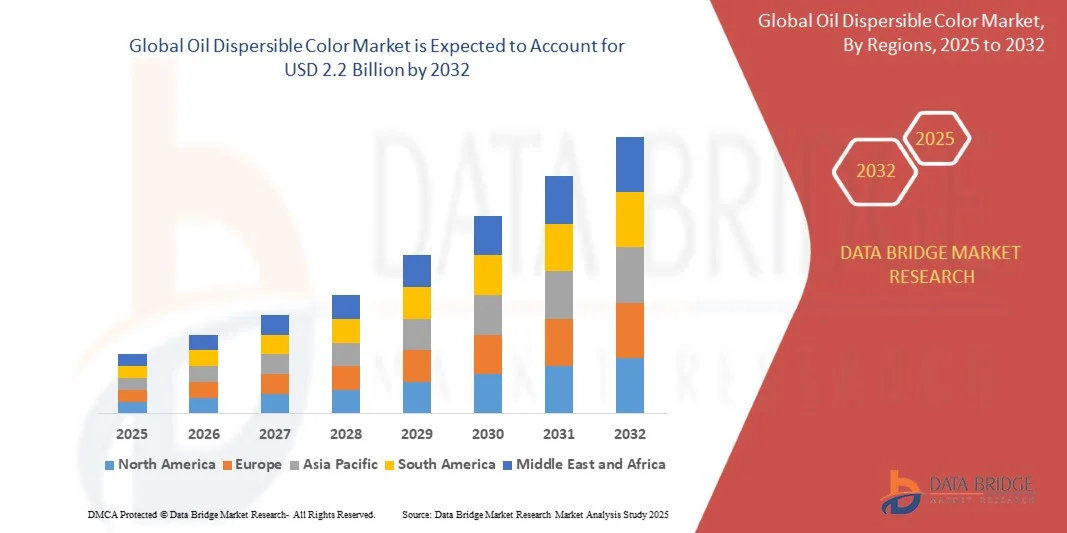
Oil Dispersible Color Market Size
- The global oil dispersible color market size was valued at USD 1.2 billion in 2024 and is expected to reach USD 2.2 billion by 2032, at a CAGR of 4.10% during the forecast period
- The market growth is largely fuelled by increasing demand from the paints, coatings, plastics, and cosmetics industries, driven by the need for vibrant, durable, and stable color solutions
- Rising adoption of advanced pigment technologies, expansion of industrial and decorative applications, and growing focus on sustainable and high-performance formulations are further supporting market growth
Oil Dispersible Color Market Analysis
- The market is witnessing strong growth due to innovations in pigment dispersibility, color intensity, and compatibility with diverse binders and resins
- Industrial sectors, including automotive, packaging, and construction, are driving the adoption of oil dispersible colors for long-lasting, high-quality finishes
- North America dominated the oil dispersible color market with the largest revenue share of 35.50% in 2024, driven by the growing demand for high-performance coatings, paints, and industrial colorants, as well as increasing adoption of advanced pigment technologies
- Asia-Pacific region is expected to witness the highest growth rate in the global oil dispersible color market, driven by increasing urbanization, expansion of the coatings and paints industry, and rising awareness about premium and durable pigmentation solutions
- The Synthetic segment held the largest market revenue share in 2024, driven by its consistent quality, vibrant shades, and superior stability in industrial applications such as paints, coatings, plastics, and inks. Synthetic oil dispersible colors are preferred by manufacturers for their ease of formulation, wide compatibility with various resins and binders, and long shelf life, making them suitable for large-scale production
Report Scope and Oil Dispersible Color Market Segmentation
|
Attributes |
Oil Dispersible Color Key Market Insights |
|
Segments Covered |
|
|
Countries Covered |
North America
Europe
Asia-Pacific
Middle East and Africa
South America
|
|
Key Market Players |
|
|
Market Opportunities |
|
|
Value Added Data Infosets |
In addition to the insights on market scenarios such as market value, growth rate, segmentation, geographical coverage, and major players, the market reports curated by the Data Bridge Market Research also include import export analysis, production capacity overview, production consumption analysis, price trend analysis, climate change scenario, supply chain analysis, value chain analysis, raw material/consumables overview, vendor selection criteria, PESTLE Analysis, Porter Analysis, and regulatory framework. |
Oil Dispersible Color Market Trends
“Rise of Advanced Pigment Technologies”
- The increasing adoption of oil dispersible colors in paints, coatings, and construction materials is transforming the industry by providing superior color strength, stability, and resistance to weathering. These pigments enable vibrant, long-lasting finishes that meet industrial and decorative requirements, while supporting compatibility with multiple substrates and resins, making them versatile for various applications
- Growing demand for customized color solutions in industrial coatings, automotive paints, and plastic applications is accelerating the use of oil dispersible colors. Their compatibility with various binders and resins improves formulation flexibility and end-product performance, enabling manufacturers to achieve precise shades and textures tailored to consumer preferences
- The affordability, easy dispersibility, and enhanced opacity of modern oil dispersible colors make them attractive for manufacturers seeking consistent and high-quality pigmentation. These advantages support operational efficiency and reduce production challenges, while also lowering waste and minimizing reprocessing in manufacturing
- For instance, in 2023, several European and North American coating manufacturers integrated high-performance oil dispersible pigments into exterior paints, improving color durability and customer satisfaction. Adoption in industrial coatings also enhanced resistance to UV degradation, corrosion, and abrasion, extending product life cycles
- While oil dispersible colors are gaining traction, their success depends on pigment quality, regulatory compliance, and compatibility with different formulations. Manufacturers must focus on innovation, eco-friendly pigments, and scalable production to meet growing global demand, while ensuring cost-effectiveness and supply chain stability
Oil Dispersible Color Market Dynamics
Driver
“Rising Demand for High-Performance and Durable Coatings”
- The increasing need for durable, fade-resistant, and vibrant coatings is driving the oil dispersible color market. Industries such as construction, automotive, and packaging are relying on these pigments to improve product quality and aesthetics, while meeting performance standards under extreme weather and environmental conditions
- Innovations in pigment technology, including nano-dispersions and advanced surface treatments, enhance color performance and stability, boosting market adoption. These innovations also improve dispersibility, reduce settling during storage, and enable energy-efficient manufacturing processes
- Environmental regulations and consumer demand for high-quality, long-lasting finishes are encouraging manufacturers to invest in oil dispersible color solutions that comply with international standards. The focus on low-VOC and eco-friendly pigments further promotes adoption in sustainable construction and green coatings markets
- For instance, in 2022, several automotive paint companies in the U.S. and Germany adopted oil dispersible pigments to meet stringent durability and performance criteria, reducing maintenance and repainting costs. This also contributed to enhanced brand perception for eco-conscious and high-performance products
- As industries continue to focus on quality, efficiency, and sustainability, the demand for oil dispersible colors is expected to grow steadily across regions, driven by increasing urbanization, infrastructure development, and industrial expansion in emerging markets
Restraint/Challenge
“High Production Costs and Regulatory Compliance Issues”
- The production of high-quality oil dispersible colors involves specialized raw materials and advanced manufacturing processes, resulting in higher costs for manufacturers. This can limit adoption, particularly in price-sensitive markets, and may slow down entry into small-scale or regional applications
- Compliance with stringent environmental and safety regulations, including VOC restrictions and pigment toxicity standards, adds complexity and increases production costs. Manufacturers must invest in R&D, testing, and certifications to ensure adherence to global regulatory norms
- Limited availability of certain high-performance pigments can disrupt supply chains and affect consistent product quality in industrial applications. Shortages of raw materials, delays in imports, and geopolitical factors can create temporary market instability
- For instance, in 2023, manufacturers in Asia-Pacific faced raw material shortages and regulatory delays that impacted pigment availability and pricing for industrial coatings. Similar challenges were reported in Europe, affecting export-dependent production lines and project timelines
- While oil dispersible colors remain in high demand, addressing cost, compliance, and supply challenges is crucial for sustainable growth and market competitiveness. Investment in local pigment production, alternative raw materials, and efficient logistics is becoming essential to maintain steady market expansion
Oil Dispersible Color Market Scope
The oil dispersible color market is segmented on the basis of product and application.
• By Product
On the basis of product, the oil dispersible color market is segmented into Natural and Synthetic. The Synthetic segment held the largest market revenue share in 2024, driven by its consistent quality, vibrant shades, and superior stability in industrial applications such as paints, coatings, plastics, and inks. Synthetic oil dispersible colors are preferred by manufacturers for their ease of formulation, wide compatibility with various resins and binders, and long shelf life, making them suitable for large-scale production.
The Natural segment is expected to witness the fastest growth rate from 2025 to 2032, driven by rising consumer demand for eco-friendly, non-toxic, and clean-label products in food, cosmetics, and pharmaceutical applications. Natural oil dispersible colors are increasingly adopted due to their safety profile, regulatory compliance, and growing awareness of sustainability, making them popular among manufacturers targeting health-conscious and environmentally aware end-users.
• By Application
On the basis of application, the market is segmented into Food & Beverages, Cosmetics, and Pharmaceuticals. The Food & Beverages segment held the largest market revenue share in 2024, fueled by the increasing use of vibrant and stable colorants in confectionery, bakery, dairy, and beverages to enhance product appeal and consumer acceptance.
The Cosmetics segment is expected to witness the fastest growth rate from 2025 to 2032, driven by the rising demand for colorful, high-performance, and safe cosmetic formulations. Oil dispersible colors are widely used in lipsticks, creams, and personal care products due to their compatibility with oils, stability under heat, and non-toxic properties, supporting the trend toward premium and natural beauty products.
Oil Dispersible Color Market Regional Analysis
- North America dominated the oil dispersible color market with the largest revenue share of 35.50% in 2024, driven by the growing demand for high-performance coatings, paints, and industrial colorants, as well as increasing adoption of advanced pigment technologies
- Manufacturers and end-users in the region highly value the superior color strength, stability, and resistance to weathering offered by oil dispersible colors, enhancing both product aesthetics and durability
- This widespread adoption is further supported by well-established chemical and coatings industries, technological advancements, and growing consumer preference for long-lasting, vibrant finishes across residential, commercial, and industrial applications
U.S. Oil Dispersible Color Market Insight
The U.S. oil dispersible color market captured the largest revenue share in 2024 within North America, fueled by the increasing need for durable, fade-resistant, and vibrant coatings. Industries such as construction, automotive, and packaging are increasingly prioritizing high-performance pigmentation. The growing trend of customized color solutions, combined with regulatory compliance and sustainability initiatives, further supports market growth. Moreover, the integration of oil dispersible colors in advanced formulations for paints, inks, and plastics is significantly contributing to market expansion.
Europe Oil Dispersible Color Market Insight
The Europe oil dispersible color market is expected to witness the fastest growth rate from 2025 to 2032, primarily driven by stringent environmental regulations and the rising demand for durable and eco-friendly pigments. The region’s increasing industrial production, coupled with the demand for high-quality coatings and decorative applications, is fostering adoption. European manufacturers are also investing in research and development to create innovative, sustainable pigment solutions, boosting market penetration across multiple industries.
U.K. Oil Dispersible Color Market Insight
The U.K. oil dispersible color market is expected to witness the fastest growth rate from 2025 to 2032, driven by rising construction activities, automotive production, and the growing preference for durable, aesthetically appealing coatings. Increasing awareness about eco-friendly and non-toxic pigments is encouraging both manufacturers and consumers to adopt oil dispersible color solutions. The UK’s strong manufacturing infrastructure and robust paint and coatings sector are expected to continue stimulating market growth.
Germany Oil Dispersible Color Market Insight
The Germany oil dispersible color market is expected to witness the fastest growth rate from 2025 to 2032, fueled by demand for technologically advanced and sustainable pigment solutions. Germany’s well-developed chemical and coatings industries, combined with stringent environmental and quality standards, are promoting adoption. Manufacturers are increasingly integrating oil dispersible colors in high-performance applications such as industrial coatings, automotive paints, and specialty plastics to meet consumer expectations.
Asia-Pacific Oil Dispersible Color Market Insight
The Asia-Pacific oil dispersible color market is expected to witness the fastest growth rate from 2025 to 2032, driven by rapid urbanization, industrialization, and rising demand for decorative and functional coatings in countries such as China, Japan, and India. The region’s growing manufacturing base, along with government initiatives promoting sustainable and high-quality products, is driving adoption. Moreover, as APAC emerges as a hub for pigment production, the affordability and accessibility of oil dispersible colors are expanding to a wider consumer and industrial base.
Japan Oil Dispersible Color Market Insight
The Japan oil dispersible color market is expected to witness the fastest growth rate from 2025 to 2032 due to the country’s advanced industrial base, technological expertise, and strong demand for high-quality coatings and industrial applications. Japanese consumers and manufacturers emphasize durability, aesthetic appeal, and environmental compliance, driving adoption of oil dispersible colors. In addition, integration with advanced formulations for paints, inks, and plastics is increasing market penetration in both commercial and industrial sectors.
China Oil Dispersible Color Market Insight
The China oil dispersible color market accounted for the largest market revenue share in Asia-Pacific in 2024, attributed to rapid industrialization, expanding construction activities, and rising demand for high-performance coatings. China is one of the largest consumers of pigments for paints, coatings, and plastics, and oil dispersible colors are increasingly preferred for their durability and vibrant finishes. Government initiatives supporting sustainable industrial practices and a strong domestic pigment manufacturing base are key factors propelling the market in China.
Oil Dispersible Color Market Share
The Oil Dispersible Color industry is primarily led by well-established companies, including:
- Sensient Technologies Corporation (U.S.)
- DDW The Color House (U.S.)
- Roha Dyechem Pvt. Ltd (India)
- GNT Group (Netherlands)
- Lycored (Israel)
- Naturex (a Givaudan company) (France)
- AromataGroup (U.K.)
- Kalsec Inc (U.S.)
- Fiorio Colori S.p.A. (Italy)
Latest Developments in Global Oil Dispersible Color Market
- In September 2024, Givaudan Active Beauty launched the N.A.S. Vibrant Collection, a new range of 100% natural origin active botanical extracts designed for hybrid makeup. This development features oil-dispersible powders that enhance biological efficacy while maintaining vibrant color performance, intensity, and stability. The innovation allows makeup brands to offer natural, high-performance products, meeting rising consumer demand for clean and effective cosmetic solutions. The introduction is expected to strengthen Givaudan’s position in the active beauty ingredient market and drive growth in the natural hybrid makeup segment
- In March 2024, Benjamin Moore introduced Woodluxe, a premium line of all-weather exterior stains available in both water and oil-based formulations with varying opacities. This product launch provides durable, aesthetically appealing finishes for outdoor surfaces, combining performance and versatility. By addressing consumer demand for high-quality, long-lasting exterior coatings, the launch is poised to enhance Benjamin Moore’s market share in the architectural coatings sector and drive adoption of advanced, weather-resistant stain solutions

- Interactive Data Analysis Dashboard
- Company Analysis Dashboard for high growth potential opportunities
- Research Analyst Access for customization & queries
- Competitor Analysis with Interactive dashboard
- Latest News, Updates & Trend analysis
- Harness the Power of Benchmark Analysis for Comprehensive Competitor Tracking
Data collection and base year analysis are done using data collection modules with large sample sizes. The stage includes obtaining market information or related data through various sources and strategies. It includes examining and planning all the data acquired from the past in advance. It likewise envelops the examination of information inconsistencies seen across different information sources. The market data is analysed and estimated using market statistical and coherent models. Also, market share analysis and key trend analysis are the major success factors in the market report. To know more, please request an analyst call or drop down your inquiry.
The key research methodology used by DBMR research team is data triangulation which involves data mining, analysis of the impact of data variables on the market and primary (industry expert) validation. Data models include Vendor Positioning Grid, Market Time Line Analysis, Market Overview and Guide, Company Positioning Grid, Patent Analysis, Pricing Analysis, Company Market Share Analysis, Standards of Measurement, Global versus Regional and Vendor Share Analysis. To know more about the research methodology, drop in an inquiry to speak to our industry experts.
Data Bridge Market Research is a leader in advanced formative research. We take pride in servicing our existing and new customers with data and analysis that match and suits their goal. The report can be customized to include price trend analysis of target brands understanding the market for additional countries (ask for the list of countries), clinical trial results data, literature review, refurbished market and product base analysis. Market analysis of target competitors can be analyzed from technology-based analysis to market portfolio strategies. We can add as many competitors that you require data about in the format and data style you are looking for. Our team of analysts can also provide you data in crude raw excel files pivot tables (Fact book) or can assist you in creating presentations from the data sets available in the report.