


Omega-6 Market Size
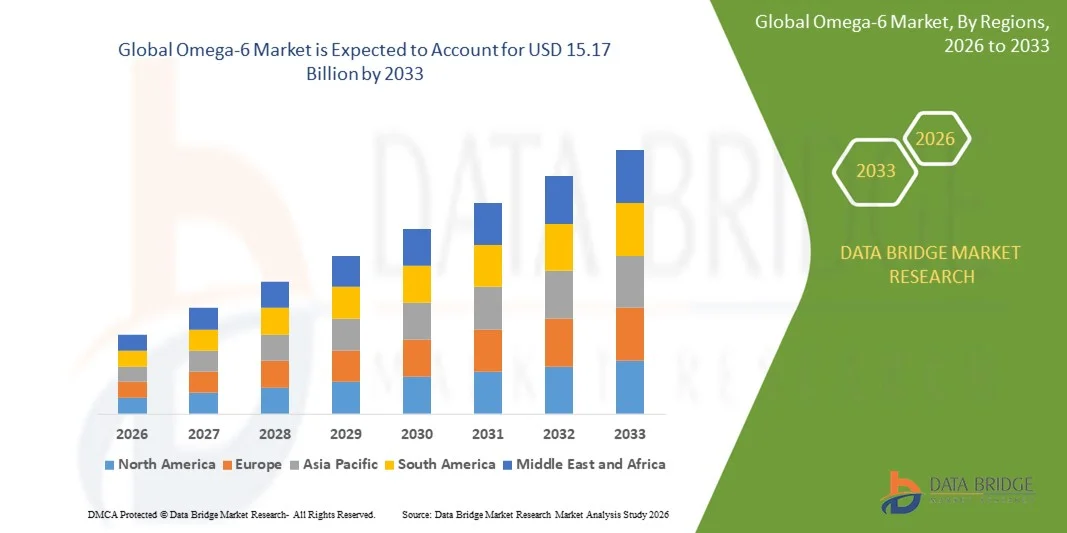
- The global omega-6 market size was valued at USD 7.56 billion in 2025 and is expected to reach USD 15.17 billion by 2033, at a CAGR of 9.10% during the forecast period
- The market growth is largely fueled by the rising consumption of functional and fortified food products enriched with essential fatty acids, driven by increasing health consciousness and a growing awareness of the nutritional benefits associated with Omega-6 ingredients in daily diets
- Furthermore, the expanding use of Omega-6 in dietary supplements, pharmaceuticals, and animal feed is strengthening its demand across global industries. These combined factors are accelerating the uptake of Omega-6–based products, thereby significantly boosting the market’s overall expansion
Omega-6 Market Analysis
- Omega-6, widely used in food and beverage formulations, supplements, and feed applications, is becoming a key nutritional component due to its role in supporting metabolism, promoting cellular health, and enhancing immune function across diverse consumer groups
- The increasing demand for Omega-6 ingredients is primarily driven by the growing preference for plant-based oils, rising production of nutritional supplements, and expanding applications across health-focused product categories, positioning Omega-6 as an essential element in modern nutrition markets
- North America dominated the omega-6 market with a share of over 40% in 2025, due to high consumption of processed foods and strong reliance on vegetable oils across household and industrial applications
- Asia-Pacific is expected to be the fastest growing region in the omega-6 market during the forecast period due to rapid urbanization, growing disposable incomes, and strong expansion of the food processing sector across China, Japan, and India
- Soybean oil segment dominated the market with a market share of 46.1% in 2025, due to its high global availability and cost-effectiveness, making it the most accessible Omega-6 source for both food manufacturers and supplement producers. Its widespread use in processed foods, cooking oils, and nutraceutical formulations strengthens its market position, as industries prefer ingredients with stable supply chains and consistent quality. The segment benefits from large-scale cultivation across major agricultural economies, ensuring steady raw material flow for industrial applications. Growing consumption of plant-based oils in emerging markets further reinforces soybean oil’s leading share within Omega-6 production
Report Scope and Omega-6 Market Segmentation
|
Attributes |
Omega-6 Key Market Insights |
|
Segments Covered |
|
|
Countries Covered |
North America
Europe
Asia-Pacific
Middle East and Africa
South America
|
|
Key Market Players |
|
|
Market Opportunities |
|
|
Value Added Data Infosets |
In addition to the insights on market scenarios such as market value, growth rate, segmentation, geographical coverage, and major players, the market reports curated by the Data Bridge Market Research also include in-depth expert analysis, pricing analysis, brand share analysis, consumer survey, demography analysis, supply chain analysis, value chain analysis, raw material/consumables overview, vendor selection criteria, PESTLE Analysis, Porter Analysis, and regulatory framework. |
Omega-6 Market Trends
Digital Expansion of Nutritional Oil Formulations
- The omega-6 market is experiencing a transformative trend marked by the digital expansion of nutritional oil formulations across functional foods, supplements, and direct-to-consumer wellness platforms. Companies are leveraging e-commerce, digital marketing, and personalized nutrition apps to promote omega-6 enriched products and educate consumers on the benefits of essential fatty acids for cardiovascular, metabolic, and skin health
- For instance, industry leaders such as DSM and BASF SE are developing plant-derived, specification-grade omega-6 ingredients and integrating digital technologies for traceability, clean-label claims, and online education. Their strategies include collaborations with e-health platforms and nutrigenomics firms to deliver customized lipid formulations and monitor consumer outcomes via wearable health devices
- The digital economy is encouraging rapid product innovation and broader consumer engagement through subscription models, influencer partnerships, and digital wellness campaigns. This trend is facilitating quicker product launches of organic, cold-pressed, and non-GMO omega-6 formulations, tailored for vegan and specialty nutrition markets
- Integration of omega-6 into novel delivery forms—such as gummies, softgels, beverages, and ready-to-eat snacks—is broadening appeal among younger, tech-savvy consumers. Transparency in sourcing, digital labeling, and direct communication channels support consumer trust and repeat purchase behaviors
- Advanced data analytics, cloud-based inventory systems, and direct-to-consumer fulfillment have streamlined supply chains for omega-6 producers. Real-time demand tracking enables companies to adapt product offerings efficiently to market trends and regional consumption patterns
- The convergence of digital health, clean-label trends, and nutritional science is reshaping the competitive landscape for omega-6. The integration of personalized wellness solutions and digital platforms is expected to accelerate growth, making digital-first strategies central to future market expansion
Omega-6 Market Dynamics
Driver
Rising Demand for Plant-Derived Essential Fatty Acids
- Significant growth in the omega-6 market is driven by rising demand for plant-derived essential fatty acids from health-conscious consumers and food manufacturers. Linoleic acid-rich oils such as sunflower, safflower, and soy are gaining widespread application for their cholesterol-lowering and anti-inflammatory properties
- For instance, Cargill Incorporated and Archer Daniels Midland Company (ADM) have scaled up production of cold-pressed sunflower and safflower oils, investing in traceable and non-GMO supply chains to meet surging demand in functional foods, dietary supplements, and fortified beverages
- Global dietary shifts toward plant-based, vegan, and allergen-free nutrition are increasing reliance on botanical omega-6 sources compared to animal-based oils. Regulatory encouragement for healthy fat consumption and integration into national nutrition programs is further amplifying uptake across Europe, North America, and Asia
- Plant-derived omega-6 oils are now featured in a variety of culinary, snack, and personal care applications. Their versatility, neutral taste profile, and label-friendly perception provide formulators with flexible options to target premium health and wellness markets
- Continuous scientific validation of omega-6 health benefits, such as enhancements in skin hydration, baby formula nutrition, and cardiovascular health, supports consumption growth. As consumers emphasize prevention and holistic wellness, plant-based omega-6 ingredients are securing a prominent role in mainstream and specialized nutrition segments
Restraint/Challenge
Pricing Volatility of Raw Material Oils
- Pricing volatility of raw material oils remains a substantial challenge for omega-6 market stakeholders. The cost of feedstocks such as sunflower, safflower, and soybean oil is subject to fluctuations influenced by global weather patterns, crop yields, energy costs, and geopolitical factors
- For instance, producers such as Wilmar International Limited and Bunge Limited have reported disruptions in raw oil supply chains due to adverse growing conditions and export restrictions, resulting in unpredictable input costs and tighter profit margins in high-growth markets
- Variability in commodity markets complicates long-term planning for manufacturers and brand owners, leading to elevated pricing of omega-6 enriched products and potential loss of price-sensitive consumers. Supply shortages and input price hikes can also delay new product development or scale-up for innovative formulations
- Stricter quality, sustainability, and clean-label requirements further add to cost pressures, as investments in traceable, non-GMO, pesticide-free oils incur premiums at both the production and processing stages
- Mitigating raw material volatility will be crucial for long-term Omega-6 market stability. This will require expanding contract farming, improving supplier diversification, and adopting hedging strategies to manage risk efficiently across global supply chains. Consistent and affordable supply of high-quality raw oils will remain a deciding factor in the successful execution of value-added omega-6 product strategies
Omega-6 Market Scope
The market is segmented on the basis of source type and application.
- By Source Type
On the basis of source type, the Omega-6 market is segmented into soybean oil, sunflower oil, rapeseed oil, sesame oil, palm oil, and others. The soybean oil segment dominated the market with the largest share of 46.1% in 2025 due to its high global availability and cost-effectiveness, making it the most accessible Omega-6 source for both food manufacturers and supplement producers. Its widespread use in processed foods, cooking oils, and nutraceutical formulations strengthens its market position, as industries prefer ingredients with stable supply chains and consistent quality. The segment benefits from large-scale cultivation across major agricultural economies, ensuring steady raw material flow for industrial applications. Growing consumption of plant-based oils in emerging markets further reinforces soybean oil’s leading share within Omega-6 production.
The sunflower oil segment is expected to witness the fastest growth rate from 2026 to 2033 because of rising demand for cleaner, premium-quality oils perceived as healthier alternatives. Sunflower oil contains high linoleic acid concentration, boosting its suitability for dietary supplements and fortified food products focused on heart and metabolic wellness. Its expanding adoption in cosmetics and personal care formulations also fuels growth, as manufacturers increasingly choose natural oils for skin nourishment products. Product reformulation trends among food producers using low-saturated-fat oils continue to accelerate sunflower oil’s expansion, making it the most rapidly emerging segment in the Omega-6 category.
- By Application
On the basis of application, the Omega-6 market is segmented into dietary supplements, animal feeds, pharmaceuticals, food and beverages, and others. The food and beverages segment dominated the market in 2025 owing to the extensive inclusion of Omega-6-rich oils in processed foods, bakery products, spreads, and everyday cooking oils. Manufacturers increasingly incorporate Omega-6 ingredients to enhance nutritional profiles and meet consumer interest in functional food products. The segment benefits from strong retail penetration, especially in emerging economies where packaged food consumption is rising rapidly. Continuous innovation in fortified food launches enables food brands to maintain high usage of Omega-6 oils across diverse product lines, supporting its dominant share.
The dietary supplements segment is projected to record the fastest growth from 2026 to 2033 due to rising awareness of essential fatty acid intake for brain, heart, and cellular health. Growing preference for plant-derived supplement ingredients accelerates the adoption of Omega-6 oils in capsule, softgel, and powder formulations. Increased consumer focus on preventive health and wellness further supports demand, especially among aging populations and fitness-oriented consumers. Expansion of e-commerce nutraceutical brands widens product accessibility, enabling rapid growth of Omega-6 supplementation across global markets.
Omega-6 Market Regional Analysis
- North America dominated the omega-6 market with the largest revenue share of over 40% in 2025, driven by high consumption of processed foods and strong reliance on vegetable oils across household and industrial applications
- The region’s well-established food processing sector continually incorporates Omega-6-rich oils for cooking, frying, and formulation use due to their functionality and cost efficiency
- Consumers increasingly value nutrient-enriched food products and supplements, strengthening the demand for Omega-6 sources. Growing awareness of dietary fatty acids, combined with strong distribution networks and consistent raw material availability, reinforces the region’s leadership in Omega-6 utilization
U.S. Omega-6 Market Insight
The U.S. accounted for the largest revenue share within North America in 2025 driven by high consumption of packaged foods, baked goods, and nutraceuticals containing Omega-6 oils. The growing shift toward plant-based diets and increased awareness of essential fatty acid intake support widespread adoption across food and supplement industries. The country’s advanced food manufacturing capabilities, strong retail presence, and rising integration of oil-based health products accelerate demand. In addition, the steady expansion of dietary supplements and fortified foods continues to propel Omega-6 consumption throughout the U.S.
Europe Omega-6 Market Insight
The Europe Omega-6 market is projected to grow at a substantial CAGR during the forecast period driven by rising consumer focus on nutrition, clean-label ingredients, and healthier oil alternatives. Increased urbanization and growing demand for processed and convenience foods support broader usage of Omega-6-rich oils across multiple categories. European consumers increasingly prefer functional food products, contributing to sustained growth. The region is also seeing higher demand in dietary supplements and pharmaceuticals, with Omega-6 ingredients being incorporated into both mainstream and specialty health products.
U.K. Omega-6 Market Insight
The U.K. market is anticipated to grow at a noteworthy CAGR as consumers prioritize healthier edible oils and enhanced nutrition profiles in packaged foods. Concerns surrounding wellness, preventive health, and balanced fatty acid intake support adoption across food and supplement categories. The country’s strong retail ecosystem, combined with increasing preference for premium, high-purity oils, is encouraging both manufacturers and consumers to shift toward Omega-6 sources. Rising interest in plant-based and fortified products further strengthens the market outlook.
Germany Omega-6 Market Insight
The Germany market is expected to expand at a considerable CAGR fueled by increasing awareness of dietary fatty acids and strong preference for high-quality, sustainable oil sources. Germany’s advanced manufacturing infrastructure and emphasis on product purity promote the use of Omega-6-rich oils across food, supplement, and pharmaceutical applications. Consumer inclination toward natural, minimally processed ingredients aligns with the expanding adoption of plant-derived Omega-6 sources. Integration of Omega-6 in functional foods and wellness-focused products continues to gain traction across the German market.
Asia-Pacific Omega-6 Market Insight
The Asia-Pacific Omega-6 market is poised to register the fastest CAGR during 2026–2033, supported by rapid urbanization, growing disposable incomes, and strong expansion of the food processing sector across China, Japan, and India. Rising adoption of packaged foods, along with increasing interest in nutritional oils, fuels the regional demand. Government-supported digitalization and industrial growth also strengthen production capabilities of edible oils and nutraceutical ingredients. As APAC evolves into a key manufacturing hub for Omega-6 sources, affordability, accessibility, and supply chain expansion continue to drive large-scale consumption.
Japan Omega-6 Market Insight
The Japan market is gaining momentum due to rising health consciousness, a strong culture of nutritional awareness, and growing preference for high-quality edible oils. Demand is supported by increasing consumption of fortified foods, dietary supplements, and functional beverages incorporating Omega-6. Integration of fatty-acid-rich oils with health-focused product lines contributes to market growth. Japan’s aging population is also driving interest in Omega-6 ingredients that support metabolic, cardiovascular, and cellular wellness.
China Omega-6 Market Insight
China accounted for the largest revenue share in Asia-Pacific in 2025 due to its large consumer base, rapid urbanization, and strong production of edible and industrial oils. High adoption of processed foods and increased demand for affordable plant-derived oils position China as a leading market for Omega-6. The country’s expanding middle class, coupled with strong domestic manufacturers supplying Omega-6-rich oils, accelerates market penetration across food, supplement, and pharmaceutical applications. Government support for industrial modernization and food quality enhancement further drives the Omega-6 market.
Omega-6 Market Share
The omega-6 industry is primarily led by well-established companies, including:
- BASF SE (Germany)
- Merck KGaA (Germany)
- Omegavia (U.S.)
- Cargill, Incorporated (U.S.)
- Innovix Pharma Inc. (U.S.)
- Nordic Naturals, Inc. (U.S.)
- DSM (Netherlands)
- Corteva (U.S.)
- NOW Foods (U.S.)
- ADM (U.S.)
- NutriGold, Inc. (U.S.)
- Dow (U.S.)
- GlaxoSmithKline plc (U.K.)
- Vital Choice Wild Seafood & Organics (U.S.)
- Croda International Plc (U.K.)
- Carlson Labs (U.S.)
- KD Nutra (Norway)
- Pharma Marine AS (Norway)
- FrieslandCampina (Netherlands)
- Kerry (Ireland)
Latest Developments in Global Omega-6 Market
- In September 2024, the acquisition of Nature’s Way by Nestlé Health Science strengthened Nestlé’s foothold in the global nutritional oils segment by integrating a strong portfolio of plant-based fatty acid products into its existing health and wellness line. This move expanded its retail and e-commerce distribution network, enabling wider availability of Omega-6 supplements. The acquisition also accelerated formulation innovation and brand visibility, resulting in increased competitive pressure and faster market penetration across North America, Europe, and Asia
- In July 2024, BASF’s collaboration with specialty oil processors advanced the precision of extraction and purification technologies used for deriving high-quality Omega-6 fatty acids from oilseeds. This collaboration improved efficiency, reduced processing impurities, and enhanced product consistency, making Omega-6 ingredients more suitable for premium nutraceutical and functional food applications. The improvement in purity and scalability broadened the adoption rate among manufacturers seeking cleaner and more reliable lipid inputs, thereby boosting overall market momentum
- In May 2024, ADM’s launch of advanced plant-derived lipid solutions introduced next-generation Omega-6 oil formulations designed for better oxidative stability, improved shelf life, and wider application compatibility. These products met the rising demand from pharmaceutical, clinical nutrition, and fortified food producers looking for high-performance lipids. The launch positioned ADM as a technology leader in the specialty oil segment and stimulated greater interest from product developers, contributing to an expansion of high-value Omega-6 applications
- In March 2024, Cargill’s investment to increase its edible oil refining capacity significantly strengthened the supply chain for Omega-6-rich oils such as soybean, sunflower, and rapeseed oils. The added capacity reduced production bottlenecks, improved supply reliability for major food and beverage manufacturers, and supported the global shift toward plant-based nutrition. This expansion helped stabilize pricing and encouraged long-term procurement contracts, fostering sustained growth in the Omega-6 market
- In January 2024, Archer Daniels Midland’s strategic partnership with regional oilseed cooperatives enhanced the sourcing efficiency and quality of raw materials used for Omega-6 extraction. By establishing deeper integration with local producers, ADM secured consistent access to high-yield oilseeds, reduced dependence on volatile global supply chains, and lowered overall production costs. This partnership strengthened market resilience, improved raw material traceability, and encouraged wider adoption of Omega-6 ingredients across dietary supplements, feed formulations, and packaged foods

- Interactive Data Analysis Dashboard
- Company Analysis Dashboard for high growth potential opportunities
- Research Analyst Access for customization & queries
- Competitor Analysis with Interactive dashboard
- Latest News, Updates & Trend analysis
- Harness the Power of Benchmark Analysis for Comprehensive Competitor Tracking
Global Omega 6 Market, Supply Chain Analysis and Ecosystem Framework
To support market growth and help clients navigate the impact of geopolitical shifts, DBMR has integrated in-depth supply chain analysis into its Global Omega 6 Market research reports. This addition empowers clients to respond effectively to global changes affecting their industries. The supply chain analysis section includes detailed insights such as Global Omega 6 Market consumption and production by country, price trend analysis, the impact of tariffs and geopolitical developments, and import and export trends by country and HSN code. It also highlights major suppliers with data on production capacity and company profiles, as well as key importers and exporters. In addition to research, DBMR offers specialized supply chain consulting services backed by over a decade of experience, providing solutions like supplier discovery, supplier risk assessment, price trend analysis, impact evaluation of inflation and trade route changes, and comprehensive market trend analysis.
Data collection and base year analysis are done using data collection modules with large sample sizes. The stage includes obtaining market information or related data through various sources and strategies. It includes examining and planning all the data acquired from the past in advance. It likewise envelops the examination of information inconsistencies seen across different information sources. The market data is analysed and estimated using market statistical and coherent models. Also, market share analysis and key trend analysis are the major success factors in the market report. To know more, please request an analyst call or drop down your inquiry.
The key research methodology used by DBMR research team is data triangulation which involves data mining, analysis of the impact of data variables on the market and primary (industry expert) validation. Data models include Vendor Positioning Grid, Market Time Line Analysis, Market Overview and Guide, Company Positioning Grid, Patent Analysis, Pricing Analysis, Company Market Share Analysis, Standards of Measurement, Global versus Regional and Vendor Share Analysis. To know more about the research methodology, drop in an inquiry to speak to our industry experts.
Data Bridge Market Research is a leader in advanced formative research. We take pride in servicing our existing and new customers with data and analysis that match and suits their goal. The report can be customized to include price trend analysis of target brands understanding the market for additional countries (ask for the list of countries), clinical trial results data, literature review, refurbished market and product base analysis. Market analysis of target competitors can be analyzed from technology-based analysis to market portfolio strategies. We can add as many competitors that you require data about in the format and data style you are looking for. Our team of analysts can also provide you data in crude raw excel files pivot tables (Fact book) or can assist you in creating presentations from the data sets available in the report.













