


Global On-Body Drug Delivery Devices Market
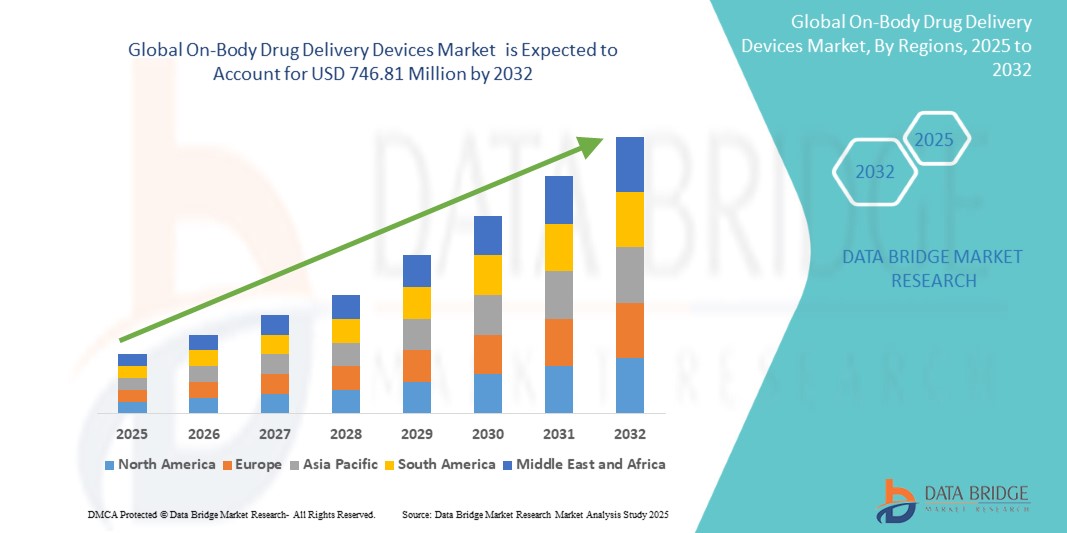
- The Global On-Body Drug Delivery Devices Market size was valued at USD 217.38 million in 2024 and is expected to reach USD 746.81 million by 2032, at a CAGR of 9.60% during the forecast period
- This growth is driven by factors such as the increasing prevalence of chronic diseases, advancements in drug delivery technologies, rising demand for non-invasive treatment options, and growing adoption of wearable medical devices for convenient and efficient drug administration.
Global On-Body Drug Delivery Devices Market Analysis
- On-body drug delivery devices are critical tools used in various medical treatments, providing controlled, precise, and efficient drug administration. They are essential for managing conditions such as cardiovascular diseases, cancer, autoimmune diseases, and diabetes, ensuring consistent drug release and improving patient compliance
- The demand for these devices is significantly driven by the increasing prevalence of chronic diseases, advancements in drug delivery technologies, and the growing need for more efficient, non-invasive treatment options for conditions such as cardiovascular diseases, cancer, autoimmune diseases, and diabetes.
- North America is expected to dominate the Global On-Body Drug Delivery Devices Market due to advanced healthcare infrastructure and increasing demand for drug delivery systems.
- Asia-Pacific is expected to be the fastest growing region in the Global On-Body Drug Delivery Devices Market during the forecast period due to rising awareness about healthcare and drug delivery solutions
- Auto-injectors segment is expected to dominate the market with a market share of 45.30% due to their ease of use and increasing demand for self-administration of medication. As the leading device for chronic disease management, advancements in auto-injector technologies improve patient compliance and treatment outcomes
Report Scope and On-Body Drug Delivery Devices Market Segmentation
|
Attributes |
Ophthalmic Operational Microscope Key Market Insights |
|
Segments Covered |
|
|
Countries Covered |
North America
Europe
Asia-Pacific
Middle East and Africa
South America
|
|
Key Market Players |
|
|
Market Opportunities |
|
|
Value Added Data Infosets |
In addition to the insights on market scenarios such as market value, growth rate, segmentation, geographical coverage, and major players, the market reports curated by the Data Bridge Market Research also include import export analysis, production capacity overview, production consumption analysis, price trend analysis, climate change scenario, supply chain analysis, value chain analysis, raw material/consumables overview, vendor selection criteria, PESTLE Analysis, Porter Analysis, and regulatory framework. |
On Body Drug Delivery Devices Market Trends
“Advancements in On-Body Drug Delivery Devices & Integration of Smart Technologies”
- One prominent trend in the evolution of on-body drug delivery devices is the increasing integration of smart technologies and real-time monitoring systems
- These innovations enhance drug delivery precision by offering personalized, on-demand medication administration and tracking, improving treatment outcomes in chronic disease management
- For instance, modern wearable injectors and patches equipped with sensors provide real-time data on medication adherence, allowing patients and healthcare providers to monitor drug delivery remotely, which is particularly beneficial for conditions like diabetes and autoimmune diseases.
- These advancements are transforming drug delivery methods, improving patient compliance, and driving the demand for next-generation on-body drug delivery systems with advanced monitoring capabilities
On Body Drug Delivery Devices Market Dynamics
Driver
“"Growing Need Due to Prevalence of Chronic Diseases”
- The rising prevalence of chronic diseases such as diabetes, cardiovascular diseases, autoimmune disorders, and cancer is significantly contributing to the increased demand for on-body drug delivery devices.
- As the global population ages, the incidence of these conditions continues to grow, with individuals requiring consistent, long-term medication administration for disease management.
- As more individuals seek treatment for these conditions, the demand for on-body drug delivery devices rises, ensuring improved medication adherence, personalized treatment plans, and reducing the risks associated with manual drug administration.
For instance,
- In 2023, according to the International Diabetes Federation (IDF), the global prevalence of diabetes reached approximately 572 million adults, and this number is expected to rise to 700 million by 2045. This increase in diabetes cases underscores the growing demand for efficient drug delivery solutions.
- As a result of the rising prevalence of chronic diseases such as diabetes, cardiovascular diseases, autoimmune disorders, and cancer, there is a significant increase in the demand for on-body drug delivery devices
Opportunity
“Advancing Drug Delivery with Artificial Intelligence Integration”
- AI-powered on-body drug delivery devices can enhance medication adherence, automate dose adjustments, and improve therapeutic outcomes, enabling patients to manage their conditions
- AI algorithms can analyze real-time data from wearable injectors or patches, providing instant feedback on medication delivery, helping to identify potential issues
- Additionally, AI-powered systems can assist in monitoring patient health, enabling personalized treatment plans, adjusting medication dosages based on individual needs, and ensuring timely administration
For instance,
- In January 2025, according to a study published in the Journal of Medical Technology, AI algorithms in on-body drug delivery devices have been shown to optimize insulin dosing for diabetic patients. By continuously monitoring glucose levels and predicting future insulin needs, AI systems can automatically adjust insulin delivery, improving glycemic control and reducing the risk of hypoglycemia. These systems help patients avoid manual injections and ensure consistent and accurate drug administration
- The integration of AI in on-body drug delivery devices can also lead to improved patient outcomes, reduced treatment complications, and enhanced quality of life. By leveraging AI-powered monitoring, healthcare providers can detect early signs of complications, optimize treatment plans, and provide personalized care to patients
Restraint/Challenge
“High Equipment Costs Hindering Market Penetration”
- The high cost of on-body drug delivery devices poses a significant challenge for the market, particularly affecting the purchasing decisions of healthcare facilities, especially in developing regions
- These devices, which are essential for consistent and personalized drug delivery, can often range from hundreds to thousands of dollars, depending on the technology and features
- This substantial financial barrier can deter smaller clinics and hospitals with limited budgets from adopting or upgrading their drug delivery systems, leading to reliance on traditional methods or manual drug administration
For instance,
- In November 2024, according to an article published by Medical Device Technology, one of the main concerns surrounding the high cost of on-body drug delivery devices is its potential impact on healthcare affordability and accessibility. The high cost of these devices adds to this burden, limiting the ability of healthcare facilities to invest in the latest technology, thereby affecting the quality of care and patient adherence to treatment regimens
- Consequently, such limitations can result in disparities in access to advanced drug delivery technologies, hindering the overall growth of the market and reducing the widespread adoption of on-body drug delivery systems
Ophthalmic Operational Microscope Market Scope
The market is segmented on the basis application, product type, technology, magnification type, end user, and distribution channel.
|
Segmentation |
Sub-Segmentation |
|
By Application |
|
|
By Product Type |
|
|
By End User |
|
|
By Technology |
|
|
By Distribution Channel
|
|
In 2025, the Auto Injectors is projected to dominate the market with a largest share in application segment
The auto-injectors segment is expected to dominate the on-body drug delivery devices market with the largest share in 2025 due to their convenience and effectiveness in delivering biologic drugs, particularly for chronic conditions such as rheumatoid arthritis, multiple sclerosis, and diabetes. As self-administration becomes a preferred option for patients, the demand for auto-injectors continues to grow. Technological advancements in these devices, including improved ergonomics, faster injection times, and integration with digital health tracking, are enhancing patient experience and compliance, driving market growth. Increasing prevalence of chronic diseases and the shift towards home-based care further contribute to the dominance of auto-injectors in the market
The Smart Wearables is expected to account for the largest share during the forecast period in technology market
In 2025, the smart wearables segment is expected to dominate the on-body drug delivery devices market with the largest market share due to their ability to offer continuous monitoring and personalized drug delivery. These devices, which are often integrated with sensors, enable real-time tracking of various health parameters and provide precise, on-demand drug administration. As wearable technology continues to evolve, smart wearables offer enhanced comfort, portability, and ease of use, making them a preferred option for chronic disease management. Increased adoption of smart wearables is driven by growing healthcare demands for self-management solutions, as well as advancements in digital health that allow for better patient outcomes
On- Body Drug Delivery Market Regional Analysis
“North America Holds the Largest Share in the On-Body Drug Delivery Devices Market"
• North America dominates the on-body drug delivery devices market, driven by advanced healthcare infrastructure, high adoption of self-administered drug delivery technologies, and strong presence of key market players
• The U.S. holds a significant share due to increased demand for chronic disease management solutions, rising prevalence of conditions such as diabetes, cancer, and autoimmune disorders, and continuous advancements in wearable and smart drug delivery devices
• The availability of well-established reimbursement policies and growing investments in research & development by leading pharmaceutical and medtech companies further strengthen the market
• In addition, the increasing shift toward home-based care and personalized medicine, along with a high rate of adoption of digital health technologies, is fueling market expansion across the region
“Asia-Pacific is Projected to Register the Highest CAGR in the On-Body Drug Delivery Devices Market”
- The Asia-Pacific region is expected to witness the highest growth rate in the on-body drug delivery devices market, driven by rapid expansion in healthcare infrastructure, increasing awareness about self-administered therapies, and rising prevalence of chronic diseases
- Countries such as China, India, and Japan are emerging as key markets due to the growing burden of conditions such as diabetes, cancer, and autoimmune diseases, which require consistent and long-term drug delivery solutions
- Japan, with its advanced medical technology and increasing demand for wearable health devices, remains a crucial market for on-body drug delivery. The country continues to lead in the adoption of smart, patient-centric drug delivery systems to improve adherence and treatment outcomes
- China and India, with their large populations and expanding chronic disease base, are witnessing increased government and private sector investments in digital health and innovative drug delivery technologies. The growing presence of global pharmaceutical and medtech companies, along with improving access to healthcare, further contributes to market growth
Global On- Body Drug Delivery Market Share
The market competitive landscape provides details by competitor. Details included are company overview, company financials, revenue generated, market potential, investment in research and development, new market initiatives, global presence, production sites and facilities, production capacities, company strengths and weaknesses, product launch, product width and breadth, application dominance. The above data points provided are only related to the companies' focus related to market.
The Major Market Leaders Operating in the Market Are:
- Becton, Dickinson and Company (BD) (U.S.)
- Gerresheimer AG – Germany
- Enable Injections, Inc. (U.S.)
- NOVO Engineering – (U.S.)
- Elcam Medical (Israel)
- Stevanato Group S.p.A. (Italy)
- Ypsomed AG (Switzerland)
- Insulet Corporation (U.S,)
- Medtronic plc (Ireland)
- West Pharmaceutical Services, Inc (U.S.)
- Lohmann Therapie-Systeme AG (LTS) (Germany)
- Coherus BioSciences, Inc (U.S.)
- Tandem Diabetes Care, Inc (U.S.)
- Battelle Memorial Institute (U.S.)
Latest Developments in Global On – Body Drug Delivery Market
- In May 2023, Coherus BioSciences announced the commercial availability of its single-dose (6mg/0.6mL) prefilled autoinjector for UDENYCA in the United States. This device offers a streamlined design, enabling administration in less than 10 seconds, suitable for both in-office and at-home settings
- Researchers have developed a new type of contraceptive implant that can be administered via injection and self-assembles in the body, potentially offering long-term drug delivery without the need for surgical procedures. While not yet tested in humans, proof-of-concept experiments in rats showed that the drug release could be sustained for at least 97 days. This approach could also be applicable for other treatments such as HIV, chronic pain, and metabolic diseases.
- The integration of smart technologies is a significant advancement in the on-body drug delivery devices industry. Many current wearable injectors now include connectivity features that enable them to communicate with smartphones and other digital health systems. This connectivity allows for real-time monitoring of medication adherence and patient health parameters, enhancing treatment outcomes and patient engagement.

- Interactive Data Analysis Dashboard
- Company Analysis Dashboard for high growth potential opportunities
- Research Analyst Access for customization & queries
- Competitor Analysis with Interactive dashboard
- Latest News, Updates & Trend analysis
- Harness the Power of Benchmark Analysis for Comprehensive Competitor Tracking
Data collection and base year analysis are done using data collection modules with large sample sizes. The stage includes obtaining market information or related data through various sources and strategies. It includes examining and planning all the data acquired from the past in advance. It likewise envelops the examination of information inconsistencies seen across different information sources. The market data is analysed and estimated using market statistical and coherent models. Also, market share analysis and key trend analysis are the major success factors in the market report. To know more, please request an analyst call or drop down your inquiry.
The key research methodology used by DBMR research team is data triangulation which involves data mining, analysis of the impact of data variables on the market and primary (industry expert) validation. Data models include Vendor Positioning Grid, Market Time Line Analysis, Market Overview and Guide, Company Positioning Grid, Patent Analysis, Pricing Analysis, Company Market Share Analysis, Standards of Measurement, Global versus Regional and Vendor Share Analysis. To know more about the research methodology, drop in an inquiry to speak to our industry experts.
Data Bridge Market Research is a leader in advanced formative research. We take pride in servicing our existing and new customers with data and analysis that match and suits their goal. The report can be customized to include price trend analysis of target brands understanding the market for additional countries (ask for the list of countries), clinical trial results data, literature review, refurbished market and product base analysis. Market analysis of target competitors can be analyzed from technology-based analysis to market portfolio strategies. We can add as many competitors that you require data about in the format and data style you are looking for. Our team of analysts can also provide you data in crude raw excel files pivot tables (Fact book) or can assist you in creating presentations from the data sets available in the report.













