


What is the On-Demand Insurance Market Size and Growth Rate?
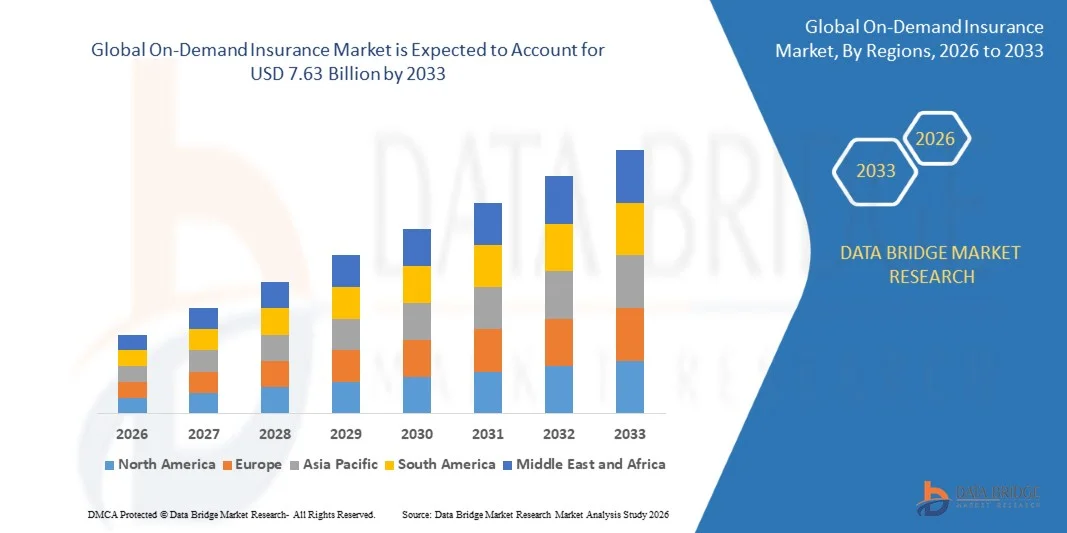
- As per Data Bridge Market Research analysis, the on-demand insurance market was valued at USD 1.65 billion in 2025 and is projected to reach USD 7.63 billion by 2033, growing at a CAGR of 21.10% from 2026 to 2033.
- The market is experiencing consistent growth driven by rising demand for flexible and personalized insurance products, increasing smartphone and internet penetration, and the rapid expansion of digital insurance platforms and mobile applications that enable consumers to purchase coverage when needed.
- The growing preference for usage-based and short-duration insurance, combined with advances in artificial intelligence, machine learning, and data analytics, is enabling insurers to offer customized coverage, automate underwriting, and respond more effectively to changing consumer needs. Digital platforms and mobile apps are increasingly replacing traditional insurance purchasing processes with convenient, flexible, and on-demand coverage models.
Market Size & Forecast
- Global Market Value (2025): USD 1.65 Billion
- Expected Market Value (2033): USD 7.63 Billion
- Forecast CAGR (2026–2033): 21.10%
- Leading Region in 2025: North America
- Fastest Growing Region: Asia Pacific
What are the Major Takeaways of the On-Demand Insurance Market?
- North America dominated the on-demand insurance market with the largest revenue share of 37.10% in 2025, supported by advanced digital infrastructure, strong insurtech penetration, and widespread adoption of usage-based insurance products.
- Asia-Pacific is expected to be the fastest-growing region at a CAGR of 21.36% from 2026 to 2033, fueled by rapid digitalization, increasing smartphone adoption, expanding embedded-insurance platforms, and growing demand for flexible coverage across India, China, Japan, and other regional markets
- The automobile and mobility segment led the market with a 39.49% share in 2025, driven by increasing demand for flexible vehicle coverage and usage-based insurance products.
- Travel insurance are the fastest-growing insurance type, projected to register a CAGR of 18.90%, reflecting the surge in international and domestic travel and the growing integration of insurance into online booking journeys.
- The pay-as-you-go segment dominated the coverage model type category with a 48.30% revenue share in 2025, led by its simple time-based activation structure and flexibility.
- Individuals accounted for 56.63% of the market share in 2025, preferred by the growing consumer demand for flexible and personalized insurance products.
- The event/trigger-based segment is the fastest-growing coverage model category, with a CAGR of 18.70%, driven by increasing use of real-time information to automatically activate coverage or claims.
Report Scope and On-Demand Insurance Market Segmentation
Attributes |
On-Demand Insurance Key Market Insights |
|
Segments Covered |
|
|
Countries Covered |
North America
Europe
Asia-Pacific
Middle East and Africa
South America
|
|
Key Market Players |
|
|
Market Opportunities |
|
|
Value Added Data Infosets |
In addition to the market insights such as market value, growth rate, market segments, geographical coverage, market players, and market scenario, the market report curated by the Data Bridge Market Research team includes in-depth expert analysis, import/export analysis, pricing analysis, production consumption analysis, and pestle analysis. |
What is the Key Trend in the On-Demand Insurance Market?
- Insurers are increasingly embedding flexible insurance products into digital ecosystems such as e-commerce, mobility, banking, and travel platforms, allowing customers to purchase coverage seamlessly alongside the underlying product or service.
- For instance, in June 2025, Insurance Journal reported that Amazon’s UK courier ecosystem had introduced “Pay-as-you-Flex,” a wallet-based, by-the-minute insurance product developed with INSHUR, enabling on-demand couriers to obtain coverage aligned with the time they spend working.
- Personalized, short-duration, and usage-based policies are gaining traction as consumers increasingly prefer insurance that can be activated, modified, or priced according to specific activities, driving behavior, or periods of actual usage.
- Mobile applications and API-based platforms are enabling real-time policy issuance, digital claims, instant policy modifications, and automated customer interactions, making insurance more responsive and convenient for digitally engaged consumers.
- For instance, in December 2025, Zuno General Insurance reported that its app-based SmartDrive usage-based car insurance, launched in March 2025, had crossed 1 crore kilometers and 1.5 lakh trips, demonstrating growing adoption of behavior-based and personalized motor insurance.
- Artificial intelligence, automation, and data analytics are increasingly being integrated into on-demand insurance workflows to improve customer segmentation, risk assessment, underwriting speed, and personalized product recommendations.
What are the Key Drivers of the On-Demand Insurance Market?
- The rapid expansion of digital commerce, mobility platforms, smartphones, and connected devices is increasing demand for insurance products that can be purchased instantly and customized according to individual customer needs.
- For instance, in December 2025, Zuno General Insurance reported that its SmartDrive usage-based motor insurance, launched in March 2025, had surpassed 1 crore kilometers and 1.5 lakh trips, demonstrating growing adoption of behavior-based insurance among Indian drivers.
- Growing adoption of embedded insurance is allowing insurers to integrate protection directly into digital customer journeys, reducing purchase friction and expanding access to low-value, event-specific, and context-driven insurance products.
- For instance, in March 2025, IRDAI was working toward expanding distribution through embedded insurance, with the framework intended to enable insurers to reach customers through e-commerce, ride-hailing, wearables, and other integrated digital channels.
- Increasing use of telematics, artificial intelligence, and real-time data analytics is enabling insurers to develop usage-based pricing models, automate underwriting decisions, and offer personalized premiums based on actual risk and behavior.
Which Factors are Challenging the Growth of the On-Demand Insurance Market?
- Integrating on-demand insurance with legacy insurance systems remains a major challenge because real-time pricing, instant policy issuance, automated underwriting, and API-based distribution require modern data infrastructure and seamless connectivity.
- For instance, in June 2025, Accenture reported that 50% of insurers identified legacy integration as their primary challenge when deploying data and AI at scale, highlighting the technological barriers insurers face when modernizing digital insurance operations.
- Data privacy, regulatory compliance, cybersecurity, and the accuracy of customer-generated data can complicate the deployment of highly personalized insurance models, particularly when insurers rely on telematics, mobile applications, IoT devices, and artificial intelligence.
- Limited consumer awareness of on-demand insurance products can constrain adoption, particularly in markets where customers remain more familiar with conventional annual or long-term insurance policies and may perceive flexible coverage as unfamiliar or less comprehensive.
- For instance, in January 2025, IRDAI introduced regulations covering the maintenance and sharing of information by regulated entities, reinforcing the growing regulatory requirements surrounding insurance data management and digital operations.
- Difficulty in standardizing risk assessment for short-duration and highly customized policies can create underwriting challenges, as limited historical data and rapidly changing usage patterns may increase pricing uncertainty and make profitability more difficult for insurers.
How is the On-Demand Insurance Market Segmented?
The on-demand insurance market is segmented on the basis of insurance type, coverage model, end user, and distribution channel.
- By Insurance Type
On the basis of insurance type, the on-demand insurance market is segmented into automobile and mobility, property insurance, travel insurance, health and life micro insurance, commercial, and others. The automobile and mobility segment dominated the market with 39.49% share in 2025, owing to increasing demand for flexible vehicle coverage and usage-based insurance products. The expansion of ride-sharing, car-sharing, and other mobility services is creating demand for insurance that can adapt to changing usage patterns. Telematics technologies are enabling insurers to monitor driving behavior and develop more personalized coverage. Digital platforms are also making temporary and pay-per-use vehicle insurance easier to purchase and manage. Growing consumer preference for flexible protection is further supporting adoption across private and commercial mobility applications.
The travel insurance segment is expected to be the fastest-growing insurance type at 18.90% CAGR from 2026 to 2033, driven by increasing international and domestic travel and the growing integration of insurance into online booking journeys. Travelers increasingly prefer short-duration protection that can be purchased for individual trips. Airline, hotel, and travel-booking platforms are making insurance more accessible by offering coverage during the purchase process. Digital claims and automated policy issuance are improving convenience for travelers. Demand for protection against flight delays, cancellations, baggage loss, and other trip-related risks is also supporting segment growth.
- By Coverage Model
On the basis of coverage model, the on-demand insurance market is segmented into pay-as-you-go, usage-based, subscription-based, and event/trigger-based. The pay-as-you-go segment dominated the market with 48.30% share in 2025, supported by its simple time-based activation structure and flexibility. Customers can obtain insurance for specific periods without committing to conventional long-term coverage. This model is well suited to temporary vehicle use, travel, rental assets, and other short-duration requirements. Digital payment systems allow customers to activate and manage policies conveniently through mobile applications and online platforms. The transparent structure of pay-as-you-go coverage is also attractive to cost-conscious customers seeking greater control over insurance spending.
The event/trigger-based segment is expected to be the fastest-growing coverage model at 18.70% CAGR during forecast period, driven by increasing use of real-time information to automatically activate coverage or claims. These products can respond to predefined events such as flight delays, adverse weather, or other measurable conditions. Integration with external data sources reduces the need for lengthy manual claims processes. Advances in artificial intelligence, IoT technologies, and data analytics are improving the ability of insurers to identify qualifying events accurately. Faster and more transparent payouts are increasing the attractiveness of trigger-based products.
- By End User
On the basis of end user, the on-demand insurance market is segmented into individuals, SMEs, and institutional groups. The individuals segment dominated the market with 56.63% share in 2025, supported by growing consumer demand for flexible and personalized insurance products. Individual customers are increasingly purchasing coverage for mobility, travel, personal health, electronics, and other short-duration needs. On-demand products allow consumers to obtain protection only when it is required rather than maintaining conventional fixed-duration policies. Mobile applications and digital platforms are simplifying policy purchase, modification, and claims management. Greater smartphone adoption is also improving access to digitally delivered insurance products.
The SMEs segment is expected to be the fastest-growing end-user segment at 15.10% CAGR during forecast period, driven by increasing demand for flexible commercial protection. Small and medium-sized businesses often face changing requirements for property, logistics, liability, employee, and operational coverage. On-demand products allow SMEs to obtain protection according to their specific activities and changing risk exposure. Digital insurance platforms are simplifying product comparison, purchasing, policy administration, and claims handling for smaller businesses. The expansion of e-commerce, logistics, and other digitally enabled businesses is creating additional demand for flexible insurance solutions.
- By Distribution Channel
On the basis of distribution channel, the on-demand insurance market is segmented into digital platforms, brokers & agents, insurance companies, and others. The digital platforms segment dominated the market with 48.30% share in 2025, driven by the increasing use of mobile applications and online insurance channels. Digital platforms enable customers to compare policies, obtain quotations, purchase coverage, and manage claims remotely. Automated underwriting and digital onboarding are reducing the time required to issue policies. These platforms also allow insurers to use customer data to provide more personalized insurance products. Lower distribution friction and growing smartphone adoption are further supporting digital insurance purchasing.
The brokers & agents segment is expected to be the fastest-growing distribution channel at 6.0% CAGR during forecast period, supported by the increasing use of technology-enabled brokerage and advisory services. Brokers and agents continue to play an important role where customers require assistance in comparing coverage and selecting suitable policies. Digital brokerage platforms are improving quotation, policy comparison, customer engagement, and claims-support capabilities. SMEs and institutional customers often require more specialized advice than fully automated purchasing channels can provide. The integration of digital tools with traditional advisory services is creating more efficient assisted-digital insurance journeys.
Which Region Holds the Largest Share of the On-Demand Insurance Market?
- North America dominated the on-demand insurance market with the largest revenue share of 37.10% in 2025, supported by advanced digital infrastructure, strong insurtech penetration, and widespread adoption of usage-based insurance products.
- The region also benefits from established digital payment systems, strong consumer acceptance of mobile-based financial services, and a large gig-economy workforce requiring flexible, activation-based coverage. The presence of leading insurtech providers and supportive regulatory frameworks is further strengthening digital policy issuance and personalized insurance offerings across the U.S. and Canada.
U.S. On-Demand Insurance Market Insight
The U.S. on-demand insurance market is witnessing strong growth due to the rapid expansion of digital insurance platforms, usage-based insurance, embedded insurance, and personalized coverage models. The country’s mature insurtech ecosystem, high smartphone penetration, extensive connected-vehicle adoption, and strong digital payment infrastructure are enabling consumers to purchase and manage insurance through mobile applications and online platforms. Insurers are increasingly using telematics, artificial intelligence, machine learning, and real-time data analytics to assess individual risk and develop flexible pricing models. The expansion of gig-economy employment and app-based mobility services is also increasing demand for temporary, pay-per-use, and activity-based insurance products.
Asia-Pacific On-Demand Insurance Market Insight
The Asia-Pacific on-demand insurance market is expected to witness rapid growth, driven by expanding digital ecosystems, rising smartphone adoption, increasing internet penetration, and growing integration of insurance into e-commerce, mobility, travel, fintech, and digital payment platforms across countries such as China, India, and Japan. The region’s large digitally connected population is creating significant demand for affordable, flexible, and easily accessible insurance products that can be activated according to individual needs. Insurers are increasingly using mobile applications, artificial intelligence, cloud computing, and data analytics to simplify underwriting and provide personalized insurance solutions. Embedded insurance is gaining traction as online platforms increasingly integrate protection directly into customer purchase journeys.
Japan On-Demand Insurance Market Insight
The Japan on-demand insurance market is witnessing consistent growth due to increasing digitalization of financial services, rising adoption of mobile insurance solutions, and growing demand for flexible protection products. Insurance companies are increasingly investing in digital platforms and data-driven technologies to improve underwriting, policy management, customer engagement, and claims processing. Japan’s highly developed technological infrastructure is supporting the integration of telematics, artificial intelligence, IoT devices, and real-time analytics into insurance products. Usage-based motor insurance is gaining relevance as connected-vehicle technologies provide insurers with greater access to driving behavior and vehicle-use data. Moreover, the expansion of embedded insurance through travel, mobility, financial, and other digital services is creating additional opportunities for insurers to reach customers at the point of need.
China On-Demand Insurance Market Insight
The China on-demand insurance market is growing rapidly, driven by extensive adoption of digital platforms, strong e-commerce activity, widespread mobile payments, and increasing integration of insurance into online consumer ecosystems. Large technology and financial platforms are creating opportunities for insurers to distribute contextual and personalized coverage through digital customer journeys. Insurance products are increasingly being incorporated into sectors such as travel, healthcare, automotive, logistics, and online commerce, allowing consumers to purchase protection alongside the underlying service. Artificial intelligence, big-data analytics, cloud computing, and mobile technologies are supporting automated underwriting and more targeted insurance offerings. The rapid expansion of digital lifestyles is also increasing consumer familiarity with purchasing financial products through mobile platforms.
U.K. On-Demand Insurance Market Insight
The U.K. on-demand insurance market is experiencing steady growth, supported by increasing consumer acceptance of app-based insurance, flexible policies, usage-based pricing, and digitally managed coverage. Insurers and insurtech companies are increasingly offering products that allow customers to obtain protection for specific assets, activities, journeys, or periods rather than relying exclusively on traditional annual policies. The country’s established fintech and insurtech ecosystem is encouraging experimentation with subscription-style and usage-based insurance models. Telematics and connected-device technologies are also supporting personalized motor and lifestyle insurance by providing insurers with detailed behavioral data. Furthermore, artificial intelligence and automation are improving underwriting, claims management, fraud detection, and customer service.
Germany On-Demand Insurance Market Insight
The Germany on-demand insurance market is expanding steadily due to increasing digitalization of insurance distribution, growing adoption of embedded insurance, and rising demand for convenient online customer experiences. Insurance companies are increasingly working with banks, telecommunications providers, mobility companies, retailers, and other digital platforms to integrate coverage directly into existing products and services. These partnerships allow customers to purchase relevant protection without completing a separate traditional insurance journey. Germany’s strong automotive sector is also supporting the development of usage-based and telematics-enabled motor insurance solutions. In addition, artificial intelligence, digital claims processing, automated underwriting, and cloud-based insurance platforms are improving operational efficiency and enabling more personalized customer experiences.
Which are the Top Companies in On-Demand Insurance Market?
The on-demand insurance industry is primarily led by well-established companies, including:
- Lemonade, Inc. (U.S.)
- ROOT (U.S.)
- Qover SA/NV (Belgium)
- Wrisk (U.K.)
- Boost Insurance USA, Inc. (U.S.)
- Next Insurance, Inc. (U.S.)
- Hippo Holdings Inc. (U.S.)
- Cover Genius Pty Ltd (Australia)
- Extracover Limited (U.K.)
- Progressive Casualty Insurance Company (U.S.)
- Chubb (Switzerland)
- The Travelers Indemnity Company (U.S.)
- AXA (France)
- Allianz (Germany)
- State Farm Mutual Automobile Insurance Company (U.S.)
- Allstate Insurance Company (U.S.)
- Government Employees Insurance Company (U.S.)
- Aviva (U.K.)
- SURE (U.S.)
- Liberty Mutual Insurance Company (U.S.)
What are Latest Developments in On-Demand Insurance Market?
- In July 2025, The Floow and Direct Line Group launched DriveXpert, the U.K. market’s first pure app-only telematics insurance proposition. The smartphone-based solution evaluates driving behavior, including smoothness, distraction, speed, road risk, and time of day, with the resulting scores used to support premium discounts and provide drivers with feedback. This launch highlights the growing use of mobile telematics to deliver personalized, behavior-based insurance.
- In April 2024, Great American Insurance Group announced the formation of a dedicated embedded insurance team to expand its embedded insurance offerings and simplify distribution through point-of-sale solutions. The team was established to develop customized products, including ticket and travel coverage, and strengthen the company’s use of APIs and embedded technology. This development demonstrates insurers’ increasing focus on integrating coverage directly into customers’ purchasing journeys.
- In October 2023, Applied Systems launched Tarmika Insured, an embedded commercial insurance quoting application designed to allow insurance agencies and businesses to embed commercial insurance quoting directly into digital and point-of-sale experiences. The solution provides real-time, bindable quotes and connects consumer-led workflows with agent-led processes, supporting faster and more streamlined policy distribution.
- In November 2022, Mobilize Financial Services announced the launch of Mobilize Insurance in collaboration with Accenture, offering integrated usage-based car insurance in Europe. The solution introduced a “pay as you drive” model with personalized pricing for Renault, Dacia, and Alpine customers, using connected-vehicle capabilities across the insurance journey. This development reflects the increasing integration of connected mobility data into flexible motor insurance.
- In May 2021, Guidewire launched its Usage-Based Insurance Solution, enabling property and casualty insurers to bring usage-based insurance programs to market with support for the full insurance lifecycle, including quoting, billing, and automated claims intake. The solution was designed to enable insurers to deploy UBI programs rapidly and respond to increasing customer demand for personalized motor insurance.

- Interactive Data Analysis Dashboard
- Company Analysis Dashboard for high growth potential opportunities
- Research Analyst Access for customization & queries
- Competitor Analysis with Interactive dashboard
- Latest News, Updates & Trend analysis
- Harness the Power of Benchmark Analysis for Comprehensive Competitor Tracking
Data collection and base year analysis are done using data collection modules with large sample sizes. The stage includes obtaining market information or related data through various sources and strategies. It includes examining and planning all the data acquired from the past in advance. It likewise envelops the examination of information inconsistencies seen across different information sources. The market data is analysed and estimated using market statistical and coherent models. Also, market share analysis and key trend analysis are the major success factors in the market report. To know more, please request an analyst call or drop down your inquiry.
The key research methodology used by DBMR research team is data triangulation which involves data mining, analysis of the impact of data variables on the market and primary (industry expert) validation. Data models include Vendor Positioning Grid, Market Time Line Analysis, Market Overview and Guide, Company Positioning Grid, Patent Analysis, Pricing Analysis, Company Market Share Analysis, Standards of Measurement, Global versus Regional and Vendor Share Analysis. To know more about the research methodology, drop in an inquiry to speak to our industry experts.
Data Bridge Market Research is a leader in advanced formative research. We take pride in servicing our existing and new customers with data and analysis that match and suits their goal. The report can be customized to include price trend analysis of target brands understanding the market for additional countries (ask for the list of countries), clinical trial results data, literature review, refurbished market and product base analysis. Market analysis of target competitors can be analyzed from technology-based analysis to market portfolio strategies. We can add as many competitors that you require data about in the format and data style you are looking for. Our team of analysts can also provide you data in crude raw excel files pivot tables (Fact book) or can assist you in creating presentations from the data sets available in the report.













