


On Premise Virtual Mobile Infrastructure Market Size
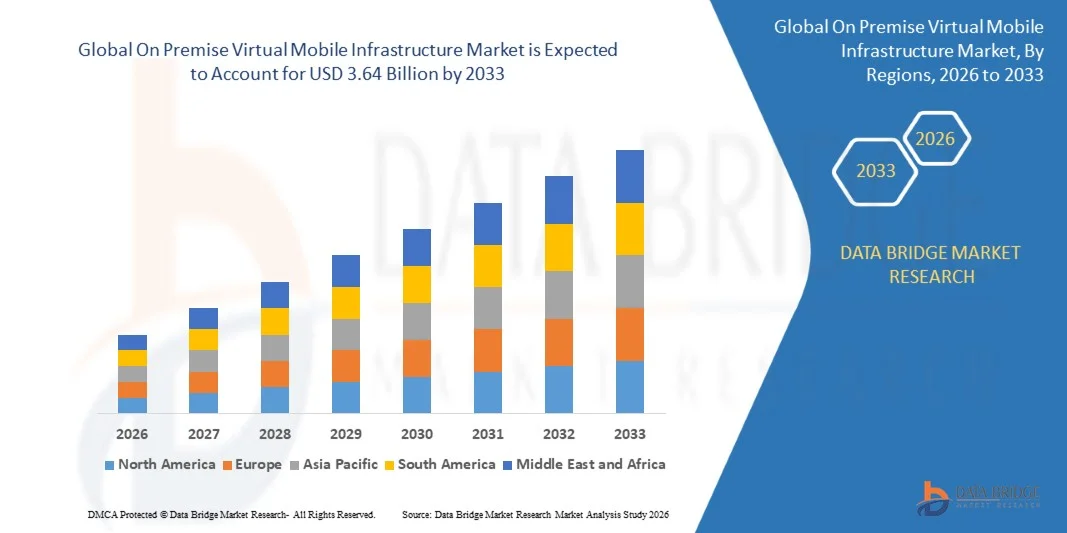
- The global on premise virtual mobile infrastructure market size was valued at USD 1.27 billion in 2025 and is expected to reach USD 3.64 billion by 2033, at a CAGR of 14.00% during the forecast period
- The market growth is largely fuelled by the rising adoption of secure enterprise mobility solutions and the increasing need to protect sensitive corporate data
- Growing demand for enhanced device management and internal control across highly regulated industries is further supporting market expansion
On Premise Virtual Mobile Infrastructure Market Analysis
- The market is witnessing steady growth due to rising emphasis on data privacy, security, and controlled mobility within enterprise IT infrastructures
- Organizations are increasingly deploying on premise VMI solutions to gain full governance over mobile applications, minimize cyber risks, and support workforces requiring secure, remote access without relying on external cloud systems
- North America dominated the global on-premise virtual mobile infrastructure (VMI) market in 2025, supported by the rising need for secure mobility solutions and strict data-protection requirements across enterprises
- Asia-Pacific region is expected to witness the highest growth rate in the global on premise virtual mobile infrastructure market, driven by rising adoption of secure mobile platforms, growing IT modernization initiatives, and expanding corporate mobility requirements
- The Solution segment held the largest market revenue share in 2025, driven by the rising enterprise focus on securing mobile workflows through controlled, internally hosted infrastructures. Organizations prefer robust, integrated VMI platforms that enable centralized management, enhanced data protection, and seamless delivery of mobile applications across multiple devices
Report Scope and On Premise Virtual Mobile Infrastructure Market Segmentation
|
Attributes |
On Premise Virtual Mobile Infrastructure Key Market Insights |
|
Segments Covered |
|
|
Countries Covered |
North America
Europe
Asia-Pacific
Middle East and Africa
South America
|
|
Key Market Players |
|
|
Market Opportunities |
|
|
Value Added Data Infosets |
In addition to the market insights such as market value, growth rate, market segments, geographical coverage, market players, and market scenario, the market report curated by the Data Bridge Market Research team includes in-depth expert analysis, import/export analysis, pricing analysis, production consumption analysis, and pestle analysis. |
On Premise Virtual Mobile Infrastructure Market Trends
“Rise of Secure, Decentralized Mobile Work Environments”
• The growing shift toward secure and decentralized mobile ecosystems is reshaping the on premise virtual mobile infrastructure (VMI) market, enabling enterprises to host mobile operating systems within controlled data centers. This approach enhances real-time access to corporate applications while ensuring strict compliance and data localization requirements
• The rising need for secure mobility in highly regulated industries such as BFSI, government, and healthcare is accelerating the adoption of on premise VMI platforms. Organizations operating under strict privacy mandates prefer internal hosting structures to minimize data exposure, reduce vulnerabilities, and maintain operational integrity
• Increasing reliance on hybrid work models is boosting demand for secure virtualized mobile environments, allowing employees to access business apps without storing sensitive data on physical devices. This significantly reduces the risks of device theft, unauthorized access, and data leakage
• For instance, in 2024, several government agencies in North America introduced secure mobility frameworks requiring all mobile workstations to operate through internally hosted virtualization layers. This led to increased deployment of private VMI systems to support controlled access and long-term data protection initiatives
• While VMI strengthens enterprise mobility and enhances compliance, successful implementation depends on robust IT infrastructure, skilled administrators, and scalable deployment models to meet evolving performance and security expectations
On Premise Virtual Mobile Infrastructure Market Dynamics
Driver
“Growing Demand for Data Sovereignty and Enterprise-Controlled Mobility”
• The expanding focus on data sovereignty is pushing enterprises to adopt on premise VMI to ensure all mobile interactions occur within secure, locally managed environments. This shift is becoming essential amid rising geopolitical tensions and stricter national data protection mandates. By keeping all data flows internal, organizations reduce reliance on third-party networks and ensure full compliance with jurisdictional requirements
• Organizations are increasingly recognizing the risks associated with unmanaged mobile endpoints, including data theft, malware attacks, and unauthorized access. As cyber threats evolve, companies are prioritizing solutions that centralize application processing and eliminate exposure from compromised devices. VMI ensures sensitive information never leaves controlled servers, strengthening enterprise security frameworks
• Rising cybersecurity incidents have further highlighted the importance of enterprise-controlled mobile ecosystems. On premise VMI helps eliminate exposure to unsecured public networks and cloud vulnerabilities, offering an added layer of protection in high-risk environments. The ability to monitor, authenticate, and track every mobile session in real time enhances threat detection and operational visibility
• For instance, in 2023, multiple financial institutions across Europe transitioned from BYOD-driven mobile workflows to secure VMI-hosted environments to comply with enhanced banking cybersecurity directives. This migration helped ensure strict protection of customer data while minimizing risks associated with employee-owned devices. The move also supported standardization across IT systems, improving management efficiency
• While security-driven demand is strong, ensuring system scalability and optimizing user experience remain essential for long-term adoption across large enterprises and government organizations. Many deployments require extensive customization to meet performance expectations across diverse device types. Balancing high security with smooth, uninterrupted mobile access continues to be a key priority for successful implementations
Restraint/Challenge
“High Deployment Costs and Complex Infrastructure Requirements”
• High initial investment requirements remain a major restraint, as enterprises must allocate significant budgets for servers, storage, virtualization software, and ongoing maintenance. For many organizations, this upfront financial burden slows digital transformation plans. The cost disparity between cloud alternatives and on premise VMI widens the adoption gap for smaller enterprises
• The complexity of deploying and managing VMI platforms requires specialized expertise, which is often scarce in developing regions. The lack of trained personnel creates operational challenges, prolongs deployment timelines, and increases reliance on external consultants. This skill shortage often results in higher long-term management costs and operational inefficiencies
• Limited infrastructure maturity in remote and underdeveloped markets further restricts adoption, as on premise VMI demands stable networks, advanced data centers, and continuous operational support. Power inconsistencies, limited bandwidth, and outdated server environments make it difficult to run VMI systems efficiently. These limitations hinder scalability and delay widespread market penetration
• For instance, in 2024, several enterprises across Southeast Asia reported delays in VMI deployment due to insufficient data center readiness and network reliability issues. Companies faced challenges integrating VMI with legacy systems, leading to extended downtime during upgrades. Such barriers continue to discourage early adoption in emerging markets
• While technology advancements continue, reducing deployment complexity and addressing infrastructure constraints remain crucial for wider adoption and long-term market scalability. Vendors are increasingly focusing on modular solutions and automation to ease integration. However, without systematic improvements in digital infrastructure, on premise VMI growth will remain uneven across global markets
On Premise Virtual Mobile Infrastructure Market Scope
The on premise virtual mobile infrastructure market is segmented on the basis of component, industry vertical, and organization size.
• By Component
On the basis of component, the on premise VMI market is segmented into Solution and Services. The Solution segment held the largest market revenue share in 2025, driven by the rising enterprise focus on securing mobile workflows through controlled, internally hosted infrastructures. Organizations prefer robust, integrated VMI platforms that enable centralized management, enhanced data protection, and seamless delivery of mobile applications across multiple devices.
The Services segment is expected to witness the fastest growth rate from 2026 to 2033, propelled by increasing demand for deployment support, system integration, and ongoing maintenance. As enterprises expand their internal mobility environments, consulting, implementation, and managed services become essential for ensuring optimal system performance and long-term operational efficiency.
• By Industry Vertical
On the basis of industry vertical, the on premise VMI market is segmented into BFSI, Government, Manufacturing, Healthcare, and Others. The BFSI segment held the largest market revenue share in 2025 due to stringent compliance requirements, high data sensitivity, and the need for secure, controlled mobile access within financial workflows. Financial institutions prioritize VMI to minimize risks associated with mobile transactions and endpoint vulnerabilities.
The Government segment is expected to witness the fastest growth rate from 2026 to 2033, driven by national data sovereignty regulations and rising cybersecurity mandates. Government agencies increasingly rely on VMI to secure classified communication, protect citizen data, and support remote workforce operations in highly regulated environments.
• By Organization Size
On the basis of organization size, the on premise VMI market is segmented into Small and Medium Enterprises and Large Enterprises. The Large Enterprises segment held the largest market revenue share in 2025, supported by their extensive IT infrastructure, higher cybersecurity budgets, and growing need to manage large volumes of mobile users through a centralized system. These organizations adopt VMI to strengthen data control and reduce exposure to mobile-borne threats.
The Small and Medium Enterprises segment is expected to witness the fastest growth rate from 2026 to 2033, fuelled by rising awareness of mobile security risks and growing interest in on premise mobility solutions as an alternative to cloud-based platforms. SMEs increasingly adopt VMI to secure internal operations while maintaining compliance with evolving industry-specific regulations.
On Premise Virtual Mobile Infrastructure Market Regional Analysis
• North America dominated the global on-premise virtual mobile infrastructure (VMI) market in 2025, supported by the rising need for secure mobility solutions and strict data-protection requirements across enterprises
• Organizations in the region increasingly prefer on-premise VMI to maintain complete control over sensitive data, ensure compliance, and enable secure access to business applications
• The widespread adoption is further driven by a technologically mature landscape, high cybersecurity spending, and the growing shift toward centralized device management, making on-premise VMI a preferred solution for large enterprises
U.S. On-Premise Virtual Mobile Infrastructure Market Insight
The U.S. market captured the largest revenue share in 2025 within North America, driven by rapid enterprise digitalization and heightened concerns around mobile data security. Companies across sectors are opting for on-premise VMI to safeguard confidential information, ensure compliance with stringent regulations, and support remote and hybrid workforces. The expanding adoption of enterprise mobility management platforms, along with the need for secure virtualized work environments integrated with corporate IT systems, is significantly boosting market growth.
Europe On-Premise Virtual Mobile Infrastructure Market Insight
The Europe market is expected to witness the fastest growth rate from 2026 to 2033, propelled by robust data-security laws and rising enterprise investments in secure mobility solutions. The region’s emphasis on GDPR compliance, combined with increasing adoption of centralized device management, is accelerating VMI implementation. Growing enterprise demand for secure remote access, coupled with modernization initiatives across commercial and government sectors, is further supporting the expansion of on-premise VMI.
U.K. On-Premise Virtual Mobile Infrastructure Market Insight
The U.K. market is anticipated to witness the fastest growth rate from 2026 to 2033, driven by a rising focus on cybersecurity and secure digital transformation. Enterprises are increasingly adopting on-premise VMI to protect sensitive information and support controlled access across mobile work environments. The strong presence of financial, healthcare, and government institutions—sectors with strict compliance requirements—is contributing to the accelerating adoption of secure, on-premise mobility platforms.
Germany On-Premise Virtual Mobile Infrastructure Market Insight
The Germany market is expected to witness the fastest growth rate from 2026 to 2033, fuelled by stringent data-sovereignty preferences and the country’s emphasis on secure IT infrastructure. German enterprises prioritize on-premise VMI to maintain full control of corporate information while supporting virtualized mobile operations. The rising integration of secure mobility solutions within industrial, manufacturing, and corporate environments is further promoting market growth, aligned with Germany’s focus on privacy and advanced technology adoption.
Asia-Pacific On-Premise Virtual Mobile Infrastructure Market Insight
The Asia-Pacific market is projected to witness the fastest growth rate from 2026 to 2033, supported by rapid digital transformation, expanding enterprise mobility, and increasing investments in secure IT frameworks across countries such as China, Japan, and India. Growing adoption of mobile workforces, government-driven digitalization programs, and rising security concerns among large enterprises are driving demand for on-premise VMI. The region’s expanding IT infrastructure and increasing emphasis on secure mobile access are widening the market’s penetration.
Japan On-Premise Virtual Mobile Infrastructure Market Insight
The Japan market is expected to witness the fastest growth rate from 2026 to 2033 due to the country’s advanced technological landscape and rising demand for enterprise-grade security. Japanese organizations prioritize reliable and highly secure mobile access systems, making on-premise VMI a strategic choice. The increasing adoption of smart workplaces, integration with IoT-enabled enterprise environments, and demand for efficient mobility solutions are collectively driving strong market expansion.
China On-Premise Virtual Mobile Infrastructure Market Insight
The China market accounted for the largest revenue share in Asia-Pacific in 2025, driven by rapid enterprise digitalization, expanding corporate IT investments, and strong domestic technological capabilities. China’s growing base of large enterprises and government organizations is increasingly deploying on-premise VMI to enhance data security and streamline mobile device management. The country’s push toward secure digital ecosystems, along with the availability of cost-efficient on-premise solutions, is significantly contributing to market growth.
On Premise Virtual Mobile Infrastructure Market Share
The On Premise Virtual Mobile Infrastructure industry is primarily led by well-established companies, including:
- Sierraware (U.S.)
- Trend Micro Incorporated (Japan)
- Avast Software s.r.o. (Czech Republic)
- Nubo Inc. (U.S.)
- Intelligent Waves LLC (U.S.)
- Pulse Secure, LLC (U.S.)
- Prescient Solutions (U.S.)
- Fortinet, Inc. (U.S.)
- Genymobile (France)
- Raytheon Company (U.S.)
- Space-O Technologies (U.S.)
- JFG Inc (U.S.)
- Forcepoint (U.S.)
- Workspot, Inc. (U.S.)

- Interactive Data Analysis Dashboard
- Company Analysis Dashboard for high growth potential opportunities
- Research Analyst Access for customization & queries
- Competitor Analysis with Interactive dashboard
- Latest News, Updates & Trend analysis
- Harness the Power of Benchmark Analysis for Comprehensive Competitor Tracking
Data collection and base year analysis are done using data collection modules with large sample sizes. The stage includes obtaining market information or related data through various sources and strategies. It includes examining and planning all the data acquired from the past in advance. It likewise envelops the examination of information inconsistencies seen across different information sources. The market data is analysed and estimated using market statistical and coherent models. Also, market share analysis and key trend analysis are the major success factors in the market report. To know more, please request an analyst call or drop down your inquiry.
The key research methodology used by DBMR research team is data triangulation which involves data mining, analysis of the impact of data variables on the market and primary (industry expert) validation. Data models include Vendor Positioning Grid, Market Time Line Analysis, Market Overview and Guide, Company Positioning Grid, Patent Analysis, Pricing Analysis, Company Market Share Analysis, Standards of Measurement, Global versus Regional and Vendor Share Analysis. To know more about the research methodology, drop in an inquiry to speak to our industry experts.
Data Bridge Market Research is a leader in advanced formative research. We take pride in servicing our existing and new customers with data and analysis that match and suits their goal. The report can be customized to include price trend analysis of target brands understanding the market for additional countries (ask for the list of countries), clinical trial results data, literature review, refurbished market and product base analysis. Market analysis of target competitors can be analyzed from technology-based analysis to market portfolio strategies. We can add as many competitors that you require data about in the format and data style you are looking for. Our team of analysts can also provide you data in crude raw excel files pivot tables (Fact book) or can assist you in creating presentations from the data sets available in the report.













