


Onchocerciasis Market Size and Growth Rate
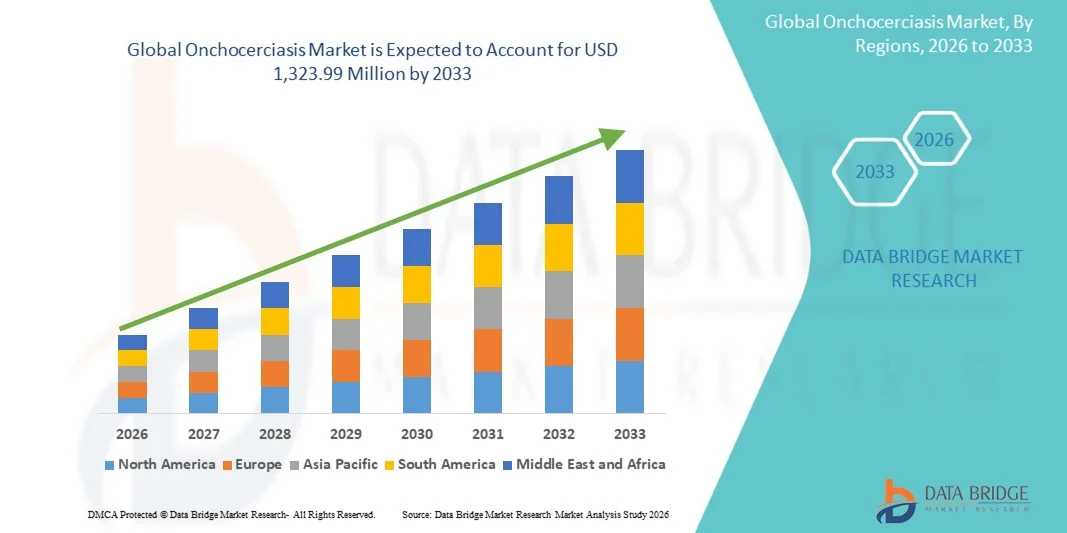
- As per Data Bridge Market Research Analysis the global onchocerciasis market size was valued at USD 800.00 million in 2025 and is expected to reach USD 1,323.99 million by 2033, at a CAGR of 6.5% during the forecast period
- The market growth is largely driven by the increasing prevalence of onchocerciasis in endemic regions, coupled with sustained global public health initiatives, mass drug administration (MDA) programs, and support from international organizations aimed at disease elimination
- Furthermore, rising investments in neglected tropical disease (NTD) control programs, improved access to ivermectin-based therapies, and expanding healthcare infrastructure in low- and middle-income countries are strengthening treatment coverage and accelerating progress toward long-term disease eradication
Market Size and Forecast:
- Global Market Value (2025): USD 800.00 million
- Expected Market Value (2033): USD 1,323.99 million
- Forecast CAGR (2026–2033): 6.5%
Onchocerciasis Market Analysis
- Onchocerciasis, also known as river blindness, is a neglected tropical disease caused by Onchocerca volvulus and transmitted through blackfly bites, requiring long-term preventive chemotherapy and coordinated public health interventions rather than conventional commercial treatment pathways, making mass drug administration programs a critical component of disease control and elimination efforts
- The escalating burden in endemic regions across Sub-Saharan Africa, combined with sustained support from global health organizations, government-led elimination programs, and widespread ivermectin distribution initiatives, is the primary factor driving demand within the onchocerciasis market
- North America dominated the onchocerciasis market with the largest share of 37.5% in 2025, primarily due to strong involvement of global health agencies, funding organizations, and pharmaceutical companies headquartered in the region that support large-scale donation programs, research initiatives, and elimination campaigns, despite the region having minimal native disease prevalence
- Asia-Pacific is expected to be the fastest growing region in the onchocerciasis market during the forecast period due to increasing healthcare investments, improving disease surveillance systems, and expanding public health infrastructure, alongside growing focus on eliminating neglected tropical diseases in vulnerable populations
- Ivermectin segment dominated the onchocerciasis market with the largest share of 72.4% in 2025, driven by its proven efficacy, large-scale donation programs by pharmaceutical stakeholders, and its central role as the cornerstone therapy in repeated mass drug administration strategies aimed at reducing transmission and achieving long-term elimination goals
Report Scope and Onchocerciasis Market Segmentation
|
Attributes |
Onchocerciasis Key Market Insights |
|
Segments Covered |
|
|
Countries Covered |
North America
Europe
Asia-Pacific
Middle East and Africa
South America
|
|
Key Market Players |
|
|
Market Opportunities |
|
|
Value Added Data Infosets |
In addition to the insights on market scenarios such as market value, growth rate, segmentation, geographical coverage, and major players, the market reports curated by the Data Bridge Market Research also include in-depth expert analysis, patient epidemiology, pipeline analysis, pricing analysis, and regulatory framework |
Onchocerciasis Market Trends
“Expansion of Mass Drug Administration and Global Elimination Programs”
- A significant and accelerating trend in the global onchocerciasis market is the continued expansion of mass drug administration (MDA) programs supported by global health organizations such as WHO, aiming to interrupt transmission and achieve elimination in endemic regions
- For instance, ivermectin-based distribution campaigns implemented through partnerships with national governments and NGOs are being scaled across Sub-Saharan Africa, enabling periodic treatment of at-risk populations through community-directed interventions
- These large-scale programs rely on repeated dosing cycles and coordinated logistics to ensure high coverage, with digital health tools and real-time monitoring increasingly used to track compliance and program effectiveness. Furthermore, integration of mapping and surveillance systems is improving identification of endemic hotspots and optimizing resource allocation
- The seamless coordination between governments, donors, and pharmaceutical donation programs facilitates centralized control over treatment delivery and reporting, creating a unified approach to disease management across regions
- This trend towards structured, data-driven, and highly coordinated elimination strategies is fundamentally reshaping expectations for neglected tropical disease control. Consequently, stakeholders are increasingly focusing on strengthening last-mile delivery systems and expanding access to remote and underserved communities
- The demand for sustained, large-scale intervention programs that ensure continuous treatment coverage is growing rapidly across endemic regions, as global stakeholders intensify efforts to eliminate onchocerciasis as a public health problem
Onchocerciasis Market Dynamics
Driver
“Growing Global Focus on Disease Elimination and Sustained Funding Support”
- The increasing global commitment to eliminating neglected tropical diseases, coupled with sustained funding from international organizations and donor-backed programs, is a significant driver for the heightened demand for onchocerciasis control and treatment initiatives
- For instance, coordinated efforts led by WHO and supported by public–private partnerships continue to expand ivermectin donation programs and strengthen national elimination strategies in endemic countries, accelerating treatment coverage and program implementation
- As governments and health agencies prioritize long-term disease elimination goals, mass treatment campaigns offer an effective approach to reducing transmission and preventing new infections across high-risk populations
- Furthermore, the growing emphasis on strengthening primary healthcare systems and integrating NTD programs into broader healthcare initiatives is making onchocerciasis control a key component of public health planning in affected regions
- The availability of donated therapies, combined with improved outreach, community engagement, and simplified treatment protocols, are key factors propelling the adoption of large-scale intervention programs in both rural and hard-to-reach areas. The trend towards community-led distribution models and increased awareness further contributes to program success
Restraint/Challenge
“Limited Healthcare Infrastructure and Treatment Adherence Challenges”
- Constraints related to weak healthcare infrastructure in endemic regions, including limited access to medical facilities and trained healthcare workers, pose a significant challenge to effective implementation of onchocerciasis control programs
- For instance, remote and hard-to-reach communities often experience logistical difficulties in maintaining consistent drug distribution cycles, leading to gaps in treatment coverage and reduced program effectiveness
- Addressing these challenges through improved supply chain systems, enhanced community health worker training, and strengthened surveillance mechanisms is essential for sustaining elimination efforts. In addition, the reliance on repeated dosing over many years can lead to issues with patient adherence and program fatigue among target populations
- While mass drug administration programs are widely implemented, maintaining high participation rates remains difficult in certain regions due to mobility of populations and limited awareness of the disease and its long-term impacts
- Overcoming these challenges through increased community engagement, improved healthcare accessibility, and continued international support will be vital for achieving sustained control and eventual elimination of onchocerciasis
Onchocerciasis Market Scope
The market is segmented on the basis of diagnosis, treatment, drug, route of administration, end-users, and distribution channel.
- By Diagnosis
On the basis of diagnosis, the onchocerciasis market is segmented into physical examination, skin biopsy, Mazzotti test, nodulectomy, PCR test, and others. The physical examination segment dominated the market with the largest revenue share in 2025. This dominance is primarily due to its widespread use in endemic regions where advanced diagnostic infrastructure is limited. Healthcare providers rely on visible clinical symptoms such as skin nodules, dermatitis, and ocular involvement to make preliminary diagnoses. It is cost-effective, requires minimal equipment, and can be performed in rural and resource-constrained settings. In addition, mass screening programs often begin with physical assessment before confirming with laboratory methods. The simplicity and accessibility of this method make it the first-line diagnostic approach across many low-income regions.
The PCR test segment is expected to witness the fastest growth over the forecast period. This growth is driven by increasing adoption of molecular diagnostics that offer higher sensitivity and specificity compared to traditional methods. PCR enables early detection of Onchocerca volvulus infection even at low parasite loads, improving disease management outcomes. Expanding laboratory infrastructure, improved awareness, and technological advancements in molecular diagnostics are further accelerating adoption. In addition, global elimination programs increasingly rely on precise diagnostic tools such as PCR to monitor transmission interruption. The declining cost of molecular testing is also contributing to its growing accessibility in developing regions.
- By Treatment
On the basis of treatment, the market is segmented into medication, supportive care, and others. The medication segment dominated the market due to its central role in disease management and control programs. Pharmacological interventions, particularly mass drug administration (MDA) campaigns, are the cornerstone of onchocerciasis elimination strategies. Medications help reduce microfilarial load, alleviate symptoms, and prevent transmission. Large-scale distribution initiatives by governments and global health organizations have ensured widespread accessibility of drug therapies. Medication-based treatment is also preferred because it is non-invasive, cost-effective, and scalable across populations. Continuous reliance on preventive chemotherapy further reinforces its dominance in endemic regions.
The supportive care segment is anticipated to grow at the fastest rate over the forecast period due to increasing emphasis on managing complications associated with chronic infection. Patients suffering from advanced onchocerciasis often require ophthalmic care, dermatological treatments, and management of secondary infections. Growing awareness about long-term disability and quality-of-life improvement is driving demand for supportive interventions. Healthcare systems are also expanding rehabilitative and symptomatic care services alongside primary drug treatments. The integration of multidisciplinary care approaches is further contributing to the expansion of this segment.
- By Drug
On the basis of drug, the market is segmented into ivermectin, moxidectin, and others. The ivermectin segment dominated the market with a market share of 72.4% owing to its long-standing use as the gold standard treatment in onchocerciasis control programs. It is widely distributed through mass drug administration initiatives supported by global health organizations. Ivermectin effectively reduces microfilarial density, thereby alleviating symptoms and interrupting transmission. Its established safety profile, affordability, and availability make it the most commonly used drug in endemic regions. Decades of clinical use and inclusion in public health programs have solidified its dominant position in the market.
The moxidectin segment is expected to register the fastest growth over the forecast period due to its longer-lasting suppression of microfilariae compared to ivermectin. It offers improved efficacy with fewer treatment cycles, making it attractive for elimination strategies. Regulatory approvals and increasing inclusion in control programs are boosting its adoption. Moxidectin is particularly valuable in regions with persistent transmission despite repeated ivermectin treatments. Ongoing research, favorable clinical outcomes, and potential for improved compliance are key factors driving its rapid growth.
- By Route of Administration
On the basis of route of administration, the market is segmented into oral and others. The oral route of administration dominated the market as most onchocerciasis treatments, including ivermectin and moxidectin, are administered orally. Oral medications are easy to distribute, require no specialized medical training for administration, and are suitable for large-scale mass drug campaigns. This route ensures high patient compliance and is particularly effective in remote and underserved regions. Oral administration also eliminates the need for injections, reducing risks associated with invasive procedures. Its practicality and scalability make it the preferred route in public health programs.
The others segment is expected to grow at the fastest rate over the forecast period, driven by ongoing research into alternative delivery methods and adjunct therapies. Although currently limited, innovations in drug formulations and delivery mechanisms may enhance treatment effectiveness and patient adherence. In certain clinical scenarios, alternative administration routes may be explored for targeted therapy or combination treatments. Increasing focus on personalized and optimized treatment approaches is also contributing to the growth of this segment.
- By End-Users
On the basis of end-users, the market is segmented into hospitals, homecare, specialty clinics, and others. The homecare segment dominated the market due to the widespread implementation of mass drug administration programs that allow treatments to be administered at the community level. Patients often receive medications at home or through community health workers, reducing the need for hospital visits. This approach is especially effective in rural and remote areas where access to healthcare facilities is limited. Home-based care also improves treatment coverage and compliance in large populations. Government-led initiatives and non-governmental organization involvement further support this decentralized care model.
The specialty clinics segment is expected to witness the fastest growth over the forecast period as awareness and diagnosis of advanced cases increase. Specialty clinics provide focused care for ocular complications and chronic skin conditions associated with onchocerciasis. The rising demand for specialized diagnostic and therapeutic services is driving patients toward these facilities. In addition, improved healthcare infrastructure and availability of trained specialists are contributing to segment expansion. Integration of advanced diagnostic tools and targeted treatment approaches further supports the growth of specialty clinics.
- By Distribution Channel
On the basis of distribution channel, the market is segmented into hospital pharmacy, online pharmacy, and retail pharmacy. The hospital pharmacy segment dominated the market due to the centralized procurement and distribution of drugs through healthcare institutions involved in public health programs. Hospitals often act as primary distribution points for mass drug administration campaigns and clinical treatments. They ensure proper storage, quality control, and regulated dispensing of medications. Government and institutional support further strengthens hospital-based distribution networks. This channel is particularly important in organized healthcare systems and large-scale treatment initiatives.
The online pharmacy segment is expected to grow at the fastest rate over the forecast period, driven by increasing digitalization of healthcare services and improved internet penetration. Online platforms provide convenient access to medications, especially in urban and semi-urban areas. Growing consumer preference for home delivery services and telemedicine integration is boosting demand. Online pharmacies also enhance accessibility for patients with mobility constraints or those in remote locations. Expanding e-commerce healthcare ecosystems and regulatory advancements are further accelerating the adoption of this channel.
Onchocerciasis Market Regional Analysis
- North America dominated the onchocerciasis market with the largest share of 37.5% in 2025, primarily due to strong involvement of global health agencies, funding organizations, and pharmaceutical companies headquartered in the region that support large-scale donation programs, research initiatives, and elimination campaigns, despite the region having minimal native disease prevalence
- The presence of leading pharmaceutical and biotechnology companies, along with well-established research institutions, supports continuous advancements in treatments such as ivermectin and emerging therapies such as moxidectin
- High adoption of advanced diagnostic technologies, including PCR-based testing, further strengthens the region’s contribution to market revenues through research, surveillance, and export of technologies. Government support, along with collaborations with international health organizations, enhances funding for eradication efforts and clinical trials targeting onchocerciasis
U.S. Onchocerciasis Market Insight
The United States captured the largest revenue share in 2025 within North America in the global onchocerciasis market, driven by its strong role in research, funding, and global health initiatives rather than disease prevalence. The country is a key contributor to neglected tropical disease (NTD) programs, supporting large-scale elimination efforts through financial aid, policy frameworks, and international collaborations. Advanced pharmaceutical and biotechnology sectors in the U.S. are actively engaged in developing improved therapeutics and diagnostic solutions, including molecular testing methods such as PCR. The presence of leading research institutions and well-established clinical trial infrastructure further accelerates innovation in treatment and surveillance strategies. In addition, strong government and non-governmental organization involvement supports mass drug administration programs in endemic regions. The combination of technological leadership, funding capacity, and global health engagement reinforces the U.S. as a dominant contributor to the onchocerciasis market.
Europe Onchocerciasis Market Insight
The Europe onchocerciasis market is projected to expand at a substantial CAGR throughout the forecast period, primarily driven by increasing participation in global elimination programs and strong emphasis on research and development. European countries contribute significantly through funding initiatives, collaborative research, and support for international health organizations targeting neglected tropical diseases. The region benefits from advanced healthcare infrastructure and well-established regulatory frameworks that promote innovation in diagnostics and therapeutics. Growing investments in tropical disease research and the adoption of molecular diagnostic technologies are enhancing Europe’s role in disease monitoring and control. In addition, increasing awareness among research institutions and policymakers is fostering collaborative efforts with endemic regions. The region’s focus on scientific advancement and global health partnerships is expected to support steady market growth.
U.K. Onchocerciasis Market Insight
The United Kingdom onchocerciasis market is anticipated to grow at a noteworthy CAGR during the forecast period, driven by its strong involvement in global health research and funding initiatives targeting neglected tropical diseases. The U.K. is home to leading academic and research institutions that actively contribute to the development of diagnostic tools and therapeutic approaches for parasitic infections. Government-backed programs and collaborations with international organizations are supporting elimination efforts in endemic regions. The country’s advanced healthcare and research ecosystem enables the development and testing of innovative solutions, including molecular diagnostics and improved treatment strategies. In addition, its active participation in global mass drug administration campaigns strengthens its contribution to disease control efforts. Increasing focus on international health security and research excellence continues to drive the U.K.’s market growth.
Germany Onchocerciasis Market Insight
The Germany onchocerciasis market is expected to expand at a considerable CAGR during the forecast period, fueled by strong investments in biomedical research and a well-developed healthcare infrastructure. Germany plays an important role in advancing diagnostic technologies and supporting research initiatives focused on tropical diseases. The country’s emphasis on innovation, sustainability, and precision medicine encourages the adoption of advanced molecular diagnostic methods and improved therapeutic approaches. German research institutions actively collaborate with global organizations to support elimination programs and disease surveillance efforts. In addition, increasing awareness of neglected tropical diseases among healthcare stakeholders is driving further research and development activities. The combination of scientific expertise, technological advancement, and international collaboration positions Germany as a key contributor to the global onchocerciasis market.
Asia-Pacific Onchocerciasis Market Insight
The Asia-Pacific onchocerciasis market is poised to grow at the fastest CAGR during the forecast period, driven by increasing healthcare investments, rising research activities, and expanding participation in global elimination programs. While the region has limited endemic prevalence, countries such as India, China, and Japan are actively contributing to pharmaceutical manufacturing, diagnostics, and research initiatives. Rapid urbanization, improving healthcare infrastructure, and growing awareness of neglected tropical diseases are supporting market expansion. Government initiatives promoting digitalization and public health programs are further enhancing disease surveillance and control capabilities. In addition, the region’s strong manufacturing base is improving the affordability and accessibility of drugs used in mass treatment campaigns. Collaborative efforts with international organizations are expected to further accelerate growth across the Asia-Pacific region.
Japan Onchocerciasis Market Insight
The Japan onchocerciasis market is gaining momentum due to the country’s advanced technological capabilities, strong healthcare system, and focus on innovation in medical research. Japan is actively involved in developing diagnostic technologies and therapeutic solutions for infectious and tropical diseases through research collaborations with global health organizations. The country’s emphasis on precision medicine and high-quality diagnostics supports advancements in molecular testing methods such as PCR. In addition, government and institutional funding for infectious disease research contributes to the development of improved treatment strategies. Japan’s aging population and increasing demand for efficient healthcare solutions further support the adoption of advanced diagnostic and monitoring tools. Its commitment to innovation and global health initiatives strengthens its contribution to the onchocerciasis market.
India Onchocerciasis Market Insight
India accounted for the largest market revenue share in Asia Pacific in 2025, attributed to its strong pharmaceutical manufacturing base, growing healthcare infrastructure, and active participation in global health initiatives. The country plays a significant role in the production of cost-effective drugs such as ivermectin, which are widely used in mass drug administration programs across endemic regions. Rapid urbanization, rising disposable incomes, and increasing adoption of advanced healthcare technologies are supporting market growth. India’s expanding research ecosystem and government-led health initiatives are also contributing to improved disease awareness and control efforts. The presence of affordable diagnostic and treatment options, along with strong domestic manufacturers, enhances accessibility across diverse populations. These factors collectively position India as a key contributor to the global onchocerciasis market.
Top Companies in Onchocerciasis Market
The Onchocerciasis industry is primarily led by well-established companies, including:
- Merck & Co., Inc. (U.S.)
- Alnylam Pharmaceuticals, Inc. (U.S.)
- GSK plc (U.K.)
- Pfizer Inc. (U.S.)
- AstraZeneca (U.K.)
- Novartis AG (Switzerland)
- Sanofi (France)
- Eisai Co., Ltd. (Japan)
- Bayer AG (Germany)
- AbbVie Inc. (U.S.)
- Medicines Development for Global Health Ltd. (Australia)
- Drugs for Neglected Diseases initiative (Switzerland)
- A·WOL Ltd. (U.K.)
- Sightsavers (U.K.)
- The Carter Center (U.S.)
- PATH (U.S.)
- BIO Ventures for Global Health (U.S.)
- Liverpool School of Tropical Medicine (U.K.)
- University of Ghana (Ghana)
What are the Recent Developments in Global Onchocerciasis Market?
- In December 2025, the Nigerian Minister of State for Health and Social Welfare reported that 47.1 million Nigerians no longer require treatment for onchocerciasis (river blindness) and lymphatic filariasis following the successful completion of the BLON project, a large-scale disease assessment and control initiative supported by funding from the Bill & Melinda Gates Foundation
- In March 2025, the 2nd Global Meeting on skin-related neglected tropical diseases (NTDs) was held in Geneva, focusing on accelerating progress through integration and innovation. Onchocerciasis (river blindness) was a key topic, with stakeholders discussing strategies to improve coordinated disease control and surveillance across endemic regions
- In January 2025, the World Health Organization verified that Niger successfully interrupted transmission of Onchocerca volvulus, making it the first country in the African Region and the fifth globally to eliminate onchocerciasis. This milestone was achieved through sustained high-coverage mass drug administration and vector control efforts, marking a historic public health achievement in the fight against river blindness
- In September 2025, researchers initiated a £4.9 million clinical trial to evaluate whether an existing antibiotic can be repurposed as a short-course cure for onchocerciasis. The study, led by the Centre for Neglected Tropical Diseases (CNTD), aims to explore novel treatment approaches beyond current mass drug administration strategies
- In December 2024, the Ghana Food and Drugs Authority granted marketing authorization for moxidectin for the treatment of onchocerciasis in adults and children aged 4 years and older. This regulatory approval supports pilot community treatment programs and represents a key step toward broader use of this newer drug in endemic countries

- Interactive Data Analysis Dashboard
- Company Analysis Dashboard for high growth potential opportunities
- Research Analyst Access for customization & queries
- Competitor Analysis with Interactive dashboard
- Latest News, Updates & Trend analysis
- Harness the Power of Benchmark Analysis for Comprehensive Competitor Tracking
Data collection and base year analysis are done using data collection modules with large sample sizes. The stage includes obtaining market information or related data through various sources and strategies. It includes examining and planning all the data acquired from the past in advance. It likewise envelops the examination of information inconsistencies seen across different information sources. The market data is analysed and estimated using market statistical and coherent models. Also, market share analysis and key trend analysis are the major success factors in the market report. To know more, please request an analyst call or drop down your inquiry.
The key research methodology used by DBMR research team is data triangulation which involves data mining, analysis of the impact of data variables on the market and primary (industry expert) validation. Data models include Vendor Positioning Grid, Market Time Line Analysis, Market Overview and Guide, Company Positioning Grid, Patent Analysis, Pricing Analysis, Company Market Share Analysis, Standards of Measurement, Global versus Regional and Vendor Share Analysis. To know more about the research methodology, drop in an inquiry to speak to our industry experts.
Data Bridge Market Research is a leader in advanced formative research. We take pride in servicing our existing and new customers with data and analysis that match and suits their goal. The report can be customized to include price trend analysis of target brands understanding the market for additional countries (ask for the list of countries), clinical trial results data, literature review, refurbished market and product base analysis. Market analysis of target competitors can be analyzed from technology-based analysis to market portfolio strategies. We can add as many competitors that you require data about in the format and data style you are looking for. Our team of analysts can also provide you data in crude raw excel files pivot tables (Fact book) or can assist you in creating presentations from the data sets available in the report.












