Global Oncolytic Virus Therapy Market
Market Size in USD Billion
CAGR :
% 
 USD
1.12 Billion
USD
5.79 Billion
2025
2033
USD
1.12 Billion
USD
5.79 Billion
2025
2033
 Forecast Period Forecast Period |
2026 –2033 |
 Market Size (Base Year) Market Size (Base Year) |
USD 1.12 Billion |
 Market Size (Forecast Year) Market Size (Forecast Year) |
USD 5.79 Billion |
 CAGR CAGR |
% |
| Major Markets Players |
|
Oncolytic Virus Therapy Market Size
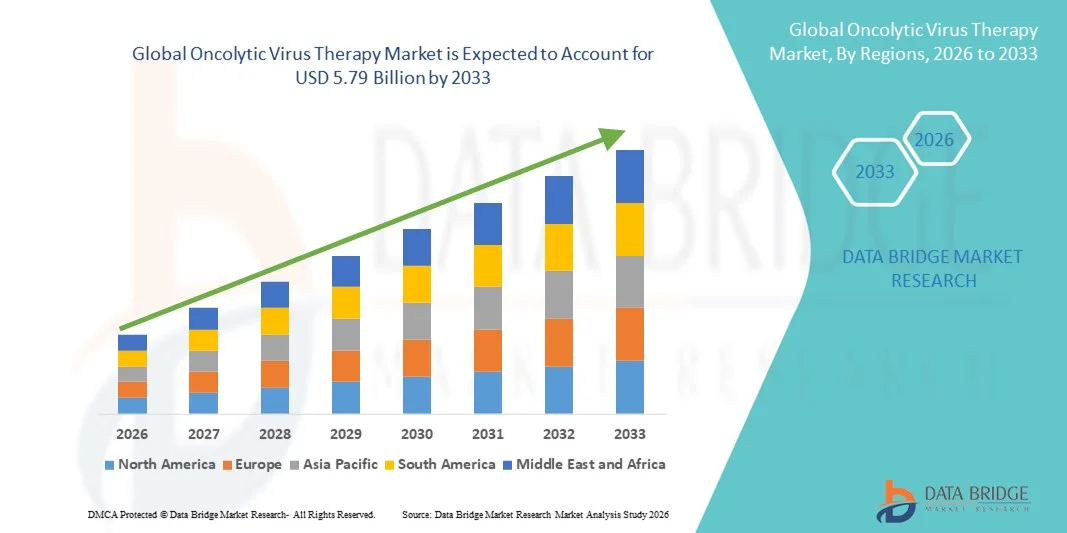
- The global oncolytic virus therapy market size was valued at USD 1.12 billion in 2025 and is expected to reach USD 5.79 billion by 2033, at a CAGR of 22.80% during the forecast period
- The market growth is primarily driven by the rising global cancer burden, increasing demand for innovative cancer therapeutics, and technological advancements in genetic engineering and viral vector design that enhance safety, selectivity, and immune activation
- Furthermore, expanding clinical pipelines, strategic collaborations between biotech firms and pharmaceutical players, and growing adoption of oncolytic viruses often in combination with other immunotherapies are strengthening therapeutic uptake across research and clinical settings. These converging factors are accelerating market expansion and reinforcing oncolytic virus therapy as a promising modality in modern oncology
Oncolytic Virus Therapy Market Analysis
- Oncolytic virus therapies, using genetically engineered or naturally occurring viruses to selectively infect and kill cancer cells while stimulating antitumor immunity, are becoming increasingly critical components of modern oncology treatment regimens across both solid tumors and hematological malignancies due to their targeted action, immunomodulatory potential, and compatibility with combination therapies
- The escalating demand for oncolytic virus therapies is primarily fueled by the rising global cancer burden, growing investment in biotech research, and increasing adoption of immuno-oncology treatments as a preferred alternative or adjunct to conventional therapies such as chemotherapy and radiotherapy
- North America dominated the oncolytic virus therapy market with the largest revenue share of 42.9% in 2025, driven by early adoption of advanced cancer therapies, well-established clinical infrastructure, and a strong presence of leading biotech and pharmaceutical companies developing innovative oncolytic virus platforms, with the U.S. witnessing substantial clinical trial activity and therapy approvals
- Asia-Pacific is expected to be the fastest-growing region in the oncolytic virus therapy market during the forecast period due to increasing healthcare expenditure, rising prevalence of cancer, expanding clinical research, and growing government support for biotechnology innovations
- Herpes Simplex Virus segment dominated the market with a share of 38.6% in 2025, driven by their established clinical efficacy, regulatory approvals, and strong pipeline presence in combination therapies with immune checkpoint inhibitors
Report Scope and Oncolytic Virus Therapy Market Segmentation
|
Attributes |
Oncolytic Virus Therapy Key Market Insights |
|
Segments Covered |
|
|
Countries Covered |
North America
Europe
Asia-Pacific
Middle East and Africa
South America
|
|
Key Market Players |
|
|
Market Opportunities |
|
|
Value Added Data Infosets |
In addition to the insights on market scenarios such as market value, growth rate, segmentation, geographical coverage, and major players, the market reports curated by the Data Bridge Market Research also include in-depth expert analysis, patient epidemiology, pipeline analysis, pricing analysis, and regulatory framework |
Oncolytic Virus Therapy Market Trends
Advancements in Combination Immunotherapies and Genetic Engineering
- A significant and accelerating trend in the global oncolytic virus therapy market is the growing development of combination therapies that pair oncolytic viruses with immune checkpoint inhibitors and CAR-T therapies, enhancing antitumor efficacy and patient response rates
- For instance, T-Vec (talimogene laherparepvec) combined with pembrolizumab has shown improved clinical outcomes in melanoma patients, demonstrating the potential of synergistic immunotherapy approaches
- Genetic engineering innovations are enabling the creation of viruses with improved tumor selectivity, immune stimulation, and safety profiles, allowing for more personalized and effective treatment options
- The integration of oncolytic virus therapy with other emerging immuno-oncology platforms facilitates multi-modal cancer management, enabling physicians to design treatment regimens that maximize both direct tumor lysis and systemic immune activation
- This trend toward more precise, combinational, and immunologically integrated therapies is reshaping oncological treatment paradigms and patient expectations
- The adoption of engineered viruses with enhanced payload delivery and immune-modulating genes is increasing rapidly across clinical trials and research programs, as biotech companies aim to expand therapeutic efficacy and application across multiple tumor types
- There is growing interest in the development of oncolytic viruses targeting rare and difficult-to-treat cancers, expanding the therapeutic scope and market potential
Oncolytic Virus Therapy Market Dynamics
Driver
Rising Cancer Prevalence and Growing Demand for Novel Immunotherapies
- The increasing incidence of various cancers worldwide, coupled with growing awareness of targeted immunotherapies, is a significant driver of the heightened demand for oncolytic virus treatments
- For instance, in March 2025, Amgen reported the expansion of clinical trials combining T-Vec with checkpoint inhibitors, signaling strong interest in developing new therapeutic protocols that improve patient outcomes
- Oncolytic virus therapies offer unique advantages, such as selective tumor cell lysis and immune system activation, providing compelling treatment options compared to conventional chemotherapy or radiotherapy
- Furthermore, the expanding pipeline of engineered viruses and supportive clinical research is accelerating adoption in both academic hospitals and specialized cancer treatment centers
- Growing government funding, favorable regulatory frameworks for advanced therapies, and increasing collaborations between biotech firms and pharmaceutical companies are also contributing to market growth
- Patient demand for minimally invasive, personalized, and highly effective cancer therapies continues to drive investment and commercialization efforts across multiple regions
- Increasing awareness and education campaigns by oncology associations are helping physicians and patients adopt oncolytic virus therapies more readily
- Strategic mergers and acquisitions among biotech companies are enhancing technology sharing, pipeline expansion, and market penetration globally
Restraint/Challenge
High Development Costs and Regulatory Hurdles
- The complexity, high cost, and lengthy development timelines of oncolytic virus therapies pose a significant challenge to market expansion
- For instance, the development of a genetically engineered virus may require extensive preclinical and clinical testing before regulatory approval, delaying market entry
- Strict regulatory requirements and the need for specialized manufacturing facilities increase barriers for smaller biotech firms and can slow commercialization
- In addition, concerns about safety, potential off-target effects, and immune-related adverse events necessitate rigorous clinical evaluation and monitoring
- The high cost of therapy and limited reimbursement coverage in some regions can restrict patient access, affecting adoption rates despite proven efficacy
- Overcoming these challenges through optimized production processes, supportive policy frameworks, and strategic partnerships is critical for sustained growth and wider patient reach
- Limited public awareness and understanding of oncolytic virus therapy can lead to slower acceptance among patients and healthcare providers
- Competition from other advanced cancer therapies, including CAR-T, checkpoint inhibitors, and gene therapy, may constrain market growth in certain regions
Oncolytic Virus Therapy Market Scope
The market is segmented on the basis of virus type, therapy type, application, and end user.
- By Virus Type
On the basis of virus type, the oncolytic virus therapy market is segmented into genetically engineered oncolytic viruses, oncolytic wild‑type viruses, herpes simplex virus (HSV), adenovirus, vaccinia virus, reovirus, Newcastle disease virus (NDV), and vesicular stomatitis virus (VSV). The Herpes Simplex Virus (HSV) segment dominated the market with a share of 38.6% in 2025, driven by its established clinical efficacy, early regulatory approvals, and strong adoption in melanoma and other solid tumor therapies. HSV-based therapies such as T-Vec have set the benchmark for oncolytic virus treatment, encouraging widespread clinical use and integration into combination therapy protocols. The segment also benefits from a robust clinical pipeline, ongoing research for other indications, and growing awareness among oncologists of its proven immune-stimulating properties. Furthermore, HSV production is scalable and supported by experienced biotech firms, enhancing its commercial availability globally.
The genetically engineered oncolytic viruses segment is expected to witness the fastest growth rate from 2026 to 2033, fueled by increasing R&D investments and technological advancements enabling virus modification for enhanced tumor targeting and immune activation. The ability to design viruses with tailored payloads, safety features, and compatibility with immunotherapy combinations is driving adoption across multiple cancer types and geographies. Rapid growth in clinical trials and regulatory support further accelerates the segment’s expansion in North America, Europe, and emerging Asia-Pacific markets.
- By Therapy Type
On the basis of therapy type, the market is segmented into monotherapy and combination therapy. The monotherapy segment dominated the market in 2025, owing to its simplicity, established regulatory approvals, and use as the primary approach for early-stage clinical applications. Monotherapy allows clinicians to evaluate virus safety and efficacy independently, providing a clear treatment framework for patients. It is widely adopted in hospitals and cancer research institutes due to predictable outcomes and regulatory familiarity. The monotherapy segment also benefits from a high number of ongoing clinical trials targeting common cancers such as melanoma and lung cancer.
The combination therapy segment is expected to witness the fastest growth rate from 2026 to 2033, driven by increasing interest in pairing oncolytic viruses with immune checkpoint inhibitors, CAR-T therapies, or chemotherapy regimens to improve treatment outcomes. Combination therapy enhances antitumor immune response and reduces resistance, making it particularly appealing for difficult-to-treat or metastatic cancers. Expanding clinical pipelines and supportive regulatory frameworks further accelerate adoption, while patients and physicians increasingly prefer integrated approaches that maximize efficacy.
- By Application
On the basis of application, the market is segmented into melanoma, lung cancer, breast cancer, prostate cancer, ovarian cancer, glioblastoma, hematological malignancies, lymphoma, leukemia, myeloma, and other tumors. The melanoma segment dominated the market in 2025, attributed to early clinical approvals of HSV-based oncolytic viruses and strong evidence of efficacy in advanced-stage melanoma patients. Melanoma treatments have been the benchmark for clinical evaluation of oncolytic virus therapies, leading to higher adoption rates in hospitals and research centers globally. The segment benefits from high awareness among oncologists and substantial ongoing research, including combination therapy trials, driving consistent revenue growth.
The glioblastoma segment is expected to witness the fastest growth rate from 2026 to 2033, fueled by unmet clinical need in this aggressive brain cancer and promising preclinical and early-phase clinical trial results. Oncolytic viruses are being engineered to cross the blood-brain barrier and stimulate immune response within the central nervous system. Rising investment in novel virus platforms targeting glioblastoma, alongside increasing incidence rates, further supports rapid adoption and market expansion in both developed and emerging regions.
- By End User
On the basis of end user, the market is segmented into hospitals, specialty clinics, and cancer research institutes. The hospitals segment dominated the market in 2025, due to the high concentration of oncology departments, advanced infrastructure, and access to clinical trial patients. Hospitals serve as the primary sites for both administration and monitoring of oncolytic virus therapies, offering robust protocols for patient safety and efficacy assessment. The segment also benefits from strong collaborations with biotech companies and pharmaceutical firms for therapy delivery and ongoing clinical studies.
The cancer research institutes segment is expected to witness the fastest growth rate from 2026 to 2033, driven by an increasing number of preclinical and early-phase clinical trials conducted in academic and private research centers. These institutes play a crucial role in developing novel virus vectors, optimizing genetic engineering techniques, and evaluating combination therapies. Rising funding from governments and private investors, particularly in North America and Asia-Pacific, is accelerating research activities and adoption, making research institutes a fast-growing end-user segment.
Oncolytic Virus Therapy Market Regional Analysis
- North America dominated the oncolytic virus therapy market with the largest revenue share of 42.9% in 2025, driven by early adoption of advanced cancer therapies, well-established clinical infrastructure, and a strong presence of leading biotech and pharmaceutical companies developing innovative oncolytic virus platforms, with the U.S. witnessing substantial clinical trial activity and therapy approvals
- Patients and healthcare providers in the region highly value the proven clinical efficacy, regulatory-approved therapies, and the ability to integrate oncolytic viruses into combination immunotherapy regimens, enhancing treatment outcomes in solid tumors and hematological malignancies
- This widespread adoption is further supported by substantial government and private funding for oncology research, a strong pipeline of clinical trials, and increasing awareness among oncologists, establishing oncolytic virus therapy as a preferred treatment option for both hospitals and specialized cancer centers
U.S. Oncolytic Virus Therapy Market Insight
The U.S. oncolytic virus therapy market captured the largest revenue share of 83% in 2025 within North America, fueled by the early adoption of advanced cancer therapies and well-established clinical infrastructure. Patients and oncologists are increasingly prioritizing innovative, targeted treatments with immune-stimulating properties. The growing number of clinical trials, combined with robust demand for combination therapies and FDA-approved oncolytic virus platforms, further propels the market. Moreover, increasing integration of immunotherapy approaches with standard care protocols is significantly contributing to market expansion.
Europe Oncolytic Virus Therapy Market Insight
The Europe oncolytic virus therapy market is projected to expand at a substantial CAGR throughout the forecast period, primarily driven by rising cancer prevalence and increasing healthcare expenditure. The adoption of innovative therapies is further supported by government initiatives promoting biotechnology research and stringent regulatory oversight ensuring therapy safety and efficacy. European healthcare providers are embracing targeted and combination therapies, which are gaining traction in both public hospitals and specialty oncology centers. The market is experiencing significant growth across melanoma, lung, and breast cancer indications.
U.K. Oncolytic Virus Therapy Market Insight
The U.K. oncolytic virus therapy market is anticipated to grow at a noteworthy CAGR during the forecast period, driven by increasing awareness of advanced immunotherapies and the integration of novel virus-based treatments into standard cancer care. Rising cancer incidence, coupled with patient preference for targeted and minimally invasive therapies, is supporting adoption. In addition, strong clinical research infrastructure, government support, and collaborations between biotech firms and hospitals are expected to continue stimulating market growth.
Germany Oncolytic Virus Therapy Market Insight
The Germany oncolytic virus therapy market is expected to expand at a considerable CAGR during the forecast period, fueled by rising cancer prevalence and a strong focus on precision medicine. Germany’s well-developed healthcare system, combined with investments in clinical research and innovative biotechnology, promotes adoption of virus-based therapies. Integration of oncolytic viruses into combination immunotherapy regimens is becoming increasingly prevalent, with hospitals and specialty clinics showing strong preference for treatments with proven safety and efficacy profiles.
Asia-Pacific Oncolytic Virus Therapy Market Insight
The Asia-Pacific oncolytic virus therapy market is poised to grow at the fastest CAGR of 23% during 2026–2033, driven by rising cancer incidence, increasing healthcare expenditure, and expanding clinical research infrastructure in countries such as China, Japan, and India. The region’s growing adoption of advanced therapies, supported by government initiatives promoting biotechnology and immuno-oncology research, is accelerating market uptake. Furthermore, emerging collaborations between local hospitals and global biotech companies are enhancing therapy availability and clinical trial participation.
Japan Oncolytic Virus Therapy Market Insight
The Japan oncolytic virus therapy market is gaining momentum due to the country’s focus on advanced medical technology, high healthcare standards, and rising cancer incidence. Japan places significant emphasis on precision oncology, and the adoption of virus-based therapies is driven by expanding clinical trial programs and integration with other immunotherapy modalities. Moreover, increasing awareness among oncologists and patients, along with government support for innovative treatments, is fueling growth in both hospitals and specialty clinics.
India Oncolytic Virus Therapy Market Insight
The India oncolytic virus therapy market accounted for the largest market revenue share in Asia-Pacific in 2025, attributed to rising cancer prevalence, increasing healthcare access, and growing awareness of targeted immunotherapies. India is emerging as a hub for clinical trials and biotech research, and oncolytic virus therapies are becoming increasingly popular in hospitals, specialty clinics, and cancer research institutes. Government initiatives promoting healthcare innovation, coupled with collaborations with global pharmaceutical companies, are key factors propelling market growth.
Oncolytic Virus Therapy Market Share
The Oncolytic Virus Therapy industry is primarily led by well-established companies, including:
- Amgen Inc (U.S.)
- Oncolytics Biotech Inc (Canada)
- Viralytics Ltd (Australia)
- Transgene SA (France)
- Oncolys BioPharma Inc (Japan)
- Targovax ASA (Norway)
- PsiOxus Therapeutics Ltd (U.K.)
- SillaJen Inc (South Korea)
- Sorrento Therapeutics Inc (U.S.)
- Lokon Pharma AB (Sweden)
- Genelux Corporation (U.S.)
- Vyriad Inc (U.S.)
- TILT Biotherapeutics (Australia)
- Cold Genesys Inc (U.S.)
- Shanghai Sunway Biotech Co Ltd (China)
- Candel Therapeutics Inc (U.S.)
- Binhui Biopharmaceutical Co Ltd (China)
- Oryx GmbH & Co KG (Germany)
- CG Oncology Inc (U.S.)
- DNAtrix Inc (U.S.)
What are the Recent Developments in Global Oncolytic Virus Therapy Market?
- In February 2026, ViroMissile expanded its ongoing Phase I IDOV-Immune™ trial into the United States following U.S. FDA IND clearance, enabling leading U.S. cancer centers to begin enrolling patients with advanced solid tumors
- In February 2025, UroGen Pharma acquired the early-phase oncolytic virus candidate ICVB-1042 from IconOVir Bio, broadening its oncology pipeline with a novel viral immunotherapy candidate aimed at solid tumors
- In December 2025, ViroMissile, Inc. announced the initiation of its first-in-human Phase I clinical trial of IDOV-Immune, an intravenously deliverable oncolytic vaccinia virus therapy for advanced solid tumors, marking a significant milestone toward systemically delivered viral cancer therapy
- In April 2024, the U.S. FDA granted Fast Track designation to ImmVira’s oncolytic herpes simplex virus therapy MVR-T3011 IT for treating recurrent or metastatic head and neck squamous cell cancer after standard therapy, expediting its clinical development pathway
- In June 2021, the Japanese Ministry of Health, Labour and Welfare approved Teserpaturev (G47Δ, marketed as Delytact), an oncolytic herpes simplex virus therapy for malignant glioma, making it one of the first approved oncolytic virotherapies for brain cancer
SKU-
Get online access to the report on the World's First Market Intelligence Cloud

- Interactive Data Analysis Dashboard
- Company Analysis Dashboard for high growth potential opportunities
- Research Analyst Access for customization & queries
- Competitor Analysis with Interactive dashboard
- Latest News, Updates & Trend analysis
- Harness the Power of Benchmark Analysis for Comprehensive Competitor Tracking
Research Methodology
Data collection and base year analysis are done using data collection modules with large sample sizes. The stage includes obtaining market information or related data through various sources and strategies. It includes examining and planning all the data acquired from the past in advance. It likewise envelops the examination of information inconsistencies seen across different information sources. The market data is analysed and estimated using market statistical and coherent models. Also, market share analysis and key trend analysis are the major success factors in the market report. To know more, please request an analyst call or drop down your inquiry.
The key research methodology used by DBMR research team is data triangulation which involves data mining, analysis of the impact of data variables on the market and primary (industry expert) validation. Data models include Vendor Positioning Grid, Market Time Line Analysis, Market Overview and Guide, Company Positioning Grid, Patent Analysis, Pricing Analysis, Company Market Share Analysis, Standards of Measurement, Global versus Regional and Vendor Share Analysis. To know more about the research methodology, drop in an inquiry to speak to our industry experts.
Customization Available
Data Bridge Market Research is a leader in advanced formative research. We take pride in servicing our existing and new customers with data and analysis that match and suits their goal. The report can be customized to include price trend analysis of target brands understanding the market for additional countries (ask for the list of countries), clinical trial results data, literature review, refurbished market and product base analysis. Market analysis of target competitors can be analyzed from technology-based analysis to market portfolio strategies. We can add as many competitors that you require data about in the format and data style you are looking for. Our team of analysts can also provide you data in crude raw excel files pivot tables (Fact book) or can assist you in creating presentations from the data sets available in the report.