


One Component Polyurethane Foam Market Overview
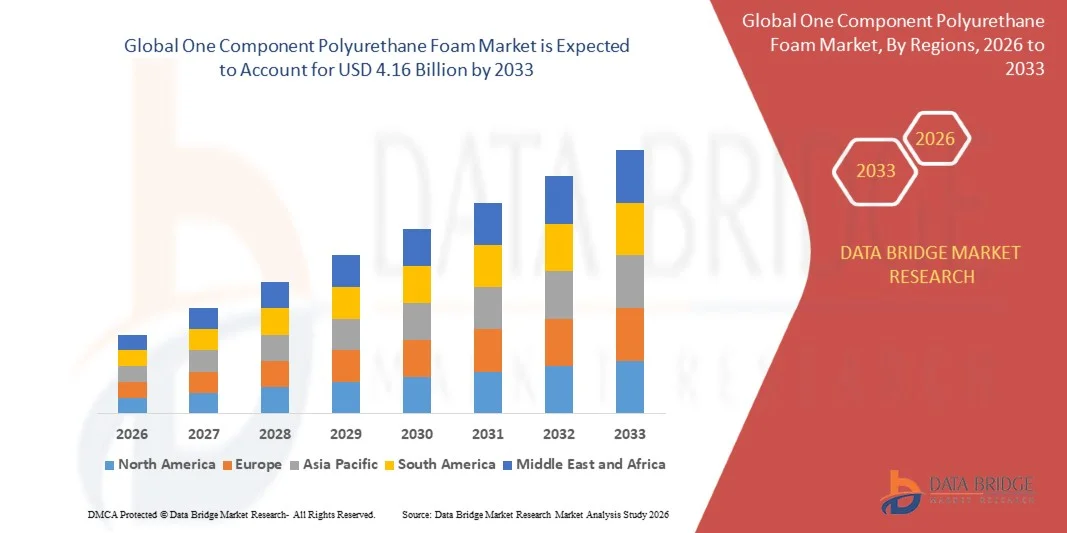
As per Data Bridge Market Research analysis the One Component Polyurethane Foam Market was valued at USD 3.04 billion in 2025 and is projected to reach USD 4.16 billion by 2033, growing at a CAGR of 4.02% from 2026 to 2033. The market is witnessing steady growth driven by rising demand from construction insulation applications, increasing use in energy-efficient building materials, and expanding adoption in sealing, bonding, and gap-filling applications across residential and commercial infrastructure projects.
The growing emphasis on energy conservation and sustainable construction practices is significantly driving demand for one component polyurethane foam, as it offers excellent thermal insulation, air sealing properties, and ease of application. In addition, increasing renovation activities, rapid urbanization, and stricter building energy efficiency regulations are encouraging builders and contractors to adopt high-performance insulation materials. The material’s ability to provide moisture resistance, durability, and strong adhesion across multiple substrates further supports its widespread use in modern construction and industrial applications.
Key Market Trends & Insights
- North America dominated the one component polyurethane foam market with the largest revenue share of 38.6% in 2025, supported by strong construction activity, high adoption of energy-efficient insulation materials, rising renovation projects, and stringent building energy efficiency standards driving demand for advanced sealing and insulation solutions.
- Asia-Pacific is expected to be the fastest-growing region, recording a CAGR of 5.1% from 2026 to 2033. Growth is driven by rapid urbanization, expanding construction activities, increasing infrastructure development, rising demand for affordable housing, and growing adoption of energy-efficient insulation materials in emerging economies such as China, India, and Southeast Asia.
- The MDI segment held the largest market revenue share of approximately 57.6% in 2025 driven by its extensive use in rigid foam formulations, superior thermal insulation properties, and strong demand from construction and insulation applications. MDI-based foams are widely preferred due to their excellent adhesion, moisture resistance, and structural stability in sealing and filling applications across residential and commercial buildings.
- The polyether polyols segment is projected to register the fastest growth at a CAGR of 4.8% from 2026 to 2033, driven by increasing demand for flexible foam applications and improved performance characteristics in terms of elasticity and durability. Rising adoption in energy-efficient building insulation systems and expanding renovation activities across developed economies are accelerating segment expansion.
- The residential segment held the largest market revenue share of approximately 61.9% in 2025 driven by rapid urbanization, rising housing construction activities, and increasing demand for energy-efficient insulation materials in homes. One component polyurethane foam is widely used in residential applications for sealing gaps, improving thermal insulation, and reducing energy loss in doors, windows, and roofing systems.
- The commercial segment is projected to register the fastest growth at a CAGR of 4.3% from 2026 to 2033, driven by rising construction of office buildings, retail spaces, and industrial facilities requiring advanced insulation and air sealing solutions. Increasing emphasis on green building certifications and energy-efficient infrastructure is further strengthening adoption in commercial construction projects.
- The door and window frame jambs segment held the largest market revenue share of approximately 34.7% in 2025 driven by high usage of polyurethane foam for sealing air leaks, improving thermal insulation, and enhancing structural stability in building envelopes. This application is widely adopted in both new construction and renovation projects due to ease of application and long-term performance benefits.
- The water pipes segment is projected to register the fastest growth at a CAGR of 5.1% from 2026 to 2033, driven by increasing demand for insulation of plumbing systems to prevent heat loss, condensation, and freezing in extreme climates. Expanding infrastructure development and rising focus on energy-efficient piping systems in residential and commercial buildings are further supporting segment growth.
Market Size & Forecast
- Global Market Value (2025): USD 3.04 Billion
- Expected Market Value (2033): USD 4.16 Billion
- Forecast CAGR (2026–2033): 4.02%
- Leading Region in 2025: North America
- Fastest Growing Region: Asia-Pacific
Report Scope and One Component Polyurethane Foam Market Segmentation
|
Attributes |
One Component Polyurethane Foam Key Market Insights |
|
Segments Covered |
· By Raw Material: MDI (Methylene Diphenyl Diisocyanate, Polyether Polyols, Polyester Polyols, and Others · By Application: Residential and Commercial · By End User: Door and Window Frame Jambs, Ceiling & Floor Joints, Partition Walls, Water Pipes, and Others |
|
Countries Covered |
North America · U.S. · Canada · Mexico Europe · Germany · France · U.K. · Netherlands · Switzerland · Belgium · Russia · Italy · Spain · Turkey · Rest of Europe Asia-Pacific · China · Japan · India · South Korea · Singapore · Malaysia · Australia · Thailand · Indonesia · Philippines · Rest of Asia-Pacific Middle East and Africa · Saudi Arabia · U.A.E. · South Africa · Egypt · Israel · Rest of Middle East and Africa South America · Brazil · Argentina · Rest of South America |
|
Key Market Players |
• Soudal Group (Belgium) |
|
Market Opportunities |
• Expansion In Energy Efficient Building Construction |
|
Value Added Data Infosets |
In addition to the insights on market scenarios such as market value, growth rate, segmentation, geographical coverage, and major players, the market reports curated by the Data Bridge Market Research also include import export analysis, production capacity overview, production consumption analysis, price trend analysis, climate change scenario, supply chain analysis, value chain analysis, raw material/consumables overview, vendor selection criteria, PESTLE Analysis, Porter Analysis, and regulatory framework. |
One Component Polyurethane Foam Market Trends
Trend: Growth In Energy Efficient Building Insulation And Advanced Sealing Applications
Increasing demand for energy-efficient, durable, and cost-effective insulation materials across residential, commercial, and industrial construction sectors is driving strong adoption of one component polyurethane foam. Conventional insulation materials such as fiberglass and mineral wool often require complex installation, additional sealing layers, and offer lower air-tightness performance, encouraging builders to adopt spray-applied polyurethane foam solutions for improved thermal efficiency and structural sealing.
In modern construction projects, contractors are increasingly using one component polyurethane foam for window and door frame sealing, roof insulation, and cavity filling applications to reduce air leakage and improve building energy performance. For instance, buildings using polyurethane foam insulation have demonstrated energy savings of approximately 20–30% in heating and cooling loads compared to conventional insulation systems, improving overall energy efficiency ratings. In Europe, energy retrofit programs under strict building energy directives have accelerated adoption of high-performance insulation materials, with polyurethane foam widely used in renovation of older residential infrastructure.
The rapid expansion of green building certifications such as LEED and BREEAM is also increasing demand for high-performance insulation materials that support sustainability compliance and carbon reduction targets. In addition, industrial applications are adopting polyurethane foam for cold storage facilities, HVAC insulation, and pipeline sealing due to its strong adhesion and moisture resistance properties. Growing renovation activity across North America and Asia-Pacific in 2025 has shown significant uptake in spray foam applications, particularly in retrofit projects targeting energy efficiency improvements of up to 25% in aging residential buildings.
One Component Polyurethane Foam Market Dynamics
Key Market Driver: Rising Demand For Energy Efficient Construction And Infrastructure Development
The construction industry is increasingly facing regulatory pressure to improve building energy efficiency and reduce carbon emissions, driving strong demand for high-performance insulation materials such as one component polyurethane foam. Governments across Europe, North America, and Asia-Pacific are implementing stricter building codes that mandate improved thermal insulation and airtightness standards in both new construction and renovation projects.
Construction companies are increasingly adopting polyurethane foam for insulation, sealing, and gap filling applications due to its ease of application and superior thermal resistance properties. For instance, energy-efficient buildings using polyurethane foam insulation systems have reported significant reductions in HVAC energy consumption, improving operational efficiency and lowering long-term energy costs. Rising urbanization and infrastructure expansion in emerging economies are further accelerating material demand across residential and commercial construction sectors.
Similarly, large-scale renovation programs in countries such as Germany and the U.K. are driving replacement of traditional insulation systems with advanced foam-based solutions to meet net-zero emission targets. Real-world building retrofit projects in 2024 have demonstrated improved thermal performance and reduced air infiltration rates after polyurethane foam application, supporting its growing adoption in sustainable construction initiatives.
Key Restraint/Challenge: Raw Material Price Volatility And Environmental Compliance Concerns
Despite strong demand, the market faces challenges related to fluctuations in raw material prices, particularly isocyanates and polyols, which significantly impact production costs and pricing stability. These cost variations create challenges for manufacturers in maintaining competitive pricing, especially in price-sensitive markets.
In addition, environmental concerns associated with chemical emissions during application and disposal of polyurethane-based materials are leading to stricter regulatory oversight in several regions. Compliance with VOC emission standards and safety regulations increases production complexity and compliance costs for manufacturers.
Industry studies indicate that fluctuations in crude oil-derived raw materials can impact polyurethane foam production costs by approximately 10–15%, directly influencing pricing strategies and profit margins across the construction materials sector.
Key Market Opportunity: Expansion In Green Buildings And Sustainable Construction Materials
Growing global emphasis on sustainable construction practices and green building certifications is creating strong opportunities for one component polyurethane foam adoption. Increasing investments in energy-efficient housing, commercial buildings, and industrial infrastructure are driving demand for advanced insulation materials with high thermal resistance and durability.
Construction firms are increasingly integrating polyurethane foam into green building designs to meet sustainability standards and reduce overall carbon footprint. For instance, energy-efficient retrofit projects in North America during 2025 have demonstrated up to 25% improvement in building thermal efficiency after polyurethane foam insulation upgrades.
In addition, advancements in low-VOC and eco-friendly polyurethane formulations are expanding application scope across residential, commercial, and industrial sectors. Rising adoption in cold chain logistics, HVAC systems, and modular construction projects in Asia-Pacific and Europe is further enhancing market opportunities, supporting long-term growth in sustainable construction materials.
One Component Polyurethane Foam Market Scope
The market is segmented on the basis of raw material, application, and end user.
- By Raw Material
On the basis of raw material, the one component polyurethane foam market is segmented into MDI (Methylene Diphenyl Diisocyanate), polyether polyols, polyester polyols, and others. The MDI segment held the largest market revenue share of approximately 57.6% in 2025 driven by its extensive use in rigid foam formulations, superior thermal insulation properties, and strong demand from construction and insulation applications. MDI-based foams are widely preferred due to their excellent adhesion, moisture resistance, and structural stability in sealing and filling applications across residential and commercial buildings.
The polyether polyols segment is projected to register the fastest growth at a CAGR of 4.8% from 2026 to 2033, driven by increasing demand for flexible foam applications and improved performance characteristics in terms of elasticity and durability. Rising adoption in energy-efficient building insulation systems and expanding renovation activities across developed economies are accelerating segment expansion.
- By Application
On the basis of application, the market is segmented into residential and commercial. The residential segment held the largest market revenue share of approximately 61.9% in 2025 driven by rapid urbanization, rising housing construction activities, and increasing demand for energy-efficient insulation materials in homes. One component polyurethane foam is widely used in residential applications for sealing gaps, improving thermal insulation, and reducing energy loss in doors, windows, and roofing systems.
The commercial segment is projected to register the fastest growth at a CAGR of 4.3% from 2026 to 2033, driven by rising construction of office buildings, retail spaces, and industrial facilities requiring advanced insulation and air sealing solutions. Increasing emphasis on green building certifications and energy-efficient infrastructure is further strengthening adoption in commercial construction projects.
- By End User
On the basis of end user, the market is segmented into door and window frame jambs, ceiling & floor joints, partition walls, water pipes, and others. The door and window frame jambs segment held the largest market revenue share of approximately 34.7% in 2025 driven by high usage of polyurethane foam for sealing air leaks, improving thermal insulation, and enhancing structural stability in building envelopes. This application is widely adopted in both new construction and renovation projects due to ease of application and long-term performance benefits.
The water pipes segment is projected to register the fastest growth at a CAGR of 5.1% from 2026 to 2033, driven by increasing demand for insulation of plumbing systems to prevent heat loss, condensation, and freezing in extreme climates. Expanding infrastructure development and rising focus on energy-efficient piping systems in residential and commercial buildings are further supporting segment growth.
One Component Polyurethane Foam Market Regional Analysis
North America One Component Polyurethane Foam Market Insight
North America dominated the one component polyurethane foam market with the largest revenue share of 38.6% in 2025, supported by strong construction activity, rising demand for energy-efficient building materials, and increasing adoption of advanced insulation and sealing solutions. Consumers and contractors in the region highly value superior thermal insulation, ease of application, and long-term durability offered by polyurethane foam in residential and commercial construction. This widespread adoption is further supported by stringent building energy efficiency regulations, high renovation activity, and strong awareness of sustainable construction practices, establishing polyurethane foam as a preferred material for sealing, bonding, and insulation applications.
U.S. One Component Polyurethane Foam Market Insight
The U.S. one component polyurethane foam market captured the largest revenue share in 2025 within North America, driven by robust housing construction activity, growing retrofit and renovation projects, and increasing focus on energy-efficient building envelopes. Contractors are increasingly adopting spray foam solutions for sealing gaps, improving HVAC efficiency, and reducing energy loss in residential and commercial buildings. Moreover, strict building codes related to energy conservation and rising demand for green-certified buildings are significantly contributing to market expansion across the country.
Europe One Component Polyurethane Foam Market Insight
The Europe one component polyurethane foam market is expected to witness the fastest growth rate from 2026 to 2033, primarily driven by stringent energy efficiency regulations, rising demand for sustainable building materials, and increasing renovation of aging infrastructure. The region is witnessing strong adoption of polyurethane foam in insulation retrofits and new green construction projects. European consumers and builders are increasingly prioritizing low-energy buildings, driving demand for high-performance sealing and insulation materials. Expansion of eco-friendly construction initiatives across Germany, France, and the Nordic countries is further supporting market growth.
U.K. One Component Polyurethane Foam Market Insight
The U.K. one component polyurethane foam market is expected to witness strong growth from 2026 to 2033, driven by increasing home renovation activities, rising adoption of energy-efficient construction practices, and growing awareness of building insulation performance. Contractors are increasingly using polyurethane foam for window sealing, roof insulation, and air leakage prevention in both residential and commercial structures. Government initiatives promoting energy-efficient housing and net-zero emission targets are further accelerating market adoption across the country.
Germany One Component Polyurethane Foam Market Insight
The Germany one component polyurethane foam market is expected to witness significant growth from 2026 to 2033, fueled by strong emphasis on sustainable construction, advanced building technologies, and strict energy efficiency standards. Builders are increasingly integrating polyurethane foam into residential and industrial projects to enhance thermal insulation and reduce energy consumption. The country’s focus on green buildings and renovation of older housing stock is further driving demand for high-performance sealing materials. Integration of polyurethane foam in modern passive house designs is also gaining traction.
Asia-Pacific One Component Polyurethane Foam Market Insight
The Asia-Pacific one component polyurethane foam market is expected to witness the fastest growth rate from 2026 to 2033, supported by rapid urbanization, expanding construction activities, and rising demand for affordable energy-efficient housing. Countries such as China, India, and Japan are increasingly adopting polyurethane foam in residential and commercial construction projects. Growing infrastructure development, rising middle-class population, and government initiatives promoting energy-efficient buildings are further accelerating market expansion across the region. Increasing adoption in industrial insulation and cold storage applications is also supporting growth.
Japan One Component Polyurethane Foam Market Insight
The Japan one component polyurethane foam market is expected to witness steady growth from 2026 to 2033 due to high demand for advanced construction materials, increasing focus on energy-efficient buildings, and strong emphasis on disaster-resistant infrastructure. Builders are increasingly using polyurethane foam for sealing and insulation in residential and commercial buildings to improve thermal efficiency and structural durability. The country’s aging housing stock and ongoing renovation activities are further supporting market demand. Integration of advanced insulation materials in smart building systems is also contributing to growth.
China One Component Polyurethane Foam Market Insight
The China one component polyurethane foam market accounted for the largest market revenue share in Asia Pacific in 2025, attributed to large-scale construction activities, rapid urbanization, and strong government support for energy-efficient infrastructure development. Polyurethane foam is widely used in residential and commercial buildings for insulation, sealing, and energy conservation applications. The country’s expanding real estate sector and infrastructure development projects are significantly driving demand. In addition, rising adoption of green building standards and increasing focus on reducing building energy consumption are further propelling market growth in China.
One Component Polyurethane Foam Market Share
The One Component Polyurethane Foam industry is primarily led by well-established companies, including:
- Soudal Group (Belgium)
- Henkel Adhesives Technologies India Private Limited (Germany)
- Hanno-Werk GmbH & Co. KG (Germany)
- Grupa Selena (Poland)
- CPG EUROPE (Germany)
- GNS Group (Australia)
- Den Braven (Netherlands)
- ASM Aerosol-Service AG (Czech Republic)
- DAP Products, Inc. (U.S.)
- McCoy Soudal Sealants Adhesives & PU Foams (India)
- Akkim (Turkey)
- TKK d.o.o. (Slovenia)
- Krimelte OÜ (Estonia)
- DuPont (U.S.)
- Kater Adhesive Industrial Co. (China)
- Polyurethane Ltd. (Israel)
- Larsen Building Products (U.K.)
- Castelein Sealants (Belgium)
Latest Developments in One Component Polyurethane Foam Market
- In December 2025, BRB International introduced BRB Sipostab, a new range of silicone surfactants for polyurethane foam applications, including one-component foam systems. The development aims to enhance foam stability, processing performance, and application versatility across flexible, rigid, and specialty foam products. This innovation is expected to improve formulation efficiency and expand product adaptability in construction and industrial insulation markets, thereby supporting broader adoption of advanced polyurethane solutions.
- In September 2025, Huntsman Corporation (U.S.) expanded its production capacity for one-component polyurethane foams in North America to meet rising demand from construction and automotive sectors. The expansion is intended to improve supply reliability, reduce delivery lead times, and strengthen regional market presence. This move is expected to enhance Huntsman’s competitive position and support growing consumption of high-performance insulation materials in energy-efficient building applications.
- In August 2025, BASF SE (Germany) launched a new range of eco-friendly one-component polyurethane foams targeted at the construction industry. The development focuses on improving sustainability performance and reducing environmental impact in insulation and sealing applications. This product launch is expected to strengthen BASF’s position in the green construction materials segment and support increasing demand for environmentally compliant building solutions.
- In July 2025, Dow Inc. (U.S.) entered into a strategic partnership with a technology firm to integrate AI-driven solutions into its polyurethane foam manufacturing processes. The initiative aims to enhance production efficiency, optimize quality control, and improve operational responsiveness. This collaboration is expected to accelerate digital transformation in the polyurethane foam industry and strengthen Dow’s competitiveness through advanced manufacturing capabilities.
- In April 2025, Sika introduced Rapid Bond Foam for Building Exteriors, a one-component polyurethane foam adhesive designed for fast and durable installation in exterior insulation and finish systems. The product is intended to improve construction efficiency, reduce application time, and enhance bonding performance. This launch is expected to support increased adoption of high-performance foam adhesives in modern building envelope applications.

- Interactive Data Analysis Dashboard
- Company Analysis Dashboard for high growth potential opportunities
- Research Analyst Access for customization & queries
- Competitor Analysis with Interactive dashboard
- Latest News, Updates & Trend analysis
- Harness the Power of Benchmark Analysis for Comprehensive Competitor Tracking
Global One Component Polyurethane Foam Market, Supply Chain Analysis and Ecosystem Framework
To support market growth and help clients navigate the impact of geopolitical shifts, DBMR has integrated in-depth supply chain analysis into its Global One Component Polyurethane Foam Market research reports. This addition empowers clients to respond effectively to global changes affecting their industries. The supply chain analysis section includes detailed insights such as Global One Component Polyurethane Foam Market consumption and production by country, price trend analysis, the impact of tariffs and geopolitical developments, and import and export trends by country and HSN code. It also highlights major suppliers with data on production capacity and company profiles, as well as key importers and exporters. In addition to research, DBMR offers specialized supply chain consulting services backed by over a decade of experience, providing solutions like supplier discovery, supplier risk assessment, price trend analysis, impact evaluation of inflation and trade route changes, and comprehensive market trend analysis.
Data collection and base year analysis are done using data collection modules with large sample sizes. The stage includes obtaining market information or related data through various sources and strategies. It includes examining and planning all the data acquired from the past in advance. It likewise envelops the examination of information inconsistencies seen across different information sources. The market data is analysed and estimated using market statistical and coherent models. Also, market share analysis and key trend analysis are the major success factors in the market report. To know more, please request an analyst call or drop down your inquiry.
The key research methodology used by DBMR research team is data triangulation which involves data mining, analysis of the impact of data variables on the market and primary (industry expert) validation. Data models include Vendor Positioning Grid, Market Time Line Analysis, Market Overview and Guide, Company Positioning Grid, Patent Analysis, Pricing Analysis, Company Market Share Analysis, Standards of Measurement, Global versus Regional and Vendor Share Analysis. To know more about the research methodology, drop in an inquiry to speak to our industry experts.
Data Bridge Market Research is a leader in advanced formative research. We take pride in servicing our existing and new customers with data and analysis that match and suits their goal. The report can be customized to include price trend analysis of target brands understanding the market for additional countries (ask for the list of countries), clinical trial results data, literature review, refurbished market and product base analysis. Market analysis of target competitors can be analyzed from technology-based analysis to market portfolio strategies. We can add as many competitors that you require data about in the format and data style you are looking for. Our team of analysts can also provide you data in crude raw excel files pivot tables (Fact book) or can assist you in creating presentations from the data sets available in the report.













