What is the Global Online Cosmetics Market Size and Growth Rate?
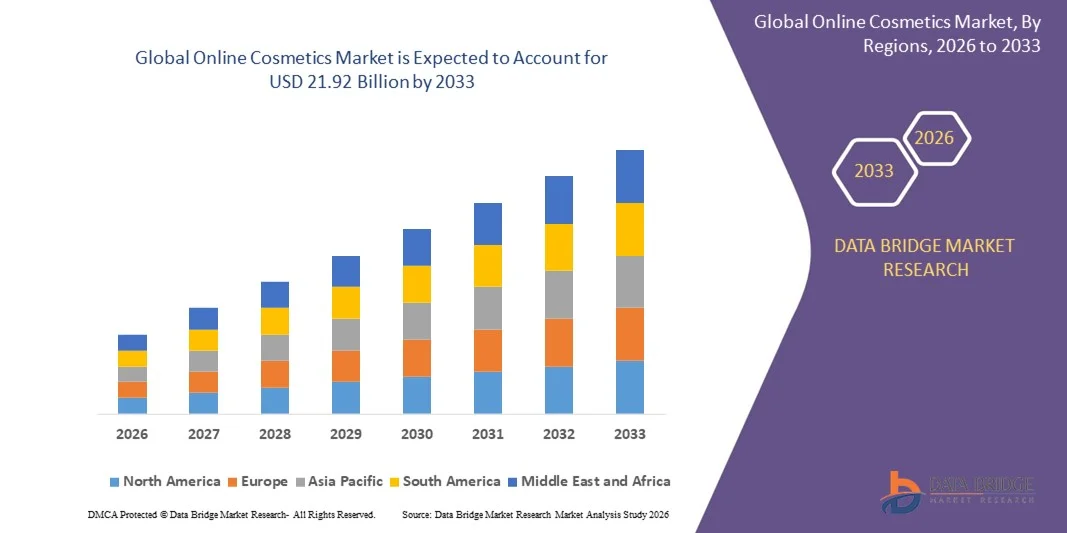
- The global online cosmetics market size was valued at USD 12.20 billion in 2025 and is expected to reach USD 21.92 billion by 2033, at a CAGR of 7.60% during the forecast period
- Increasing internet penetration, rising smartphone usage, growing influence of social media beauty trends, expanding e-commerce infrastructure, demand for personalized skincare and makeup solutions, rapid adoption of digital payment systems, and strong growth of direct-to-consumer (D2C) beauty brands are some of the major as well as vital factors which will such asly to augment the growth of the Online Cosmetics market
What are the Major Takeaways of Online Cosmetics Market?
- Rising consumer preference for convenience-based shopping, availability of a wide product portfolio, virtual try-on technologies, AI-driven product recommendations, and increasing demand for organic and vegan cosmetics across developing economies will further contribute by generating massive opportunities that will lead to the growth of the Online Cosmetics market
- Concerns related to counterfeit products, return and refund complexities, lack of physical product trials, pricing competition, and logistics challenges in cross-border e-commerce which will such asly to act as market restraint factors for the growth of the Online Cosmetics market
- North America dominated the online cosmetics market with a 40.9% revenue share in 2025, driven by high internet penetration, strong e-commerce infrastructure, widespread smartphone adoption, and growing consumer preference for direct-to-consumer (D2C) beauty brands across the U.S. and Canada
- Asia-Pacific is projected to register the fastest CAGR of 9.8% from 2026 to 2033, driven by rapid urbanization, expanding middle-class population, rising smartphone usage, and strong growth of social commerce platforms across China, Japan, India, South Korea, and Southeast Asia
- The Skincare segment dominated the market with a 38.6% share in 2025, driven by rising consumer awareness regarding skin health, anti-aging solutions, sun protection, and personalized skincare routines
Report Scope and Online Cosmetics Market Segmentation
|
Attributes |
Online Cosmetics Key Market Insights |
|
Segments Covered |
|
|
Countries Covered |
North America
Europe
Asia-Pacific
Middle East and Africa
South America
|
|
Key Market Players |
|
|
Market Opportunities |
|
|
Value Added Data Infosets |
In addition to the insights on market scenarios such as market value, growth rate, segmentation, geographical coverage, and major players, the market reports curated by the Data Bridge Market Research also include in-depth expert analysis, pricing analysis, brand share analysis, consumer survey, demography analysis, supply chain analysis, value chain analysis, raw material/consumables overview, vendor selection criteria, PESTLE Analysis, Porter Analysis, and regulatory framework. |
What is the Key Trend in the Online Cosmetics Market?
Rising Adoption of AI-Powered Personalization and Social Commerce in Online Cosmetics
- The online cosmetics market is witnessing strong growth in AI-driven personalization tools, virtual try-on technologies, augmented reality (AR) applications, and data-based product recommendations designed to enhance digital shopping experiences
- Brands are increasingly integrating influencer marketing, live-stream shopping, and social commerce features across platforms such as Instagram, TikTok, and brand-owned apps to drive direct consumer engagement
- Growing demand for clean beauty, vegan formulations, customized skincare routines, and dermatologist-backed products is reshaping online product portfolios and brand positioning strategies
- For instance, leading companies such as L’Oréal, Estée Lauder, Shiseido, and Unilever have expanded their digital beauty ecosystems with virtual skin diagnostics, AI chatbots, and personalized subscription models
- Increasing consumer preference for convenience, doorstep delivery, and digital product comparisons is accelerating the shift toward online-first cosmetic brands
- As digital engagement and mobile commerce continue to expand globally, Online Cosmetics will remain central to omnichannel retail strategies and direct-to-consumer growth models
What are the Key Drivers of Online Cosmetics Market?
- Rising internet penetration, increasing smartphone adoption, expanding digital payment infrastructure, and growing trust in e-commerce platforms are significantly driving market expansion
- For instance, in 2025, several global beauty brands enhanced their direct-to-consumer websites with AI-powered recommendation engines, loyalty programs, and subscription-based skincare models to improve customer retention
- Growing demand for organic, cruelty-free, and sustainable beauty products across the U.S., Europe, and Asia-Pacific is boosting online product launches and cross-border e-commerce sales
- Advancements in AR-based virtual try-on, AI skin analysis tools, and personalized beauty algorithms have strengthened consumer confidence in purchasing cosmetics online
- Rising influence of beauty influencers, user-generated content, product reviews, and social media advertising continues to create high digital engagement and brand visibility
- Supported by rapid digital transformation, evolving consumer preferences, and expansion of global logistics networks, the Online Cosmetics market is expected to witness sustained long-term growth
Which Factor is Challenging the Growth of the Online Cosmetics Market?
- Concerns related to counterfeit products, product authenticity verification, and unauthorized third-party sellers restrict consumer trust in certain online channels
- For instance, during 2024–2025, increasing cases of fake cosmetic listings on e-commerce platforms created quality assurance and brand reputation challenges for global manufacturers
- Inability to physically test products such as foundation shades, fragrances, and textures may lead to higher return rates and customer dissatisfaction
- Intense pricing competition among online retailers and discount-driven sales strategies can compress profit margins for premium brands
- Logistics complexities in cross-border shipping, customs regulations, and return management create operational challenges for online cosmetic retailers
- To address these issues, companies are focusing on blockchain-based product authentication, enhanced virtual try-on tools, stronger supply chain monitoring, and improved customer service strategies to strengthen global adoption of Online Cosmetics
How is the Online Cosmetics Market Segmented?
The market is segmented on the basis of product type, packaging type, ingredient type, and distribution channel.
- By Product Type
On the basis of product type, the online cosmetics market is segmented into Skincare, Makeup, Haircare, Fragrances, and Bath & Body Products. The Skincare segment dominated the market with a 38.6% share in 2025, driven by rising consumer awareness regarding skin health, anti-aging solutions, sun protection, and personalized skincare routines. Increasing demand for serums, moisturizers, cleansers, and dermatologist-recommended treatments has significantly boosted online sales. Social media influence, ingredient transparency, and AI-based skin analysis tools further strengthen skincare purchases through digital platforms.
The Makeup segment is projected to grow at the fastest CAGR from 2026 to 2033, supported by virtual try-on technologies, influencer-led product launches, expanding premium beauty portfolios, and growing demand for inclusive shade ranges across global markets.
- By Packaging Type
On the basis of packaging type, the market is segmented into Sustainable Packaging, Travel-Sized Packaging, Sample-Sized Packaging, Eco-friendly Packaging, and Luxury Packaging. The Sustainable Packaging segment dominated the market with a 34.9% share in 2025, as environmentally conscious consumers increasingly prefer recyclable, refillable, and biodegradable cosmetic packaging. Brands are investing heavily in reducing plastic usage and promoting eco-friendly alternatives to align with ESG goals and regulatory standards.
The Eco-friendly Packaging segment is expected to grow at the fastest CAGR from 2026 to 2033, driven by stricter environmental regulations, rising consumer demand for green beauty products, and growing brand commitments toward carbon neutrality and responsible sourcing practices.
- By Ingredient Type
On the basis of ingredient type, the online cosmetics market is segmented into Natural & Organic, Conventional, Dermatologically Tested, Hypoallergenic, and Vegan. The Natural & Organic segment dominated the market with a 36.2% share in 2025, supported by rising preference for clean-label products, plant-based formulations, and chemical-free skincare solutions. Consumers increasingly seek transparency in ingredients, cruelty-free certifications, and toxin-free beauty alternatives, which significantly drives online purchasing decisions.
The Vegan segment is projected to grow at the fastest CAGR from 2026 to 2033, fueled by ethical consumerism trends, animal welfare awareness, and increasing global demand for cruelty-free beauty brands across North America and Europe.
- By Distribution Channel
On the basis of distribution channel, the market is segmented into Brand Website, E-commerce Platforms, Social Media Platforms, Subscription Boxes, and Retail Stores. The E-commerce Platforms segment dominated the market with a 42.8% share in 2025, owing to wide product availability, competitive pricing, fast delivery services, and consumer trust in established online marketplaces. Strong logistics networks and digital payment systems further enhance platform growth.
The Social Media Platforms segment is expected to grow at the fastest CAGR from 2026 to 2033, propelled by live commerce, influencer marketing, direct-to-consumer engagement, and integrated in-app purchasing features that are reshaping the digital beauty buying experience.
Which Region Holds the Largest Share of the Online Cosmetics Market?
- North America dominated the online cosmetics market with a 40.9% revenue share in 2025, driven by high internet penetration, strong e-commerce infrastructure, widespread smartphone adoption, and growing consumer preference for direct-to-consumer (D2C) beauty brands across the U.S. and Canada. Rising demand for personalized skincare, premium beauty products, and subscription-based cosmetic services continues to fuel regional market expansion
- Leading beauty brands and online retailers in North America are integrating AI-powered product recommendations, virtual try-on tools, augmented reality (AR) applications, and influencer-driven marketing strategies, strengthening the region’s digital beauty ecosystem. Continuous investment in logistics networks, digital payments, and omnichannel retail strategies further supports long-term growth
- Strong purchasing power, high social media engagement, early adoption of clean beauty trends, and presence of major global cosmetic companies further reinforce regional market leadership
U.S. Online Cosmetics Market Insight
The U.S. is the largest contributor in North America, supported by a mature e-commerce ecosystem, strong presence of global cosmetic brands, and high consumer spending on premium and organic beauty products. Increasing adoption of AI-based skin diagnostics, live-stream shopping, and personalized subscription boxes intensifies online sales growth. Rising demand for cruelty-free, vegan, and dermatologist-approved cosmetics further drives digital platform expansion.
Canada Online Cosmetics Market Insight
Canada contributes significantly to regional growth, driven by increasing online beauty adoption, strong cross-border e-commerce activity, and rising consumer awareness regarding sustainable and eco-friendly cosmetic products. Growing influence of social media beauty influencers and expanding digital payment adoption continue to strengthen market penetration across the country.
Asia-Pacific Online Cosmetics Market
Asia-Pacific is projected to register the fastest CAGR of 9.8% from 2026 to 2033, driven by rapid urbanization, expanding middle-class population, rising smartphone usage, and strong growth of social commerce platforms across China, Japan, India, South Korea, and Southeast Asia. Increasing demand for K-beauty, J-beauty, herbal cosmetics, and affordable skincare products is accelerating online purchases. Growth in digital wallets, live commerce, and influencer marketing continues to create significant opportunities for global and regional brands.
China Online Cosmetics Market Insight
China is the largest contributor to Asia-Pacific due to massive e-commerce penetration, strong live-stream commerce adoption, and rapid expansion of domestic beauty brands. High engagement on digital platforms and demand for skincare and premium cosmetics significantly drive online sales.
Japan Online Cosmetics Market Insight
Japan demonstrates steady growth supported by advanced digital infrastructure, strong consumer preference for premium skincare, and increasing demand for dermatologist-tested and anti-aging formulations sold through online channels.
India Online Cosmetics Market Insight
India is emerging as a high-growth market, driven by rising internet accessibility, expansion of beauty-focused e-commerce platforms, and growing demand for affordable, herbal, and organic cosmetic products among young consumers.
South Korea Online Cosmetics Market Insight
South Korea contributes significantly due to global popularity of K-beauty products, strong digital marketing ecosystems, and high social media engagement, accelerating online cosmetic sales both domestically and internationally.
Which are the Top Companies in Online Cosmetics Market?
The online cosmetics industry is primarily led by well-established companies, including:
- L’Oréal (France)
- Estée Lauder (U.S.)
- Procter & Gamble (U.S.)
- Unilever (U.K.)
- Shiseido (Japan)
- Coty (U.S.)
- Revlon (U.S.)
- Avon (U.K.)
- Mary Kay (U.S.)
- Amway (U.S.)
What are the Recent Developments in Global Online Cosmetics Market?
- In August 2024, Kay Beauty, an India-based beauty brand, introduced its new Hydra Crème Lipstick range featuring 16 shades formulated with hyaluronic acid and lychee extracts, strengthening its premium lip care portfolio and expanding its presence in the competitive color cosmetics segment
- In July 2024, Curology, a U.S.-based skincare company, expanded its non-prescription skincare line through CVS Pharmacy across 3,800 stores nationwide and on CVS.com, significantly enhancing its offline and online retail footprint across the U.S. market
- In April 2024, epres, a U.S.-based haircare brand, launched its Healthy Hair Shampoo and Healthy Hair Conditioner developed using proprietary Biodiffusion technology, reinforcing innovation-driven product development within the premium haircare category
- In February 2024, Kao Corporation, a Japan-based chemicals and cosmetics manufacturer, unveiled its new haircare brand “melt,” aiming to strengthen its haircare business segment and expand its consumer base in the beauty and personal care industry
- In July 2023, Grown Alchemist, an Australia-based skincare company, opened a new pop-up store in Shanghai’s Changning District, while Ceremonia, a U.S.-based haircare brand, launched its flagship store in New York, enhancing brand visibility and expanding their global retail presence

- Interactive Data Analysis Dashboard
- Company Analysis Dashboard for high growth potential opportunities
- Research Analyst Access for customization & queries
- Competitor Analysis with Interactive dashboard
- Latest News, Updates & Trend analysis
- Harness the Power of Benchmark Analysis for Comprehensive Competitor Tracking
Data collection and base year analysis are done using data collection modules with large sample sizes. The stage includes obtaining market information or related data through various sources and strategies. It includes examining and planning all the data acquired from the past in advance. It likewise envelops the examination of information inconsistencies seen across different information sources. The market data is analysed and estimated using market statistical and coherent models. Also, market share analysis and key trend analysis are the major success factors in the market report. To know more, please request an analyst call or drop down your inquiry.
The key research methodology used by DBMR research team is data triangulation which involves data mining, analysis of the impact of data variables on the market and primary (industry expert) validation. Data models include Vendor Positioning Grid, Market Time Line Analysis, Market Overview and Guide, Company Positioning Grid, Patent Analysis, Pricing Analysis, Company Market Share Analysis, Standards of Measurement, Global versus Regional and Vendor Share Analysis. To know more about the research methodology, drop in an inquiry to speak to our industry experts.
Data Bridge Market Research is a leader in advanced formative research. We take pride in servicing our existing and new customers with data and analysis that match and suits their goal. The report can be customized to include price trend analysis of target brands understanding the market for additional countries (ask for the list of countries), clinical trial results data, literature review, refurbished market and product base analysis. Market analysis of target competitors can be analyzed from technology-based analysis to market portfolio strategies. We can add as many competitors that you require data about in the format and data style you are looking for. Our team of analysts can also provide you data in crude raw excel files pivot tables (Fact book) or can assist you in creating presentations from the data sets available in the report.