


Online Grocery Market Overview
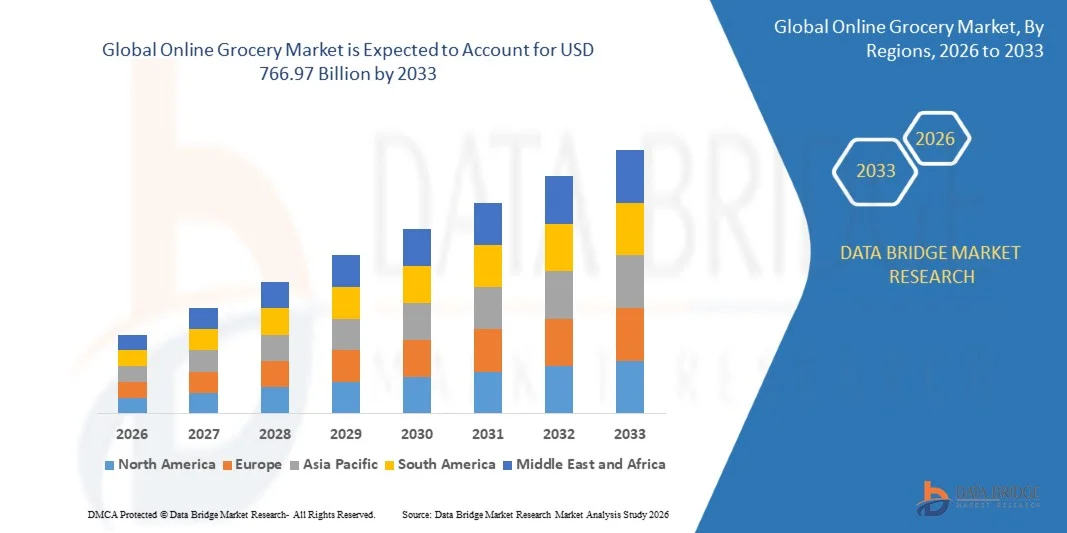
The Online Grocery Market was valued at USD 65.15 billion in 2025 and is projected to reach USD 766.97 billion by 2033, growing at a CAGR of 36.10% from 2026 to 2033. The market is witnessing rapid expansion driven by increasing digital adoption in retail, rising consumer preference for convenience-based shopping, and the growing penetration of smartphones and high-speed internet connectivity. Expanding quick-commerce platforms and last-mile delivery innovations are further accelerating market growth across urban and semi-urban regions.
The increasing shift in consumer lifestyle patterns, combined with growing demand for time-saving shopping solutions, is significantly boosting adoption of online grocery platforms. Retailers are investing heavily in advanced logistics networks, AI-driven inventory management, and hyperlocal delivery systems to enhance efficiency and reduce delivery time. In addition, rising integration of subscription-based grocery services, personalized recommendations, and digital payment solutions is further strengthening market expansion globally.
Key Market Trends & Insights
- North America dominated the online grocery market with the largest revenue share of 38.6% in 2025, supported by high digital adoption, strong e-commerce penetration, and well-developed logistics infrastructure. Consumers in the region increasingly prefer convenient grocery shopping solutions driven by busy lifestyles and growing demand for doorstep delivery services.
- Asia-Pacific online grocery market is expected to witness the fastest growth rate from 2026 to 2033, driven by rapid urbanization, increasing disposable incomes, and strong expansion of digital ecosystems. Countries such as China, India, and Japan are experiencing high adoption of mobile-based grocery shopping platforms.
- The Fresh and Perishable Goods segment held the largest market revenue share of approximately 51.2% in 2025, driven by increasing consumer shift toward online purchasing of fruits, vegetables, dairy, meat, and bakery items. Strong penetration of cold chain logistics and temperature-controlled delivery systems has further improved reliability for perishable deliveries. Rising urban lifestyles and time-constrained consumers are also accelerating dependence on digital grocery platforms. In addition, frequent purchase cycles of fresh items compared to packaged goods are supporting sustained revenue contribution.
- The Pantry Staples and Cooking Essentials segment accounted for approximately 34.0% share in 2025, supported by consistent household demand for rice, flour, pulses, edible oils, packaged foods, and beverages. Growing adoption of subscription-based replenishment services and bulk purchasing behavior is strengthening segment growth. Expansion of private-label grocery products offered by e-commerce platforms is further improving affordability and customer retention. For instance, consumers increasingly prefer consolidated monthly orders through digital platforms, reducing dependence on offline retail channels.
- The Same-Day Delivery segment held the largest market revenue share of approximately 42.5% in 2025, driven by strong consumer demand for faster fulfillment without compromising order consolidation benefits. Expansion of micro-fulfillment centers and dark stores has significantly improved delivery efficiency in urban regions. Improved route optimization technologies and real-time inventory tracking are further enhancing service reliability. In addition, partnerships between retailers and logistics providers are strengthening same-day delivery networks across major cities.
- The Instant Delivery segment is projected to register the fastest growth with an estimated CAGR of 12.3% from 2026 to 2033, driven by rapid expansion of quick-commerce platforms offering delivery within 10 to 30 minutes. Increasing consumer preference for on-demand convenience shopping, especially in metro cities, is accelerating adoption. High smartphone penetration and digital payment integration are further supporting rapid order placement and fulfillment. For instance, consumers increasingly use instant delivery for urgent needs such as dairy, snacks, and household essentials.
- The Own Website/App segment held the largest market revenue share of approximately 58.6% in 2025, driven by strong brand loyalty, direct customer engagement, and better profit margins for retailers. Leading grocery chains and quick-commerce companies are investing heavily in proprietary apps to enhance user experience and retention. Integration of loyalty programs, personalized recommendations, and subscription models is further strengthening this segment. In addition, better control over pricing and supply chain operations is supporting dominance.
- The Aggregator Platforms segment accounted for approximately 34.7% share in 2025, supported by rising consumer preference for multi-store comparison and broader product assortment availability. These platforms offer convenience by consolidating multiple retailers in a single interface, improving purchase flexibility. Competitive pricing, discount aggregation, and promotional campaigns are also driving user engagement. For instance, urban consumers often use aggregator apps to compare delivery times and pricing across multiple grocery providers.
Market Size & Forecast
- Global Market Value (2025): USD 65.15 Billion
- Expected Market Value (2033): USD 766.97 Billion
- Forecast CAGR (2026–2033): 36.10%
- Leading Region in 2025: North America
- Fastest Growing Region: Asia-Pacific
Report Scope and Online Grocery Market Segmentation
|
Attributes |
Online Grocery Key Market Insights |
|
Segments Covered |
· By Product Category: Fresh and Perishable Goods, Pantry Staples and Cooking Essentials, and More · By Delivery Model: Instant Delivery, Same-Day Delivery, Scheduled Delivery, and Other Models · By Platform Type: Own Website/App, Aggregator Platforms, and Others |
|
Countries Covered |
North America · U.S. · Canada · Mexico Europe · Germany · France · U.K. · Netherlands · Switzerland · Belgium · Russia · Italy · Spain · Turkey · Rest of Europe Asia-Pacific · China · Japan · India · South Korea · Singapore · Malaysia · Australia · Thailand · Indonesia · Philippines · Rest of Asia-Pacific Middle East and Africa · Saudi Arabia · U.A.E. · South Africa · Egypt · Israel · Rest of Middle East and Africa South America · Brazil · Argentina · Rest of South America |
|
Key Market Players |
• AEON Next Co., Ltd. (Japan) |
|
Market Opportunities |
• Expansion Of Quick Commerce Grocery Delivery Platforms |
|
Value Added Data Infosets |
In addition to the market insights such as market value, growth rate, market segments, geographical coverage, market players, and market scenario, the market report curated by the Data Bridge Market Research team includes in-depth expert analysis, import/export analysis, pricing analysis, production consumption analysis, and pestle analysis. |
Online Grocery Market Trends
Trend: Growth In Digital Commerce Transformation And Hyperlocal Quick Grocery Delivery Ecosystems
Increasing demand for fast, convenient, and contactless grocery shopping solutions across urban and semi-urban populations. Traditional brick-and-mortar grocery retail is being rapidly disrupted by mobile-first platforms, subscription-based models, and AI-enabled recommendation engines that enhance personalization and reduce purchase friction.
In modern retail ecosystems, online grocery platforms are integrating hyperlocal fulfillment networks, for instance companies such as Instacart, Amazon Fresh, and India-based quick commerce players such as Blinkit and Zepto, to enable delivery within minutes to hours, improving customer convenience and retention while increasing order frequency. In developed markets, retailers are deploying automated micro-fulfillment centers and dark stores to optimize inventory turnover and reduce last-mile delivery costs, improving operational efficiency and scalability.
The rapid expansion of urban working populations and dual-income households is also increasing demand for time-saving grocery procurement solutions capable of supporting scheduled deliveries, repeat ordering, and real-time stock visibility. In addition, integration of digital payment systems, loyalty programs, and AI-driven demand forecasting is enhancing customer engagement and supply chain efficiency. Growing industry validation through 2025 retail logistics data indicates that quick commerce grocery orders in major metropolitan cities have reduced average delivery times to under 30 minutes in optimized zones, significantly improving customer adoption rates in high-density urban regions
Online Grocery Market Dynamics
Key Market Driver: Rising Adoption Of Digital Shopping Platforms And Convenience-Based Consumption Behavior
Consumers worldwide are increasingly shifting toward online grocery platforms due to rising smartphone penetration, expanding internet connectivity, and evolving lifestyle patterns prioritizing convenience and time efficiency. Retailers are leveraging advanced technologies such as AI-based personalization, predictive analytics, and automated warehousing systems to enhance customer experience and optimize inventory management.
Major e-commerce and grocery platforms are expanding their digital ecosystems by integrating multiple product categories, subscription models, and express delivery services. For instance, large-scale online grocery ecosystems in the U.S., China, and India are witnessing strong growth in weekly repeat purchases driven by household essentials, fresh produce, and packaged food categories. In addition, partnerships between retail chains and technology-driven logistics providers are enabling faster fulfillment cycles and improved supply chain visibility.
Key Restraint/Challenge: High Last-Mile Delivery Costs And Inventory Management Complexities
Despite strong growth potential, the online grocery market faces significant challenges related to high logistics and last-mile delivery costs, particularly in low-density and rural areas. Maintaining product freshness, especially for perishable goods such as dairy, fruits, and vegetables, adds operational complexity and increases wastage risk.
In addition, fragmented supply chains and fluctuating demand patterns create inventory management inefficiencies, leading to stock-outs or overstocking issues. Cold chain infrastructure limitations in emerging economies further restrict the scalability of fresh grocery delivery services. Rising customer expectations for ultra-fast delivery and free shipping also exert pressure on profit margins, making sustainable profitability a key challenge for market players.
Key Market Opportunity: Expansion Of Quick Commerce And AI Driven Grocery Personalization
The growing adoption of quick commerce models and AI-powered personalization systems is creating strong opportunities for online grocery market expansion. Retailers are increasingly focusing on 10–30 minute delivery models supported by localized dark stores and automated fulfillment hubs.
Technology-driven platforms are enhancing customer experience through predictive shopping lists, smart replenishment reminders, and real-time pricing optimization. For instance, major urban markets in Asia-Pacific and North America are witnessing rapid scaling of instant grocery delivery services supported by dense micro-warehouse networks and gig-based delivery fleets. In addition, integration of AI-based demand forecasting and dynamic inventory allocation is improving operational efficiency, reducing delivery times, and increasing customer retention across competitive urban retail landscapes.
Online Grocery Market Scope
The market is segmented on the basis of product category, delivery model, platform type, and end-use application.
- By Product Category
On the basis of product category, the Online Grocery Market is segmented into Fresh and Perishable Goods, Pantry Staples and Cooking Essentials, and Others. The Fresh and Perishable Goods segment held the largest market revenue share of approximately 51.2% in 2025, driven by increasing consumer shift toward online purchasing of fruits, vegetables, dairy, meat, and bakery items. Strong penetration of cold chain logistics and temperature-controlled delivery systems has further improved reliability for perishable deliveries. Rising urban lifestyles and time-constrained consumers are also accelerating dependence on digital grocery platforms. In addition, frequent purchase cycles of fresh items compared to packaged goods are supporting sustained revenue contribution.
The Pantry Staples and Cooking Essentials segment accounted for approximately 34.0% share in 2025, supported by consistent household demand for rice, flour, pulses, edible oils, packaged foods, and beverages. Growing adoption of subscription-based replenishment services and bulk purchasing behavior is strengthening segment growth. Expansion of private-label grocery products offered by e-commerce platforms is further improving affordability and customer retention. For instance, consumers increasingly prefer consolidated monthly orders through digital platforms, reducing dependence on offline retail channels.
- By Delivery Model
On the basis of delivery model, the Online Grocery Market is segmented into Instant Delivery, Same-Day Delivery, Scheduled Delivery, and Other Models. The Same-Day Delivery segment held the largest market revenue share of approximately 42.5% in 2025, driven by strong consumer demand for faster fulfillment without compromising order consolidation benefits. Expansion of micro-fulfillment centers and dark stores has significantly improved delivery efficiency in urban regions. Improved route optimization technologies and real-time inventory tracking are further enhancing service reliability. In addition, partnerships between retailers and logistics providers are strengthening same-day delivery networks across major cities.
The Instant Delivery segment is projected to register the fastest growth with an estimated CAGR of 12.3% from 2026 to 2033, driven by rapid expansion of quick-commerce platforms offering delivery within 10 to 30 minutes. Increasing consumer preference for on-demand convenience shopping, especially in metro cities, is accelerating adoption. High smartphone penetration and digital payment integration are further supporting rapid order placement and fulfillment. For instance, consumers increasingly use instant delivery for urgent needs such as dairy, snacks, and household essentials.
- By Platform Type
On the basis of platform type, the Online Grocery Market is segmented into Own Website/App, Aggregator Platforms, and Others. The Own Website/App segment held the largest market revenue share of approximately 58.6% in 2025, driven by strong brand loyalty, direct customer engagement, and better profit margins for retailers. Leading grocery chains and quick-commerce companies are investing heavily in proprietary apps to enhance user experience and retention. Integration of loyalty programs, personalized recommendations, and subscription models is further strengthening this segment. In addition, better control over pricing and supply chain operations is supporting dominance.
The Aggregator Platforms segment accounted for approximately 34.7% share in 2025, supported by rising consumer preference for multi-store comparison and broader product assortment availability. These platforms offer convenience by consolidating multiple retailers in a single interface, improving purchase flexibility. Competitive pricing, discount aggregation, and promotional campaigns are also driving user engagement. For instance, urban consumers often use aggregator apps to compare delivery times and pricing across multiple grocery providers.
Online Grocery Market Regional Analysis
North America Online Grocery Market Insight
North America dominated the online grocery market with the largest revenue share of 38.6% in 2025, supported by high digital adoption, strong e-commerce penetration, and well-developed logistics infrastructure. Consumers in the region increasingly prefer convenient grocery shopping solutions driven by busy lifestyles and growing demand for doorstep delivery services. The widespread use of smartphones, digital payment systems, and subscription-based grocery models is further accelerating market expansion. In addition, strong presence of major online grocery platforms and quick-commerce players is enhancing service accessibility and delivery speed across urban and suburban areas.
U.S. Online Grocery Market Insight
The U.S. online grocery market captured the largest revenue share in 2025 within North America, driven by strong consumer adoption of digital retail platforms and increasing reliance on home delivery services. Rising demand for time-saving shopping solutions and expansion of same-day and instant delivery services are significantly boosting market growth. Consumers are increasingly shifting toward app-based grocery ordering supported by personalized recommendations and loyalty programs. In addition, integration of advanced technologies such as AI-driven inventory management and automated warehouses is improving operational efficiency and order fulfillment accuracy.
Europe Online Grocery Market Insight
The Europe online grocery market is expected to witness the fastest growth rate from 2026 to 2033, driven by increasing urbanization, sustainability initiatives, and rising demand for convenient shopping solutions. Consumers in the region are increasingly adopting online grocery platforms due to expanding delivery networks and improved cold chain logistics. Strict environmental regulations are also encouraging retailers to adopt eco-friendly packaging and optimized delivery routes. In addition, growing penetration of subscription-based grocery services and expansion of e-grocery platforms across both Western and Eastern Europe are supporting market expansion.
U.K. Online Grocery Market Insight
The U.K. online grocery market is expected to witness strong growth from 2026 to 2033, driven by high digital adoption, strong e-commerce infrastructure, and increasing preference for home delivery services. Consumers are increasingly relying on online platforms for weekly grocery shopping due to convenience and time efficiency. The growing popularity of same-day and scheduled delivery models is further strengthening market growth. In addition, widespread adoption of loyalty programs and integration of grocery apps with digital wallets and payment systems are enhancing customer retention and purchase frequency.
Germany Online Grocery Market Insight
The Germany online grocery market is expected to witness steady growth from 2026 to 2033, supported by rising demand for high-quality food products and increasing digital transformation in retail. Consumers are gradually shifting toward online grocery platforms due to improved delivery reliability and growing availability of fresh and organic products. Strong emphasis on sustainability and efficient supply chain systems is also encouraging adoption of optimized grocery delivery solutions. In addition, expansion of hybrid retail models combining offline supermarkets with online ordering platforms is contributing to market growth.
Asia-Pacific Online Grocery Market Insight
The Asia-Pacific online grocery market is expected to witness the fastest growth rate from 2026 to 2033, driven by rapid urbanization, increasing disposable incomes, and strong expansion of digital ecosystems. Countries such as China, India, and Japan are experiencing high adoption of mobile-based grocery shopping platforms. The growth of quick-commerce services and improved last-mile delivery infrastructure is significantly enhancing market penetration. In addition, increasing penetration of smartphones and digital payment solutions is making online grocery shopping more accessible to a larger consumer base.
Japan Online Grocery Market Insight
The Japan online grocery market is expected to witness steady growth from 2026 to 2033 due to rising demand for convenience, aging population trends, and strong technological adoption. Consumers are increasingly adopting online grocery platforms integrated with smart home ecosystems and mobile applications. High standards of service quality and precision logistics are further supporting market expansion. In addition, increasing use of automated delivery systems and robotic warehouses is improving efficiency in order fulfillment and last-mile delivery operations.
China Online Grocery Market Insight
The China online grocery market accounted for the largest market revenue share in Asia-Pacific in 2025, supported by rapid urbanization, strong digital infrastructure, and widespread adoption of e-commerce platforms. The expanding middle-class population and growing preference for convenient shopping solutions are key growth drivers. Strong presence of domestic e-commerce giants and quick-commerce platforms is enhancing competition and service innovation. In addition, integration of super-app ecosystems and advanced logistics networks is significantly boosting online grocery penetration across urban and semi-urban regions.
Online Grocery Market Share
The Online Grocery industry is primarily led by well-established companies, including:
Here is the Top 15 Companies list for the Online Grocery Market in the required format:
• AEON Next Co., Ltd. (Japan)
• Alibaba.com (China)
• Amazon.com, Inc. (U.S.)
• Blink Commerce Private Limited (India)
• Instacart (U.S.)
• JD.com, Inc. (China)
• Nature’s Basket Limited (India)
• Rakuten Rewards (Ebates Performance Marketing Inc.) (Japan)
• Reliance Industries Limited (JioMart) (India)
• Supermarket Grocery Supplies Pvt. Ltd. (India)
• Target Brands, Inc. (U.S.)
• Tesco.com (U.K.)
• The Kroger Co. (U.S.)
• Walmart (U.S.)
• Flipkart Grocery (India) (India)
Latest Developments in Online Grocery Market
- In June 2025, Supermarket Grocery Supplies Pvt. Ltd. (BigBasket) announced the launch of 10-minute food delivery services across India, focusing on strengthening its position in the quick-commerce segment. The company plans to utilize dark stores and localized fulfillment centers to enable ultra-fast deliveries. This initiative is expected to enhance customer convenience and increase order frequency. It is also likely to intensify competition in India’s rapidly expanding instant grocery delivery market.
- In May 2025, Instacart announced the acquisition of Wynshop, a U.S.-based e-commerce solutions provider, to strengthen its enterprise grocery technology offerings. The acquisition is aimed at enhancing digital tools for retailers and improving platform capabilities for grocery partners. It will help Instacart deepen retailer relationships and expand its technology-driven ecosystem. This move is expected to improve operational efficiency and accelerate digital transformation across grocery retail networks.
- In May 2025, Alibaba launched an upgraded fast-delivery service on its Taobao platform to improve local logistics and delivery speed. The service integrates food, grocery, electronics, and fashion categories using Ele.me’s logistics infrastructure. This development is designed to enhance last-mile delivery efficiency and expand quick-commerce capabilities. It is expected to strengthen Alibaba’s competitive position in China’s highly dynamic e-commerce and online grocery market.
- In June 2025, C&S Wholesale Grocers acquired SpartanNash for USD 1.77 billion, creating a large distribution network of nearly 60 centers serving around 10,000 independent stores. The acquisition aims to expand supply chain scale and improve distribution efficiency across retail grocery channels. It is expected to strengthen wholesale grocery logistics and increase market consolidation in the U.S. grocery distribution sector. This move will also enhance product availability and streamline inventory management for independent retailers.
- In July 2024, Walmart announced the development of five automated fresh-food distribution centers across multiple U.S. states to enhance perishables handling capacity. The initiative focuses on improving automation, inventory accuracy, and delivery speed for fresh grocery products. It is expected to strengthen Walmart’s cold-chain logistics infrastructure and support growing demand for online grocery fulfillment. This expansion will also improve efficiency in handling high-volume perishable goods across its e-commerce operations.

- Interactive Data Analysis Dashboard
- Company Analysis Dashboard for high growth potential opportunities
- Research Analyst Access for customization & queries
- Competitor Analysis with Interactive dashboard
- Latest News, Updates & Trend analysis
- Harness the Power of Benchmark Analysis for Comprehensive Competitor Tracking
Data collection and base year analysis are done using data collection modules with large sample sizes. The stage includes obtaining market information or related data through various sources and strategies. It includes examining and planning all the data acquired from the past in advance. It likewise envelops the examination of information inconsistencies seen across different information sources. The market data is analysed and estimated using market statistical and coherent models. Also, market share analysis and key trend analysis are the major success factors in the market report. To know more, please request an analyst call or drop down your inquiry.
The key research methodology used by DBMR research team is data triangulation which involves data mining, analysis of the impact of data variables on the market and primary (industry expert) validation. Data models include Vendor Positioning Grid, Market Time Line Analysis, Market Overview and Guide, Company Positioning Grid, Patent Analysis, Pricing Analysis, Company Market Share Analysis, Standards of Measurement, Global versus Regional and Vendor Share Analysis. To know more about the research methodology, drop in an inquiry to speak to our industry experts.
Data Bridge Market Research is a leader in advanced formative research. We take pride in servicing our existing and new customers with data and analysis that match and suits their goal. The report can be customized to include price trend analysis of target brands understanding the market for additional countries (ask for the list of countries), clinical trial results data, literature review, refurbished market and product base analysis. Market analysis of target competitors can be analyzed from technology-based analysis to market portfolio strategies. We can add as many competitors that you require data about in the format and data style you are looking for. Our team of analysts can also provide you data in crude raw excel files pivot tables (Fact book) or can assist you in creating presentations from the data sets available in the report.













