


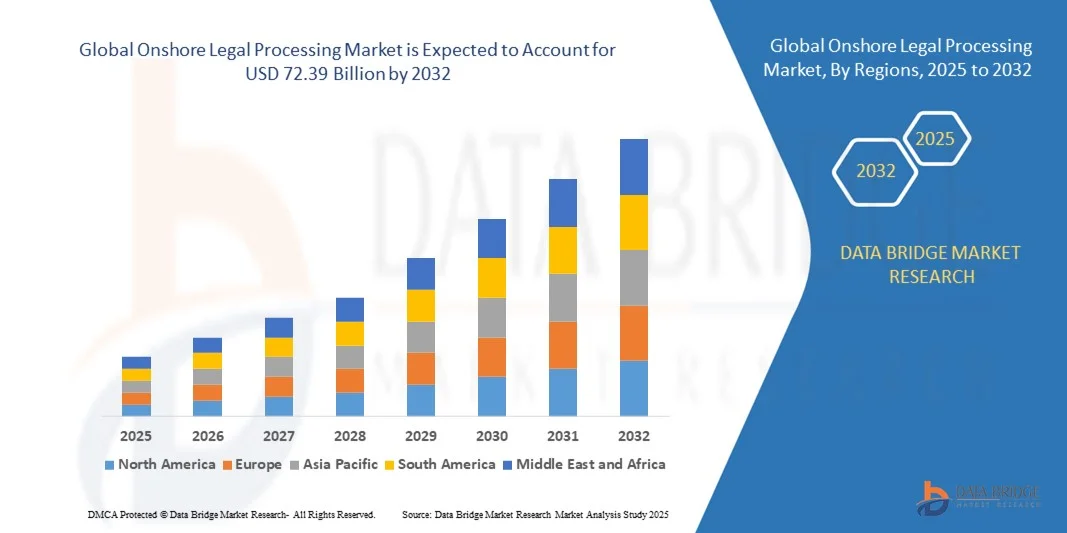
Onshore Legal Processing Market Size
- The global onshore legal processing market size was valued at USD 8.82 billion in 2024 and is expected to reach USD 72.39 billion by 2032, at a CAGR of 30.10% during the forecast period
- The market growth is largely fuelled by increasing demand for streamlined legal services, growing adoption of digital legal solutions, and rising regulatory compliance requirements across industries
- The rapid expansion of corporate legal departments and law firms, along with the need for cost-effective and efficient onshore legal processing, is further driving market growth
Onshore Legal Processing Market Analysis
- The rising adoption of digital platforms and AI-driven tools is transforming onshore legal processing by enabling faster document review, contract management, and compliance checks. These technologies improve efficiency, reduce human errors, and lower operational costs for law firms and corporate legal departments
- Growing demand for data security, confidentiality, and compliance with local regulations is encouraging companies to adopt onshore legal processing services instead of offshore alternatives. Onshore solutions provide better control over sensitive information and minimize legal risks
- North America dominated the onshore legal processing market with the largest revenue share in 2024, driven by increasing demand for digital legal solutions, regulatory compliance, and the growing adoption of AI-enabled platforms by law firms and corporate legal departments
- Asia-Pacific region is expected to witness the highest growth rate in the global onshore legal processing market, driven by rapid digitization, expanding corporate and financial sectors, and supportive government initiatives promoting legal process automation and compliance standards
- The Software segment held the largest market revenue share in 2024, driven by the increasing adoption of AI-powered document management, contract lifecycle management, and compliance automation platforms. Software solutions enable faster document processing, reduce manual errors, and improve overall operational efficiency, making them a preferred choice for corporate legal departments and law firms
Report Scope and Onshore Legal Processing Market Segmentation
|
Attributes |
Onshore Legal Processing Key Market Insights |
|
Segments Covered |
|
|
Countries Covered |
North America
Europe
Asia-Pacific
Middle East and Africa
South America
|
|
Key Market Players |
|
|
Market Opportunities |
|
|
Value Added Data Infosets |
In addition to the market insights such as market value, growth rate, market segments, geographical coverage, market players, and market scenario, the market report curated by the Data Bridge Market Research team includes in-depth expert analysis, import/export analysis, pricing analysis, production consumption analysis, and pestle analysis. |
Onshore Legal Processing Market Trends
Rise Of Digital And Integrated Onshore Legal Processing Solutions
- The growing adoption of digital and integrated onshore legal processing solutions is transforming the legal services landscape by enabling faster, more accurate, and compliant document handling. These platforms streamline workflows across multiple departments, reduce manual intervention, and improve turnaround times for contract reviews, litigation support, and compliance reporting. The efficiency of these platforms allows law firms and corporations to streamline case management and regulatory reporting, resulting in improved productivity and reduced operational risks
- The high demand for secure and real-time legal processing in both corporate and government sectors is accelerating the adoption of cloud-based platforms and automated workflow systems. These systems offer centralized document management, real-time collaboration, and automated tracking of case progress, ensuring higher operational transparency and accountability. These solutions are particularly effective for large law firms and multinational companies where compliance and turnaround time are critical
- The affordability and scalability of modern onshore legal processing platforms are making them attractive for small and mid-sized law firms. Modular solutions allow firms to scale services as needed, integrate with existing software ecosystems, and reduce operational overhead. Providers benefit from flexible service models, reduced manual errors, and the ability to integrate with existing case management and compliance systems
- For instance, in 2023, several corporate legal departments in the U.S. implemented automated onshore legal processing solutions, resulting in faster contract reviews, reduced human errors, and enhanced regulatory compliance. This integration enabled seamless auditing, improved record-keeping, and enhanced reporting efficiency, significantly reducing operational bottlenecks
- While digital legal processing enhances efficiency and accuracy, its impact depends on continued innovation, secure data management, and workforce training. The adoption of AI-assisted analytics, workflow optimization, and compliance monitoring further strengthens operational reliability. Stakeholders must focus on AI integration, modular platforms, and compliance-focused solutions to fully capitalize on growing demand
Onshore Legal Processing Market Dynamics
Driver
Increasing Regulatory Compliance Requirements And Adoption Of Legal Tech Solutions
- The rise in stringent regulatory compliance requirements is pushing law firms and corporate legal departments to adopt automated onshore legal processing solutions. These platforms help maintain consistent standards for document validation, audit trails, and contract lifecycle management across multiple jurisdictions. Compliance with data privacy, contract law, and corporate governance standards is accelerating investment in advanced platforms
- Organizations are increasingly aware of the operational risks and costs associated with manual legal processing, including delays, errors, and non-compliance penalties. Automation reduces human errors, accelerates case handling, and improves accountability, ultimately mitigating legal and financial risks. This awareness is driving higher adoption across corporate, financial, and government sectors
- Public sector initiatives promoting legal digitization and process standardization are supporting investments in secure onshore legal processing platforms. Government-backed e-filing systems, centralized legal databases, and standardized compliance requirements create an ecosystem favorable for automation. From e-filing requirements to centralized regulatory reporting, supportive frameworks are enabling faster adoption
- For instance, in 2022, several European financial institutions implemented AI-driven onshore legal processing platforms to streamline compliance reporting, boosting demand for secure and integrated solutions across the region. The platforms improved document traceability, ensured regulatory alignment, and reduced time-intensive manual interventions
- While regulatory pressure and technology adoption are key drivers, challenges such as data security concerns, integration complexity, and skilled workforce availability must be addressed for sustained adoption. Firms are investing in training, cybersecurity, and change management to overcome these barriers and fully utilize technological advancements
Restraint/Challenge
High Cost Of Advanced Legal Processing Solutions And Data Security Concerns
- The high price point of advanced onshore legal processing solutions, including AI-powered document review and compliance platforms, limits accessibility for small law firms and organizations. Subscription fees, implementation costs, and licensing for multiple users increase initial expenditures. Cost remains a major barrier to widespread deployment
- Many organizations lack trained personnel capable of managing and maintaining complex legal processing systems. Training programs, technical support, and ongoing system updates require dedicated resources, limiting adoption in regions with a skills gap. The absence of technical expertise and supporting infrastructure further reduces adoption in certain regions
- Data security and privacy concerns related to sensitive legal information restrict the use of cloud-based or integrated solutions. Encryption, access control, and audit mechanisms are necessary to ensure compliance with local and international regulations. Companies must invest in robust cybersecurity measures, which adds to overall costs and complexity
- For instance, in 2023, several mid-sized law firms in Asia reported delays in implementing automated legal processing solutions due to budget constraints and concerns about compliance with local data protection regulations. These concerns also slowed integration with international clients and cross-border legal processes
- While onshore legal processing technologies continue to evolve, addressing cost, data security, and workforce challenges is essential. Firms must adopt scalable, secure, and user-friendly platforms while developing internal expertise to expand adoption and ensure sustainable growth
Onshore Legal Processing Market Scope
The market is segmented on the basis of component, organization size, and industry.
- By Component
On the basis of component, the onshore legal processing market is segmented into Software and Service. The Software segment held the largest market revenue share in 2024, driven by the increasing adoption of AI-powered document management, contract lifecycle management, and compliance automation platforms. Software solutions enable faster document processing, reduce manual errors, and improve overall operational efficiency, making them a preferred choice for corporate legal departments and law firms.
The Service segment is expected to witness the fastest growth rate from 2025 to 2032, driven by the rising demand for managed legal processing services, consultation, and support for compliance and regulatory requirements. Service offerings help organizations implement, maintain, and optimize onshore legal processing solutions, ensuring secure, accurate, and timely legal operations.
- By Organization Size
On the basis of organization size, the market is segmented into Small and Medium-Sized Enterprises (SMEs) and Large Enterprises. The Large Enterprises segment held the largest share in 2024 due to high investment capabilities, complex legal operations, and the need for compliance across multiple jurisdictions. Large organizations benefit from comprehensive solutions that integrate with existing enterprise systems, improving productivity and regulatory adherence.
The SME segment is expected to witness the fastest growth rate from 2025 to 2032, driven by increasing awareness of affordable and scalable onshore legal processing solutions. SMEs are adopting cloud-based platforms and outsourced services to streamline legal workflows, reduce operational costs, and enhance compliance capabilities.
- By Industry
On the basis of industry, the market is segmented into Banking, Financial Services, and Insurance (BFSI), Government, Automotive, Healthcare and Life Sciences, and Others. The BFSI segment held the largest market revenue share in 2024, fueled by stringent regulatory requirements, the need for accurate reporting, and risk mitigation. BFSI organizations rely heavily on automated platforms for compliance monitoring, document verification, and reporting.
The Government segment is expected to witness the fastest growth rate from 2025 to 2032, driven by digital transformation initiatives, e-filing mandates, and the modernization of legal and administrative processes. Government agencies are increasingly deploying secure onshore legal processing platforms to enhance efficiency, transparency, and service delivery across departments.
Onshore Legal Processing Market Regional Analysis
- North America dominated the onshore legal processing market with the largest revenue share in 2024, driven by increasing demand for digital legal solutions, regulatory compliance, and the growing adoption of AI-enabled platforms by law firms and corporate legal departments
- Organizations in the region highly value the efficiency, accuracy, and compliance offered by automated legal processing systems, which reduce manual errors, accelerate document review, and enhance reporting capabilities
- This widespread adoption is further supported by high digital maturity, robust IT infrastructure, and strong regulatory frameworks, establishing onshore legal processing solutions as a preferred choice across corporate, financial, and government sectors
U.S. Onshore Legal Processing Market Insight
The U.S. onshore legal processing market captured the largest revenue share in North America in 2024, fueled by rapid adoption of AI-driven document review, workflow automation, and compliance management tools. Corporations and law firms are increasingly investing in secure, cloud-based solutions to streamline legal operations and reduce operational risk. The growing emphasis on e-filing, regulatory reporting, and digital contract management is significantly contributing to the market’s expansion.
Europe Onshore Legal Processing Market Insight
The Europe onshore legal processing market is expected to witness the fastest growth rate from 2025 to 2032, primarily driven by stringent regulatory requirements, increasing digitization of legal services, and rising demand for compliance automation. European law firms and corporate legal departments are investing in integrated platforms that ensure accuracy, efficiency, and data security. The region is experiencing growth across corporate, financial, and government sectors, with automation solutions being adopted in both legacy operations and new implementations.
U.K. Onshore Legal Processing Market Insight
The U.K. onshore legal processing market is expected to witness the fastest growth rate from 2025 to 2032, driven by regulatory pressures, adoption of legal tech, and the growing need for faster, accurate document handling. Concerns regarding compliance, risk mitigation, and operational efficiency are encouraging both law firms and corporations to invest in AI-enabled legal processing solutions. The U.K.’s robust IT infrastructure and strong legal services sector continue to stimulate market growth.
Germany Onshore Legal Processing Market Insight
The Germany onshore legal processing market is expected to witness significant growth from 2025 to 2032, fueled by rising awareness of digital compliance tools and adoption of AI-powered solutions. Germany’s emphasis on legal process standardization, innovation, and secure document handling promotes the deployment of automated legal processing platforms, particularly among large enterprises and financial institutions. Integration with corporate governance and compliance management systems is becoming increasingly prevalent.
Asia-Pacific Onshore Legal Processing Market Insight
The Asia-Pacific onshore legal processing market is expected to witness the fastest growth rate from 2025 to 2032, driven by increasing regulatory requirements, adoption of digital solutions, and rising investments in legal tech across countries such as China, Japan, and India. The region’s growing digitalization, coupled with rising demand for efficiency and accuracy in legal operations, is driving the adoption of AI-enabled platforms. Furthermore, increasing cross-border corporate activities and compliance obligations are contributing to market expansion.
Japan Onshore Legal Processing Market Insight
The Japan onshore legal processing market is expected to witness rapid growth from 2025 to 2032 due to the country’s advanced technological infrastructure, regulatory emphasis, and demand for efficient legal services. Japanese corporations and law firms are increasingly adopting AI-driven legal processing tools for document review, contract management, and compliance reporting. The integration of automated platforms with enterprise IT systems is fueling growth, while government regulations continue to encourage digitization in legal operations.
China Onshore Legal Processing Market Insight
The China onshore legal processing market accounted for the largest market revenue share in Asia-Pacific in 2024, attributed to the country’s growing corporate sector, rising regulatory compliance requirements, and rapid adoption of digital legal solutions. Corporations and law firms are increasingly leveraging AI and cloud-based platforms to enhance efficiency, accuracy, and compliance. The expansion of legal service providers and availability of affordable technology solutions are key factors propelling the market in China.
Onshore Legal Processing Market Share
The Onshore Legal Processing industry is primarily led by well-established companies, including:
- Clairvolex (U.S.)
- Evalueserve (Switzerland)
- Integreon, Inc. (U.S.)
- Clutch (U.S.)
- COBRA LEGAL SOLUTIONS (U.K.)
- CPA Global (U.K.)
- Exigent (U.S.)
- Infosys Limited (India)
- Legal Advantage LLC (U.S.)
- Lexplosion Solutions Private Limited (India)
- DWF Mindcrest Inc. (U.S.)
- QuisLex (U.S.)
- UnitedLex (U.S.)
- ADEC Preview (U.S.)
- Bodhi Global Solutions (India)
- Pangea (U.S.)
- Epson America, Inc. (U.S.)
- Accace (Slovakia)
- Aeren IT Solutions Pvt Ltd. (India)
- Clutch (U.S.)

- Interactive Data Analysis Dashboard
- Company Analysis Dashboard for high growth potential opportunities
- Research Analyst Access for customization & queries
- Competitor Analysis with Interactive dashboard
- Latest News, Updates & Trend analysis
- Harness the Power of Benchmark Analysis for Comprehensive Competitor Tracking
Data collection and base year analysis are done using data collection modules with large sample sizes. The stage includes obtaining market information or related data through various sources and strategies. It includes examining and planning all the data acquired from the past in advance. It likewise envelops the examination of information inconsistencies seen across different information sources. The market data is analysed and estimated using market statistical and coherent models. Also, market share analysis and key trend analysis are the major success factors in the market report. To know more, please request an analyst call or drop down your inquiry.
The key research methodology used by DBMR research team is data triangulation which involves data mining, analysis of the impact of data variables on the market and primary (industry expert) validation. Data models include Vendor Positioning Grid, Market Time Line Analysis, Market Overview and Guide, Company Positioning Grid, Patent Analysis, Pricing Analysis, Company Market Share Analysis, Standards of Measurement, Global versus Regional and Vendor Share Analysis. To know more about the research methodology, drop in an inquiry to speak to our industry experts.
Data Bridge Market Research is a leader in advanced formative research. We take pride in servicing our existing and new customers with data and analysis that match and suits their goal. The report can be customized to include price trend analysis of target brands understanding the market for additional countries (ask for the list of countries), clinical trial results data, literature review, refurbished market and product base analysis. Market analysis of target competitors can be analyzed from technology-based analysis to market portfolio strategies. We can add as many competitors that you require data about in the format and data style you are looking for. Our team of analysts can also provide you data in crude raw excel files pivot tables (Fact book) or can assist you in creating presentations from the data sets available in the report.













