


OpenUSD-Based Interoperability Platforms Market Overview
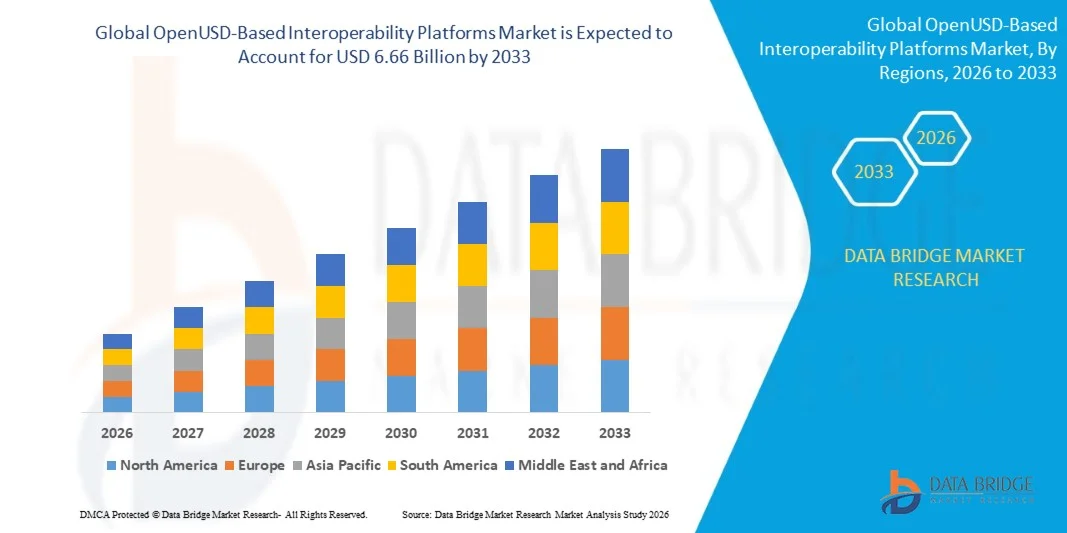
The OpenUSD-Based Interoperability Platforms Market was valued at USD 1.69 billion in 2025 and is projected to reach USD 6.66 billion by 2033, growing at a CAGR of 18.7% from 2026 to 2033. The market is experiencing rapid expansion due to the growing adoption of OpenUSD (Open Universal Scene Description) standards for interoperable 3D workflows, real-time collaboration, digital twin ecosystems, and industrial metaverse applications across industries such as media & entertainment, gaming, manufacturing, automotive, and architecture.
The increasing demand for seamless interoperability between 3D content creation tools, simulation environments, rendering engines, and XR platforms is accelerating the deployment of OpenUSD-based platforms. Enterprises are increasingly leveraging these platforms to improve workflow efficiency, reduce data silos, enable collaborative design environments, and support scalable digital twin infrastructures.
Key Market Trends & Insights
- North America is the dominating region in the OpenUSD-Based Interoperability Platforms Market, accounting for the largest market share of 39.4% in 2025, driven by strong adoption of industrial metaverse technologies, presence of major technology providers, and increasing investments in digital twin and 3D collaboration ecosystems.
- Asia-Pacific is the fastest-growing region in the market, projected to expand at a CAGR of 21.1%, fueled by rapid digital transformation, expansion of gaming and animation industries, growing smart manufacturing initiatives, and increasing adoption of XR technologies across China, Japan, South Korea, and India.
- Software is the dominating segment in the OpenUSD-Based Interoperability Platforms Market, accounting for the largest market share of 71.8% in 2025, owing to increasing adoption of OpenUSD-enabled collaboration tools, rendering engines, simulation platforms, and digital content interoperability frameworks.
- Services is the fastest-growing segment in the market, projected to expand at a CAGR of 20.8%, driven by rising enterprise demand for OpenUSD integration consulting, workflow customization, cloud deployment support, and interoperability optimization services.
- By Deployment Mode, Cloud-Based deployment is the dominating segment in the OpenUSD-Based Interoperability Platforms Market, holding a market share of 63.5% in 2025, supported by increasing demand for scalable collaboration platforms, distributed content creation workflows, and cloud-native digital twin environments.
- By Deployment Mode, On-Premises deployment continues to maintain significant adoption in industries requiring strict data security, low-latency processing, and high-performance rendering environments, particularly in defense, automotive, and industrial manufacturing sectors.
- By Platform Type, 3D Content Collaboration Platforms is the dominating segment in the market, accounting for a market share of 27.9% in 2025, driven by increasing use of collaborative asset pipelines across animation, gaming, film production, and enterprise visualization workflows.
- By Platform Type, Digital Twin Platforms is the fastest-growing segment in the market, projected to grow at a CAGR of 22.4% (2026–2033), fueled by rising industrial metaverse adoption, smart factory initiatives, and real-time simulation requirements.
- By Application, Media & Entertainment is the dominating segment in the OpenUSD-Based Interoperability Platforms Market, accounting for a market share of 26.7% in 2025, supported by extensive use of OpenUSD in animation production, VFX pipelines, virtual production, and real-time rendering workflows.
- By Application, Manufacturing is the fastest-growing segment in the market, projected to expand at a CAGR of 22.9% (2026–2033), driven by increasing deployment of digital twins, industrial automation systems, and immersive simulation environments.
Market Size & Forecast
- Global Market Value (2025): USD 1.69 Billion
- Expected Market Value (2033): USD 6.66 Billion
- Forecast CAGR (2026–2033): 18.7%
- Leading Region in 2025: North America
- Fastest Growing Region: Asia-Pacific
Report Scope and OpenUSD-Based Interoperability Platforms Market Segmentation
|
Attributes |
OpenUSD-Based Interoperability Platforms Key Market Insights |
|
Segments Covered |
|
|
Countries Covered |
North America · U.S. · Canada · Mexico Europe · Germany · France · U.K. · Netherlands · Switzerland · Belgium · Russia · Italy · Spain · Turkey · Rest of Europe Asia-Pacific · China · Japan · India · South Korea · Singapore · Malaysia · Australia · Thailand · Indonesia · Philippines · Rest of Asia-Pacific Middle East and Africa · Saudi Arabia · U.A.E. · South Africa · Egypt · Israel · Rest of Middle East and Africa South America · Brazil · Argentina · Rest of South America |
|
Key Market Players |
· NVIDIA Corporation (U.S.) · Pixar Animation Studios (U.S.) · Autodesk, Inc. (U.S.) · Adobe Inc. (U.S.) · Apple Inc. (U.S.) · Siemens Digital Industries Software (Germany) · Dassault Systèmes SE (France) · Unity Software Inc. (U.S.) · Epic Games, Inc. (U.S.) · SideFX (Canada) · Bentley Systems, Incorporated (U.S.) · PTC Inc. (U.S.) · Hexagon AB (Sweden) · Omniverse Platform by NVIDIA (U.S.) · Amazon Web Services, Inc. (U.S.) · Meta Platforms, Inc. (U.S.) |
|
Market Opportunities |
· Expansion of industrial metaverse ecosystems · Rising adoption of digital twins in manufacturing and smart infrastructure · Increasing demand for interoperable 3D workflows across XR and AI-powered environments |
|
Value Added Data Infosets |
In addition to the insights on market scenarios such as market value, growth rate, segmentation, geographical coverage, and major players, the market reports curated by the Data Bridge Market Research also include in-depth expert analysis, geographically represented company-wise production and capacity, network layouts of distributors and partners, detailed and updated price trend analysis and deficit analysis of supply chain and demand. |
OpenUSD-Based Interoperability Platforms Market Trends
Trend: Rapid Adoption of OpenUSD Standards Across Industrial Metaverse and Digital Twin Ecosystems
The market is witnessing strong momentum with the increasing adoption of OpenUSD as a standardized framework for interoperable 3D asset exchange, simulation integration, and collaborative virtual environments. Organizations across media production, gaming, manufacturing, and industrial automation are deploying OpenUSD-enabled platforms to streamline cross-application workflows and improve real-time collaboration. Technology providers are integrating OpenUSD into digital twin and simulation ecosystems to enable interoperability between CAD systems, rendering engines, XR environments, and AI-powered visualization platforms. For instance, NVIDIA’s Omniverse platform leverages OpenUSD to support collaborative industrial digital twin applications, while companies such as Autodesk and Adobe are increasingly integrating OpenUSD compatibility into creative design workflows.
OpenUSD-Based Interoperability Platforms Market Dynamics
Key Market Driver: Growing Demand for Seamless 3D Workflow Interoperability
The increasing complexity of 3D content creation and simulation workflows is driving strong adoption of OpenUSD-based interoperability platforms across industries. Organizations require unified frameworks capable of connecting multiple software applications, rendering engines, simulation environments, and XR systems without data fragmentation. Industries such as media & entertainment, automotive, and manufacturing are leveraging OpenUSD to enable real-time collaboration between designers, engineers, simulation experts, and visualization teams. For example, animation studios are increasingly using OpenUSD to manage large-scale scene composition and collaborative VFX production pipelines, while automotive manufacturers are deploying interoperable digital twin environments for vehicle simulation and virtual prototyping.
Key Restraint/Challenge: Integration Complexity and Lack of Standardization Across Legacy Systems
A major challenge in the OpenUSD-based interoperability platforms market is the complexity associated with integrating OpenUSD frameworks into existing enterprise workflows and legacy software infrastructures. Many organizations continue to operate proprietary systems with incompatible file formats, rendering pipelines, and simulation environments, limiting seamless interoperability. Furthermore, the lack of universally standardized implementation practices across industries creates challenges related to workflow consistency, asset compatibility, and performance optimization. Smaller enterprises and independent creators may also face barriers associated with integration costs, technical expertise requirements, and infrastructure modernization.
Key Market Opportunity: Expansion of Cloud-Native Digital Twin and Industrial Metaverse Platforms
The rapid growth of cloud-native digital twin ecosystems and industrial metaverse initiatives is creating significant opportunities for OpenUSD-based interoperability platform providers. Enterprises are increasingly adopting scalable cloud infrastructures to support collaborative 3D workflows, immersive simulations, and real-time operational intelligence. Cloud-based OpenUSD platforms enable geographically distributed teams to collaborate on large-scale virtual environments while reducing infrastructure complexity and improving workflow accessibility. Industries such as manufacturing, architecture, and healthcare are increasingly leveraging interoperable digital twin ecosystems for predictive maintenance, operational simulation, and immersive visualization.
OpenUSD-Based Interoperability Platforms Market Scope
The OpenUSD-based interoperability platforms market is segmented on the basis of component, deployment mode, platform type, application, and end user.
- By Component
On the basis of component, the OpenUSD-Based Interoperability Platforms Market is segmented into software and services. The Software segment dominated the market with a 71.8% share in 2025, owing to increasing adoption of OpenUSD-enabled collaboration tools, digital twin frameworks, simulation platforms, and real-time rendering environments across media, gaming, manufacturing, and enterprise visualization industries. Organizations are increasingly investing in interoperable software ecosystems to streamline 3D asset exchange, improve workflow efficiency, and support scalable virtual collaboration.
The Services segment is expected to witness the fastest growth at a CAGR of 20.8% from 2026 to 2033, driven by rising demand for OpenUSD integration consulting, cloud migration support, workflow customization, interoperability optimization, and managed platform services. Increasing enterprise adoption of industrial metaverse ecosystems and digital twin infrastructures is further accelerating service demand globally.
- By Deployment Mode
On the basis of deployment mode, the OpenUSD-Based Interoperability Platforms Market is segmented into cloud-based and on-premises solutions. The Cloud-Based segment dominated the market with a 63.5% share in 2025, supported by increasing adoption of scalable collaboration platforms, distributed 3D content creation workflows, and cloud-native digital twin environments. Enterprises are increasingly leveraging cloud infrastructures to enable real-time collaboration, remote asset management, and AI-powered rendering workflows.
The On-Premises segment is expected to witness steady growth during the forecast period due to strong demand from industries requiring strict data security, high-performance rendering control, and low-latency processing environments, particularly in defense & aerospace, automotive, and industrial manufacturing sectors. Organizations managing sensitive intellectual property and mission-critical simulation environments continue to prefer on-premises deployments for enhanced operational control and compliance requirements.
- By Platform Type
On the basis of platform type, the OpenUSD-Based Interoperability Platforms Market is segmented into 3D content collaboration platforms, digital twin platforms, simulation & visualization platforms, industrial metaverse platforms, cross-application data exchange platforms, real-time rendering interoperability platforms, and AR/VR/XR interoperability platforms. The 3D Content Collaboration Platforms segment dominated the market with a 27.9% share in 2025, driven by increasing use of collaborative 3D workflows across animation, gaming, VFX production, virtual production, and enterprise design environments. OpenUSD is increasingly enabling seamless interoperability between content creation applications and rendering pipelines.
The Digital Twin Platforms segment is expected to witness the fastest growth at a CAGR of 22.4% from 2026 to 2033, fueled by rapid expansion of industrial metaverse initiatives, smart manufacturing systems, and real-time operational simulation environments. Industries are increasingly deploying OpenUSD-enabled digital twins for predictive maintenance, process optimization, immersive visualization, and collaborative engineering applications.
- By Application
On the basis of application, the OpenUSD-Based Interoperability Platforms Market is segmented into media & entertainment, gaming, automotive, architecture, engineering & construction (AEC), manufacturing, retail & e-commerce, healthcare & life sciences, defense & aerospace, and education & research. The Media & Entertainment segment dominated the market with a 26.7% share in 2025, driven by extensive adoption of OpenUSD workflows in animation production, visual effects (VFX), virtual production studios, and real-time rendering environments. Studios and content creators increasingly rely on interoperable 3D asset pipelines to improve production scalability and collaboration efficiency.
The Manufacturing segment is expected to register the fastest growth at a CAGR of 22.9% from 2026 to 2033, fueled by rising deployment of digital twins, industrial automation systems, smart factory visualization platforms, and AI-driven simulation environments. Manufacturers are increasingly adopting OpenUSD-enabled interoperability platforms to unify engineering workflows, improve operational visibility, and accelerate product lifecycle management.
- By End User
On the basis of end user, the OpenUSD-Based Interoperability Platforms Market is segmented into enterprises, individual creators & professionals, educational institutions, government organizations, and research labs. The Enterprises segment dominated the market with a 49.1% share in 2025, owing to large-scale investments in industrial metaverse platforms, enterprise visualization systems, collaborative engineering workflows, and digital transformation initiatives across industries such as manufacturing, automotive, media, and healthcare.
The Research Labs segment is expected to witness the fastest growth at a CAGR of 21.5% from 2026 to 2033, driven by increasing adoption of OpenUSD frameworks for scientific visualization, AI-integrated simulation environments, immersive research collaboration, and advanced digital twin experimentation. Growing investments in XR research, computational visualization, and high-performance collaborative simulation platforms are further accelerating segment growth.
OpenUSD-Based Interoperability Platforms Market Regional Analysis
North America dominated the OpenUSD-based interoperability platforms market and accounted for the largest revenue share of 39.4% in 2025, driven by strong presence of major technology companies, rapid adoption of industrial metaverse technologies, and increasing investments in digital twin ecosystems and collaborative 3D workflows. The region also benefits from advanced cloud infrastructure, strong AI integration capabilities, and extensive deployment of real-time rendering and simulation platforms across media, manufacturing, and automotive industries.
U.S. OpenUSD-Based Interoperability Platforms Market Insight
The U.S. OpenUSD-based interoperability platforms market is witnessing significant growth due to increasing adoption of digital twins, virtual production technologies, and collaborative 3D design ecosystems across industries such as media & entertainment, manufacturing, aerospace, and gaming. Major technology providers including NVIDIA Corporation, Autodesk, Inc., and Adobe Inc. are actively expanding OpenUSD integration capabilities to support scalable interoperability and immersive content workflows. Additionally, rising investment in AI-powered simulation, industrial metaverse infrastructure, and cloud-native rendering platforms is further accelerating market expansion in the U.S.
Europe OpenUSD-Based Interoperability Platforms Market Insight
The Europe OpenUSD-based interoperability platforms market remains a major contributor to global revenue, supported by strong industrial automation capabilities, advanced manufacturing ecosystems, and increasing adoption of digital engineering technologies. The region is witnessing growing deployment of interoperable digital twin platforms across automotive, architecture, and aerospace sectors. Increasing focus on sustainable manufacturing, collaborative product development, and Industry 4.0 initiatives is further driving demand for OpenUSD-enabled interoperability solutions across Europe.
U.K. OpenUSD-Based Interoperability Platforms Market Insight
The U.K. OpenUSD-based interoperability platforms market is experiencing steady growth due to increasing adoption of immersive content production, virtual collaboration tools, and real-time simulation platforms across media, gaming, and engineering industries. Growing investments in XR technologies, AI-driven visualization systems, and cloud-based creative workflows are strengthening market expansion. Universities, creative studios, and enterprise design organizations are increasingly integrating OpenUSD workflows to improve interoperability and production scalability.
Germany OpenUSD-Based Interoperability Platforms Market Insight
The Germany OpenUSD-based interoperability platforms market is expanding steadily due to the country’s strong industrial engineering base and leadership in smart manufacturing and automotive innovation. German manufacturers and industrial technology providers are increasingly leveraging OpenUSD-enabled digital twin ecosystems and simulation platforms for factory optimization, product lifecycle management, and collaborative engineering workflows. Rising adoption of Industry 4.0 technologies and industrial metaverse initiatives is further supporting market growth in Germany.
Asia-Pacific OpenUSD-Based Interoperability Platforms Market Insight
The Asia-Pacific OpenUSD-based interoperability platforms market is expected to witness rapid growth, driven by expanding gaming and animation industries, increasing industrial automation, and rising investments in smart manufacturing and XR ecosystems across China, Japan, South Korea, and India. Growing digital transformation initiatives and increasing adoption of cloud-native collaboration platforms are significantly boosting demand for OpenUSD-enabled interoperability solutions across enterprise and creative industries.
Japan OpenUSD-Based Interoperability Platforms Market Insight
The Japan OpenUSD-based interoperability platforms market is witnessing consistent growth due to strong adoption of advanced visualization technologies, robotics simulation systems, and immersive design environments. Automotive manufacturers, gaming companies, and electronics firms are increasingly deploying OpenUSD-enabled workflows for real-time collaboration, digital twin visualization, and simulation-driven product development. Integration of AI, XR technologies, and cloud rendering platforms is further enhancing market expansion across Japan.
China OpenUSD-Based Interoperability Platforms Market Insight
The China OpenUSD-based interoperability platforms market is growing rapidly, driven by large-scale industrial digitization, strong government support for smart manufacturing initiatives, and rapid expansion of gaming, animation, and XR industries. Enterprises are increasingly adopting OpenUSD-based platforms to improve interoperability across design, simulation, and visualization environments. Rising investments in industrial metaverse ecosystems, AI-powered rendering technologies, and cloud-based digital twin platforms are positioning China as one of the fastest-growing markets globally.
OpenUSD-Based Interoperability Platforms Market Share
The openUSD-based interoperability platforms industry is primarily led by well-established companies, including:
- NVIDIA Corporation (U.S.)
- Pixar Animation Studios (U.S.)
- Autodesk, Inc. (U.S.)
- Adobe Inc. (U.S.)
- Apple Inc. (U.S.)
- Siemens Digital Industries Software (Germany)
- Dassault Systèmes SE (France)
- Unity Software Inc. (U.S.)
- Epic Games, Inc. (U.S.)
- SideFX (Canada)
- Bentley Systems, Incorporated (U.S.)
- PTC Inc. (U.S.)
- Hexagon AB (Sweden)
- Omniverse Platform by NVIDIA (U.S.)
- Amazon Web Services, Inc. (U.S.)
- Meta Platforms, Inc. (U.S.)
Latest Developments in OpenUSD-Based Interoperability Platforms Market
- In August 2025, NVIDIA Corporation expanded its Omniverse platform with new OpenUSD interoperability libraries, Cosmos world foundation models, and robotics simulation capabilities to strengthen industrial digital twin and physical AI ecosystems. The company introduced OpenUSD-based SDKs enabling interoperability between MuJoCo and OpenUSD environments, along with cloud-based simulation deployment through NVIDIA DGX Cloud. The development enhances large-scale simulation, robotics training, and cross-platform digital twin collaboration capabilities across manufacturing, automotive, and industrial AI applications.
- In March 2025, NVIDIA Corporation announced expanded Omniverse integrations with major industrial software providers including Siemens, SAP, Schneider Electric, Cadence, and Hexagon to accelerate OpenUSD-enabled industrial digitalization and interoperability workflows. The initiative introduced new Omniverse blueprints for AI factory digital twins and large-scale synthetic data generation, strengthening OpenUSD adoption across smart manufacturing and industrial metaverse ecosystems.
- In January 2025, NVIDIA Corporation enhanced its Omniverse ecosystem by introducing generative physical AI capabilities integrated with OpenUSD-based simulation frameworks. The upgrade enables enterprises to build interoperable robotics, autonomous vehicle, and industrial AI simulation environments using scalable OpenUSD digital twin architectures. Companies including Siemens, Microsoft, Altair, and Cadence adopted Omniverse integrations to accelerate collaborative industrial AI development workflows.
- In August 2023, NVIDIA Corporation released a major Omniverse platform upgrade with expanded OpenUSD-native interoperability features, generative AI integrations, and real-time collaboration capabilities. The update introduced enhanced OpenUSD workflows, Omniverse Cloud APIs, XR development tools, and interoperability integrations with Adobe Firefly, SideFX Houdini, and other 3D ecosystem platforms, supporting scalable virtual production and industrial metaverse applications.
- In October 2025, Adobe Inc. expanded its strategic AI and creative technology partnership with Google Cloud to enhance interoperable AI-powered creative workflows across enterprise content ecosystems. The collaboration strengthens Adobe’s cloud-based content supply chain infrastructure and supports scalable creative collaboration environments increasingly aligned with interoperable 3D and OpenUSD-enabled workflows for enterprise media production and immersive content creation.
- In September 2025, Adobe Inc. announced that Qualcomm adopted Adobe GenStudio to optimize AI-powered content supply chain workflows and enterprise-scale digital content collaboration. The platform improves workflow interoperability, AI-assisted content generation, and scalable enterprise creative operations, supporting broader industry movement toward interoperable digital asset ecosystems and collaborative media production infrastructures.

- Interactive Data Analysis Dashboard
- Company Analysis Dashboard for high growth potential opportunities
- Research Analyst Access for customization & queries
- Competitor Analysis with Interactive dashboard
- Latest News, Updates & Trend analysis
- Harness the Power of Benchmark Analysis for Comprehensive Competitor Tracking
Global Openusd Based Interoperability Platforms Market, Supply Chain Analysis and Ecosystem Framework
To support market growth and help clients navigate the impact of geopolitical shifts, DBMR has integrated in-depth supply chain analysis into its Global Openusd Based Interoperability Platforms Market research reports. This addition empowers clients to respond effectively to global changes affecting their industries. The supply chain analysis section includes detailed insights such as Global Openusd Based Interoperability Platforms Market consumption and production by country, price trend analysis, the impact of tariffs and geopolitical developments, and import and export trends by country and HSN code. It also highlights major suppliers with data on production capacity and company profiles, as well as key importers and exporters. In addition to research, DBMR offers specialized supply chain consulting services backed by over a decade of experience, providing solutions like supplier discovery, supplier risk assessment, price trend analysis, impact evaluation of inflation and trade route changes, and comprehensive market trend analysis.
Data collection and base year analysis are done using data collection modules with large sample sizes. The stage includes obtaining market information or related data through various sources and strategies. It includes examining and planning all the data acquired from the past in advance. It likewise envelops the examination of information inconsistencies seen across different information sources. The market data is analysed and estimated using market statistical and coherent models. Also, market share analysis and key trend analysis are the major success factors in the market report. To know more, please request an analyst call or drop down your inquiry.
The key research methodology used by DBMR research team is data triangulation which involves data mining, analysis of the impact of data variables on the market and primary (industry expert) validation. Data models include Vendor Positioning Grid, Market Time Line Analysis, Market Overview and Guide, Company Positioning Grid, Patent Analysis, Pricing Analysis, Company Market Share Analysis, Standards of Measurement, Global versus Regional and Vendor Share Analysis. To know more about the research methodology, drop in an inquiry to speak to our industry experts.
Data Bridge Market Research is a leader in advanced formative research. We take pride in servicing our existing and new customers with data and analysis that match and suits their goal. The report can be customized to include price trend analysis of target brands understanding the market for additional countries (ask for the list of countries), clinical trial results data, literature review, refurbished market and product base analysis. Market analysis of target competitors can be analyzed from technology-based analysis to market portfolio strategies. We can add as many competitors that you require data about in the format and data style you are looking for. Our team of analysts can also provide you data in crude raw excel files pivot tables (Fact book) or can assist you in creating presentations from the data sets available in the report.













