


Operational Room Management Market Size
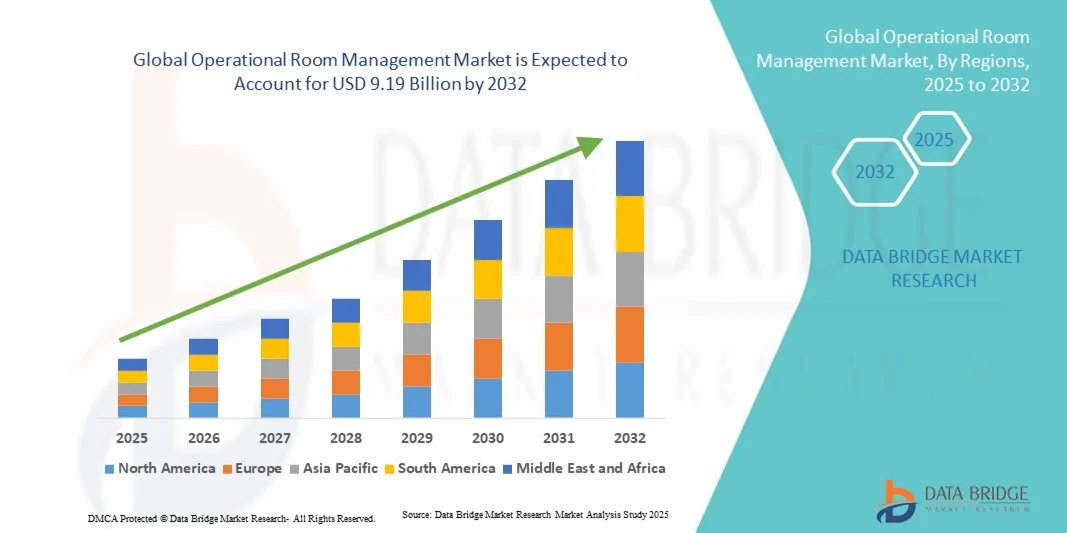
- The global operational room management market size was valued at USD 3.70 billion in 2024 and is expected to reach USD 9.19 billion by 2032, at a CAGR of 12.05% during the forecast period
- The market growth is largely fueled by the increasing demand for efficient, streamlined, and technologically advanced healthcare facilities, leading to enhanced operational efficiency in hospitals and surgical centers
- Furthermore, rising emphasis on reducing surgery delays, optimizing resource utilization, and improving patient throughput is driving the adoption of Operational Room Management solutions, thereby significantly boosting the industry's growth. These converging factors are encouraging hospitals and clinics to implement digital platforms and integrated systems for scheduling, monitoring, and managing surgical operations effectively.
Operational Room Management Market Analysis
- Operational Room Management systems are increasingly essential in modern healthcare facilities, enabling hospitals and surgical centers to optimize operating room utilization, streamline workflows, and improve patient outcomes through efficient scheduling, equipment management, and staff coordination
- The escalating demand for operational room management systems is primarily fueled by the growing number of surgeries, rising focus on reducing procedural delays, and increasing adoption of digital hospital infrastructure and smart workflow technologies
- North America dominated the operational room management market with the largest revenue share of 42.2% in 2024, characterized by advanced healthcare infrastructure, high investments in digital solutions, and the strong presence of key industry players. The U.S. experienced substantial growth in Operational Room Management system installations, particularly in large hospital networks and high-throughput surgical centers, driven by innovations from both established companies and emerging technology providers focusing on automation and integration with hospital information systems
- Asia-Pacific is expected to be the fastest-growing region in the operational room management market during the forecast period, with a projected CAGR from 2025 to 2032, driven by increasing urbanization, rising healthcare expenditure, and the expansion of hospitals and surgical centers investing in advanced room management solutions. Countries such as China, Japan, and India are adopting digital OR management systems to enhance efficiency and patient care
- The software segment dominated the operational room management market with the largest revenue share of 57.4% in 2024, driven by hospitals’ increasing reliance on advanced operating room scheduling, workflow management, and analytics platforms
Report Scope and Operational Room Management Market Segmentation
|
Attributes |
Operational Room Management Key Market Insights |
|
Segments Covered |
|
|
Countries Covered |
North America
Europe
Asia-Pacific
Middle East and Africa
South America
|
|
Key Market Players |
|
|
Market Opportunities |
|
|
Value Added Data Infosets |
In addition to the insights on market scenarios such as market value, growth rate, segmentation, geographical coverage, and major players, the market reports curated by the Data Bridge Market Research also include in-depth expert analysis, pricing analysis, brand share analysis, consumer survey, demography analysis, supply chain analysis, value chain analysis, raw material/consumables overview, vendor selection criteria, PESTLE Analysis, Porter Analysis, and regulatory framework. |
Operational Room Management Market Trends
Adoption of Advanced Digital Scheduling and Analytics in Operational Room Management
- A significant and accelerating trend in the global operational room management market is the adoption of advanced digital scheduling, real-time analytics, and automated resource allocation systems in hospitals and surgical centers. This trend is enabling better utilization of operating rooms, reducing patient wait times, and improving overall hospital efficiency
- For instance, in February 2023, Surgical Theater Inc. launched its OR Analytics Suite, which integrates predictive analytics to optimize surgical scheduling and resource allocation, allowing hospitals to increase OR utilization rates while minimizing delays
- The integration of real-time data monitoring with hospital information systems is helping medical teams track room occupancy, staff availability, and equipment readiness. This enables proactive decision-making and reduces last-minute cancellations or delays during surgical procedures
- Cloud-based operational management platforms are becoming increasingly popular, allowing administrators to access OR schedules, performance metrics, and patient data remotely, facilitating better planning and coordination
- Software solutions that provide visual dashboards, performance alerts, and predictive analytics are helping hospitals manage high patient volumes efficiently and maintain high standards of patient care
- The trend towards centralized operational oversight and digital performance tracking is expected to reshape expectations for hospital workflow management, encouraging continuous improvement in surgical efficiency and patient safety
Operational Room Management Market Dynamics
Driver
Rising Need for Efficient Hospital Operations and Reduced Procedure Delays
- The growing demand for operational efficiency in hospitals and surgical centers is a key driver of the Operational Room Management market. Hospitals are increasingly under pressure to reduce patient wait times, optimize resource allocation, and improve surgical outcomes
- For instance, in March 2024, GE Healthcare introduced its OR Optimizer platform in North America, which uses predictive analytics to manage operating room schedules and staffing, reducing idle time and enhancing resource utilization
- Expanding hospital infrastructure in emerging economies, coupled with the growing volume of elective surgeries, is driving adoption of OR management software
- The increasing complexity of surgical procedures and the need for precise coordination among surgeons, nurses, and anesthesiologists further fuels demand for digital operational management solutions
- Hospitals are seeking centralized platforms that consolidate scheduling, staff management, and equipment availability, which improves transparency, reduces errors, and ensures timely interventions
- The shift towards value-based healthcare models is also encouraging hospitals to adopt systems that can optimize OR performance, reduce costs, and improve patient outcomes
- Rising investments by healthcare providers in technology-enabled infrastructure, combined with government initiatives promoting hospital efficiency, are further supporting market growth
Restraint/Challenge
High Implementation Costs and Integration Complexity
- The high initial cost of installing comprehensive operational room management systems is a major challenge, particularly for small and mid-sized hospitals in developing regions
- For instance, in May 2023, Siemens Healthineers highlighted that some hospitals faced delays in adopting its OR management platform due to budget constraints and the need for staff training on advanced analytics tools
- Integration of new software with legacy hospital information systems can be complex, leading to potential workflow disruptions during the transition phase
- The need for continuous system updates, cybersecurity measures to protect patient data, and staff training programs increases operational expenditure, which can limit adoption
- Resistance to change among hospital staff, due to reliance on traditional manual scheduling practices, can slow the deployment of automated solutions
- Differences in hospital infrastructure and varying IT capabilities across regions make standardization of OR management solutions challenging
- Addressing these challenges through phased implementation, training programs, and scalable software solutions will be essential for ensuring sustained market growth and improved hospital operational efficiency
Operational Room Management Market Scope
The market is segmented on the basis of component, solution, delivery mode, and end users.
- By Component
On the basis of component, the operational room management market is segmented into software and services. The software segment dominated the market with the largest revenue share of 57.4% in 2024, driven by hospitals’ increasing reliance on advanced operating room scheduling, workflow management, and analytics platforms. Hospitals are prioritizing software adoption to optimize surgical efficiency, reduce patient wait times, and streamline complex documentation processes. Integration with electronic health records (EHR) and interoperability across multiple hospital departments has enhanced the demand for software solutions. Moreover, software solutions offer predictive analytics for resource allocation and enable better coordination among surgical teams. Hospitals and large healthcare systems prefer software platforms that allow centralized management of multiple operating rooms and real-time monitoring of surgical schedules. The growing adoption of AI-powered analytics and decision-support tools further strengthens software dominance. Customizable dashboards, automated reporting, and remote access capabilities make software solutions more attractive compared to services. Enhanced data security features and compliance with healthcare regulations also contribute to the segment’s leadership in revenue share.
The services segment is anticipated to witness the fastest CAGR of 18.6% from 2025 to 2032, fueled by increasing demand for technical support, maintenance, and training for both small and large hospitals. Healthcare providers are seeking managed services to ensure optimal performance of OR management systems, minimize downtime, and reduce operational costs. Hospitals prefer services that offer proactive monitoring, timely software updates, and rapid troubleshooting. In addition, the expansion of IT support in emerging markets is driving growth in services. Customized implementation and workflow optimization services enhance the adoption rate across diverse healthcare facilities.
- By Solution
On the basis of solution, the operational room management market is segmented into data management and communication solutions, anaesthesia information management solutions, and others. The data management and communication solutions segment dominated with a revenue share of 45.8% in 2024, driven by the increasing need for real-time access to patient data and seamless coordination between surgical teams. Hospitals require solutions that integrate scheduling, resource management, and team communication to minimize delays and enhance surgical outcomes. The availability of centralized dashboards for surgical case tracking, automated alerts, and secure messaging has reinforced the demand for this segment. Integration with hospital IT infrastructure and EHRs ensures that patient information is accessible to all stakeholders, facilitating better decision-making. Furthermore, hospitals are increasingly using data management solutions for reporting, compliance, and operational efficiency. Predictive analytics and resource optimization features also contribute to segment dominance, providing actionable insights to improve OR utilization.
The anaesthesia information management solutions segment is expected to witness the fastest CAGR of 19.2% during 2025–2032, driven by hospitals’ growing focus on patient safety, accurate anaesthesia documentation, and regulatory compliance. Adoption is fueled by the need for precise monitoring of anaesthesia delivery, dosage, and patient vitals during surgeries. Advanced solutions enable integration with monitoring devices and EHRs, providing seamless data flow and real-time decision-making. Hospitals and ambulatory centres increasingly prefer solutions that reduce human errors, streamline workflow, and allow retrospective audits of anaesthesia records. The growing trend of minimally invasive procedures and complex surgeries is further boosting adoption.
- By Delivery Mode
On the basis of delivery mode, the operational room management market is segmented into on-premise, web-based, and cloud-based solutions. The cloud-based segment dominated the market with a revenue share of 52.1% in 2024, owing to its flexibility, scalability, and reduced IT infrastructure costs. Hospitals are increasingly moving to cloud platforms to enable centralized management of multiple operating rooms, real-time access to OR schedules, and remote monitoring. Cloud-based delivery allows secure multi-user access, automatic software updates, and integration with analytics tools. The segment’s leadership is supported by growing awareness about cost efficiency, disaster recovery capabilities, and minimal dependency on in-house IT staff. Cloud platforms also enable data storage compliance with healthcare regulations while providing secure remote access.
The web-based segment is expected to witness the fastest CAGR of 20.3% from 2025 to 2032, driven by its easy deployment, minimal installation requirements, and secure accessibility via web browsers. Web-based solutions are preferred for their convenience in multi-site management and ability to provide real-time updates to multiple stakeholders. Hospitals and ambulatory centres favor web-based delivery for its cost-effectiveness and reduced IT complexity. Increasing adoption in emerging regions with limited infrastructure supports the rapid growth of this segment. Furthermore, continuous improvements in cybersecurity measures and user-friendly interfaces are enhancing trust and usability among healthcare providers. The integration of web-based solutions with electronic health records and scheduling systems also streamlines operations and improves overall clinical workflow efficiency.
- By End Users
On the basis of end users, the operational room management market is segmented into hospitals, ambulatory centres, and others. The hospitals segment accounted for the largest revenue share of 63.7% in 2024, driven by the increasing number of surgeries, focus on operating room efficiency, and integration of OR management systems into hospital IT ecosystems. Large hospitals and multi-specialty centers prioritize centralized scheduling, resource optimization, and real-time analytics, which contributes to dominance. Enhanced coordination between surgeons, nurses, and support staff also drives software and solution adoption.
The ambulatory centres segment is expected to witness the fastest CAGR of 17.8% during 2025–2032, fueled by the increasing number of outpatient surgeries, need for cost-effective OR management solutions, and demand for streamlined scheduling in smaller surgical facilities. Ambulatory centres benefit from solutions that optimize operating room utilization, reduce waiting times, and improve patient throughput, driving rapid adoption. Furthermore, the rising preference for minimally invasive procedures and same-day surgeries in outpatient settings is encouraging investment in advanced OR management tools. Integration with cloud-based and web-based solutions also allows ambulatory centres to enhance data accuracy, monitor performance remotely, and improve overall patient care efficiency.
Operational Room Management Market Regional Analysis
- North America dominated the operational room management market with the largest revenue share of 42.2% in 2024, characterized by advanced healthcare infrastructure, high investments in digital solutions, and a strong presence of key industry players
- The market experienced substantial growth in operational room management system installations, particularly in large hospital networks and high-throughput surgical centers
- Driven by innovations from both established companies and emerging technology providers focusing on automation and integration with hospital information systems
U.S. Operational Room Management Market Insight
The U.S. operational room management market captured the largest revenue share of 81% in 2024 within North America, fueled by the rapid adoption of digital OR management systems and integration with hospital IT networks. Hospitals are increasingly prioritizing efficient resource allocation, scheduling, and surgical workflow optimization to improve patient outcomes. The expansion of large hospital networks, investment in high-throughput surgical centers, and the implementation of advanced automation and data analytics solutions are key factors driving the market.
Europe Operational Room Management Market Insight
The Europe operational room management market is projected to expand at a substantial CAGR throughout the forecast period, driven by strict healthcare regulations, increasing hospital modernization projects, and rising investments in digital healthcare infrastructure. Germany, France, and Italy are modernizing operating rooms with integrated management systems that enhance surgical scheduling, optimize equipment usage, and improve overall operational efficiency.
U.K. Operational Room Management Market Insight
The U.K. operational room management market is expected to grow at a noteworthy CAGR during the forecast period, supported by healthcare IT initiatives, modernization of hospital facilities, and the need to improve operating room efficiency. Hospitals are implementing digital OR systems to streamline surgical procedures, reduce delays, and maximize utilization of resources, thereby improving patient care and workflow management.
Germany Operational Room Management Market Insight
The Germany operational room management market is anticipated to witness consistent growth, supported by a technologically advanced healthcare infrastructure, emphasis on operational efficiency, and sustainability initiatives. Hospitals are integrating OR management systems with hospital networks to monitor surgical workflows, optimize staff allocation, and ensure better management of medical equipment.
Asia-Pacific Operational Room Management Market Insight
The Asia-Pacific operational room management market is poised to be the fastest-growing region during the forecast period, with a projected CAGR from 2025 to 2032, driven by rising healthcare expenditure, increasing urbanization, and the expansion of hospitals and surgical centers investing in advanced room management solutions. Countries such as China, Japan, and India are adopting digital OR management systems to enhance operational efficiency, optimize surgical workflows, and improve patient care.
Japan Operational Room Management Market Insight
The Japan operational room management market is gaining momentum due to high-tech hospital infrastructure, aging population, and the increasing focus on efficiency in surgical operations. Advanced OR management solutions are being adopted to optimize surgical schedules, monitor equipment usage, and improve patient throughput, while supporting the growing demand for minimally invasive surgeries and high-precision procedures.
China Operational Room Management Market Insight
The China operational room management market accounted for the largest market revenue share in Asia-Pacific in 2024, supported by the country’s rapidly expanding healthcare infrastructure, rising middle-class population, and strong adoption of digital solutions. Hospitals are increasingly deploying OR management systems to improve scheduling, optimize surgical workflows, and enhance operational efficiency across large hospital networks and high-volume surgical centers
Operational Room Management Market Share
The Operational Room Management industry is primarily led by well-established companies, including:
- Cerner Corporation (U.S.)
- Koninklijke Philips N.V. (Netherlands)
- GE Healthcare (U.S.)
- Siemens Healthineers AG (Germany)
- Medtronic (Ireland)
- Getinge AB (Sweden)
- Drägerwerk AG & Co. KGaA (Germany)
- McKesson Corporation (U.S.)
- Epic Systems Corporation (U.S.)
- Stryker (U.S.)
- Hill-Rom Holdings, Inc. (U.S.)
- Ascom (Switzerland)
- Surgical Information Systems (U.S.)
- ConMed Corporation (U.S.)
- Agfa-Gevaert Group (Belgium)
Latest Developments in Global Operational Room Management Market
- In March 2023, MedTech Solutions launched ORTrack, an advanced operating room management system integrated with artificial intelligence. ORTrack employs real-time data analysis and predictive analytics to optimize scheduling, maximize equipment usage, and elevate patient safety standards. This groundbreaking solution is anticipated to transform the management of operating rooms on a global scale
- In March 2024, Cromwell Hospital in London pioneered the use of Apple's Vision Pro mixed reality headset in UK surgeries. The eXeX software, combined with the Vision Pro headset, offers nurses and technicians holographic and touch-free access to surgical setups and procedural guides from within the sterile field of the operating room. This innovation has significantly increased the efficiency of surgical delivery by enhancing equipment and workflow accuracy, ultimately improving patient outcomes
- In October 2024, Oracle unveiled its next-generation Electronic Health Record (EHR) system, featuring integrated artificial intelligence capabilities. The new EHR offers a more natural, intuitive, and responsive experience for users, leveraging AI to deliver contextual insights and streamline clinical workflows. This advancement aims to enhance the efficiency and effectiveness of healthcare delivery
- In February 2025, Corewell Health in Michigan became the first health system in the state to utilize Surgical Theater’s eXperiential Reality platform in neurosurgery cases. This platform employs virtual and augmented reality technology to enable patients to "tour" their own brains and assist physicians with planning and surgery, marking a significant step forward in surgical precision and patient engagement
- In September 2025, Oracle launched an AI-powered patient portal, allowing patients to interact with their medical records using plain-language queries. This AI-driven portal enables users to seek explanations of diagnoses or lab results, prepare for upcoming doctor visits, and draft messages to providers, thereby enhancing patient engagement and understanding

- Interactive Data Analysis Dashboard
- Company Analysis Dashboard for high growth potential opportunities
- Research Analyst Access for customization & queries
- Competitor Analysis with Interactive dashboard
- Latest News, Updates & Trend analysis
- Harness the Power of Benchmark Analysis for Comprehensive Competitor Tracking
Data collection and base year analysis are done using data collection modules with large sample sizes. The stage includes obtaining market information or related data through various sources and strategies. It includes examining and planning all the data acquired from the past in advance. It likewise envelops the examination of information inconsistencies seen across different information sources. The market data is analysed and estimated using market statistical and coherent models. Also, market share analysis and key trend analysis are the major success factors in the market report. To know more, please request an analyst call or drop down your inquiry.
The key research methodology used by DBMR research team is data triangulation which involves data mining, analysis of the impact of data variables on the market and primary (industry expert) validation. Data models include Vendor Positioning Grid, Market Time Line Analysis, Market Overview and Guide, Company Positioning Grid, Patent Analysis, Pricing Analysis, Company Market Share Analysis, Standards of Measurement, Global versus Regional and Vendor Share Analysis. To know more about the research methodology, drop in an inquiry to speak to our industry experts.
Data Bridge Market Research is a leader in advanced formative research. We take pride in servicing our existing and new customers with data and analysis that match and suits their goal. The report can be customized to include price trend analysis of target brands understanding the market for additional countries (ask for the list of countries), clinical trial results data, literature review, refurbished market and product base analysis. Market analysis of target competitors can be analyzed from technology-based analysis to market portfolio strategies. We can add as many competitors that you require data about in the format and data style you are looking for. Our team of analysts can also provide you data in crude raw excel files pivot tables (Fact book) or can assist you in creating presentations from the data sets available in the report.













