


Ophthalmic Data Management Systems Market Overview
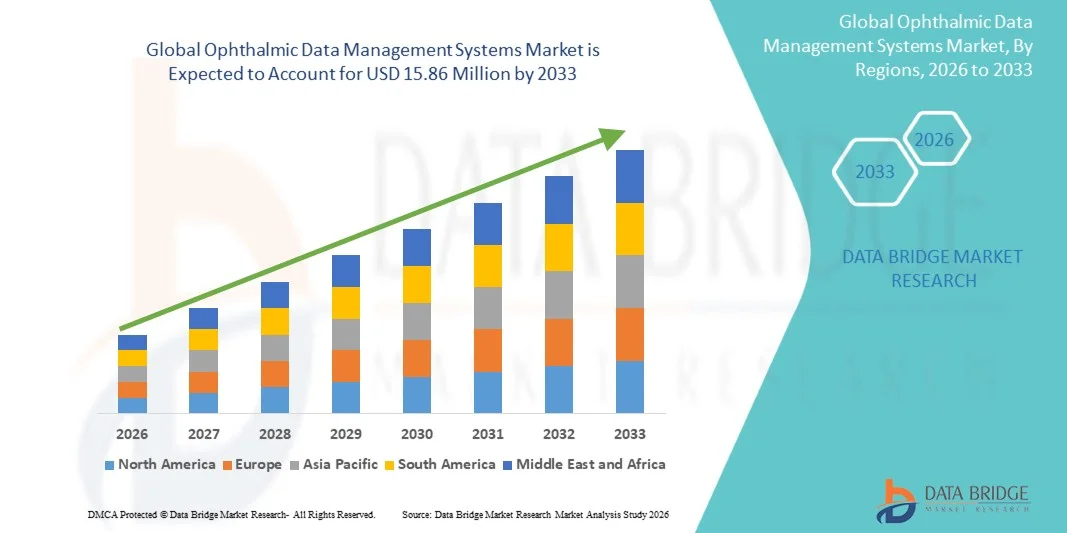
The Ophthalmic Data Management Systems Market was valued at USD 8.20 million in 2025 and is projected to reach USD 15.86 million by 2033, growing at a CAGR of 8.60% from 2026 to 2033. The market is witnessing steady expansion driven by the rising prevalence of ophthalmic disorders such as glaucoma, diabetic retinopathy, and age-related macular degeneration, along with the increasing digitization of eye care workflows across hospitals and specialty clinics.
The growing shift toward integrated electronic health records (EHR), cloud-based imaging platforms, and AI-enabled diagnostic tools is significantly enhancing the adoption of ophthalmic data management systems. Increasing patient volumes in ophthalmology departments, combined with the need for efficient storage, retrieval, and analysis of high-resolution imaging data is further accelerating demand. In addition, regulatory emphasis on data security, interoperability, and standardized clinical reporting is encouraging healthcare providers to invest in advanced, scalable ophthalmic data management solutions.
Key Market Trends & Insights
- North America dominated the Ophthalmic Data Management Systems Market with the largest revenue share of 38.62% in 2025, supported by advanced healthcare IT infrastructure, high adoption of electronic medical records, and strong presence of leading ophthalmic device manufacturers and software providers.
- The Cloud-Based segment led the market with a 44.18% share in 2025, driven by increasing demand for centralized data access, seamless interoperability, and scalability across multi-location ophthalmology networks.
- Asia-Pacific is expected to be the fastest-growing region from 2026 to 2033, with a CAGR of 8.1%, fueled by rising prevalence of eye diseases, expanding ophthalmology service capacity, increasing healthcare.
- Web-Based are the fastest-growing deployment type, projected to register a CAGR of 8.3%, reflecting the surge in demand for lightweight, browser-accessible solutions that do not require heavy infrastructure investment.
- The Diabetic Retinopathy segment dominated the disease type category with a 39.52% revenue share in 2025, led by the rising global diabetic population and increasing need for regular retinal screening and monitoring.
- Store, Manage and Review Data accounted for 34.67% of the market, preferred by its foundational role in organizing large volumes of ophthalmic imaging and patient records.
- The Automatically Register and Align Fundus Images segment is the fastest-growing feature category, with a CAGR of 8.2%, driven by increasing demand for precision imaging and AI-assisted diagnostics.
Market Size & Forecast
- Global Market Value (2025): USD 8.20 Million
- Expected Market Value (2033): USD 15.86 Million
- Forecast CAGR (2026–2033): 8.60%
- Leading Region in 2025: North America
- Fastest Growing Region: Asia Pacific
Report Scope and Ophthalmic Data Management Systems Market Segmentation
|
Attributes |
Ophthalmic Data Management Systems Key Market Insights |
|
Segments Covered |
|
|
Countries Covered |
North America · U.S. · Canada · Mexico Europe · Germany · France · U.K. · Netherlands · Switzerland · Belgium · Russia · Italy · Spain · Turkey · Rest of Europe Asia-Pacific · China · Japan · India · South Korea · Singapore · Malaysia · Australia · Thailand · Indonesia · Philippines · Rest of Asia-Pacific Middle East and Africa · Saudi Arabia · U.A.E. · South Africa · Egypt · Israel · Rest of Middle East and Africa South America · Brazil · Argentina · Rest of South America |
|
Key Market Players |
· ZEISS Meditec AG (Germany) · Topcon Corporation (Japan) · Heidelberg Engineering GmbH (Germany) · Optomed Oyj (Finland) · NIDEK CO., LTD. (Japan) · Canon Inc. (Japan) · Haag-Streit AG (Switzerland) · Altris AB (Sweden) · Medflow Inc. (United States) · Nextech Systems, LLC (U.S.) · EyePACS, LLC (U.S.) · Ophthalmic Data Systems, Inc. (U.S.) · Forus Health Private Limited (India) · Clarity Medical Systems, Inc. (U.S.) · Intelligent Retinal Imaging Systems, LLC (U.S.) · Eyenuk, Inc. (U.S.) · Visunex Medical Systems, Inc. (U.S.) · Diopsys, Inc. (U.S.) · iCare Finland Oy (Finland) · CANON MEDICAL SYSTEMS CORPORATION (Japan) |
|
Market Opportunities |
· Rising adoption of tele-ophthalmology platforms · Increasing use of AI-driven retinal imaging and predictive analytics · Growing integration of ophthalmic data platforms with hospital EHRs and imaging devices |
|
Value Added Data Infosets |
In addition to the insights on market scenarios such as market value, growth rate, segmentation, geographical coverage, and major players, the market reports curated by the Data Bridge Market Research also include in-depth expert analysis, patient epidemiology, pipeline analysis, pricing analysis, and regulatory framework. |
Ophthalmic Data Management Systems Market Trends
Trend: Rapid Shift Toward Cloud-Based Ophthalmic Data Platforms
Healthcare providers are increasingly adopting cloud-based ophthalmic data management systems to centralize imaging data, streamline patient records, and enable multi-site accessibility across ophthalmology networks. The integration of OCT, fundus imaging, and visual field data into unified platforms is improving diagnostic efficiency and clinical decision-making. For instance, cloud-native ophthalmology platforms are being deployed in large eye hospital chains to support real-time data sharing between specialists and remote clinics, while AI-assisted modules enhance image interpretation and workflow automation.
Ophthalmic Data Management Systems Market Dynamics
Key Market Driver: Rising Burden of Ophthalmic Diseases and Imaging Volumes
The increasing prevalence of glaucoma, diabetic retinopathy, and age-related macular degeneration is driving the demand for advanced ophthalmic data management systems capable of handling large volumes of high-resolution diagnostic imaging data. Hospitals and eye care centers are integrating these systems to improve storage efficiency, reduce diagnostic delays, and enhance long-term patient monitoring. For instance, major ophthalmology hospitals are implementing integrated data platforms to manage growing OCT scan volumes and enable longitudinal tracking of retinal disease progression across patient populations.
Key Restraint/Challenge: High Implementation Cost and Integration Complexity
A significant restraint in the Ophthalmic Data Management Systems Market is the high cost associated with deployment, customization, and integration with existing hospital IT infrastructure and imaging devices. Smaller clinics often face challenges in adopting these systems due to licensing fees, training requirements, and interoperability issues with legacy equipment. For instance, mid-sized eye care centers in emerging markets face delays in adoption due to the need for system upgrades and integration with multiple diagnostic imaging devices from different manufacturers, increasing overall operational costs.
Key Market Opportunity: Expansion of AI-Driven Diagnostic and Workflow Automation Platforms
The integration of artificial intelligence into ophthalmic data management systems presents a strong market opportunity by enabling automated image analysis, predictive diagnostics, and enhanced clinical workflow efficiency. AI-powered tools can assist in early disease detection and reduce clinician workload by prioritizing critical cases from large imaging datasets. For instance, AI-enabled retinal screening platforms are being deployed in large hospital networks to automatically detect diabetic retinopathy from fundus images and flag high-risk patients for immediate specialist review.
Ophthalmic Data Management Systems Market Scope
The ophthalmic data management systems market is segmented on the basis of deployment type, disease type, features, and end use.
- By Deployment Type
On the basis of deployment type, the Ophthalmic Data Management Systems Market is segmented into cloud-based and web-based systems. The Cloud-Based segment dominated the market with a 44.18% share in 2025, owing to increasing demand for centralized data access, seamless interoperability, and scalability across multi-location ophthalmology networks. These systems enable real-time sharing of diagnostic imaging data such as OCT, fundus photography, and visual field reports across hospitals and clinics. They also reduce dependency on on-premise IT infrastructure, lowering maintenance burdens for healthcare providers. Enhanced data security protocols and compliance with healthcare regulations are further strengthening adoption. Integration with AI-based diagnostic tools and EHR systems is improving clinical efficiency. The segment continues to expand as large hospital chains increasingly shift toward digital, connected ophthalmic workflows.
The Web-Based segment is projected to register the fastest growth at a CAGR of 8.3% from 2026 to 2033, driven by increasing demand for lightweight, browser-accessible solutions that do not require heavy infrastructure investment. These platforms enable clinicians to access ophthalmic imaging and patient data directly through secure web interfaces, improving flexibility and remote usability. Rising adoption in small and mid-sized eye clinics is accelerating growth due to lower upfront costs and easier deployment. Expanding tele-ophthalmology services and remote consultations are further boosting demand. Continuous improvements in web security protocols and cloud integration are enhancing reliability and clinical acceptance. Growing preference for scalable, device-independent systems is also supporting strong segment expansion.
- By Disease Type
On the basis of disease type, the Ophthalmic Data Management Systems Market is segmented into glaucoma, diabetic retinopathy, refractive error, age-related macular degeneration, astigmatism, and cataract. The Diabetic Retinopathy segment dominated the market with a 39.52% share in 2025, driven by the rising global diabetic population and increasing need for regular retinal screening and monitoring. Ophthalmic data systems are widely used to store, compare, and analyze longitudinal retinal images for early disease detection. Integration with AI-based screening tools is improving diagnostic accuracy and reducing clinician workload. Government-led diabetic eye screening programs are further supporting adoption. Hospitals and diagnostic centers are increasingly relying on structured imaging databases for disease tracking. The high imaging frequency required for diabetic patients ensures sustained demand for data management platforms.
The Glaucoma segment is expected to witness the fastest growth at a CAGR of 7.5% from 2026 to 2033, driven by the increasing prevalence of undiagnosed and progressive vision loss cases globally. Continuous monitoring of intraocular pressure, optic nerve imaging, and visual field progression requires advanced data management systems. These platforms enable long-term tracking and comparison of patient data to support early intervention. Growing awareness about irreversible vision loss from glaucoma is increasing screening rates. AI-assisted progression analysis tools are further enhancing clinical decision-making. Expansion of specialty eye clinics and early diagnosis initiatives is accelerating segment growth.
- By Features
On the basis of features, the Ophthalmic Data Management Systems Market is segmented into store, manage and review data; communicate and share information; compare current and historical exams; enhanced workflow; complete interoperability; and automatically register and align fundus images. The Store, Manage and Review Data segment dominated the market with a 34.67% share in 2025, owing to its foundational role in organizing large volumes of ophthalmic imaging and patient records. These features enable efficient archiving and retrieval of diagnostic data across multiple eye care modalities. They are widely adopted in hospitals and ophthalmic centers for daily clinical operations. Integration with imaging devices such as OCT and fundus cameras improves workflow efficiency. Secure data storage and compliance with medical data standards are key adoption drivers. The segment forms the core functionality of most ophthalmic data platforms globally.
The Automatically Register and Align Fundus Images segment is expected to witness the fastest growth at a CAGR of 8.2% from 2026 to 2033, driven by increasing demand for precision imaging and AI-assisted diagnostics. These tools enable accurate alignment of retinal images over time, supporting early detection of disease progression. Advanced image processing algorithms are improving speed and accuracy of clinical interpretation. Growing adoption of AI in ophthalmology is significantly boosting demand for automated imaging features. These capabilities reduce manual workload and improve diagnostic consistency. Expanding use in research and large-scale screening programs is further accelerating growth.
- By End Use
On the basis of end use, the Ophthalmic Data Management Systems Market is segmented into hospitals, diagnostic centers, ophthalmic centers, and others. The Hospitals segment dominated the market with a 52.47% share in 2025, owing to high patient inflow, availability of advanced imaging infrastructure, and increasing adoption of integrated electronic health record systems. Hospitals manage large volumes of ophthalmic imaging data requiring centralized storage and analysis. These systems improve coordination between departments such as radiology and ophthalmology. Growing investment in hospital digital transformation initiatives is further supporting adoption. Integration with AI-based diagnostic platforms enhances clinical efficiency and decision-making. Hospitals also benefit from regulatory compliance requirements for structured patient data management.
The Ophthalmic Centers segment is expected to witness the fastest growth at a CAGR of 8.0% from 2026 to 2033, driven by the rising number of specialized eye care clinics globally. These centers focus on high-volume diagnostic and surgical ophthalmic procedures requiring efficient data handling systems. Increasing demand for specialized retinal and glaucoma care is boosting adoption. Cloud-based systems are particularly favored due to lower infrastructure costs. Growing patient preference for specialized eye care services is accelerating expansion. Integration of advanced imaging technologies in standalone ophthalmic centers is further driving market growth.
Ophthalmic Data Management Systems Market Regional Analysis
North America dominated the Ophthalmic Data Management Systems Market with the largest revenue share of 38.62% in 2025, supported by advanced healthcare IT infrastructure, high adoption of electronic medical records, and strong presence of leading ophthalmic device manufacturers and software providers. The region also benefits from high prevalence of ophthalmic disorders, strong reimbursement frameworks, and early adoption of AI-integrated diagnostic platforms. Increasing use of cloud-based ophthalmic data systems across hospitals and specialty eye clinics continues to enhance workflow efficiency and data interoperability. Growing investments in digital healthcare transformation and tele-ophthalmology further strengthen North America’s leadership position in the global market.
U.S. Ophthalmic Data Management Systems Market Insight
The U.S. ophthalmic data management systems market is witnessing strong growth due to rising investments in digital healthcare infrastructure, high adoption of electronic health records, and increasing integration of AI-enabled diagnostic platforms. The country’s advanced ophthalmology ecosystem, along with growing prevalence of diabetic retinopathy and age-related macular degeneration, is driving demand across hospitals and specialty eye clinics. In addition, strong presence of leading medical imaging and healthcare IT providers is accelerating deployment of cloud-based ophthalmic data systems. Increasing focus on tele-ophthalmology and value-based care models is further supporting market expansion across the U.S.
Europe Ophthalmic Data Management Systems Market Insight
The Europe ophthalmic data management systems market remains a major contributor to global revenue, driven by strong healthcare regulations, widespread digitization of hospital systems, and high adoption of interoperable medical imaging platforms. The region benefits from structured screening programs for glaucoma and diabetic eye diseases, supporting consistent demand for ophthalmic data platforms. Increasing investments in AI-powered diagnostic tools and cloud-based healthcare infrastructure are enhancing system adoption. Growing emphasis on data privacy compliance and standardized clinical reporting continues to strengthen market penetration across Europe.
U.K. Ophthalmic Data Management Systems Market Insight
The U.K. ophthalmic data management systems market is experiencing steady growth, supported by increasing adoption of NHS digital transformation initiatives and rising demand for integrated ophthalmic imaging systems. Hospitals and eye care centers are increasingly implementing cloud-based platforms to improve workflow efficiency and patient data accessibility. Growing prevalence of chronic eye diseases and expansion of telemedicine services are further contributing to market growth. In addition, integration of AI-assisted diagnostic tools and interoperable EHR systems is improving clinical accuracy and operational efficiency in the U.K. healthcare system.
Germany Ophthalmic Data Management Systems Market Insight
The Germany ophthalmic data management systems market is expanding steadily due to strong healthcare infrastructure, advanced medical imaging capabilities, and increasing focus on digitalization in ophthalmology practices. Hospitals and specialty eye clinics are increasingly adopting structured data management systems for retinal imaging, glaucoma monitoring, and surgical planning. Continuous advancements in medical software integration and interoperability standards are supporting market growth. Moreover, Germany’s strong emphasis on research-driven healthcare innovation and precision diagnostics is further accelerating adoption of advanced ophthalmic data platforms.
Asia-Pacific Ophthalmic Data Management Systems Market Insight
The Asia-Pacific ophthalmic data management systems market is expected to witness rapid growth, driven by increasing prevalence of eye disorders, expanding healthcare infrastructure, and rising investments in hospital digitization across countries such as China, India, and Japan. Growing adoption of AI-based screening tools and cloud-enabled data platforms is significantly boosting demand in the region. In addition, increasing awareness of early diagnosis and preventive eye care is supporting market expansion. Rapid growth of specialty eye hospitals and tele-ophthalmology services is further accelerating adoption across commercial and public healthcare systems.
Japan Ophthalmic Data Management Systems Market Insight
The Japan ophthalmic data management systems market is witnessing consistent growth due to advanced healthcare infrastructure, high adoption of medical imaging technologies, and strong focus on precision diagnostics. Hospitals and ophthalmic centers are increasingly deploying integrated data management systems for retinal imaging and glaucoma monitoring. Growing elderly population and rising incidence of age-related eye diseases are further driving demand. In addition, increasing integration of AI-enabled diagnostic tools and cloud-based platforms is enhancing workflow efficiency and supporting long-term patient monitoring in Japan.
China Ophthalmic Data Management Systems Market Insight
The China ophthalmic data management systems market is growing rapidly, driven by expanding healthcare infrastructure, rising burden of diabetic retinopathy, and increasing government focus on digital healthcare transformation. Growing adoption of AI-powered screening systems and cloud-based ophthalmic platforms is significantly boosting market demand across hospitals and diagnostic centers. In addition, increasing investments in eye care facilities and rising awareness of early disease detection are supporting market expansion. Rapid development of tele-ophthalmology networks and large-scale screening programs is positioning China as one of the fastest-growing markets globally.
Ophthalmic Data Management Systems Market Share
The ophthalmic data management systems industry is primarily led by well-established companies, including:
- ZEISS Meditec AG (Germany)
- Topcon Corporation (Japan)
- Heidelberg Engineering GmbH (Germany)
- Optomed Oyj (Finland)
- NIDEK CO., LTD. (Japan)
- Canon Inc. (Japan)
- Haag-Streit AG (Switzerland)
- Altris AB (Sweden)
- Medflow Inc. (United States)
- Nextech Systems, LLC (U.S.)
- EyePACS, LLC (U.S.)
- Ophthalmic Data Systems, Inc. (U.S.)
- Forus Health Private Limited (India)
- Clarity Medical Systems, Inc. (U.S.)
- Intelligent Retinal Imaging Systems, LLC (U.S.)
- Eyenuk, Inc. (U.S.)
- Visunex Medical Systems, Inc. (U.S.)
- Diopsys, Inc. (U.S.)
- iCare Finland Oy (Finland)
- CANON MEDICAL SYSTEMS CORPORATION (Japan)
Latest Developments in Ophthalmic Data Management Systems Market
- In March 2024, Carl Zeiss Meditec announced major enhancements to its ZEISS FORUM ophthalmic data management platform, improving interoperability across diagnostic devices and strengthening integration of multimodal imaging data such as OCT, fundus photography, and visual field testing. The upgrade focused on enabling seamless clinical workflow connectivity, centralized patient data access, and enhanced cybersecurity features for large ophthalmology networks. It also improved automation in image organization and reporting, supporting more efficient diagnosis and long-term patient monitoring in eye care centers
- In June 2023, Altris AI expanded its AI-powered retinal analysis integration within ophthalmic imaging workflows, enabling automated interpretation of OCT scans for retinal disease detection. The solution supports identification of key biomarkers and assists clinicians in early diagnosis and progression monitoring of conditions such as macular degeneration and diabetic retinopathy. The integration enhances decision support capabilities within ophthalmic data systems and reduces manual interpretation workload. This development highlights the growing role of AI in ophthalmic data management ecosystems
- In May 2023, Topcon Healthcare expanded its Harmony platform, a cloud-enabled ophthalmic data management ecosystem designed to unify imaging and diagnostic data across multiple devices and locations. The update enhanced interoperability between retinal imaging systems, OCT devices, and electronic medical records, allowing clinicians to access consolidated patient information in real time. It also strengthened remote data sharing capabilities, supporting tele-ophthalmology workflows and multi-site eye care delivery. This development reinforced Topcon’s focus on connected eye care solutions and integrated clinical decision support
- In September 2022, Heidelberg Engineering updated its HEYEX 2 ophthalmic imaging and data management platform, improving workflow automation and expanding support for multimodal retinal and glaucoma data analysis. The upgrade enhanced integration with imaging devices and enabled more efficient longitudinal tracking of disease progression through structured data storage. It also improved system interoperability across hospital networks, supporting standardized ophthalmic reporting. The development strengthened its position in advanced ophthalmic data visualization and clinical documentation systems
- In January 2021, Optomed advanced its portable digital retinal imaging ecosystem by strengthening cloud connectivity and data management capabilities for remote eye screening applications. The enhancement enabled seamless transfer of retinal images from handheld devices to centralized storage systems for review and diagnosis. It supported broader deployment in primary care and screening programs, particularly for diabetic retinopathy detection. This development improved accessibility of ophthalmic imaging in underserved and remote healthcare settings

- Interactive Data Analysis Dashboard
- Company Analysis Dashboard for high growth potential opportunities
- Research Analyst Access for customization & queries
- Competitor Analysis with Interactive dashboard
- Latest News, Updates & Trend analysis
- Harness the Power of Benchmark Analysis for Comprehensive Competitor Tracking
Data collection and base year analysis are done using data collection modules with large sample sizes. The stage includes obtaining market information or related data through various sources and strategies. It includes examining and planning all the data acquired from the past in advance. It likewise envelops the examination of information inconsistencies seen across different information sources. The market data is analysed and estimated using market statistical and coherent models. Also, market share analysis and key trend analysis are the major success factors in the market report. To know more, please request an analyst call or drop down your inquiry.
The key research methodology used by DBMR research team is data triangulation which involves data mining, analysis of the impact of data variables on the market and primary (industry expert) validation. Data models include Vendor Positioning Grid, Market Time Line Analysis, Market Overview and Guide, Company Positioning Grid, Patent Analysis, Pricing Analysis, Company Market Share Analysis, Standards of Measurement, Global versus Regional and Vendor Share Analysis. To know more about the research methodology, drop in an inquiry to speak to our industry experts.
Data Bridge Market Research is a leader in advanced formative research. We take pride in servicing our existing and new customers with data and analysis that match and suits their goal. The report can be customized to include price trend analysis of target brands understanding the market for additional countries (ask for the list of countries), clinical trial results data, literature review, refurbished market and product base analysis. Market analysis of target competitors can be analyzed from technology-based analysis to market portfolio strategies. We can add as many competitors that you require data about in the format and data style you are looking for. Our team of analysts can also provide you data in crude raw excel files pivot tables (Fact book) or can assist you in creating presentations from the data sets available in the report.













