


What is the Ophthalmic Equipment Market Size and Growth Rate?
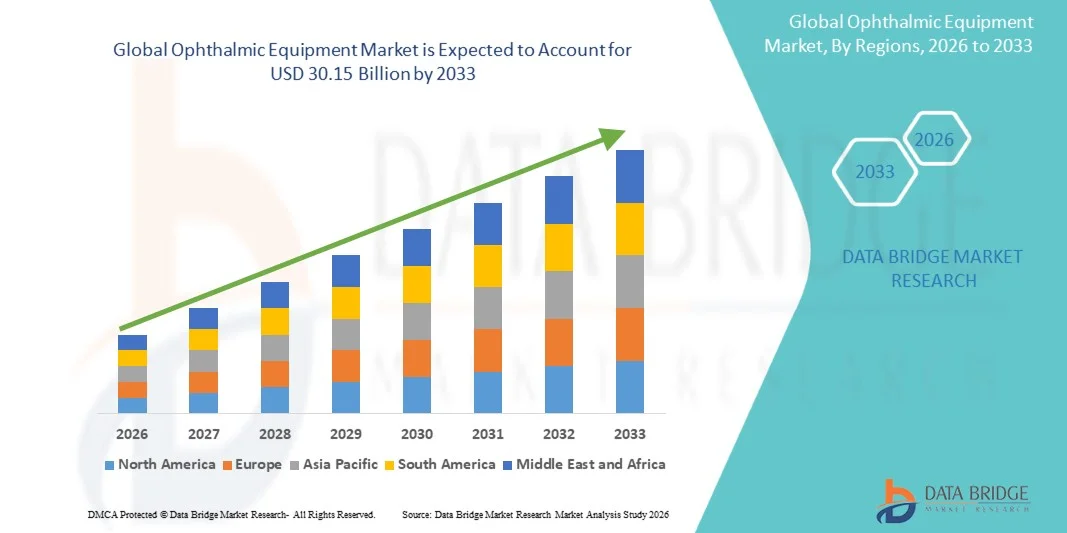
- As per Data Bridge Market Research analysis, the ophthalmic equipment market was valued at USD 19.65 billion in 2025 and is projected to reach USD 30.15 billion by 2033, growing at a CAGR of 5.50% from 2026 to 2033.
- The market is experiencing consistent growth driven by the increasing prevalence of eye disorders, a growing elderly population, and the rapid adoption of advanced diagnostic and surgical technologies, with rising healthcare spending, awareness of early diagnosis, and expanding access to specialized eye care services further supporting market demand.
- The increasing prevalence of cataracts, glaucoma, diabetic retinopathy, age-related macular degeneration, and refractive errors, combined with the growing aging population, is driving demand for advanced ophthalmic equipment. Technological advancements in diagnostic, monitoring, and surgical equipment, including AI-enabled imaging and minimally invasive technologies, are further supporting market expansion.
Market Size & Forecast
- Global Market Value (2025): USD 19.65 Billion
- Expected Market Value (2033): USD 30.15 Billion
- Forecast CAGR (2026–2033): 5.50%
- Leading Region in 2025: North America
- Fastest Growing Region: Asia Pacific
What are the Major Takeaways of the Ophthalmic Equipment Market?
- North America dominated the ophthalmic equipment market with the largest revenue share of 35.0% in 2025, supported by a large healthcare system, high hospital and clinic activity, mature procurement channels, and high adoption of advanced ophthalmic equipment.
- Asia-Pacific is expected to be the fastest-growing region at a CAGR of 7.0% from 2026 to 2033, fueled by large and ageing populations, a high and rising burden of cataract, refractive error, and diabetic eye disease, expanding healthcare access, and government screening programs across China, India, and Japan
- The ophthalmic surgical devices segment led the market with a 45% share in 2025, driven by the increasing number of cataracts, glaucoma, retinal, and refractive procedures performed globally.
- Ophthalmic diagnostic devices are the fastest-growing product type, projected to register a CAGR of 7%, reflecting the surge in demand for early detection and monitoring of eye diseases.
- The optical coherence tomography segment dominated the technology category with a 35% revenue share in 2025, led by its non-invasive nature, high-resolution imaging capabilities, and extensive use in retinal and optic nerve assessment.
- Cataract surgery accounted for 40% of the market share in 2025, preferred by the high global prevalence of cataracts and the large number of cataract procedures performed worldwide
- The retinal surgery segment is the fastest-growing application category, with a CAGR of 6.7%, driven by the increasing prevalence of retinal disorders and improvements in vitreoretinal surgical technologies.
Report Scope and Ophthalmic Equipment Market Segmentation
Attributes |
Ophthalmic Equipment Key Market Insights |
|
Segments Covered |
|
|
Countries Covered |
North America
Europe
Asia-Pacific
Middle East and Africa
South America
|
|
Key Market Players |
|
|
Market Opportunities |
|
|
Value Added Data Infosets |
In addition to the insights on market scenarios such as market value, growth rate, segmentation, geographical coverage, and major players, the market reports curated by the Data Bridge Market Research also include in-depth expert analysis, patient epidemiology, pipeline analysis, pricing analysis, and regulatory framework. |
What is the Key Trend in the Ophthalmic Equipment Market?
- Ophthalmic equipment manufacturers are increasingly integrating artificial intelligence, deep learning, and multimodal imaging into diagnostic systems to improve the early detection, classification, and monitoring of retinal and optic nerve diseases.
- For instance, in April 2024, the U.S. FDA authorized AEYE-DS, an autonomous AI-based retinal diagnostic system designed to analyze fundus images and detect more-than-mild diabetic retinopathy, demonstrating the growing integration of AI into ophthalmic diagnostic equipment.
- Multimodal imaging technologies are enabling ophthalmologists to combine complementary retinal imaging data, improving diagnostic information and supporting more comprehensive disease assessment.
- Ophthalmic imaging systems are increasingly incorporating automated analysis capabilities to support screening programs and improve access to specialist-level eye disease detection.
- For instance, in June 2024, the U.S. FDA highlighted the development of methods for monitoring AI-enabled medical devices, including ophthalmology applications, reflecting the increasing deployment of adaptive AI technologies in medical imaging and ophthalmic diagnostics.
- As artificial intelligence, multimodal imaging, and automated diagnostics continue to advance, ophthalmic equipment manufacturers are expected to increasingly develop intelligent systems that improve diagnostic efficiency, support early disease detection, and expand access to eye-care services globally.
What are the Key Drivers of the Ophthalmic Equipment Market?
- The growing global burden of vision impairment and eye diseases is significantly increasing demand for ophthalmic diagnostic, monitoring, and surgical equipment across hospitals, clinics, and specialized eye-care centers.
- For instance, in February 2025, the World Health Organization (WHO) reported that at least 2.2 billion people globally have vision impairment, including at least 1 billion cases that could have been prevented or remain unaddressed, highlighting the substantial unmet need for eye-care diagnosis and treatment.
- Population ageing is further increasing demand for ophthalmic equipment because older populations have a higher prevalence of cataract, glaucoma, age-related macular degeneration, and other chronic eye conditions.
- For instance, in October 2025, WHO reported that more than 150 million people in the Western Pacific Region were living with visual impairment, while regional countries were working toward a 30% increase in effective cataract surgical coverage and a 40% increase in effective refractive-error coverage by 2030, supporting demand for ophthalmic diagnostic and surgical equipment.
- With the rising prevalence of preventable and age-related eye disorders increasing the need for early diagnosis, monitoring, and treatment, ophthalmic equipment will remain essential for expanding access to comprehensive eye-care services worldwide
Which Factors are Challenging the Growth of the Ophthalmic Equipment Market?
- Advanced ophthalmic equipment requires substantial capital investment because sophisticated OCT systems, retinal imaging platforms, surgical lasers, and integrated diagnostic technologies involve complex hardware and software components.
- For instance, in October 2022, the World Health Organization reported that essential ophthalmic equipment and consumables were frequently unavailable in the public sector of some low- and middle-income countries, while the costs of eye-care services were also a major barrier to access and provision.
- These investment requirements can limit adoption among smaller hospitals, independent eye-care clinics, and healthcare facilities in low-resource settings where access to specialized ophthalmic equipment remains constrained.
- For instance, in February 2026, WHO reported that three in four people requiring cataract surgery in the African Region remained untreated, with structural barriers including shortages of trained eye-care professionals, high out-of-pocket costs, and limited surgical infrastructure restricting access to eye-care services.
- The high acquisition costs, specialized infrastructure requirements, and uneven availability of trained ophthalmic professionals continue to restrict equipment deployment, particularly across low-income and underserved healthcare markets
How is the Ophthalmic Equipment Market Segmented?
The ophthalmic equipment market is segmented on the basis of product type, technology, application, and end-users.
- By Product Type
On the basis of product type, the ophthalmic equipment market is segmented into ophthalmic surgical devices, ophthalmic diagnostic devices, and ophthalmic vision care devices. The ophthalmic surgical devices segment dominated the market with an estimated 45% share in 2025, driven by the increasing number of cataract, glaucoma, retinal, and refractive procedures performed globally. Rising prevalence of eye disorders and the growing ageing population are increasing demand for ophthalmic surgical equipment. These devices include surgical microscopes, phacoemulsification systems, ophthalmic lasers, and other specialized surgical instruments. Technological advancements are improving surgical precision, visualization, and patient outcomes. Increasing adoption of minimally invasive ophthalmic procedures is further supporting demand for advanced surgical devices. Growing access to ophthalmic surgery in emerging economies is also contributing to the segment's continued market dominance.
The ophthalmic diagnostic devices segment is projected to register the fastest growth at a CAGR of 7% from 2026 to 2033, supported by increasing demand for early detection and monitoring of eye diseases. These devices include optical coherence tomography systems, fundus cameras, visual field analyzers, tonometers, and other diagnostic technologies. The rising prevalence of glaucoma, diabetic retinopathy, and age-related macular degeneration is increasing demand for advanced diagnostic equipment. OCT and other high-resolution imaging technologies enable clinicians to identify structural changes at earlier stages. Integration of artificial intelligence and automated image analysis is further enhancing diagnostic capabilities. Increasing emphasis on preventive eye care and early disease detection is expected to accelerate adoption of ophthalmic diagnostic devices.
- By Technology
On the basis of technology, the ophthalmic equipment market is segmented into laser technology, optical coherence tomography, ultrasound technology, and phacoemulsification. The optical coherence tomography segment dominated the market with an estimated 35% share in 2025, owing to its non-invasive nature, high-resolution imaging capabilities, and extensive use in retinal and optic nerve assessment. OCT enables clinicians to obtain detailed cross-sectional images of ocular structures without invasive procedures. The technology is widely used for diagnosing and monitoring glaucoma, diabetic retinopathy, and age-related macular degeneration. Technological advancements in spectral-domain and swept-source OCT are improving imaging speed and resolution. Growing demand for early and accurate diagnosis of retinal diseases is further supporting adoption. Increasing integration of artificial intelligence with OCT imaging is also expanding its clinical applications.
The laser technology segment is projected to register the fastest growth at a CAGR of 7.2% from 2026 to 2033, driven by increasing adoption of laser-based ophthalmic procedures. Femtosecond lasers, excimer lasers, and other ophthalmic laser technologies are increasingly used in refractive, cataract, retinal, and glaucoma procedures. These systems provide high precision and controlled treatment delivery while supporting minimally invasive surgical techniques. Growing demand for refractive correction procedures is creating additional opportunities for advanced laser equipment. Continuous technological development is improving treatment accuracy, safety, and clinical outcomes. Increasing adoption of laser-assisted procedures in emerging healthcare markets is expected to further accelerate segment growth.
- By Application
On the basis of application, the ophthalmic equipment market is segmented into cataract surgery, retinal surgery, glaucoma surgery, and refractive surgery. The cataract surgery segment dominated the market with an estimated 40% share in 2025, supported by the high global prevalence of cataracts and the large number of cataract procedures performed worldwide. Cataract surgery requires specialized equipment such as phacoemulsification systems, ophthalmic surgical microscopes, lasers, and related surgical devices. The ageing global population is significantly increasing the number of patients requiring cataract treatment. Technological advancements in cataract surgery are improving surgical precision and patient outcomes. Increasing healthcare access and cataract-treatment programs in developing countries are further expanding procedure volumes. The continued global burden of cataract is therefore expected to maintain strong demand for equipment used in cataract surgery.
The retinal surgery segment is projected to witness the fastest growth at a CAGR of 6.7% from 2026 to 2033, driven by the increasing prevalence of retinal disorders and improvements in vitreoretinal surgical technologies. Rising incidence of diabetic retinopathy, diabetic macular edema, and age-related retinal diseases is increasing demand for retinal diagnosis and treatment. Advanced vitrectomy systems, visualization technologies, retinal imaging systems, and microsurgical instruments are supporting increasingly sophisticated procedures. Technological advancements are enabling ophthalmic surgeons to perform retinal interventions with greater precision and improved visualization. Increasing awareness of early diagnosis and treatment of retinal diseases is also supporting market growth.
- By End-Users
On the basis of end-users, the ophthalmic equipment market is segmented into hospitals, ophthalmology clinics, ambulatory surgical centers (ASCs), optical retail centers, and other end-users. Hospitals dominated the market with an estimated 49% share in 2025, owing to their comprehensive infrastructure and ability to provide both diagnostic and complex ophthalmic surgical services. Hospitals utilize a broad range of ophthalmic equipment, including OCT systems, fundus cameras, surgical microscopes, lasers, and phacoemulsification systems. Their capacity to manage patients with complex and multiple ophthalmic conditions supports sustained equipment demand. Increasing numbers of ophthalmic surgeries and diagnostic procedures are encouraging hospitals to expand their specialized eye-care capabilities. Rising healthcare expenditure and investments in advanced hospital infrastructure are further supporting equipment procurement.
The ambulatory surgical centers (ASCs) segment is projected to register the fastest growth at a CAGR of 7.9% from 2026 to 2033, driven by increasing preference for outpatient and cost-effective ophthalmic procedures. ASCs provide same-day treatment and are particularly suitable for high-volume procedures such as cataract and refractive surgeries. The shift toward minimally invasive procedures and shorter patient recovery times is increasing demand for specialized ambulatory surgical facilities. Advanced ophthalmic equipment enables ASCs to perform procedures efficiently while maintaining high levels of surgical precision. Healthcare providers are increasingly expanding dedicated ophthalmology-focused surgical centers to address growing procedure volumes.
Which Region Holds the Largest Share of the Ophthalmic Equipment Market?
- North America dominated the ophthalmic equipment market with the largest revenue share of 35.0% in 2025, supported by a large healthcare system, high hospital and clinic activity, mature procurement channels, and high adoption of advanced ophthalmic equipment.
- The region also benefits from increasing demand for advanced ophthalmic technologies, a high prevalence of eye disorders, growing healthcare expenditure, and strong adoption of innovative diagnostic and surgical equipment. The United States represents the dominant country within the region, while continued investments in ophthalmic infrastructure and technological advancements are expected to strengthen North America's position in the global market.
U.S. Ophthalmic Equipment Market Insight
The U.S. ophthalmic equipment market is witnessing strong growth due to the country’s advanced healthcare infrastructure, high ophthalmic procedure volumes, and widespread adoption of sophisticated diagnostic and surgical technologies. The large burden of age-related eye diseases, including cataracts, glaucoma, and retinal disorders, is supporting demand for ophthalmic equipment across hospitals and specialized eye-care centers. In addition, the country has strong adoption of OCT, retinal imaging, laser systems, and phacoemulsification technologies. The U.S. also benefits from a well-established network of ophthalmologists, ambulatory surgical centers, and specialized clinics. The U.S. FDA maintains a dedicated list of AI-enabled medical devices, including ophthalmic diagnostic technologies, reflecting continued integration of advanced technologies into U.S. eye care.
Asia-Pacific Ophthalmic Equipment Market Insight
The Asia-Pacific ophthalmic equipment market is expected to witness rapid growth, driven by a large ageing population, increasing prevalence of vision impairment, and expanding access to eye-care services across countries such as China, India, and Japan. Growing demand for cataract diagnosis and treatment, retinal imaging, glaucoma screening, and refractive procedures is supporting regional equipment adoption. Increasing healthcare expenditure and development of ophthalmology clinics and specialized eye-care facilities are further strengthening market expansion. The region is also witnessing greater adoption of digital imaging, OCT, laser technologies, and other advanced diagnostic systems. The World Health Organization identifies population ageing and the increasing burden of eye conditions as important factors driving the need for expanded eye-care services in the Western Pacific Region.
Japan Ophthalmic Equipment Market Insight
The Japan ophthalmic equipment market is witnessing consistent growth due to its ageing population, established healthcare infrastructure, and increasing need for diagnosis and treatment of age-related eye conditions. Cataract, glaucoma, and retinal disorders are generating sustained demand for advanced diagnostic and surgical equipment across hospitals and ophthalmology clinics. Japan's sophisticated healthcare system supports the adoption of OCT, retinal imaging, laser systems, and other precision ophthalmic technologies. The country's emphasis on early diagnosis and management of chronic diseases is further supporting demand for ophthalmic diagnostic equipment. In addition, the growing requirement for cataract and retinal care among older adults is strengthening equipment utilization. Japan's Ministry of Health, Labour and Welfare reported that people aged 65 and over accounted for 29.3% of the population in 2024, highlighting the substantial ageing population requiring age-related healthcare services.
China Ophthalmic Equipment Market Insight
The China ophthalmic equipment market is growing rapidly, driven by a large population, increasing prevalence of myopia and other eye disorders, expanding healthcare infrastructure, and rising demand for advanced eye-care services. Increasing numbers of ophthalmology hospitals and specialized clinics are supporting adoption of diagnostic imaging, surgical systems, lasers, and other ophthalmic equipment. The country's growing elderly population is also increasing demand for cataract and retinal disease diagnosis and treatment. Government initiatives aimed at improving eye health and controlling myopia are further supporting investments in ophthalmic services and technologies. Increasing adoption of advanced diagnostic and surgical equipment is strengthening China's position as an important ophthalmic equipment market. The World Health Organization reports that China has one of the world's largest populations affected by myopia, making myopia prevention, detection, and management an important eye-health priority.
U.K. Ophthalmic Equipment Market Insight
The U.K. ophthalmic equipment market is experiencing steady growth, supported by high demand for cataract surgery, increasing ophthalmology activity, and efforts to expand diagnostic and surgical capacity across the National Health Service. Increasing adoption of OCT, AI-supported eye-care pathways, virtual clinics, and advanced surgical technologies is improving the efficiency of ophthalmic services. The country's ageing population and substantial ophthalmology waiting lists are creating continued demand for diagnostic and treatment capacity. NHS providers are increasingly using technology to improve patient assessment and increase procedure volumes. NHS England reported that ophthalmology accounted for 14% of the waiting list among patients aged 65 and over, making it the largest specialty for this age group.
Germany Ophthalmic Equipment Market Insight
The Germany ophthalmic equipment market is expanding steadily due to its advanced healthcare infrastructure, established medical technology sector, ageing population, and high demand for ophthalmic diagnosis and treatment. Hospitals and specialized ophthalmology facilities are increasingly adopting advanced imaging systems, surgical equipment, lasers, and other technologies to manage cataract, glaucoma, retinal, and refractive conditions. Germany's strong healthcare expenditure and technologically advanced clinical environment support the adoption of sophisticated ophthalmic equipment. Increasing hospital activity related to diseases of the eye and its adnexa is also generating demand for ophthalmic technologies. Germany's Federal Statistical Office recorded 311,446 hospital patients with diseases of the eye and its adnexa in its latest published hospital diagnosis statistics, demonstrating the substantial clinical burden requiring ophthalmic care
Which are the Top Companies in Ophthalmic Equipment Market?
The ophthalmic equipment industry is primarily led by well-established companies, including:
- Alcon Inc. (U.S.)
- Bausch + Lomb (Canada)
- Johnson & Johnson Services, Inc. (U.S.)
- Carl Zeiss AG (Germany)
- Topcon Healthcare (U.S.)
- NIDEK CO., LTD. (Japan)
- Heidelberg Engineering GmbH (Germany)
- haag-streit.com (Switzerland)
- HOYA Corporation (Japan)
- Huvitz Corp. (South Korea)
- OCULUS (Germany)
- Glaukos Corporation (U.S.)
- STAAR SURGICAL (U.S.)
- Rayner Group (U.K.)
- HumanOptics Holding AG (Germany)
- Ziemer Ophthalmic Systems AG (Switzerland)
- Oertli Instrumente AG (Switzerland)
- Geuder AG (Germany)
- Moria SA (France)
- Tomey Corporation (Japan)
What are Latest Developments in Ophthalmic Equipment Market?
- In October 2025, Optos announced the launch of Silverstone RGB, a retinal imaging platform combining 200° single-shot true-to-life color imaging with swept-source optical coherence tomography. The system integrates nine imaging modalities in a single device, including ultra-widefield imaging, fluorescein angiography, indocyanine green angiography, autofluorescence, and swept-source OCT, strengthening advanced retinal visualization and diagnostic capabilities.
- In February 2025, Alcon announced the full U.S. commercial launch of the Voyager Direct Selective Laser Trabeculoplasty device for glaucoma and ocular hypertension. Voyager automates SLT by using eye-tracking technology to deliver 120 laser pulses without a gonioscopy lens or manual aiming, simplifying the procedure and reducing specialized training requirements.
- In June 2024, NIDEK launched the RS-1 Glauvas Optical Coherence Tomography system, incorporating a scan speed of up to 250,000 A-scans per second, wide and deep-area imaging, and deep-learning-based analytics. The system was designed to streamline clinical workflow and support diagnostic assessment of glaucoma and retinal vascular diseases in high-volume practices.
- In December 2023, BELKIN Vision received U.S. FDA clearance for its Eagle glaucoma laser, a contactless selective laser trabeculoplasty (SLT) system designed to treat glaucoma and ocular hypertension. The device automatically identifies the treatment area and delivers the laser while its eye-tracking technology compensates for eye movement, representing a significant advancement in automated ophthalmic laser technology.
- In October 2023, NIDEK launched the NP-1/NP-1C Preloaded IOL Injection System, featuring a fully preloaded aspheric hydrophobic soft acrylic lens designed for smoother and more controlled intraocular lens implantation. The system uses a two-step operating process and was developed to provide consistent IOL delivery during cataract surgery.

- Interactive Data Analysis Dashboard
- Company Analysis Dashboard for high growth potential opportunities
- Research Analyst Access for customization & queries
- Competitor Analysis with Interactive dashboard
- Latest News, Updates & Trend analysis
- Harness the Power of Benchmark Analysis for Comprehensive Competitor Tracking
Data collection and base year analysis are done using data collection modules with large sample sizes. The stage includes obtaining market information or related data through various sources and strategies. It includes examining and planning all the data acquired from the past in advance. It likewise envelops the examination of information inconsistencies seen across different information sources. The market data is analysed and estimated using market statistical and coherent models. Also, market share analysis and key trend analysis are the major success factors in the market report. To know more, please request an analyst call or drop down your inquiry.
The key research methodology used by DBMR research team is data triangulation which involves data mining, analysis of the impact of data variables on the market and primary (industry expert) validation. Data models include Vendor Positioning Grid, Market Time Line Analysis, Market Overview and Guide, Company Positioning Grid, Patent Analysis, Pricing Analysis, Company Market Share Analysis, Standards of Measurement, Global versus Regional and Vendor Share Analysis. To know more about the research methodology, drop in an inquiry to speak to our industry experts.
Data Bridge Market Research is a leader in advanced formative research. We take pride in servicing our existing and new customers with data and analysis that match and suits their goal. The report can be customized to include price trend analysis of target brands understanding the market for additional countries (ask for the list of countries), clinical trial results data, literature review, refurbished market and product base analysis. Market analysis of target competitors can be analyzed from technology-based analysis to market portfolio strategies. We can add as many competitors that you require data about in the format and data style you are looking for. Our team of analysts can also provide you data in crude raw excel files pivot tables (Fact book) or can assist you in creating presentations from the data sets available in the report.













