


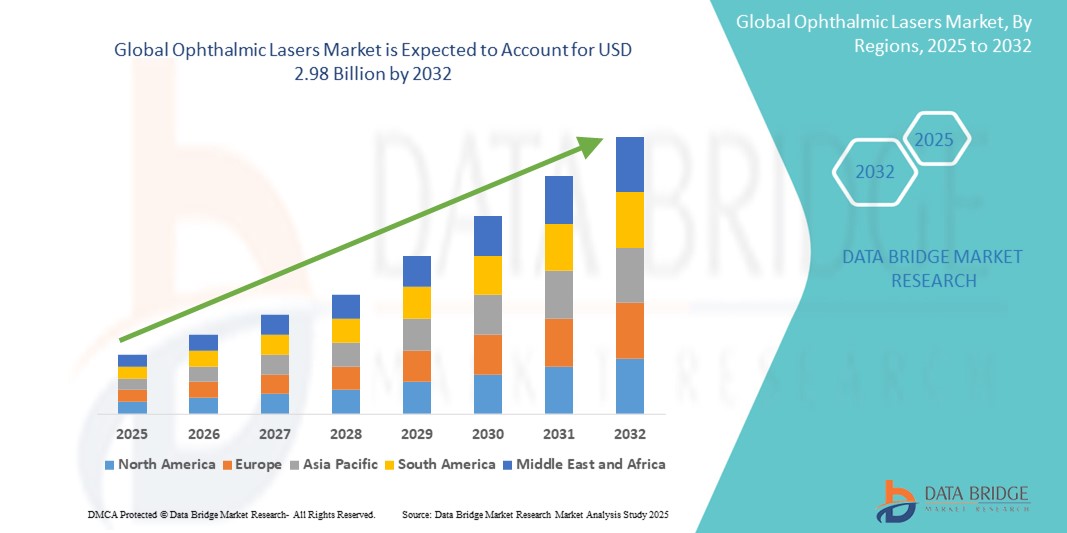
Ophthalmic Lasers Market Size
- The global ophthalmic lasers market size was valued at USD 1.62 billion in 2024 and is expected to reach USD 2.98 billion by 2032, at a CAGR of 7.93% during the forecast period
- This growth is driven by factors such as rising prevalence of eye disorders such as cataracts, glaucoma, and diabetic retinopathy, along with a growing geriatric population more prone to vision issues
Ophthalmic Lasers Market Analysis
- Ophthalmic lasers are critical medical devices used in precision eye surgeries, enabling effective treatment of various vision disorders through minimally invasive techniques. They play a vital role in improving surgical accuracy, reducing recovery time, and enhancing patient outcomes across a range of ophthalmic procedures
- The ophthalmic lasers market is witnessing robust growth, fueled by the rising prevalence of eye conditions such as cataracts, glaucoma, and diabetic retinopathy, increasing demand for minimally invasive treatments, continuous technological advancements in laser systems, and expanding access to advanced eye care in both developed and emerging healthcare markets
- North America is expected to dominate the ophthalmic lasers market with a share of 32.0%, due to its well-developed healthcare infrastructure and high investment in advanced medical technologies
- Asia-Pacific is expected to be the fastest growing region in the ophthalmic lasers market during the forecast period due to high prevalence of cataracts and other ophthalmic conditions, especially in developing countries
- Femtosecond lasers segment is expected to dominate the market with a market share of 30.6% due to its advanced precision and safety in performing delicate eye surgeries. These lasers enable highly accurate corneal incisions with minimal tissue damage, reducing complications and improving patient outcomes
Report Scope and Ophthalmic Lasers Market Segmentation
|
Attributes |
Ophthalmic Lasers Key Market Insights |
|
Segments Covered |
|
|
Countries Covered |
North America
Europe
Asia-Pacific
Middle East and Africa
South America
|
|
Key Market Players |
|
|
Market Opportunities |
|
|
Value Added Data Infosets |
In addition to the insights on market scenarios such as market value, growth rate, segmentation, geographical coverage, and major players, the market reports curated by the Data Bridge Market Research also include depth expert analysis, patient epidemiology, pipeline analysis, pricing analysis, and regulatory framework. |
Ophthalmic Lasers Market Trends
“Increasing Prevalence of Eye Diseases”
- One prominent trend in the global ophthalmic lasers market is the increasing prevalence of eye diseases
- This trend is driven by the rising global incidence of vision disorders such as cataracts, glaucoma, diabetic retinopathy, and age-related macular degeneration, particularly among the aging population
- For instance, according to the World Health Organization (WHO), at least 2.2 billion people globally have a vision impairment or blindness, with many cases attributed to untreated or late-diagnosed conditions that are treatable through laser-based procedures
- The growing burden of eye diseases is prompting greater demand for accurate, minimally invasive treatments, fueling the adoption of ophthalmic lasers in both advanced healthcare systems and resource-limited settings
- As the number of individuals affected by ocular conditions continues to rise, the need for effective, safe, and efficient laser technologies is expected to remain a key trend shaping the future of the ophthalmic lasers market
Ophthalmic Lasers Market Dynamics
Driver
“Rising Adoption of Laser-Assisted Eye Surgery”
- The rising adoption of laser-assisted eye surgery is emerging as a key driver for the ophthalmic lasers market, as healthcare providers seek to deliver more precise, efficient, and minimally invasive treatments for various vision disorders
- This trend is gaining traction globally, with increasing preference for laser-based procedures in cataract removal, refractive error correction, and retinal treatments due to their enhanced accuracy and shorter recovery times
- As patient demand for safer, faster, and more effective surgical options grows, there is a heightened focus on integrating advanced laser technologies into ophthalmic practices and surgical centers
- Healthcare facilities are investing in state-of-the-art ophthalmic lasers that support high-volume procedures and reduce complication rates, improving both clinical outcomes and patient satisfaction
- Moreover, the growing number of certified eye surgeons trained in laser-based techniques is accelerating the shift toward laser-assisted surgeries across developed and emerging markets
For instance,
- In countries such as U.S., Germany, and Japan, outpatient centers and hospitals are equipping operating rooms with multi-functional laser systems to meet growing surgical demand
- Meanwhile, emerging markets such as India and Brazil are witnessing increased adoption due to rising cataract surgery volumes and government-backed vision care initiatives
- As laser technologies continue to advance, their expanding role in ophthalmic procedures will remain a primary factor driving sustained growth in the ophthalmic lasers market
Opportunity
“Advancements in Laser Technology”
- Advancements in laser technology present a significant opportunity for the ophthalmic lasers market, enabling improved surgical precision, enhanced safety, and broader clinical applications in eye care
- Manufacturers are capitalizing on this opportunity by developing next-generation lasers with features such as real-time imaging integration, femtosecond pulse delivery, and customizable treatment parameters, which significantly improve patient outcomes and procedural efficiency
- This aligns with the growing demand for minimally invasive, outcome-driven treatments, as healthcare providers seek more versatile and accurate solutions for a range of ophthalmic conditions
For instance,
- Companies such as Alcon and Johnson & Johnson Vision are investing in platforms that combine advanced laser systems with intraoperative diagnostics to support personalized, image-guided treatments
- ZEISS and Lumenis are enhancing their product portfolios with lasers that offer better energy control, reduced tissue damage, and expanded use in retinal and glaucoma procedures
- As demand increases for safer and faster procedures, continuous innovation in laser technology will remain a key opportunity area, driving the adoption of ophthalmic lasers across global healthcare systems
Restraint/Challenge
“High Cost Associated with the Equipment and Therapy”
- The high cost associated with ophthalmic laser equipment and therapy presents a significant challenge for the ophthalmic lasers market, limiting accessibility and adoption, especially in price-sensitive and emerging markets
- Many healthcare providers and clinics face difficulties in justifying the substantial upfront investment and ongoing maintenance expenses required for advanced laser systems
- This challenge is further compounded by the expensive nature of laser-based procedures, which can restrict patient affordability and limit insurance reimbursement options in several regions
For instance,
- Manufacturers such as Alcon and Bausch + Lomb are exploring strategies to offer flexible financing and leasing options, but high price points continue to pose a barrier for widespread adoption
- Without addressing these cost challenges through innovation, pricing strategies, and improved reimbursement frameworks, the growth of the ophthalmic lasers market could face significant constraints, particularly in less affluent regions
Ophthalmic Lasers Market Scope
The market is segmented on the basis of product type, application, and end user.
|
Segmentation |
Sub-Segmentation |
|
By Product Type |
|
|
By Application |
|
|
By End User |
|
In 2025, the femtosecond lasers is projected to dominate the market with a largest share in product type segment
The femtosecond lasers segment is expected to dominate the ophthalmic lasers market with the largest share of 30.6% in 2025 due to its advanced precision and safety in performing delicate eye surgeries. These lasers enable highly accurate corneal incisions with minimal tissue damage, reducing complications and improving patient outcomes.
The refractive error correction is expected to account for the largest share during the forecast period in application segment
In 2025, the refractive error correction segment is expected to dominate the market with the largest market share of 22.7% due to rising prevalence of vision problems such as myopia, hyperopia, and astigmatism globally. Increasing awareness about eye health, advancements in laser technologies, and the growing demand for minimally invasive and effective vision correction procedures such as LASIK and PRK are driving this segment’s growth.
Ophthalmic Lasers Market Regional Analysis
“North America Holds the Largest Share in the Ophthalmic lasers Market”
- North America dominates the ophthalmic lasers market with a share of 32.0%, driven by its well-developed healthcare infrastructure and high investment in advanced medical technologies
- U.S. holds a significant share due to its robust healthcare system, early adoption of cutting-edge ophthalmic laser technologies, and a strong focus on improving patient outcomes in eye care treatments such as cataract, refractive, and retinal surgeries
- Regional leadership is further strengthened by the presence of major ophthalmic device manufacturers, ongoing innovations in laser technology, and supportive regulatory frameworks that facilitate faster product approvals and clinical adoption
- Increasing prevalence of eye disorders, rising geriatric population, and growing patient awareness about laser-based treatments are expected to sustain North America’s market dominance through 2032
“Asia-Pacific is Projected to Register the Highest CAGR in the Ophthalmic lasers Market”
- Asia-Pacific is expected to witness the highest growth rate in the ophthalmic lasers market, driven by high prevalence of cataracts and other ophthalmic conditions, especially in developing countries
- India holds a significant share due to its large patient population, expanding healthcare infrastructure, rising government initiatives to improve eye care access, and increasing number of cataract surgeries performed annually
- Market expansion is further supported by improving healthcare facilities, growing awareness of advanced laser treatments, and increasing adoption of minimally invasive ophthalmic procedures in countries such as China, Japan, and South Korea
- The rising burden of vision impairment, technological advancements in ophthalmic laser devices, and growing investments in healthcare infrastructure make Asia-Pacific the fastest-growing region in the ophthalmic lasers market through the forecast period
Ophthalmic Lasers Market Share
The market competitive landscape provides details by competitor. Details included are company overview, company financials, revenue generated, market potential, investment in research and development, new market initiatives, global presence, production sites and facilities, production capacities, company strengths and weaknesses, product launch, product width and breadth, application dominance. The above data points provided are only related to the companies' focus related to market.
The Major Market Leaders Operating in the Market Are:
- Alcon (U.S.)
- Carl Zeiss Meditec AG (Germany)
- Ellex Inc. (Australia)
- Abbott (U.S.)
- Bausch & Lomb Incorporated (U.S.)
- Topcon Corporation (Japan)
- IRIDEX Corporation (U.S.)
- Lumenis. (Israel)
- Ziemer Ophthalmic Systems (Switzerland)
- NIDEK CO., LTD (Japan)
- Johnson & Johnson Surgical Vision Inc. (U.S.)
- LUMIBIRD (France)
- LIGHTMED (U.S.)
- Coherent, Inc. (U.S.)
- Ocular Instruments. (U.S.)
- ASICO, LLC. (U.S.)
- Deka M.E.L.A. srl (Italy)
- NoIR Laser Company, L.L.C. (U.S.)
Latest Developments in Global Ophthalmic Lasers Market
- In January 2025, Norlase announced the commercial launch and received FDA 510(k) clearance and CE Mark for Norlase LYNX, the world’s first battery-powered, pattern scanning laser indirect ophthalmoscope. This innovation significantly enhances the ophthalmic lasers market by introducing a fully portable, untethered solution that allows surgeons to perform treatments in a wider range of clinical settings. With its integrated laser and pattern module built into a lightweight headset, along with advanced features such as wireless control and multilingual voice commands, LYNX is set to improve surgical efficiency and accessibility, driving further adoption of laser-based treatments worldwide
- In August 2024, Meridian Medical received FDA approval for its MR Q laser family, comprising the MR Q, MR Q SLT, and MR Q Supine, marking a significant advancement in the ophthalmic lasers market by expanding the availability of versatile, fully integrated Nd:YAG laser systems in the U.S.
- In February 2024, Meridian Medical AG expanded its presence in the U.S. ophthalmic lasers market with the launch of three new Microruptor (MR) Q laser models: MR Q, MR Q SLT, and MR Q Supine. This product expansion strengthens Meridian’s portfolio by offering advanced laser options tailored for diverse clinical needs, enhancing treatment versatility and reinforcing the company’s competitive position in the growing U.S. ophthalmic laser market
- In January 2024, Iridex Corporation launched its Iridex 532 and Iridex 577 laser platforms in the U.S., featuring continuous-wave and proprietary MicroPulse technology along with intuitive touchscreen controls, further strengthening its market position by offering clinicians greater flexibility and precision in laser-based eye treatments

- Interactive Data Analysis Dashboard
- Company Analysis Dashboard for high growth potential opportunities
- Research Analyst Access for customization & queries
- Competitor Analysis with Interactive dashboard
- Latest News, Updates & Trend analysis
- Harness the Power of Benchmark Analysis for Comprehensive Competitor Tracking
Data collection and base year analysis are done using data collection modules with large sample sizes. The stage includes obtaining market information or related data through various sources and strategies. It includes examining and planning all the data acquired from the past in advance. It likewise envelops the examination of information inconsistencies seen across different information sources. The market data is analysed and estimated using market statistical and coherent models. Also, market share analysis and key trend analysis are the major success factors in the market report. To know more, please request an analyst call or drop down your inquiry.
The key research methodology used by DBMR research team is data triangulation which involves data mining, analysis of the impact of data variables on the market and primary (industry expert) validation. Data models include Vendor Positioning Grid, Market Time Line Analysis, Market Overview and Guide, Company Positioning Grid, Patent Analysis, Pricing Analysis, Company Market Share Analysis, Standards of Measurement, Global versus Regional and Vendor Share Analysis. To know more about the research methodology, drop in an inquiry to speak to our industry experts.
Data Bridge Market Research is a leader in advanced formative research. We take pride in servicing our existing and new customers with data and analysis that match and suits their goal. The report can be customized to include price trend analysis of target brands understanding the market for additional countries (ask for the list of countries), clinical trial results data, literature review, refurbished market and product base analysis. Market analysis of target competitors can be analyzed from technology-based analysis to market portfolio strategies. We can add as many competitors that you require data about in the format and data style you are looking for. Our team of analysts can also provide you data in crude raw excel files pivot tables (Fact book) or can assist you in creating presentations from the data sets available in the report.













