


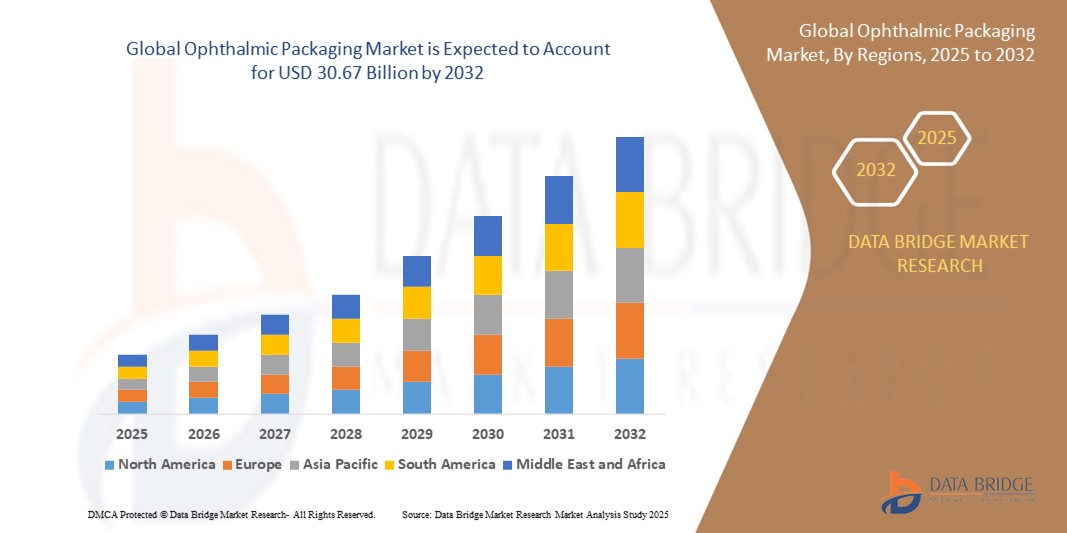
Ophthalmic Packaging Market Size
- The global ophthalmic packaging market size was valued at USD 13.30 billion in 2024 and is expected to reach USD 30.67 billion by 2032, at a CAGR of 11.00% during the forecast period
- The market growth is largely fuelled by the increasing prevalence of eye disorders, rising geriatric population, and growing demand for innovative and patient-friendly packaging solutions in ophthalmology
- In addition, the shift toward preservative-free formulations and the rising adoption of single-dose units for enhanced hygiene and compliance are expected to further boost market expansion
Ophthalmic Packaging Market Analysis
- The market is witnessing strong innovation trends, particularly in multi-dose packaging technologies designed to prevent contamination and improve drug stability
- Emerging economies are presenting significant growth opportunities due to increasing healthcare expenditure, improving access to ophthalmic treatments, and rising awareness regarding eye care
- North America dominated the ophthalmic packaging market with the largest revenue share of 38.24% in 2024, primarily driven by the presence of major pharmaceutical players, advanced healthcare infrastructure, and a rising geriatric population with age-related eye disorders
- Asia-Pacific region is expected to witness the highest growth rate in the global ophthalmic packaging market, driven by rapid urbanization, increased healthcare spending, and growing awareness of eye care in emerging economies such as China, India, and Indonesia. The presence of cost-effective manufacturing hubs and expanding pharmaceutical exports are also contributing to the region’s strong market momentum
- The bottles segment dominated the market with the largest revenue share in 2024, driven by its wide usage in packaging multi-dose eye drops and medications. Bottles are preferred for their durability, affordability, and ease of use in daily medication routines, especially in chronic treatments. Their compatibility with tamper-evident and dropper-integrated designs also supports patient safety and dosage accuracy
Report Scope and Ophthalmic Packaging Market Segmentation
|
Attributes |
Ophthalmic Packaging Key Market Insights |
|
Segments Covered |
|
|
Countries Covered |
North America
Europe
Asia-Pacific
Middle East and Africa
South America
|
|
Key Market Players |
|
|
Market Opportunities |
• Rising Demand for Preservative-Free and Single-Dose Ophthalmic Packaging • Growth in Emerging Markets Due to Increasing Access To Eye Care Services |
|
Value Added Data Infosets |
In addition to the insights on market scenarios such as market value, growth rate, segmentation, geographical coverage, and major players, the market reports curated by the Data Bridge Market Research also include import export analysis, production capacity overview, production consumption analysis, price trend analysis, climate change scenario, supply chain analysis, value chain analysis, raw material/consumables overview, vendor selection criteria, PESTLE Analysis, Porter Analysis, and regulatory framework. |
Ophthalmic Packaging Market Trends
“Shift Toward Sustainable and Eco‑Friendly Packaging Solutions”
- Pharmaceutical companies are accelerating the replacement of conventional plastics with recyclable resins and bio‑based polymers in ophthalmic bottles and vials, driven by corporate sustainability commitments, tightening global waste directives, and growing demand for low‑carbon products
- Packaging converters are investing in lightweight single‑dose systems molded from plant‑derived materials that maintain barrier integrity, reduce overall plastic consumption, and appeal to environmentally conscious consumers, especially in Europe and North America where green purchasing behavior is strongest
- Retail pharmacies and online eye‑care retailers are leveraging eco‑labeled packaging to strengthen brand differentiation and satisfy buyers who prioritize responsible sourcing, prompting a wider market shift toward cradle‑to‑cradle design and clear recyclability labeling on outer cartons and inserts
- For instance, a leading European eye‑drop manufacturer introduced a fully recyclable polyethylene terephthalate (rPET) bottle in 2023, claiming a 40 percent reduction in carbon emissions per unit compared with virgin‑plastic formats, and reported a marked uptick in sales across eco‑focused retail channels
- These sustainability initiatives are catalyzing supplier collaboration, material innovation, and regulatory alignment, ultimately establishing green packaging as a baseline expectation rather than a premium feature in the ophthalmic sector
Ophthalmic Packaging Market Dynamics
Driver
“Growing Geriatric Population and Rising Prevalence Of Eye Disorders”
• Rapid population aging worldwide is elevating incidence rates of cataracts, glaucoma, age‑related macular degeneration, and chronic dry eye, expanding the patient pool that relies on multi‑dose and single‑dose ophthalmic medications packaged for sterility, dose accuracy, and ease of handling
• Healthcare providers and payers are emphasizing adherence and patient safety, prompting demand for tamper‑evident bottles with metered‑dose valves, low‑force droppers, and intuitive labeling that accommodate reduced dexterity and partial vision loss common among elderly users
• Market participants are launching preservative‑free, unit‑dose formats that reduce microbial risk and enhance shelf life, stimulating higher packaging volumes per therapy course and reinforcing recurring demand from both hospital and at‑home treatment channels
• For instance, the World Health Organization projects global vision‑impairment cases will exceed 3 billion by 2050, a trend already reflected in rising prescription volumes for ocular lubricants and glaucoma drops that require compliant, contamination‑free packaging solutions
• Consequently, sustained growth in senior demographics is expected to underpin long‑term expansion of ophthalmic packaging demand, encouraging manufacturers to scale capacity and develop user‑centric designs that improve medication outcomes and quality of life
Restraint/Challenge
“Stringent Regulatory Requirements and Cost‑Intensive Compliance”
• Ophthalmic containers must meet exacting sterility, extractables‑and‑leachables, and particulate limits mandated by agencies such as the U.S. Food and Drug Administration and the European Medicines Agency, necessitating extensive validation, clean‑room infrastructure, and continuous quality monitoring
• Small and mid‑sized producers face high capital expenditure for barrier‑resin sourcing, aseptic filling lines, and real‑time microbial testing, often pushing project breakeven points beyond competitive thresholds and restricting regional market entry, particularly in developing economies
• Frequent updates to pharmacopoeial standards on preservative levels, dropper tip geometries, and microbial ingress testing compel manufacturers to implement costly reformulations and requalifications, disrupting supply chains and lengthening time‑to‑market for new therapies
• For instance, a 2022 revision to United States Pharmacopeia <771> introduced stricter particulate limits for ophthalmic solutions, compelling multiple contract packagers to retrofit filtration systems and conduct supplementary particulate assessments, delaying product release schedules by several months
• Unless harmonized global guidelines, modular validation pathways, and financial incentives are adopted, these compliance hurdles will continue to constrain innovation speed, increase per‑unit costs, and limit the availability of advanced ophthalmic therapies in price‑sensitive regions
Ophthalmic Packaging Market Scope
The market is segmented on the basis of packaging type, capacity, distribution channel, application, end-use case, dose, material, and type.
- By Packaging Type
On the basis of packaging type, the ophthalmic packaging market is segmented into tubes, bottles, syringes, flexible pouches, and ampoules and vials. The bottles segment dominated the market with the largest revenue share in 2024, driven by its wide usage in packaging multi-dose eye drops and medications. Bottles are preferred for their durability, affordability, and ease of use in daily medication routines, especially in chronic treatments. Their compatibility with tamper-evident and dropper-integrated designs also supports patient safety and dosage accuracy.
The syringes segment is expected to witness the fastest growth from 2025 to 2032 due to increasing demand for precise drug delivery and anti-VEGF injections in ophthalmic procedures. These prefilled units offer reduced contamination risks, improved dosing precision, and high user convenience in both clinical and self-administered settings, boosting their adoption in specialized eye treatments.
- By Capacity
Based on capacity, the market is categorized into less than 2 ml, 2 to 5 ml, 6 to 10 ml, and above 10 ml. The 2 to 5 ml segment held the largest revenue share in 2024, attributed to its ideal suitability for most ophthalmic drug courses, including eye drops and lubricants. This capacity ensures effective shelf life while minimizing wastage and preserving sterility in both prescription and OTC formulations.
The less than 2 ml segment is expected to witness the fastest growth from 2025 to 2032 due to growing demand for unit-dose and preservative-free formats. These small-capacity units are particularly preferred in sensitive eye therapies and pediatric use, where hygiene, controlled usage, and reduced chemical exposure are critical.
- By Distribution Channel
On the basis of distribution channel, the market is segmented into institutional sales, retail sales, and e-commerce. The institutional sales segment led the market in 2024, supported by bulk procurement by hospitals, clinics, and healthcare facilities. These channels often rely on standardized packaging formats for efficiency, compliance, and cost control in high-volume treatment centers.
The e-commerce segment is expected to witness the fastest growth from 2025 to 2032, driven by the rising trend of online pharmacies and direct-to-patient delivery models. Consumers are increasingly seeking convenience, privacy, and home delivery of eye-care products, encouraging manufacturers to offer optimized and protective packaging formats suited for online channels.
- By Application
The ophthalmic packaging market is segmented into eye drops, ophthalmology gels, ophthalmology ointment, and anti-VEGF drugs. The eye drops segment dominated the market in 2024 owing to their widespread use in managing dry eye, infections, allergies, and glaucoma. This application requires both multi-dose and single-dose packaging formats, contributing to high volume demand globally.
The anti-VEGF drugs segment is expected to witness the fastest growth from 2025 to 2032 due to increasing cases of age-related macular degeneration and diabetic retinopathy. These drugs are typically packaged in sterile syringes or vials to ensure precision delivery and maintain high safety standards in intravitreal applications.
- By End-use Case
The market is segmented by end-use case into refractive errors, cataracts and glaucoma, retinal disorders, corneal diseases, pediatric ophthalmology, neuro-ophthalmology, ophthalmology plastic surgery, uveitis and ocular inflammation, and other conditions. The cataracts and glaucoma segment held the largest share in 2024 due to the high global prevalence of these conditions and the continuous need for long-term pharmacological management.
Retinal disorders is expected to witness the fastest growth from 2025 to 2032, supported by the expanding use of injectables and biologics in treatment protocols. These therapies demand sophisticated packaging solutions to preserve formulation stability and meet regulatory sterility standards.
- By Dose
Based on dose type, the market is segmented into multi-dose and single-dose. The multi-dose segment accounted for the largest market share in 2024, primarily due to its cost-efficiency, ease of use, and suitability for chronic therapies such as glaucoma and dry eye treatment. These formats are often preferred for long-term medication use and come equipped with droppers to support accurate dosing.
The single-dose segment is expected to witness the fastest growth from 2025 to 2032 due to the rising preference for preservative-free formulations and infection control. This format is particularly ideal for sensitive eyes, pediatric patients, and postoperative care, where minimizing contamination risk is a priority.
- By Material
On the basis of material, the ophthalmic packaging market is segmented into glass, plastic, and others. The plastic segment dominated the market in 2024, favored for its lightweight nature, flexibility, and lower risk of breakage. Plastics such as polyethylene and polypropylene are widely used in both single-use and reusable containers due to their cost-effectiveness and compatibility with drug formulations.
The glass segment is expected to witness the fastest growth from 2025 to 2032, especially in preservative-sensitive drugs and injectables. Glass ensures high chemical resistance and impermeability, making it suitable for sensitive biologics and anti-VEGF therapies requiring enhanced drug protection.
- By Type
By type, the market is segmented into OTC (over-the-counter) and prescription. The prescription segment led the market in 2024 owing to the high reliance on doctor-prescribed treatments for chronic and serious eye disorders. These drugs demand regulated, sterile packaging formats that comply with pharmaceutical standards for long-term use.
The OTC segment is expected to witness the fastest growth from 2025 to 2032, supported by increasing self-care awareness and rising demand for lubricating drops, allergy relief drops, and eye cleansers. This growth is encouraging packaging innovations focused on portability, shelf appeal, and ease of administration.
Ophthalmic Packaging Market Regional Analysis
• North America dominated the ophthalmic packaging market with the largest revenue share of 38.24% in 2024, primarily driven by the presence of major pharmaceutical players, advanced healthcare infrastructure, and a rising geriatric population with age-related eye disorders
• The increasing demand for eye care solutions, especially for conditions such as cataracts and glaucoma, is driving the need for safe and effective packaging formats in the region
• In addition, high per capita healthcare expenditure, a strong emphasis on patient safety, and regulatory mandates around sterile packaging are further boosting market growth for ophthalmic packaging in both the U.S. and Canada
U.S. Ophthalmic Packaging Market Insight
The U.S. ophthalmic packaging market captured the largest revenue share in 2024 within North America, fueled by rising demand for eye drops, anti-VEGF therapies, and over-the-counter (OTC) ophthalmic solutions. The presence of leading packaging manufacturers, pharmaceutical innovators, and strong regulatory frameworks ensures consistent innovation in packaging design. Moreover, increasing investments in sustainable and multi-dose packaging formats are aligning with consumer safety and convenience preferences across the country.
Europe Ophthalmic Packaging Market Insight
The Europe ophthalmic packaging market is expected to witness the fastest growth from 2025 to 2032, driven by an aging population, an increase in chronic eye diseases, and growing awareness regarding hygiene and contamination risks. Regulatory initiatives supporting safe drug administration and eco-friendly packaging are fostering demand across various segments. Countries such as Germany, France, and the U.K. are witnessing rising adoption of single-dose packaging and advanced drug delivery systems for ophthalmic applications.
U.K. Ophthalmic Packaging Market Insight
The U.K. ophthalmic packaging market is expected to witness the fastest growth from 2025 to 2032, spurred by a high demand for effective treatment formats for dry eyes, conjunctivitis, and age-related macular degeneration. The market benefits from government-backed healthcare programs and a robust pharmaceutical manufacturing base. In addition, patient demand for non-prescription OTC ophthalmic products and the adoption of convenient packaging formats such as tubes and single-dose vials are supporting sustained market expansion.
Germany Ophthalmic Packaging Market Insight
The Germany ophthalmic packaging market is expected to witness the fastest growth from 2025 to 2032, due to the country’s emphasis on medical technology innovation and high-quality pharmaceutical packaging. Demand for precision drug delivery, especially in anti-VEGF drugs and glaucoma treatment, is propelling the use of plastic and glass vials. Moreover, manufacturers are increasingly shifting toward recyclable and sustainable materials in compliance with evolving EU environmental directives, creating new growth avenues.
Asia-Pacific Ophthalmic Packaging Market Insight
The Asia-Pacific ophthalmic packaging market is expected to witness the fastest growth from 2025 to 2032, driven by increasing healthcare awareness, expanding pharmaceutical production, and rising vision-related ailments in countries such as India, China, and Japan. Government initiatives supporting local drug manufacturing and the growing demand for cost-effective, sterilized packaging solutions are creating strong market momentum. In addition, a growing preference for e-commerce and retail pharmacy channels is boosting demand for tamper-evident and single-use ophthalmic packaging formats.
Japan Ophthalmic Packaging Market Insight
The Japan ophthalmic packaging market is expected to witness the fastest growth from 2025 to 2032, owing to the country’s aging population, which is increasingly affected by chronic eye conditions such as glaucoma and macular degeneration. The demand for highly sterile, user-friendly packaging formats is strong, particularly for eye drops and ophthalmology ointments. Furthermore, Japan’s emphasis on precision medicine and advanced drug delivery methods is fostering innovations in multi-dose and preservative-free packaging solutions.
China Ophthalmic Packaging Market Insight
The China ophthalmic packaging market accounted for the largest market revenue share in Asia-Pacific in 2024, supported by the rapid expansion of the domestic pharmaceutical industry and increasing incidence of vision-related disorders. With strong local manufacturing capabilities, the country is producing high volumes of ophthalmic solutions for both domestic use and export. Rising investments in modern packaging technologies, particularly for anti-VEGF drugs and pediatric ophthalmic products, are further accelerating market development.
Ophthalmic Packaging Market Share
The ophthalmic packaging industry is primarily led by well-established companies, including:
- Amcor plc (Australia)
- West Pharmaceutical Services, Inc. (U.S.)
- Gerresheimer AG (Germany)
- SCHOTT AG (Germany)
- AptarGroup, Inc. (U.S.)
- Akorn, Inc. (U.S.)
- Johnson & Johnson Vision (U.S.)
- Mitotech, SA (Luxembourg)
- Bausch & Lomb Incorporated (U.S.)
- Aerie Pharmaceuticals, Inc. (U.S.)
- Novartis AG (Switzerland)
- Merck Sharp & Dohme Corp. (U.S.)
- Bayer AG (Germany)
- F. Hoffmann-La Roche Ltd. (Switzerland)
- Allergan (U.S.)
- Santen Pharmaceutical Co. (Japan)
- Teva Pharmaceutical Industries Ltd. (Israel)
Latest Developments in Global Ophthalmic Packaging Market
- In January 2024, Taisei Kako Co., Ltd. introduced its ClearX-High Performance Syringe System, an innovation that earned recognition at the World Packaging Organization's global packaging competition. The system was awarded for its advanced functionality and design, aiming to enhance drug delivery precision and reliability. This development strengthens Taisei Kako’s presence in the ophthalmic packaging space and sets a benchmark for innovation in the industry
- In March 2023, Nemera entered a strategic partnership with Nelson Labs Europe to integrate drug delivery expertise with comprehensive testing capabilities. This collaboration is designed to streamline the development process for ophthalmic packaging by ensuring regulatory compliance and performance validation. It is expected to improve product safety and accelerate time-to-market, benefitting pharmaceutical companies and end-users alike
- In October 2022, Gerresheimer launched a new dropper insert specifically tailored for low-viscosity eye medications. The product enhances dosing precision and user comfort, addressing a key demand in ophthalmic treatment packaging. This innovation reinforces Gerresheimer’s commitment to user-centric design and is likely to improve medication adherence and patient experience

- Interactive Data Analysis Dashboard
- Company Analysis Dashboard for high growth potential opportunities
- Research Analyst Access for customization & queries
- Competitor Analysis with Interactive dashboard
- Latest News, Updates & Trend analysis
- Harness the Power of Benchmark Analysis for Comprehensive Competitor Tracking
Global Ophthalmic Packaging Market, Supply Chain Analysis and Ecosystem Framework
To support market growth and help clients navigate the impact of geopolitical shifts, DBMR has integrated in-depth supply chain analysis into its Global Ophthalmic Packaging Market research reports. This addition empowers clients to respond effectively to global changes affecting their industries. The supply chain analysis section includes detailed insights such as Global Ophthalmic Packaging Market consumption and production by country, price trend analysis, the impact of tariffs and geopolitical developments, and import and export trends by country and HSN code. It also highlights major suppliers with data on production capacity and company profiles, as well as key importers and exporters. In addition to research, DBMR offers specialized supply chain consulting services backed by over a decade of experience, providing solutions like supplier discovery, supplier risk assessment, price trend analysis, impact evaluation of inflation and trade route changes, and comprehensive market trend analysis.
Data collection and base year analysis are done using data collection modules with large sample sizes. The stage includes obtaining market information or related data through various sources and strategies. It includes examining and planning all the data acquired from the past in advance. It likewise envelops the examination of information inconsistencies seen across different information sources. The market data is analysed and estimated using market statistical and coherent models. Also, market share analysis and key trend analysis are the major success factors in the market report. To know more, please request an analyst call or drop down your inquiry.
The key research methodology used by DBMR research team is data triangulation which involves data mining, analysis of the impact of data variables on the market and primary (industry expert) validation. Data models include Vendor Positioning Grid, Market Time Line Analysis, Market Overview and Guide, Company Positioning Grid, Patent Analysis, Pricing Analysis, Company Market Share Analysis, Standards of Measurement, Global versus Regional and Vendor Share Analysis. To know more about the research methodology, drop in an inquiry to speak to our industry experts.
Data Bridge Market Research is a leader in advanced formative research. We take pride in servicing our existing and new customers with data and analysis that match and suits their goal. The report can be customized to include price trend analysis of target brands understanding the market for additional countries (ask for the list of countries), clinical trial results data, literature review, refurbished market and product base analysis. Market analysis of target competitors can be analyzed from technology-based analysis to market portfolio strategies. We can add as many competitors that you require data about in the format and data style you are looking for. Our team of analysts can also provide you data in crude raw excel files pivot tables (Fact book) or can assist you in creating presentations from the data sets available in the report.













