


What is the Optical I/O for AI Chips Market Size and Growth Rate?
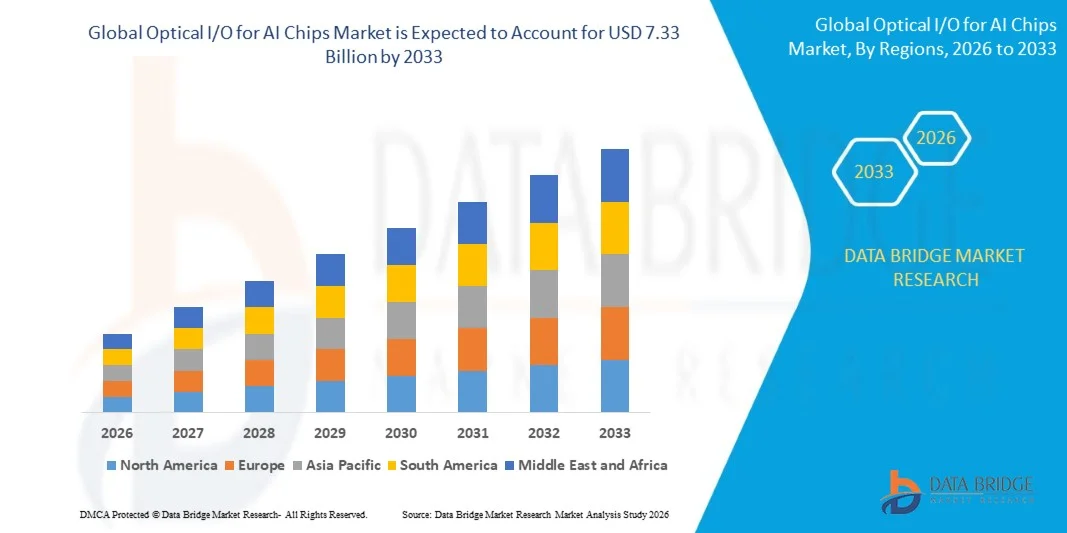
- As per Data Bridge Market Research analysis the optical I/O for AI chips market market was valued at USD 1.05 billion in 2025 and is projected to reach USD 7.33 billion by 2033, growing at a CAGR of 27.50% from 2026 to 2033.
- The market is experiencing explosive growth, driven by the fundamental shift in AI data center bottlenecks from compute power to data movement. As AI models scale to billions of parameters, traditional copper interconnects can no longer provide the necessary bandwidth, latency, and power efficiency required for high-performance computing and large-scale AI clusters.
- The transition from pluggable optical modules to integrated optical I/O solutions, including Co-Packaged Optics (CPO), Near-Packaged Optics (NPO), and On-Board Optics (OBO), represents the most significant generational shift in AI computing infrastructure. By placing optical engines directly adjacent to or within the same package as the compute silicon, these technologies drastically shorten electrical paths, enabling high-bandwidth, low-latency communication essential for GPU-to-GPU and chip-to-chip connectivity in AI training and inference systems.
Market Size & Forecast
- Market Value (2025): USD 1.05 Billion
- Expected Market Value (2033): USD 7.33 Billion
- Forecast CAGR (2026–2033): 27.50%
- Leading Region in 2025: North America
- Fastest Growing Region: Asia-Pacific
What are the Major Takeaways of the Optical I/O for AI Chips Market?
- North America is the dominant region in the optical I/O for AI chips market, accounting for over of the total market share in 2025. This leadership is attributed to its mature semiconductor ecosystem, the significant concentration of leading technology firms, and aggressive investments in AI research and data center expansion.
- The Asia-Pacific Optical I/O for AI Chips market is expected to witness the fastest growth rate from 2026 to 2033, supported by rapid expansion of AI infrastructure, increasing semiconductor investments, and growing deployment of hyperscale data centers across countries such as China, Japan, South Korea, and Taiwan.
- The Co-Packaged Optics for Switches segment dominated the market with the largest revenue share in 2025, owing to its ability to address bandwidth limitations, reduce power consumption, and improve data transfer efficiency in large-scale AI and hyperscale data center environments.
- The Accelerator Optical I/O segment is projected to register the fastest growth from 2026 to 2033, driven by increasing demand for high-performance AI accelerators, GPU clusters, and efficient interconnect technologies.
- The 800G segment accounted for the largest market share in 2025, supported by widespread deployment in AI data centers, cloud computing infrastructure, and high-performance networking applications.
- The 3.2T and Above segment is expected to experience the fastest growth from 2026 to 2033, driven by increasing AI model complexity, massive computational requirements, and the expansion of hyperscale AI clusters.
Report Scope and Optical I/O for AI Chips Market Segmentation
|
Attributes |
Optical I/O for AI Chips Key Market Insights |
|
Segments Covered |
|
|
Countries Covered |
North America
Europe
Asia-Pacific
Middle East and Africa
South America
|
|
Key Market Players |
|
|
Market Opportunities |
|
|
Value Added Data Infosets |
In addition to the insights on market scenarios such as market value, growth rate, segmentation, geographical coverage, and major players, the market reports curated by the Data Bridge Market Research also include in-depth expert analysis, geographically represented company-wise production and capacity, network layouts of distributors and partners, detailed and updated price trend analysis and deficit analysis of supply chain and demand. |
What is the Key Trend in the Optical I/O for AI Chips Market?
- The increasing adoption of co-packaged optics (CPO), silicon photonics, and optical I/O technologies is emerging as a key trend in the AI chip industry as data centers face bandwidth limitations and rising power consumption from rapidly expanding AI workloads.
- For instance, in June 2024, Intel demonstrated its fully integrated Optical Compute Interconnect (OCI) chiplet, a co-packaged optical I/O solution designed to improve scalability for AI infrastructure and high-performance computing by enabling high-bandwidth, low-power data transmission between compute components. The OCI chiplet demonstrated 4 Tbps bidirectional bandwidth, highlighting the potential of optical I/O to overcome electrical interconnect limitations in future AI systems.
- Optical I/O technologies are enabling faster communication between AI accelerators, memory systems, and networking components by reducing signal loss and improving energy efficiency compared with traditional electrical interconnects.
- For instance, in 2024, NVIDIA expanded its AI networking ecosystem with Spectrum-X Ethernet technology, incorporating optical networking capabilities and co-packaged optical switching approaches to support large-scale AI factories requiring higher bandwidth and improved power efficiency.
- As generative AI models, large language models (LLMs), and hyperscale AI computing continue increasing data movement requirements, optical I/O is expected to become a critical enabling technology for next-generation AI chip architectures, supporting higher bandwidth, lower latency, and energy-efficient computing.
What are the Key Drivers of the Global Optical I/O for AI Chips Market?
- The rapid growth of generative AI applications, AI training clusters, and hyperscale data centers is significantly driving demand for optical I/O solutions that enable faster communication between thousands of interconnected AI processors.
- For instance, in 2024, NVIDIA highlighted that its Spectrum-X Ethernet platform was developed specifically for AI factories, providing enhanced networking performance for large-scale AI workloads and supporting high-speed connectivity required by next-generation AI infrastructure.
- Semiconductor manufacturers and technology companies are increasingly investing in optical interconnect solutions to address the limitations of copper-based electrical connections, including increasing power consumption, signal degradation, and scalability challenges at higher bandwidth levels.
- With AI infrastructure providers continuously scaling GPU clusters and requiring faster data exchange between computing nodes, optical I/O technologies are expected to become increasingly essential for improving AI system performance, reducing energy consumption, and enabling future AI workloads.
Which Factors are Challenging the Growth of the Global Optical I/O for AI Chips Market?
- The high manufacturing complexity and cost associated with optical I/O integration remain significant challenges, as AI optical interconnect solutions require advanced silicon photonics, co-packaged optics (CPO), optical transceivers, and high-precision semiconductor packaging technologies. These requirements increase capital expenditure and create barriers for large-scale commercialization.
- The complexity of integrating optical components with AI processors and advanced semiconductor packages also limits adoption, as optical engines, lasers, and electronic circuits must operate together with high reliability while maintaining thermal and power efficiency.
- For instance, in June 2024, Intel demonstrated its integrated Optical Compute Interconnect (OCI) chiplet, which combined silicon photonics technology with semiconductor packaging to address AI infrastructure bandwidth requirements. The demonstration also highlighted the engineering challenges involved in integrating optical I/O directly with computing platforms for future AI systems.
- In addition, the high cost of deploying optical infrastructure in AI data centers remains a challenge, particularly for organizations seeking to upgrade from conventional electrical interconnect systems. Large-scale AI clusters require substantial investment in optical networking equipment, advanced packaging, and supporting infrastructure.
- These manufacturing, integration, standardization, and infrastructure challenges continue to limit the widespread adoption of optical I/O technologies, particularly among smaller semiconductor companies and cost-sensitive AI computing environments, despite growing demand for high-bandwidth AI systems.
How is the Optical I/O for AI Chips Market Segmented?
The market is segmented on the basis of deployment architecture, data rate, component, application, and end-use application.
- By Deployment Architecture
On the basis of deployment architecture, the global Optical I/O for AI Chips market is segmented into Co-Packaged Optics for Switches, Accelerator Optical I/O, Near-Packaged Optics, and On-Board Optics. The Co-Packaged Optics for Switches segment dominated the market with the largest revenue share in 2025, owing to its ability to address bandwidth limitations, reduce power consumption, and improve data transfer efficiency in large-scale AI and hyperscale data center environments. These solutions enable closer integration of optical components with switching silicon, supporting high-speed communication requirements for AI workloads and next-generation networking infrastructure.
The Accelerator Optical I/O segment is projected to register the fastest growth from 2026 to 2033, driven by increasing demand for high-performance AI accelerators, GPU clusters, and efficient interconnect technologies. The rapid expansion of generative AI applications and large language model training is accelerating the adoption of optical connectivity solutions that provide higher bandwidth, lower latency, and improved scalability.
- By Data Rate
On the basis of data rate, the global Optical I/O for AI Chips market is segmented into Below 800G, 800G, 1.6T, 3.2T, and Above. The 800G segment accounted for the largest market share in 2025, supported by widespread deployment in AI data centers, cloud computing infrastructure, and high-performance networking applications. The growing need for faster data movement between AI processors, memory systems, and networking components is driving the adoption of 800G optical interconnect solutions.
The 3.2T and Above segment is expected to experience the fastest growth from 2026 to 2033, driven by increasing AI model complexity, massive computational requirements, and the expansion of hyperscale AI clusters. Advancements in silicon photonics, optical engines, and high-speed communication technologies are enabling the development of next-generation optical I/O solutions capable of supporting ultra-high bandwidth applications.
- By Component
On the basis of component, the global Optical I/O for AI Chips market is segmented into Optical Engines, Switch ASICs & Electrical ICs, Laser Sources, and Connectors & Packaging. The Optical Engines segment dominated the market in 2025, owing to their critical role in enabling high-speed optical communication between AI chips, accelerators, and networking systems. Increasing adoption of silicon photonics and co-packaged optical technologies is further strengthening demand for advanced optical engines in AI infrastructure.
The Connectors & Packaging segment is anticipated to witness the fastest CAGR from 2026 to 2033, driven by growing demand for efficient thermal management, compact designs, and reliable high-density interconnect solutions. Increasing complexity of AI hardware architectures and the need for scalable chip-to-chip communication are encouraging innovation in optical packaging technologies.
- By Application
On the basis of application, the global Optical I/O for AI Chips market is segmented into AI Training Clusters, AI Inference Clusters, HPC Systems, and AI Cloud Data Centers. The AI Training Clusters segment held the largest market share in 2025, supported by the growing deployment of large-scale AI models, generative AI platforms, and advanced machine learning workloads. Optical I/O technologies enable faster communication between GPUs, accelerators, and computing nodes, improving training efficiency and reducing network bottlenecks.
The AI Inference Clusters segment is projected to register the fastest growth from 2026 to 2033, driven by increasing demand for real-time AI applications, edge intelligence, and cloud-based inference services. The expansion of AI-powered applications across industries is increasing the need for low-latency, energy-efficient optical interconnect solutions.
- By End-User
On the basis of end-user, the global Optical I/O for AI Chips market is segmented into Hyperscale Cloud Providers, GPU Cloud Providers, Data Centers, Government and Defense. The Hyperscale Cloud Providers segment dominated the market in 2025, owing to significant investments by major cloud companies in AI infrastructure, high-performance computing systems, and next-generation data center networks. The growing deployment of AI workloads and large-scale accelerator clusters is driving demand for advanced optical connectivity solutions among hyperscale operators.
The GPU Cloud Providers segment is expected to witness the fastest growth from 2026 to 2033, driven by increasing demand for AI computing-as-a-service, GPU-based cloud platforms, and specialized AI infrastructure. The rapid adoption of generative AI applications and the expansion of AI startups are further accelerating investments in high-bandwidth optical I/O technologies.
Which Region Holds the Largest Share of the Optical I/O for AI Chips Market?
- North America is the dominant region in the optical I/O for AI chips market, accounting for over of the total market share in 2025. This leadership is attributed to its mature semiconductor ecosystem, the significant concentration of leading technology firms, and aggressive investments in AI research and data center expansion.
- The presence of industry giants such as NVIDIA, Intel, Broadcom, and AMD, combined with strong government and private sector support for R&D, fosters a highly conducive environment for the adoption and commercialization of these advanced technologies.
U.S. Optical I/O for AI Chips Market Insight
The U.S. Optical I/O for AI Chips market captured the largest revenue share in 2025 within North America, fueled by rapid expansion of AI data centers, increasing deployment of GPU-based computing infrastructure, and significant investments in next-generation networking technologies. The growing adoption of AI workloads by hyperscale cloud providers, semiconductor companies, and technology enterprises is driving demand for low-latency and energy-efficient optical connectivity solutions. Moreover, advancements in silicon photonics, co-packaged optics, and high-speed optical engines are further contributing to market growth.
Europe Optical I/O for AI Chips Market Insight
The Europe Optical I/O for AI Chips market is expected to witness significant growth from 2026 to 2033, primarily driven by increasing investments in artificial intelligence, high-performance computing, and advanced data center infrastructure. The region’s focus on digital transformation, energy-efficient computing solutions, and semiconductor innovation is encouraging the adoption of optical interconnect technologies. Growing demand for AI applications across automotive, healthcare, research, and industrial sectors is further supporting the expansion of optical I/O solutions across Europe.
U.K. Optical I/O for AI Chips Market Insight
The U.K. Optical I/O for AI Chips market is expected to witness strong growth from 2026 to 2033, driven by increasing AI research activities, expansion of cloud computing infrastructure, and rising adoption of high-performance computing systems. The country’s growing focus on artificial intelligence development and digital infrastructure modernization is encouraging investments in advanced chip-to-chip communication technologies. In addition, increasing demand for scalable AI data centers and efficient networking solutions is expected to support market growth.
Germany Optical I/O for AI Chips Market Insight
The Germany Optical I/O for AI Chips market is expected to witness considerable growth from 2026 to 2033, fueled by increasing adoption of AI technologies, industrial automation, and high-performance computing applications. Germany’s strong semiconductor ecosystem, focus on energy-efficient technologies, and investments in advanced manufacturing are promoting the adoption of optical communication solutions. The integration of AI across automotive, industrial, and research applications is further increasing demand for high-speed optical interconnect technologies.
Asia-Pacific Optical I/O for AI Chips Market Insight
The Asia-Pacific Optical I/O for AI Chips market is expected to witness the fastest growth rate from 2026 to 2033, supported by rapid expansion of AI infrastructure, increasing semiconductor investments, and growing deployment of hyperscale data centers across countries such as China, Japan, South Korea, and Taiwan. The region’s strong semiconductor manufacturing capabilities, rising demand for AI computing, and government initiatives supporting digital transformation are driving the adoption of optical I/O technologies. Furthermore, increasing investments in advanced packaging, silicon photonics, and next-generation networking infrastructure are accelerating regional market growth.
Japan Optical I/O for AI Chips Market Insight
The Japan Optical I/O for AI Chips market is expected to witness significant growth from 2026 to 2033 due to the country’s advanced semiconductor industry, strong research capabilities, and increasing demand for AI-driven computing solutions. Japan’s focus on high-performance electronics, robotics, and next-generation communication technologies is encouraging the adoption of optical interconnect solutions. The integration of optical I/O technologies into AI servers, HPC systems, and advanced computing platforms is further supporting market expansion.
China Optical I/O for AI Chips Market Insight
The China Optical I/O for AI Chips market accounted for the largest market revenue share in Asia-Pacific in 2025, attributed to rapid AI infrastructure development, large-scale data center expansion, and strong investments in semiconductor technologies. China’s growing demand for artificial intelligence applications, cloud computing services, and high-performance computing systems is accelerating the adoption of optical connectivity solutions. In addition, government initiatives supporting AI innovation, domestic semiconductor development, and the expansion of AI data centers are key factors propelling the Optical I/O for AI Chips market in China.
Which are the Top Companies in Optical I/O for AI Chips Market?
The optical I/O for AI chips market industry is primarily led by well-established companies, including:
- NVIDIA Corporation (U.S.)
- Broadcom Inc. (U.S.)
- Intel Corporation (U.S.)
- Marvell Technology Group Ltd. (U.S.)
- Ayar Labs (U.S.)
- TSMC (Taiwan)
- MediaTek Inc. (Taiwan)
- Lumentum Holdings Inc. (U.S.)
- Coherent Corp. (U.S.)
What are Latest Developments in Optical I/O for AI Chips Market?
- In March 2026, Lumentum Holdings Inc. entered into a strategic partnership and investment agreement with NVIDIA, under which NVIDIA invested USD 2 billion to accelerate the development, manufacturing capacity, and commercialization of advanced optical interconnect technologies. The collaboration is intended to strengthen next-generation AI data center networks by improving bandwidth, power efficiency, and optical connectivity performance, while supporting the growing demand for large-scale AI infrastructure.
- In February 2026, Marvell Technology, Inc. completed its acquisition of Celestial AI, following the USD 3.25 billion agreement announced in December 2025. Through the acquisition, Marvell expanded its portfolio with Celestial AI’s Photonic Fabric optical interconnect technology, enabling high-bandwidth, low-latency, and energy-efficient connectivity for next-generation AI and cloud data centers. The transaction strengthens Marvell’s position in optical I/O and accelerates the adoption of silicon photonics-based AI infrastructure.
- In 2026, Ayar Labs expanded commercialization of its TeraPHY optical I/O chiplet platform, the industry’s first co-packaged optical I/O chiplet designed for AI accelerators, networking devices, and high-performance computing systems. The technology delivers multi-terabit bandwidth, lower latency, and significantly improved power efficiency compared with conventional electrical interconnects, helping address critical data movement bottlenecks in large-scale AI infrastructure and accelerating the transition toward optical computing architectures.

- Interactive Data Analysis Dashboard
- Company Analysis Dashboard for high growth potential opportunities
- Research Analyst Access for customization & queries
- Competitor Analysis with Interactive dashboard
- Latest News, Updates & Trend analysis
- Harness the Power of Benchmark Analysis for Comprehensive Competitor Tracking
Global Optical Io For Ai Chips Market, Supply Chain Analysis and Ecosystem Framework
To support market growth and help clients navigate the impact of geopolitical shifts, DBMR has integrated in-depth supply chain analysis into its Global Optical Io For Ai Chips Market research reports. This addition empowers clients to respond effectively to global changes affecting their industries. The supply chain analysis section includes detailed insights such as Global Optical Io For Ai Chips Market consumption and production by country, price trend analysis, the impact of tariffs and geopolitical developments, and import and export trends by country and HSN code. It also highlights major suppliers with data on production capacity and company profiles, as well as key importers and exporters. In addition to research, DBMR offers specialized supply chain consulting services backed by over a decade of experience, providing solutions like supplier discovery, supplier risk assessment, price trend analysis, impact evaluation of inflation and trade route changes, and comprehensive market trend analysis.
Data collection and base year analysis are done using data collection modules with large sample sizes. The stage includes obtaining market information or related data through various sources and strategies. It includes examining and planning all the data acquired from the past in advance. It likewise envelops the examination of information inconsistencies seen across different information sources. The market data is analysed and estimated using market statistical and coherent models. Also, market share analysis and key trend analysis are the major success factors in the market report. To know more, please request an analyst call or drop down your inquiry.
The key research methodology used by DBMR research team is data triangulation which involves data mining, analysis of the impact of data variables on the market and primary (industry expert) validation. Data models include Vendor Positioning Grid, Market Time Line Analysis, Market Overview and Guide, Company Positioning Grid, Patent Analysis, Pricing Analysis, Company Market Share Analysis, Standards of Measurement, Global versus Regional and Vendor Share Analysis. To know more about the research methodology, drop in an inquiry to speak to our industry experts.
Data Bridge Market Research is a leader in advanced formative research. We take pride in servicing our existing and new customers with data and analysis that match and suits their goal. The report can be customized to include price trend analysis of target brands understanding the market for additional countries (ask for the list of countries), clinical trial results data, literature review, refurbished market and product base analysis. Market analysis of target competitors can be analyzed from technology-based analysis to market portfolio strategies. We can add as many competitors that you require data about in the format and data style you are looking for. Our team of analysts can also provide you data in crude raw excel files pivot tables (Fact book) or can assist you in creating presentations from the data sets available in the report.













