


Optical Lens Edger Market Size
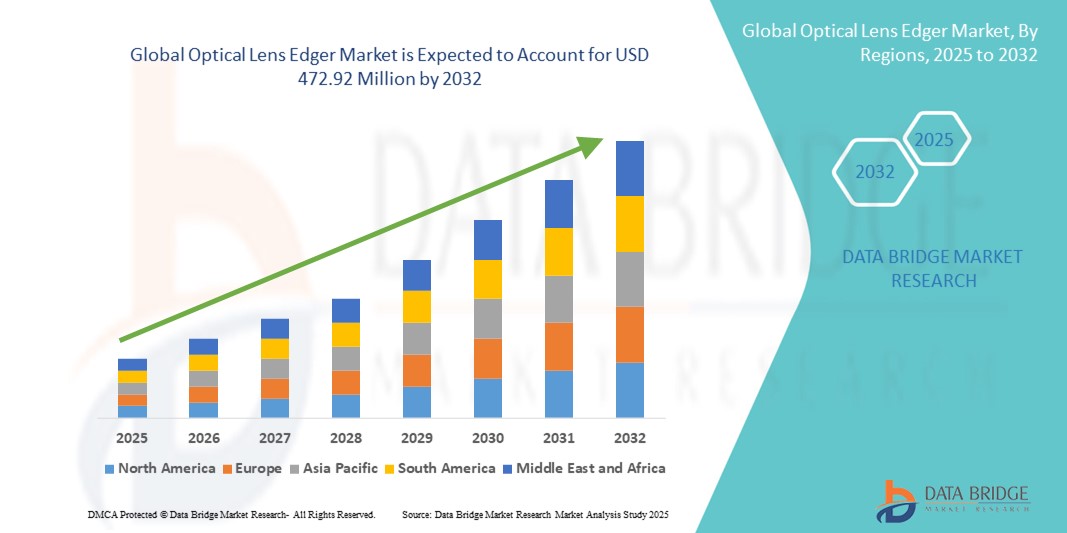
- The global optical lens edger market size was valued at USD 290.08 million in 2024 and is expected to reach USD 472.92 million by 2032, at a CAGR of 6.30% during the forecast period
- The market growth is primarily driven by the increasing demand for customized and precision-cut lenses in ophthalmic applications, alongside advancements in lens edging technology that enhance efficiency and accuracy
- In addition, growing awareness about eye care and the rising prevalence of vision-related disorders are prompting higher consumption of corrective eyewear, which in turn is fueling the adoption of advanced optical lens edgers in both retail and clinical settings. These factors collectively contribute to the robust expansion of the optical lens edger market globally
Optical Lens Edger Market Analysis
- Optical lens edgers, essential devices used for cutting and shaping lenses to precise specifications, are becoming increasingly important in the eyewear manufacturing and ophthalmic industries due to their ability to enhance lens accuracy, efficiency, and customization
- The growing demand for personalized eyewear, rising prevalence of vision impairments, and advancements in edging technology, including automation and integration with digital lens design software, are key drivers fueling market expansion
- North America dominated the optical lens edger market with the largest revenue share of 39% in 2024, supported by a mature optical retail sector, high healthcare expenditure, and strong adoption of cutting-edge ophthalmic equipment, with the U.S. market showing notable growth driven by innovations in lens finishing technologies and increasing optical practice modernization
- Asia-Pacific is anticipated to be the fastest-growing region in the optical lens edger market during the forecast period, attributed to rapid urbanization, increasing awareness of eye health, growing optical retail chains, and expanding manufacturing capabilities in countries such as China and India
- The Semi-automatic optical lens edger segment dominated the optical lens edger market with a share of 46.2% in 2024, driven by its balance of affordability and precision, making it popular among small to mid-sized optical laboratories worldwide
Report Scope and Optical Lens Edger Market Segmentation
|
Attributes |
Optical Lens Edger Key Market Insights |
|
Segments Covered |
|
|
Countries Covered |
North America
Europe
Asia-Pacific
Middle East and Africa
South America
|
|
Key Market Players |
|
|
Market Opportunities |
|
|
Value Added Data Infosets |
In addition to the insights on market scenarios such as market value, growth rate, segmentation, geographical coverage, and major players, the market reports curated by the Data Bridge Market Research also include in-depth expert analysis, pricing analysis, brand share analysis, consumer survey, demography analysis, supply chain analysis, value chain analysis, raw material/consumables overview, vendor selection criteria, PESTLE Analysis, Porter Analysis, and regulatory framework. |
Optical Lens Edger Market Trends
Automation and Precision through Digital Integration
- A key and rapidly growing trend in the global optical lens edger market is the integration of automation with digital technologies such as CAD/CAM software, enabling highly precise and customized lens edging solutions. This trend significantly enhances production efficiency and accuracy in eyewear manufacturing
- For instance, advanced edgers from companies such as Essilor and Nidek offer seamless compatibility with digital lens design platforms, allowing operators to automate edging processes for complex prescriptions and frame shapes with minimal manual adjustments
- Digital integration facilitates real-time communication between lens measurement and edging systems, ensuring consistent lens quality and fit, which is critical for premium and progressive lenses
- These capabilities help optical labs reduce turnaround times and labor costs while meeting increasing consumer demand for personalized and high-quality eyewear
- Companies such as Rodenstock are innovating smart edgers with adaptive settings that automatically optimize edging parameters based on lens material and design, driving further improvements in efficiency and product quality
- The growing emphasis on speed, precision, and customization across both retail optical shops and large manufacturers is accelerating the adoption of digitally integrated and automated lens edgers worldwide
Optical Lens Edger Market Dynamics
Driver
Increasing Demand for Customized, High-Quality Eyewear
- The rising global prevalence of vision disorders and increasing consumer preference for customized eyewear are major drivers of the optical lens edger market growth
- For instance, in 2024, Nidek introduced a new high-precision edger line targeting premium ophthalmic lenses, addressing the demand for accurate edging of complex lens designs and coatings
- The evolution of lens materials such as high-index, progressive, and photochromic lenses requires precise edging techniques to ensure optimal fit and functionality, further boosting market demand
- Expansion of optical retail chains and eye care centers in emerging markets also fuels the need for advanced and reliable lens edging equipment
- A growing focus on aesthetics and comfort in eyewear is encouraging the use of sophisticated edging solutions capable of supporting intricate frame designs and customization
Restraint/Challenge
High Cost and Maintenance Requirements
- The significant upfront costs and ongoing maintenance expenses associated with advanced optical lens edgers present challenges, especially for small and medium optical labs in developing countries
- For instance, some smaller optical labs in regions such as Southeast Asia have reported difficulties maintaining costly automated edgers due to limited access to technical support and replacement parts, impacting operational continuity
- While automated edgers offer enhanced precision and throughput, their operational complexity requires skilled personnel and regular technical support, increasing total cost of ownership
- This cost barrier may limit adoption among price-sensitive customers and restrict market growth in regions with budget constraints
- In addition, inconsistent power supply and limited access to authorized service centers in some areas can affect machine reliability and user confidence
- Manufacturers are responding by developing more affordable, easy-to-use edgers and expanding after-sales service networks to overcome these barriers and promote broader adoption
Optical Lens Edger Market Scope
The market is segmented on the basis of type, application, and end user.
- By Type
On the basis of type, the optical lens edger market is segmented into manual optical lens edger, automatic optical lens edger, and semi-automatic optical lens edger. The semi-automatic optical lens edger segment dominated the market with the largest revenue share of 46.2% in 2024, driven by its ideal balance of affordability and precision. This makes it the preferred choice for small to mid-sized optical laboratories that require reliable and efficient edging without the high costs associated with fully automated systems.
The automatic optical lens edger segment is anticipated to witness the fastest growth during the forecast period, propelled by increasing demand for automation and high-precision lens production in large-scale optical manufacturing units and premium eyewear brands. These automated systems minimize manual intervention, improve consistency, and reduce turnaround times, making them attractive for high-volume operations.
- By Application
On the basis of application, the optical lens edger market is segmented into eyeglass lens, microscope lens, and camera lens. The eyeglass lens segment dominated the market with the largest revenue share in 2024, reflecting the widespread and growing global demand for corrective, protective, and fashion eyewear. Increasing prevalence of vision impairments and a rising consumer preference for customized and premium lenses continue to drive this segment.
On the other hand, the microscope lens segment is expected to witness the fastest growth over the forecast period, supported by advancements in medical diagnostics, biotechnology, and scientific research. These fields require highly precise lens edging to ensure optimal optical performance. Growth in the camera lens segment, while steady, is comparatively moderate, driven by ongoing innovations in photography and imaging technologies that demand accurate lens shaping and finishing.
- By End User
On the basis of end user, the optical lens edger market is segmented into eye specialty clinics, eye institutes, hospitals, and others. The eye specialty clinics segment dominated the market with the largest revenue share in 2024, largely due to the increasing number of optical retail outlets and dedicated lens finishing laboratories focusing on personalized eyewear solutions. These clinics leverage optical lens edgers to provide fast, customized services that meet evolving consumer expectations.
The hospitals segment is projected to register the fastest growth rate during the forecast period, driven by growing investments in healthcare infrastructure, adoption of advanced ophthalmic equipment, and rising demand for clinical and surgical lens applications. Eye institutes, focusing on education and research, also contribute significantly by utilizing high-precision lens edgers for specialized ophthalmic lens production. The ‘others’ segment includes optical manufacturing companies and research facilities that create demand for specialized and bulk lens edging equipment.
Optical Lens Edger Market Regional Analysis
- North America led the optical lens edger market with the largest revenue share of 39% in 2024, supported by a mature optical retail sector, high healthcare expenditure, and strong adoption of cutting-edge ophthalmic equipment, with the U.S. market showing notable growth driven by innovations in lens finishing technologies and increasing optical practice modernization
- Consumers and optical professionals in the region prioritize precision, customization, and rapid turnaround times, fueling demand for automated and semi-automatic lens edging systems
- This dominance is further supported by ongoing investments in eye care infrastructure, technological innovation by key market players, and increasing awareness of vision health, making North America a leading market for high-quality optical lens edgers in both clinical and retail settings
U.S. Optical Lens Edger Market Insight
The U.S. optical lens edger market captured the largest revenue share of 35% in 2024 within North America, driven by a mature optical retail and healthcare sector, high expenditure on eye care, and strong adoption of advanced ophthalmic technologies. Consumers and professionals prioritize precision, customization, and rapid turnaround times, fueling demand for automated and semi-automatic lens edging systems. Leading industry players continue to invest heavily in innovation and infrastructure, ensuring steady technological advancement. In addition, rising public awareness about vision health and advancements in CNC and digital lens edging machines contribute to robust market growth.
Europe Optical Lens Edger Market Insight
The Europe optical lens edger market is projected to expand steadily at a significant CAGR during the forecast period, propelled by increasing healthcare expenditure, an aging population, and rising rates of vision impairment. Growing consumer preference for premium, customized eyewear is fostering demand for high-precision, automated lens edging equipment. The adoption of digital lens edging technology improves efficiency and accuracy in lens manufacturing and fitting, leading to enhanced patient outcomes and customer satisfaction. The expansion of optical retail chains and modernization of eye care clinics further support this growth trajectory.
U.K. Optical Lens Edger Market Insight
The U.K. optical lens edger market is anticipated to grow at a noteworthy CAGR, supported by the modernization of optical retail and healthcare sectors. Increasing consumer focus on eye health, coupled with demand for technologically advanced, efficient lens edging solutions, is encouraging clinics and retailers to upgrade equipment. The U.K.’s robust e-commerce infrastructure facilitates wider distribution of automated and semi-automatic lens edgers, making these technologies more accessible. In addition, government health initiatives aimed at improving vision care awareness and service accessibility are boosting adoption rates.
Germany Optical Lens Edger Market Insight
The Germany optical lens edger market is expected to witness considerable growth, driven by the nation’s strong healthcare infrastructure and emphasis on technological innovation and sustainability. German consumers value high-quality, eco-conscious products, which is reflected in growing demand for precision lens edging solutions that reduce waste and energy consumption. Integration of lens edging equipment with digital workflows and ophthalmic diagnostic devices enhances operational efficiency in both clinical and retail settings. The country's well-established manufacturing base also supports the development and deployment of cutting-edge lens edging technologies.
Asia-Pacific Optical Lens Edger Market Insight
The Asia-Pacific optical lens edger market is poised to grow at the fastest CAGR of approximately 22% from 2025 to 2032, fueled by rapid urbanization, rising disposable incomes, and expanding optical retail networks in key countries such as China, India, and Japan. Government initiatives aimed at improving eye care access and growing public awareness of vision health are accelerating adoption of advanced lens edging equipment. Moreover, Asia-Pacific's emergence as a manufacturing hub lowers costs and increases availability, broadening market reach. The growing middle class’s demand for fashionable, high-precision eyewear further propels market expansion.
Japan Optical Lens Edger Market Insight
The Japan optical lens edger market is gaining momentum due to its advanced technological ecosystem and aging population requiring precise and user-friendly ophthalmic solutions. The country’s focus on innovation and integration of lens edging systems with diagnostic equipment supports consistent growth. The increasing number of smart optical labs and connected devices enhances operational workflows and customer experiences.
India Optical Lens Edger Market Insight
The India optical lens edger market accounted for the largest revenue share in Asia-Pacific in 2024, driven by its expanding middle class, rising awareness of vision health, and significant investments in healthcare infrastructure. The proliferation of optical retail chains and ophthalmic clinics, especially in urban and semi-urban areas, increases adoption of both manual and semi-automatic lens edgers. Affordable domestic manufacturing of lens edging machines supports broader market penetration. Government programs targeting vision care and screening also positively impact market demand.
Optical Lens Edger Market Share
The Optical Lens Edger industry is primarily led by well-established companies, including:
- Huvitz Co., Ltd. (South Korea)
- EssilorLuxottica (France)
- Visionix (France)
- Nidek Co., Ltd. (Japan)
- Shamir Optical Industry Ltd. (Israel)
- ZEISS Group (Germany)
- Rodenstock GmbH (Germany)
- Topcon Corporation (Japan)
- Satisloh AG (Switzerland)
- OptoTech Optikmaschinen GmbH (Germany)
- Shin-Nippon Machinery Co., Ltd. (Japan)
- Singh Optical (India)
- Miller's Optical (U.S.)
- Marco Ophthalmic, Inc. (U.S.)
- HOYA Corporation (Japan)
- LRI Optics (France)
- Salmoiraghi & Viganò S.p.A. (Italy)
- Ideal Optical Instruments Co., Ltd. (China)
- Guangzhou Yaguang Optical Instrument Co., Ltd. (China)
- Lexington International Co., Ltd. (South Korea)
What are the Recent Developments in Global Optical Lens Edger Market?
- In July 2025, Huvitz highlighted the speed and precision capabilities of the new HPE‑990 lens edger, emphasizing its impact on workflow efficiency and customer satisfaction in optical shops. The machine balances rapid lens processing with high accuracy, accommodating complex lens types such as high-curvature and lens-over-frame formats. Optical shops using the HPE‑990 can significantly minimize wait times and maintain quality—an essential upgrade for high-volume operations
- In May 2025, Huvitz unveiled the HPE‑990, the first premium lens edger capable of processing lens-over-frame sunglasses, marking a significant advancement in eyewear manufacturing. The device supports precision processing with its Deep Step Bevel feature (up to 20 mm depth), Scan & Cut shape editing, and improved stability through upgraded clamps and motor components. Launched at the MIDO 2025 expo, it’s set for rollout in France and North America, aiming to meet growing demand for customized and fashion-forward eyewear
- In September 2024, Theia Technologies’ IQ Lens System earned enduring recognition at the 2024 EDGE Awards in the Machine Vision & Inspection category. The system features motorized lenses and integrated software, offering automated control over zoom, focus, and aperture strengthening automation in vision inspection systems
- In February 2024, Essilor Instruments USA announced the release of its new ES 700, ES 700M, ES 800, and ES 800M edgers, bundled with the TCB 800 automatic tracer‑centerer‑blocker. These systems feature ergonomic multi-touch screens, hybrid milling/grinding technology, and eco-friendly dry-cut capabilities, enhancing axis control and reducing lens waste
- In August 2023, Visionix USA introduced the latest iteration in its automatic lens edger lineup: the Briot Attitude 3. Designed for personalized eyewear production, it automates lens measurement, shaping, and edging, significantly reducing manual labor and improving efficiency in optical labs

- Interactive Data Analysis Dashboard
- Company Analysis Dashboard for high growth potential opportunities
- Research Analyst Access for customization & queries
- Competitor Analysis with Interactive dashboard
- Latest News, Updates & Trend analysis
- Harness the Power of Benchmark Analysis for Comprehensive Competitor Tracking
Data collection and base year analysis are done using data collection modules with large sample sizes. The stage includes obtaining market information or related data through various sources and strategies. It includes examining and planning all the data acquired from the past in advance. It likewise envelops the examination of information inconsistencies seen across different information sources. The market data is analysed and estimated using market statistical and coherent models. Also, market share analysis and key trend analysis are the major success factors in the market report. To know more, please request an analyst call or drop down your inquiry.
The key research methodology used by DBMR research team is data triangulation which involves data mining, analysis of the impact of data variables on the market and primary (industry expert) validation. Data models include Vendor Positioning Grid, Market Time Line Analysis, Market Overview and Guide, Company Positioning Grid, Patent Analysis, Pricing Analysis, Company Market Share Analysis, Standards of Measurement, Global versus Regional and Vendor Share Analysis. To know more about the research methodology, drop in an inquiry to speak to our industry experts.
Data Bridge Market Research is a leader in advanced formative research. We take pride in servicing our existing and new customers with data and analysis that match and suits their goal. The report can be customized to include price trend analysis of target brands understanding the market for additional countries (ask for the list of countries), clinical trial results data, literature review, refurbished market and product base analysis. Market analysis of target competitors can be analyzed from technology-based analysis to market portfolio strategies. We can add as many competitors that you require data about in the format and data style you are looking for. Our team of analysts can also provide you data in crude raw excel files pivot tables (Fact book) or can assist you in creating presentations from the data sets available in the report.













