


What is the Optical Metasurface Market Size and Growth Rate?
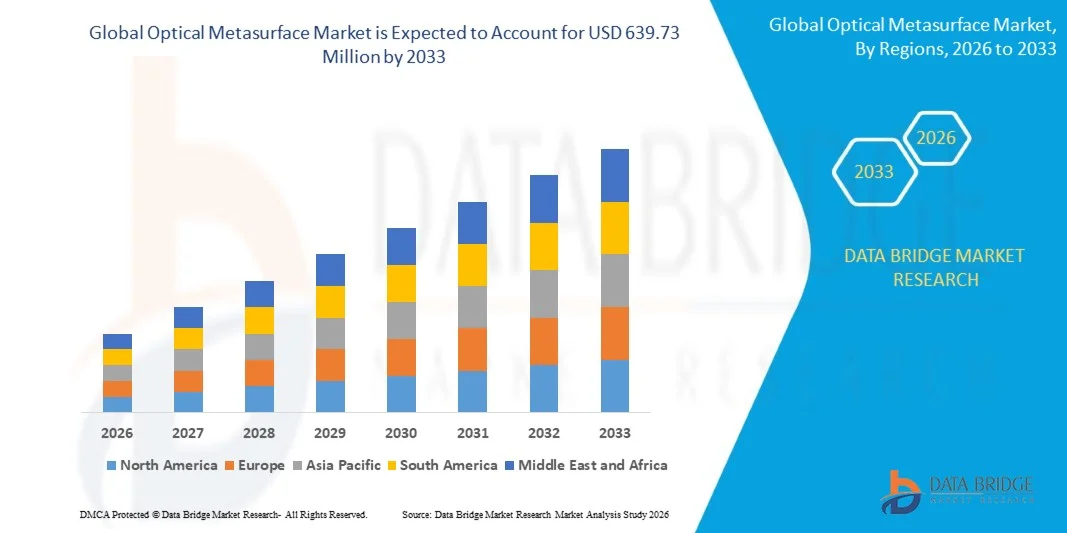
- As per Data Bridge Market Research Analysis the global optical metasurface market size was valued at USD 175 million in 2025 and is expected to reach USD 639.73 million by 2033, at a CAGR of 17.59% during the forecast period
- The market growth is largely driven by rapid advancements in nanophotonics and flat optics technologies, enabling miniaturized optical components with enhanced performance for AR/VR, imaging, and communication applications
- Furthermore, increasing demand for compact, lightweight, and high-efficiency optical systems in consumer electronics, automotive LiDAR, and telecommunication devices is encouraging the adoption of metasurface-based solutions, thereby significantly propelling market expansion
Market Size and Forecast:
- Global Market Value (2025): USD 175 million
- Expected Market Value (2033): USD 639.73 million
- Forecast CAGR (2026–2033): 17.59%
How Optical Metasurface Market Analysed?
- Optical metasurfaces are ultra-thin, engineered surfaces that manipulate light at the nanoscale to perform functions such as focusing, beam steering, polarization conversion, and holography, replacing bulkier traditional optics
- The rising adoption is primarily fueled by the need for smaller, high-performance optical components, advancements in fabrication techniques, and growing applications across AR/VR, optical communication, and imaging systems
- North America dominated the optical metasurface market with a share of 34.5% in 2025, due to increasing investments in advanced photonics, AR/VR devices, and high-speed optical communication infrastructure
- Asia-Pacific is expected to be the fastest growing region in the optical metasurface market during the forecast period due to rapid urbanization, increasing R&D investment, and technological advancements in countries such as China, Japan, and India
- Dielectric metasurfaces segment dominated the market with a market share of 51% in 2025, due to their low optical losses, high efficiency, and suitability for visible and near-infrared wavelength applications. These materials are widely adopted in imaging systems, AR/VR devices, and optical communication because they maintain high transmission efficiency while enabling compact, ultrathin designs
Report Scope and Optical Metasurface Market Segmentation
|
Attributes |
Optical Metasurface Key Market Insights |
|
Segments Covered |
|
|
Countries Covered |
North America
Europe
Asia-Pacific
Middle East and Africa
South America
|
|
Key Market Players |
|
|
Market Opportunities |
|
|
Value Added Data Infosets |
In addition to the insights on market scenarios such as market value, growth rate, segmentation, geographical coverage, and major players, the market reports curated by the Data Bridge Market Research also include in-depth expert analysis, geographically represented company-wise production and capacity, network layouts of distributors and partners, detailed and updated price trend analysis and deficit analysis of supply chain and demand. |
What are the Optical Metasurface Market Trends?
“Growing Integration of Metasurfaces in AR/VR and Imaging Devices”
- A significant trend in the optical metasurface market is the increasing integration of metasurfaces into AR/VR headsets, imaging systems, and compact optical modules, driven by the demand for lighter, thinner, and more efficient optical components. This integration is enhancing imaging quality, miniaturizing optical setups, and enabling novel light-manipulation functionalities across consumer electronics, healthcare imaging, and telecommunications
- For instance, Metalenz develops compact metasurface lenses for AR/VR devices that replace conventional bulky optics, improving device ergonomics and performance. Such implementations are accelerating adoption in next-generation wearable technologies and portable imaging systems
- The use of metasurfaces in computational imaging and holographic display applications is growing as these devices enable precise wavefront shaping and enhanced light control. This positions optical metasurfaces as critical elements for immersive displays and advanced imaging technologies that demand high fidelity and compact form factors
- Healthcare and biomedical imaging sectors are leveraging metasurfaces for miniaturized endoscopic and diagnostic imaging systems where precise light control improves resolution and reduces device footprint. This trend is driving innovation in non-invasive imaging tools and portable medical devices
- Industries focusing on optical communication and LiDAR systems are incorporating metasurfaces to manipulate beam direction, polarization, and phase for higher efficiency and smaller footprints. This is shaping demand for metasurface-based components that optimize signal performance in constrained optical environments
- The market is witnessing strong interest in integrating metasurfaces into consumer electronics cameras and sensors, improving imaging quality, autofocus speed, and overall device miniaturization. This rising adoption is reinforcing the transition toward smarter, lighter, and more energy-efficient optical systems across global industries
Optical Metasurface Market Dynamics
Driver
“Rising Demand for Compact and High-Efficiency Optical Components”
- The rising need for smaller, lighter, and energy-efficient optical systems in AR/VR devices, cameras, and LiDAR is driving demand for optical metasurfaces that can replace conventional bulky lenses. These components enable improved performance, reduced system size, and integration flexibility across diverse applications
- For instance, STMicroelectronics develops metasurface-based optical modules for wearable devices that provide high-efficiency light focusing while reducing device volume. Such advancements allow device manufacturers to enhance user comfort without compromising optical performance
- The increasing adoption of compact optical solutions in telecommunications, imaging, and consumer electronics is reinforcing this trend. Metasurfaces offer precise control over phase, polarization, and beam shaping, meeting the technical requirements of modern optical systems
- Miniaturization of optical instruments for industrial and scientific applications is further stimulating market growth. Metasurfaces reduce the number of conventional optical elements needed, simplifying design and assembly while maintaining high performance
- The growing requirement for energy-efficient optical components in portable and battery-powered devices continues to strengthen this driver. Metasurfaces enable low-loss optical paths and compact form factors, positioning them as essential enablers of modern photonic systems
Restraint/Challenge
“High Fabrication Costs and Complex Manufacturing Processes”
- The optical metasurface market faces challenges due to the intricate nanofabrication techniques required to produce high-precision metasurfaces, which involve advanced lithography, etching, and deposition processes. These complexities elevate production costs and limit large-scale manufacturing feasibility
- For instance, companies such as NIL Technology (NILT) employ nanoscale imprint lithography to fabricate metasurfaces with precise control over feature sizes. Such processes require high-end equipment, cleanroom facilities, and skilled operators, increasing overall production expenses
- Achieving consistent optical performance across large-area metasurfaces demands stringent quality control and uniformity, adding to time and cost constraints. These requirements can slow down product scaling and introduce supply-side bottlenecks
- The reliance on specialized materials, including high-refractive-index dielectrics and advanced polymers, adds to cost variability and supply chain challenges. Manufacturers must balance material performance with economic feasibility to maintain competitiveness
- Scaling up manufacturing for commercial applications while retaining precision and efficiency remains a key challenge. This constraint pressures companies to innovate fabrication techniques and cost-reduction strategies while maintaining product quality and reliability
Optical Metasurface Market Scope
The market is segmented on the basis of component, material, application, and end-use.
• By Component
On the basis of component, the optical metasurface market is segmented into metalenses, beam deflectors, polarization converters, meta-holograms, and others. The metalenses segment dominated the largest market revenue share of 37.5% in 2025, driven by their ability to replace bulky conventional lenses with ultrathin, lightweight alternatives while maintaining high-resolution imaging capabilities. Metalenses are increasingly preferred in AR/VR devices and mobile imaging systems due to their miniaturization potential and integration with semiconductor fabrication processes. The segment also benefits from ongoing R&D in tunable and multi-functional metalenses, further enhancing optical performance and versatility across applications.
The beam deflectors segment is anticipated to witness the fastest growth rate from 2026 to 2033, fueled by rising adoption in LiDAR systems, optical switching, and precision laser applications. Beam deflectors provide dynamic control over light propagation, enabling rapid scanning and high-speed optical routing, which is critical for automotive and telecommunication applications. Their compatibility with compact and integrated photonics systems, along with growing demand in industrial automation, drives market expansion for this component.
• By Material
On the basis of material, the optical metasurface market is segmented into dielectric metasurfaces, metallic metasurfaces, and hybrid metasurfaces. Dielectric metasurfaces dominated the largest market revenue share of 51% in 2025 due to their low optical losses, high efficiency, and suitability for visible and near-infrared wavelength applications. These materials are widely adopted in imaging systems, AR/VR devices, and optical communication because they maintain high transmission efficiency while enabling compact, ultrathin designs. Advances in fabrication techniques, such as nanoimprint lithography, have further enhanced their scalability and cost-effectiveness for commercial use.
The hybrid metasurfaces segment is expected to register the fastest CAGR from 2026 to 2033, driven by their ability to combine the high efficiency of dielectrics with the tunability of metallic structures. For instance, companies such as Zymergen are developing hybrid metasurfaces for multifunctional optical devices that enable simultaneous beam shaping and polarization control. Hybrid metasurfaces are gaining traction in applications requiring multifunctionality, including adaptive optics, holography, and sensing, further boosting market growth.
• By Application
On the basis of application, the optical metasurface market is segmented into AR & VR, optical communication, imaging & sensing systems, holography, sensing & detection, and others. The AR & VR segment dominated the largest market revenue share in 2025, driven by the rapid adoption of augmented and virtual reality devices for gaming, industrial training, and healthcare applications. Optical metasurfaces enhance AR/VR devices by enabling compact, lightweight lenses that reduce device bulk while maintaining high-quality visual output. Integration with consumer electronics and wearable devices further strengthens demand, while continuous innovation in immersive displays supports sustained growth.
The optical communication segment is expected to witness the fastest CAGR from 2026 to 2033, fueled by growing deployment of high-speed fiber-optic networks and photonic devices for data centers and telecommunication infrastructure. For instance, companies such as Lumentum are leveraging metasurface-based modulators and beam steering devices to enhance bandwidth and reduce energy consumption. The need for miniaturized, high-performance optical components in 5G and beyond networks accelerates the adoption of metasurfaces in communication systems.
• By End-use
On the basis of end-use, the optical metasurface market is segmented into commercial, industrial, research & academia, and others. The commercial segment dominated the largest market revenue share in 2025, driven by adoption in consumer electronics, AR/VR headsets, and mobile imaging devices that require compact and high-performance optical components. Commercial demand is further supported by the growing emphasis on miniaturized devices for imaging, display, and sensing applications, with manufacturers investing in metasurface-based solutions for enhanced performance.
The research & academia segment is anticipated to witness the fastest growth rate from 2026 to 2033, fueled by increasing investments in photonics research and advanced optical studies. For instance, institutions such as MIT Media Lab are exploring novel metasurface architectures for quantum optics, holography, and nanophotonic devices. Growing focus on innovation and prototyping in universities and research centers drives adoption of advanced metasurfaces, accelerating technological developments in this sector.
Optical Metasurface Market Regional Analysis
- North America dominated the optical metasurface market with the largest revenue share of 34.5% in 2025, driven by increasing investments in advanced photonics, AR/VR devices, and high-speed optical communication infrastructure
- Consumers and industries in the region highly value the miniaturization, high efficiency, and multifunctionality offered by optical metasurfaces in imaging, sensing, and display systems
- This widespread adoption is further supported by strong R&D capabilities, high technological awareness, and government initiatives promoting photonics innovation, establishing optical metasurfaces as a preferred solution across commercial, industrial, and research sectors
U.S. Optical Metasurface Market Insight
The U.S. optical metasurface market captured the largest revenue share in North America in 2025, fueled by rapid advancements in AR/VR technologies, optical communication networks, and high-resolution imaging systems. Enterprises and research institutions are increasingly prioritizing compact, high-performance optical components capable of replacing conventional bulky optics. The growing integration of photonic devices in commercial and industrial systems further propels market growth, while collaborations between technology companies and research organizations accelerate the development and deployment of innovative optical metasurface solutions.
Europe Optical Metasurface Market Insight
The Europe optical metasurface market is projected to expand at a substantial CAGR throughout the forecast period, primarily driven by growing adoption of photonics in imaging, sensing, and communication systems. Increasing government funding for research, coupled with strong industrial and academic collaborations, is fostering the uptake of advanced optical metasurfaces. European enterprises are attracted to the compact, energy-efficient, and multifunctional nature of metasurfaces, and the region is experiencing growth across industrial, commercial, and research applications, with optical metasurfaces integrated into next-generation devices.
U.K. Optical Metasurface Market Insight
The U.K. optical metasurface market is anticipated to grow at a noteworthy CAGR during the forecast period, driven by rising investment in photonics startups and AR/VR technologies. Demand is fueled by commercial and industrial sectors requiring miniaturized optical components for sensing, imaging, and display systems. The U.K.’s strong academic and research ecosystem, alongside a focus on innovation, continues to stimulate market growth, and integration with IoT-enabled devices and photonic systems further enhances adoption in both industrial and research applications.
Germany Optical Metasurface Market Insight
The Germany optical metasurface market is expected to expand at a considerable CAGR during the forecast period, fueled by increasing awareness of photonics solutions and their applications in optical communication, industrial automation, and AR/VR devices. Germany’s robust industrial base, technological innovation focus, and sustainability initiatives promote adoption in commercial and industrial settings. High investment in research and development, combined with collaboration with universities and technology institutes, supports the integration of advanced optical components across multiple sectors.
Asia-Pacific Optical Metasurface Market Insight
The Asia-Pacific optical metasurface market is poised to grow at the fastest CAGR during the forecast period of 2026 to 2033, driven by rapid urbanization, increasing R&D investment, and technological advancements in countries such as China, Japan, and India. The region’s growing electronics and photonics manufacturing base, along with increasing adoption of AR/VR, imaging, and optical communication systems, accelerates market growth. Government initiatives supporting digitalization, smart devices, and advanced optical technologies further boost demand, while affordability, accessibility, and localized manufacturing of optical metasurface components are expanding adoption across commercial and industrial applications.
Japan Optical Metasurface Market Insight
The Japan optical metasurface market is gaining momentum due to the country’s high-tech culture, advanced electronics industry, and strong R&D ecosystem. Demand is driven by integration of optical metasurfaces in AR/VR devices, imaging systems, and sensing applications. Japan’s emphasis on precision technologies and high-tech adoption spurs demand for compact, multifunctional optical components, while integration with IoT-enabled optical systems and industrial automation continues to support growth across commercial and research sectors.
China Optical Metasurface Market Insight
The China optical metasurface market accounted for the largest revenue share in Asia-Pacific in 2025, attributed to rapid technological adoption, expanding electronics manufacturing, and strong industrial demand. China is emerging as a hub for AR/VR, optical communication, and photonics research, driving growth in optical metasurface applications. Availability of affordable components, strong domestic manufacturers, and government-backed smart city initiatives further propel market expansion, and widespread deployment across commercial, industrial, and academic applications is supporting sustained growth in the region.
Which are the Top Companies in Optical Metasurface Market?
The optical metasurface industry is primarily led by well-established companies, including:
- Viavi Solutions (U.S.)
- NIL Technology (NILT) (Netherlands)
- Lumotive (U.S.)
- Hamamatsu Photonics K.K. (Japan)
- MetaOptics Technologies (U.S.)
- STMicroelectronics (Switzerland)
- Kymeta Corporation (U.S.)
- Moxtek (U.S.)
- Nanohmics Inc. (U.S.)
- 2Pi Optics (U.S.)
- Echodyne Corporation (U.S.)
- Jabil Inc. (U.S.)
- NKT Photonics A/S (Denmark)
- Metalenz (U.S.)
- Tunoptix (U.S.)
What are the Latest Developments in Global Optical Metasurface Market?
- In February 2026, Kymeta Corporation and Japan Display Inc. (JDI) announced a master supply agreement to co-develop next-generation multi-band metasurface apertures for Ku/Ka-band satellite communications. This partnership is expected to accelerate the adoption of metasurface technology in high-performance communications systems and expand its application from defense to commercial satellite solutions, strengthening market demand for metasurface-based RF and optical components
- In November 2025, researchers demonstrated that metasurfaces can significantly enhance augmented reality (AR) image clarity and brightness through a novel single waveguide in‑coupler design. This breakthrough is likely to make AR glasses more power-efficient and practical for everyday use, potentially accelerating adoption of metasurface optics in next-generation wearable displays and expanding commercial demand for compact optical solutions in consumer electronics
- In August 2025, Metalenz expanded its metasurface technology portfolio to include system-level sensing applications supported by an extensive global patent portfolio. This expansion is expected to broaden market opportunities for metasurface optics beyond basic components into full sensing solutions for consumer, industrial, and security applications, driving higher adoption rates and supporting long-term market growth
- In July 2025, STMicroelectronics and Metalenz signed a new license agreement expanding ST’s intellectual property rights for metasurface optics production on its 300 mm semiconductor platform. This agreement enables scalable manufacturing of advanced metasurface components and targets high-volume applications such as biometrics, LiDAR, robotics, and automotive sensing, which is projected to boost market penetration and reduce production costs for metasurface optics
- In April 2025, Circularise announced the launch of digital product passports (DPPs) together with Teijin Limited for advanced aramid and carbon fiber materials, enhancing traceability and sustainability data across the materials supply chain in compliance with EU Ecodesign requirements. This initiative underscores the growing importance of transparent lifecycle tracking for advanced materials, supporting sustainable and compliant manufacturing practices in the optical metasurface supply chain

- Interactive Data Analysis Dashboard
- Company Analysis Dashboard for high growth potential opportunities
- Research Analyst Access for customization & queries
- Competitor Analysis with Interactive dashboard
- Latest News, Updates & Trend analysis
- Harness the Power of Benchmark Analysis for Comprehensive Competitor Tracking
Global Optical Metasurface Market, Supply Chain Analysis and Ecosystem Framework
To support market growth and help clients navigate the impact of geopolitical shifts, DBMR has integrated in-depth supply chain analysis into its Global Optical Metasurface Market research reports. This addition empowers clients to respond effectively to global changes affecting their industries. The supply chain analysis section includes detailed insights such as Global Optical Metasurface Market consumption and production by country, price trend analysis, the impact of tariffs and geopolitical developments, and import and export trends by country and HSN code. It also highlights major suppliers with data on production capacity and company profiles, as well as key importers and exporters. In addition to research, DBMR offers specialized supply chain consulting services backed by over a decade of experience, providing solutions like supplier discovery, supplier risk assessment, price trend analysis, impact evaluation of inflation and trade route changes, and comprehensive market trend analysis.
Data collection and base year analysis are done using data collection modules with large sample sizes. The stage includes obtaining market information or related data through various sources and strategies. It includes examining and planning all the data acquired from the past in advance. It likewise envelops the examination of information inconsistencies seen across different information sources. The market data is analysed and estimated using market statistical and coherent models. Also, market share analysis and key trend analysis are the major success factors in the market report. To know more, please request an analyst call or drop down your inquiry.
The key research methodology used by DBMR research team is data triangulation which involves data mining, analysis of the impact of data variables on the market and primary (industry expert) validation. Data models include Vendor Positioning Grid, Market Time Line Analysis, Market Overview and Guide, Company Positioning Grid, Patent Analysis, Pricing Analysis, Company Market Share Analysis, Standards of Measurement, Global versus Regional and Vendor Share Analysis. To know more about the research methodology, drop in an inquiry to speak to our industry experts.
Data Bridge Market Research is a leader in advanced formative research. We take pride in servicing our existing and new customers with data and analysis that match and suits their goal. The report can be customized to include price trend analysis of target brands understanding the market for additional countries (ask for the list of countries), clinical trial results data, literature review, refurbished market and product base analysis. Market analysis of target competitors can be analyzed from technology-based analysis to market portfolio strategies. We can add as many competitors that you require data about in the format and data style you are looking for. Our team of analysts can also provide you data in crude raw excel files pivot tables (Fact book) or can assist you in creating presentations from the data sets available in the report.













