


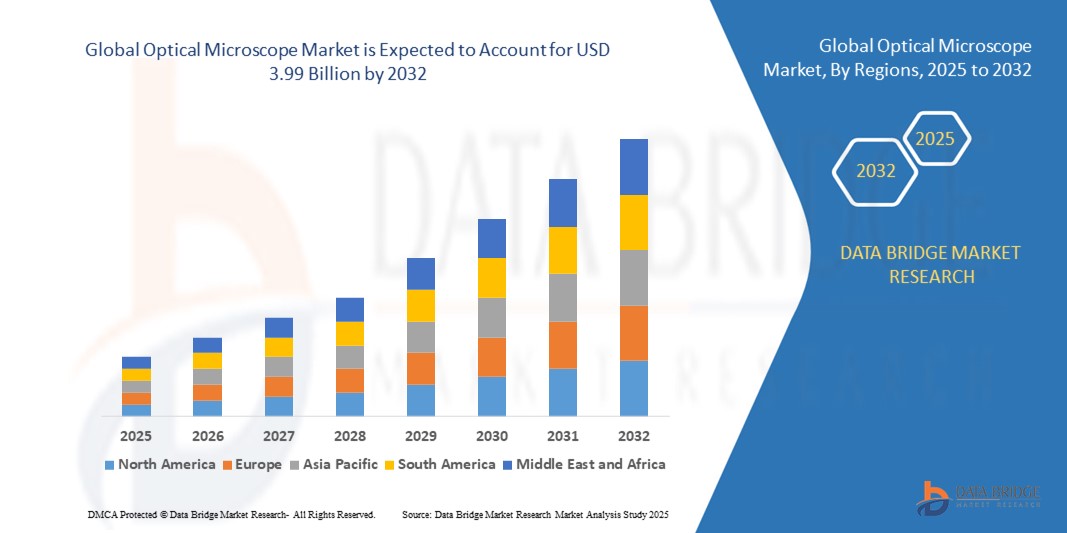
Optical Microscope Market Size
- The global optical microscope market size was valued at USD 2.54 billion in 2024 and is expected to reach USD 3.99 billion by 2032, at a CAGR of 5.80% during the forecast period
- The market growth is primarily driven by increasing demand for high-resolution imaging in medical diagnostics, research, and industrial applications, coupled with advancements in optical technologies and digital integration
- Rising awareness of the importance of precise diagnostics and research in healthcare and life sciences is further propelling the demand for optical microscopes across academic, clinical, and industrial sectors
Optical Microscope Market Analysis
- The optical microscope market is experiencing steady growth due to the growing need for advanced imaging solutions in scientific research, healthcare, and industrial quality control
- Increasing adoption in both high-end research facilities and cost-sensitive markets is encouraging manufacturers to innovate with compact, user-friendly, and digitally enhanced microscopes
- North America dominated the optical microscope market with the largest revenue share of 34.62% in 2024, driven by a well-established healthcare and research infrastructure, along with high investments in life sciences and biotechnology
- Asia-Pacific is expected to be the fastest-growing region during the forecast period, fueled by rapid advancements in healthcare infrastructure, increasing research funding, and growing adoption of advanced microscopy in countries such as China, India, and Japan
- The inverted microscopes segment dominated the largest market revenue share of 38.9% in 2024, driven by their compatibility with live-cell imaging and extensive use in regenerative medicine and tissue engineering. Inverted microscopes allow observation of samples from below, making them ideal for studying living cells in culture, which is critical for research in biotechnology and pharmaceutical development
Report Scope and Optical Microscope Market Segmentation
|
Attributes |
Optical Microscope Key Market Insights |
|
Segments Covered |
|
|
Countries Covered |
North America
Europe
Asia-Pacific
Middle East and Africa
South America
|
|
Key Market Players |
|
|
Market Opportunities |
|
|
Value Added Data Infosets |
In addition to the market insights such as market value, growth rate, market segments, geographical coverage, market players, and market scenario, the market report curated by the Data Bridge Market Research team includes in-depth expert analysis, import/export analysis, pricing analysis, production consumption analysis, and pestle analysis. |
Optical Microscope Market Trends
Increasing Integration of AI and Digital Imaging Technologies
- The global optical microscope market is experiencing a significant trend toward the integration of Artificial Intelligence (AI) and advanced digital imaging technologies
- These technologies enable automated image analysis, enhanced resolution, and real-time data processing, providing deeper insights into sample characteristics, cellular structures, and material properties
- AI-powered microscopy solutions facilitate proactive research and diagnostics by identifying patterns and anomalies in samples, reducing manual analysis time and improving accuracy
- For instance, companies are developing AI-driven platforms such as Nikon’s ECLIPSE Ji, which automate cellular image acquisition and analysis, streamlining workflows in cancer and neurological research
- This trend enhances the value proposition of optical microscopes, making them more efficient for academic research, clinical diagnostics, and industrial applications
- AI algorithms can analyze complex datasets, such as fluorescence imaging patterns, to support high-content screening and phenotype quantification in pharmaceutical research
Optical Microscope Market Dynamics
Driver
Rising Demand for Advanced Research and Diagnostic Capabilities
- The growing demand for high-resolution imaging in life sciences, biotechnology, and material sciences is a major driver for the global optical microscope market
- Optical microscopes enhance research and diagnostics through features such as live-cell imaging, fluorescence microscopy, and super-resolution capabilities
- Government funding, such as the National Institutes of Health’s shared instrumentation grants in North America and the EU’s Horizon Europe program, is contributing to the widespread adoption of advanced microscopy systems
- The proliferation of digital imaging and high-speed connectivity, such as 5G, enables faster data processing and sharing, supporting sophisticated applications such as telepathology and remote collaboration
- Manufacturers are increasingly offering advanced optical microscopes with integrated digital cameras and software as standard features to meet research and clinical demands
Restraint/Challenge
High Cost of Advanced Systems and Data Management Concerns
- The substantial initial investment required for advanced optical microscopes, including hardware, software, and integration, can be a significant barrier to adoption, particularly for smaller institutions and emerging markets
- Integrating sophisticated microscopy systems, such as confocal or super-resolution platforms, into existing laboratory workflows can be complex and costly
- In addition, data management and storage concerns pose a major challenge, as digital microscopes generate large volumes of high-resolution imaging data, raising issues about secure storage, processing capacity, and compliance with data protection regulations
- The fragmented regulatory landscape across countries regarding data handling and imaging standards complicates operations for global manufacturers and research facilities
- These factors can deter potential adopters and limit market expansion, especially in regions with limited funding or heightened sensitivity to data management costs
Optical Microscope market Scope
The market is segmented on the basis of product, and end user.
- By Product
On the basis of product, the global optical microscope market is segmented into compound microscopes, digital microscopes, stereo microscopes, inverted microscopes, and others. The inverted microscopes segment dominated the largest market revenue share of 38.9% in 2024, driven by their compatibility with live-cell imaging and extensive use in regenerative medicine and tissue engineering. Inverted microscopes allow observation of samples from below, making them ideal for studying living cells in culture, which is critical for research in biotechnology and pharmaceutical development. Their integration with advanced imaging technologies, such as fluorescence and confocal systems, further enhances their appeal for academic and clinical research.
The digital microscopes segment is expected to register the fastest growth rate from 2025 to 2032, as demand for automated and high-resolution imaging solutions grows. Digital microscopes, which capture and display images on a computer screen, offer seamless integration with AI-driven image analysis and remote collaboration tools. This makes them increasingly popular in diagnostics, education, and research, where real-time data sharing and automated analysis are critical for efficiency and accuracy.
- By End User
On the basis of end user, the global optical microscope market is categorized into hospitals and clinics, academic and research institutes, diagnostics laboratories, pharmaceutical and biotech companies, and others. The hospitals and clinics segment accounted for the highest revenue share in 2024, supported by the widespread use of optical microscopes in microbiology labs for identifying pathogens and intraoperative tissue analysis. These settings rely on microscopes for rapid diagnostics, high-quality imaging, and integration with digital pathology systems, which enhance documentation and collaboration among medical professionals.
The diagnostics laboratories segment is anticipated to grow at the fastest CAGR from 2025 to 2032, propelled by the rising demand for telepathology and AI-powered diagnostics. Diagnostic laboratories are increasingly adopting optical microscopes to handle high sample volumes, improve workflow efficiency, and support early disease detection. The growing prevalence of chronic diseases, such as cancer, and the expansion of diagnostic testing further accelerate the adoption of advanced microscopy solutions in this segment.
Optical Microscope Market Regional Analysis
- North America dominated the optical microscope market with the largest revenue share of 34.62% in 2024, driven by a well-established healthcare and research infrastructure, along with high investments in life sciences and biotechnology
- Consumers and institutions prioritize optical microscopes for high-resolution imaging, enhanced diagnostic accuracy, and research applications, particularly in regions with strong academic and healthcare infrastructure
- Growth is supported by advancements in microscopy technology, including digital imaging, fluorescence, and AI-powered analysis, alongside rising adoption in both academic and clinical settings
U.S. Optical Microscope Market Insight
The U.S. optical microscope market captured the largest revenue share of 87.3% in 2024 within North America, fueled by significant research funding and growing demand for advanced microscopy in life sciences and diagnostics. The trend towards automated and digital microscopy systems, coupled with increasing regulations promoting high-quality imaging standards, further boosts market expansion. The integration of microscopes in academic, research, and clinical applications creates a diverse product ecosystem.
Europe Optical Microscope Market Insight
The Europe optical microscope market is expected to witness significant growth, supported by regulatory emphasis on research excellence and diagnostic precision. Consumers and institutions seek microscopes that enhance imaging clarity while supporting advanced applications such as live-cell imaging. Growth is prominent in both academic research and clinical diagnostics, with countries such as Germany and France showing significant uptake due to rising investments in biotechnology and healthcare.
U.K. Optical Microscope Market Insight
The U.K. market for optical microscopes is expected to experience robust growth, driven by demand for high-resolution imaging and diagnostic accuracy in research and clinical settings. Increased interest in advanced microscopy techniques and growing awareness of their benefits in medical and scientific applications encourage adoption. Evolving regulations on diagnostic tools and research standards influence consumer choices, balancing imaging capabilities with compliance.
Germany Optical Microscope Market Insight
Germany is expected to witness significant growth in the optical microscope market, attributed to its advanced research and healthcare sectors and high consumer focus on precision imaging and efficiency. German institutions prefer technologically advanced microscopes, such as confocal and fluorescence systems, that support cutting-edge research and diagnostics. The integration of these microscopes in academic, clinical, and pharmaceutical applications supports sustained market growth.
Asia-Pacific Optical Microscope Market Insight
The Asia-Pacific region is expected to witness the fastest growth rate, driven by expanding research activities and rising investments in biotechnology and healthcare in countries such as China, India, and Japan. Increasing awareness of advanced imaging, diagnostic accuracy, and research applications is boosting demand. Government initiatives promoting scientific research and healthcare infrastructure further encourage the use of advanced optical microscopes.
Japan Optical Microscope Market Insight
Japan’s optical microscope market is expected to witness rapid growth due to strong consumer preference for high-quality, technologically advanced microscopes that enhance research and diagnostic capabilities. The presence of major microscope manufacturers and the integration of advanced systems in academic and clinical settings accelerate market penetration. Rising interest in research and development also contributes to growth.
China Optical Microscope Market Insight
China holds the largest share of the Asia-Pacific optical microscope market, propelled by rapid urbanization, increasing research funding, and growing demand for advanced imaging solutions. The country’s expanding biotechnology and healthcare sectors, along with a focus on scientific innovation, support the adoption of advanced optical microscopes. Strong domestic manufacturing capabilities and competitive pricing enhance market accessibility.
Optical Microscope Market Share
The optical microscope industry is primarily led by well-established companies, including:
- Apple ACCU-SCOPE Inc. (U.S.)
- Agilent Technologies (U.S.)
- AmScope (U.S.)
- Bruker Corporation (U.S.)
- Labomed, Inc. (U.S.)
- Olympus Corporation (Japan)
- Celestron (U.S.)
- Nikon Instruments Inc. (U.S.)
- Meiji Techno (Japan)
- Carl Zeiss AG (Germany)
- Hitachi High-Tech Corporation (Japan)
- Danaher Corporation (U.S.)
What are the Recent Developments in Global Optical Microscope Market?
- In June 2025, Thermo Fisher Scientific unveiled its next-generation Orbitrap Astral Zoom and Orbitrap Excedion Pro mass spectrometers at ASMS 2025, setting a new benchmark in biopharma and omics research. These advanced instruments deliver 35% faster scan speeds and 50% greater multiplexing capabilities, enabling deeper, more precise insights into complex biological systems. Designed to accelerate breakthroughs in precision medicine, they support high-throughput analysis of diseases such as Alzheimer’s and cancer, while improving workflow efficiency and data quality. The launch reflects Thermo Fisher’s commitment to pushing the boundaries of analytical science through cutting-edge innovation
- In May 2025, Bruker Corporation introduced the timsMetabo mass spectrometer, a pioneering platform for 4D-Metabolomics and 4D-Lipidomics research. This system integrates Trapped Ion Mobility Spectrometry (TIMS) with Mobility Range Enhancement technology, enabling high-resolution small molecule analysis and real-time gas-phase CCS ion separation. These capabilities allow for precise quantification and deeper insights into human metabolism, paving the way for more targeted therapeutic strategies and advancing our understanding of metabolic disorders and disease mechanisms
- In May 2025, Olympus Corporation received FDA clearance for its EZ1500 series endoscopes, marking a significant advancement in gastrointestinal imaging. These endoscopes feature Extended Depth of Field (EDOF) technology, which enhances image clarity and diagnostic precision during procedures. Seamlessly integrated with the EVIS X1™ system, the EZ1500 series also incorporates cutting-edge imaging modalities such as Texture and Color Enhancement Imaging and Narrow Band Imaging (NBI). Together, these innovations aim to improve lesion detection, streamline workflows, and elevate patient outcomes in clinical gastroenterology
- In April 2025, Bruker unveiled the nVista 2P Miniature Microscope, a compact two-photon imaging system tailored for functional imaging in freely behaving animals. This lightweight device enables high-resolution imaging at depths of up to 300 microns, making it ideal for in vivo neuroscience studies. Seamless integration with existing Inscopix systems enhances its utility, allowing researchers to capture dynamic neural activity with precision while maintaining animal mobility. The nVista 2P represents a significant leap in neurotechnology, supporting deeper insights into brain function and behavior

- Interactive Data Analysis Dashboard
- Company Analysis Dashboard for high growth potential opportunities
- Research Analyst Access for customization & queries
- Competitor Analysis with Interactive dashboard
- Latest News, Updates & Trend analysis
- Harness the Power of Benchmark Analysis for Comprehensive Competitor Tracking
Data collection and base year analysis are done using data collection modules with large sample sizes. The stage includes obtaining market information or related data through various sources and strategies. It includes examining and planning all the data acquired from the past in advance. It likewise envelops the examination of information inconsistencies seen across different information sources. The market data is analysed and estimated using market statistical and coherent models. Also, market share analysis and key trend analysis are the major success factors in the market report. To know more, please request an analyst call or drop down your inquiry.
The key research methodology used by DBMR research team is data triangulation which involves data mining, analysis of the impact of data variables on the market and primary (industry expert) validation. Data models include Vendor Positioning Grid, Market Time Line Analysis, Market Overview and Guide, Company Positioning Grid, Patent Analysis, Pricing Analysis, Company Market Share Analysis, Standards of Measurement, Global versus Regional and Vendor Share Analysis. To know more about the research methodology, drop in an inquiry to speak to our industry experts.
Data Bridge Market Research is a leader in advanced formative research. We take pride in servicing our existing and new customers with data and analysis that match and suits their goal. The report can be customized to include price trend analysis of target brands understanding the market for additional countries (ask for the list of countries), clinical trial results data, literature review, refurbished market and product base analysis. Market analysis of target competitors can be analyzed from technology-based analysis to market portfolio strategies. We can add as many competitors that you require data about in the format and data style you are looking for. Our team of analysts can also provide you data in crude raw excel files pivot tables (Fact book) or can assist you in creating presentations from the data sets available in the report.













