


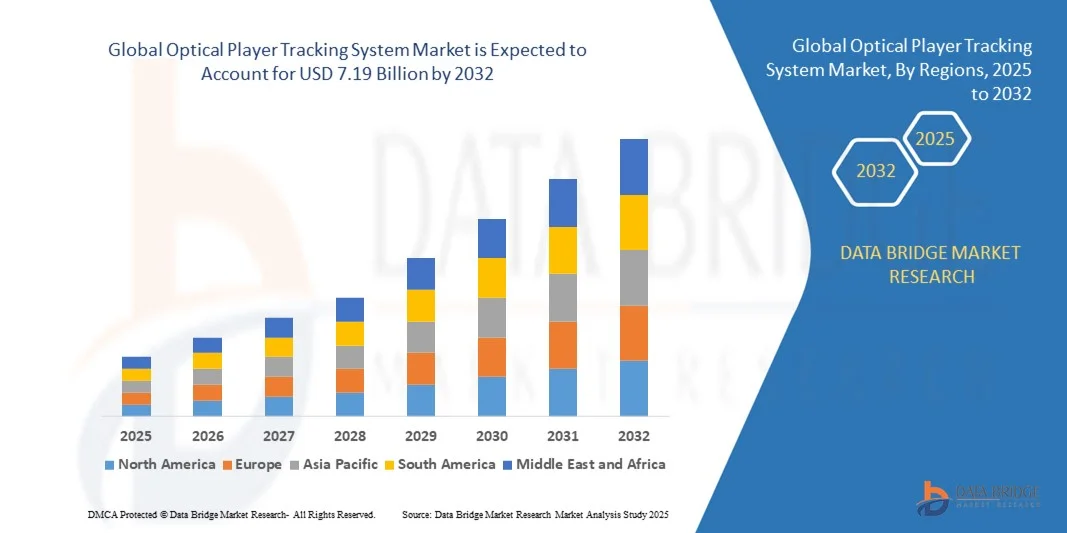
Optical Player Tracking System Market Size
- The global optical player tracking system market size was valued at USD 1.20 billion in 2024 and is expected to reach USD 7.19 billion by 2032, at a CAGR of 25.10% during the forecast period
- The market growth is largely fuelled by the rising adoption of advanced analytics and wearable technologies in professional sports to enhance player performance and injury prevention
- Increasing investments by sports teams and organizations in performance tracking solutions to gain a competitive edge are further driving market expansion
Optical Player Tracking System Market Analysis
- The market is witnessing strong growth due to the increasing need for precise and real-time performance monitoring in sports such as football, basketball, cricket, and tennis
- Technological advancements in camera systems, high-speed sensors, and AI-based motion tracking are enhancing the accuracy and efficiency of player tracking solutions
- North America dominated the optical player tracking system market with the largest revenue share of 42.15% in 2024, driven by the growing adoption of advanced sports analytics and performance monitoring technologies across professional and amateur leagues
- Asia-Pacific region is expected to witness the highest growth rate in the global optical player tracking system market, driven by increasing urbanization, rising government support for sports development, and growing interest in data-driven performance optimization across both individual and team sports
- The Solutions segment held the largest market revenue share in 2024, driven by the widespread adoption of advanced tracking software, high-speed cameras, and motion capture technologies that enable real-time performance analysis. Solutions offer integrated platforms for data collection, visualization, and reporting, making them the preferred choice for professional sports teams and training academies
Report Scope and Optical Player Tracking System Market Segmentation
|
Attributes |
Optical Player Tracking System Key Market Insights |
|
Segments Covered |
|
|
Countries Covered |
North America
Europe
Asia-Pacific
Middle East and Africa
South America
|
|
Key Market Players |
|
|
Market Opportunities |
|
|
Value Added Data Infosets |
In addition to the market insights such as market value, growth rate, market segments, geographical coverage, market players, and market scenario, the market report curated by the Data Bridge Market Research team includes in-depth expert analysis, import/export analysis, pricing analysis, production consumption analysis, and pestle analysis. |
Optical Player Tracking System Market Trends
Increasing Adoption of Real-Time Player Performance Analytics
- The growing use of real-time performance analytics is transforming the sports technology landscape by enabling instant tracking of player movements, speed, and positioning. The integration of optical tracking systems allows coaches and analysts to make immediate tactical decisions, enhancing team performance and minimizing injury risks. In addition, collected data can be used for long-term performance benchmarking, player conditioning programs, and strategic planning for upcoming matches
- Rising demand for data-driven insights in professional and amateur sports leagues is accelerating the adoption of high-speed cameras, sensors, and motion capture platforms. These systems are particularly valuable for sports with fast-paced action such as football, basketball, and hockey, where precise performance tracking is critical. Moreover, advanced visualization and reporting tools are enabling coaches and analysts to quickly interpret data and implement actionable strategies
- The affordability and ease of deploying modern optical tracking solutions are making them increasingly popular for training sessions, match analysis, and talent scouting. Teams and academies can implement tracking solutions without substantial infrastructure investment, improving overall player management and performance evaluation. In addition, these systems facilitate remote monitoring and allow data sharing between coaching staff, sports scientists, and management for collaborative decision-making
- For instance, in 2023, several European football clubs reported enhanced player performance monitoring after integrating optical tracking systems into their training facilities. These systems allowed for detailed motion analysis, optimizing training schedules and reducing injury risks while improving competitive results. The insights gained also helped in recovery management, rotation planning, and long-term development of youth players within the club’s academy system
- While optical tracking systems are accelerating data-driven sports management, their effectiveness depends on continual software updates, sensor calibration, and staff training. Providers must focus on scalable, user-friendly solutions to fully capitalize on growing demand. Integration with AI-driven predictive analytics and cloud-based platforms is also critical for maximizing the potential of these systems across leagues and tournaments globally
Optical Player Tracking System Market Dynamics
Driver
Rising Demand for Performance Optimization and Injury Prevention in Sports
- The increasing focus on maximizing athlete performance is encouraging teams and organizations to adopt optical player tracking solutions. By monitoring key metrics such as speed, acceleration, and fatigue, coaches can optimize training and reduce injury risks, improving overall team performance. Furthermore, these insights support long-term player health management, early injury detection, and tailored conditioning programs for individual athletes
- Sports organizations are increasingly investing in analytics tools to gain a competitive edge, and the trend is supported by rising consumer demand for high-quality, entertaining sports content. Detailed performance data allows for better tactical planning, scouting, and in-game decision-making. The availability of interactive dashboards and visualization tools also enables coaches to communicate findings effectively to players, enhancing performance understanding and execution
- Government and sports federations are promoting advanced analytics and technology adoption in professional leagues and youth academies. Funding programs and technological partnerships are helping clubs deploy state-of-the-art tracking systems for both training and match-day applications. These initiatives are also encouraging standardized performance measurement frameworks across leagues and promoting the adoption of technology in grassroots and amateur sports
- For instance, in 2022, the English Premier League mandated the use of optical tracking systems across all clubs to enhance player performance analysis, boosting demand for sophisticated high-speed camera solutions. This move also led to the integration of wearable sensors and AI-powered analytics in training programs, allowing clubs to gain a competitive advantage through objective, data-driven insights
- While performance optimization and institutional support are driving market growth, there is a need to enhance affordability, ensure technical support, and integrate tracking data into coaching workflows to sustain adoption. Collaboration between technology providers, sports scientists, and team management is key to maximizing value and ensuring seamless deployment across multiple competitions and venues
Restraint/Challenge
High Cost of Optical Tracking Systems and Technical Complexity
- Advanced optical tracking systems, including high-speed cameras, motion sensors, and analytics software, come at a high cost, limiting access for smaller clubs and academies. This cost barrier remains a significant challenge for widespread adoption. In addition, ongoing maintenance, software updates, and system calibration add further operational expenses that can deter small and medium-sized organizations
- In many regions, a lack of trained personnel capable of operating and maintaining these complex systems restricts deployment. Teams often require technical experts to calibrate cameras, manage data, and interpret analytics, which adds to operational costs. Furthermore, the steep learning curve for integrating tracking outputs into practical coaching strategies can slow adoption among less technologically adept organizations
- Supply chain and installation challenges, particularly for outdoor stadiums and large arenas, further constrain market penetration. Ensuring accurate tracking across multiple zones and under varied lighting conditions requires specialized infrastructure and ongoing maintenance. Delays in component availability and installation complexities can also impede the timely deployment of optical tracking solutions in developing regions
- For instance, in 2023, several small-scale football academies in Sub-Saharan Africa reported limited access to optical tracking systems due to high equipment costs and the absence of local technical support. This gap highlights the need for cost-effective, scalable solutions and localized training programs to improve adoption and operational efficiency
- While technology continues to advance, addressing cost and complexity challenges is essential. Market stakeholders need to focus on modular, scalable systems, cloud-based analytics, and remote support to expand adoption and unlock the full potential of the optical player tracking system market. Developing subscription-based models and cloud services can also lower entry barriers and make advanced tracking solutions more accessible to a broader range of sports organizations globally
Optical Player Tracking System Market Scope
The market is segmented on the basis of type, end-user, application, and deployment types.
- By Type
On the basis of type, the optical player tracking system market is segmented into Solutions and Services. The Solutions segment held the largest market revenue share in 2024, driven by the widespread adoption of advanced tracking software, high-speed cameras, and motion capture technologies that enable real-time performance analysis. Solutions offer integrated platforms for data collection, visualization, and reporting, making them the preferred choice for professional sports teams and training academies.
The Services segment is expected to witness the fastest growth rate from 2025 to 2032, driven by increasing demand for installation, maintenance, technical support, and data analytics services. Services are particularly popular among smaller clubs and emerging sports leagues that require expert guidance and scalable solutions without investing heavily in hardware infrastructure.
- By End-User
On the basis of end-user, the market is segmented into Individual Sports and Team Sports. The Team Sports segment held the largest market share in 2024, supported by the rising adoption of player tracking technologies in football, basketball, hockey, and cricket leagues worldwide. These systems provide coaches and analysts with comprehensive data to optimize team strategies, monitor player performance, and prevent injuries.
The Individual Sports segment is expected to witness the fastest growth from 2025 to 2032, fueled by the increasing use of optical tracking systems in tennis, athletics, swimming, and other competitive sports where precise motion analysis can enhance athlete performance and training outcomes.
- By Application
On the basis of application, the market is segmented into Fitness Tracking, Performance Tracking, Fraud Detection, and Player Safety. The Performance Tracking segment held the largest revenue share in 2024, driven by growing demand for real-time analytics and tactical insights to improve training efficiency, match strategies, and overall player development.
The Player Safety segment is expected to witness the fastest growth from 2025 to 2032, supported by increasing awareness about injury prevention, monitoring of fatigue, and tracking high-risk movements. These applications are becoming critical for professional teams and leagues to ensure long-term athlete health and career longevity.
- By Deployment Types
On the basis of deployment types, the market is segmented into Cloud and On-Premise. The Cloud segment held the largest share in 2024, driven by the growing preference for scalable, remote-accessible tracking solutions that enable data storage, processing, and analysis without requiring extensive on-site infrastructure.
The On-Premise segment is expected to witness the fastest growth from 2025 to 2032, fueled by organizations seeking enhanced data security, low latency, and complete control over analytics systems. On-premise deployment is particularly preferred by professional clubs and sports institutions with large-scale operations and dedicated IT teams.
Optical Player Tracking System Market Regional Analysis
- North America dominated the optical player tracking system market with the largest revenue share of 42.15% in 2024, driven by the growing adoption of advanced sports analytics and performance monitoring technologies across professional and amateur leagues
- Teams and sports organizations in the region highly value the accuracy, real-time insights, and ease of integrating optical tracking systems with other analytics platforms and wearable devices
- This widespread adoption is further supported by substantial investments in sports infrastructure, technologically advanced training facilities, and a strong focus on data-driven performance optimization, establishing optical tracking solutions as a preferred tool for both individual and team sports
U.S. Optical Player Tracking System Market Insight
The U.S. optical player tracking system market captured the largest revenue share in 2024 within North America, fueled by the increasing use of high-speed cameras, motion sensors, and AI-driven analytics to enhance player performance. Sports teams are increasingly prioritizing tactical analysis, injury prevention, and talent scouting through real-time tracking systems. Moreover, the growing demand for data-driven coaching, cloud-based analytics, and integration with wearable devices is significantly contributing to market expansion.
Europe Optical Player Tracking System Market Insight
The Europe optical player tracking system market is expected to witness the fastest growth rate from 2025 to 2032, primarily driven by rising investments in professional sports analytics and stringent regulations regarding player safety. Increasing urbanization and the adoption of technologically advanced training facilities are fostering the deployment of tracking solutions. European sports clubs are also integrating optical tracking systems in both match-day analysis and training programs to improve performance and reduce injury risks.
U.K. Optical Player Tracking System Market Insight
The U.K. optical player tracking system market is expected to witness the fastest growth rate from 2025 to 2032, driven by the adoption of advanced analytics in football, rugby, and cricket leagues. Increasing emphasis on player performance optimization and injury prevention is encouraging both clubs and academies to implement optical tracking solutions. The U.K.’s robust sports infrastructure, digital adoption, and access to technical expertise are expected to further accelerate market growth.
Germany Optical Player Tracking System Market Insight
The Germany optical player tracking system market is expected to witness notable growth from 2025 to 2032, fueled by growing awareness of sports science, injury prevention, and performance monitoring. Germany’s well-developed infrastructure, emphasis on innovation, and strong presence of professional sports leagues promote the adoption of optical tracking systems. Integration with AI analytics and wearable devices is becoming increasingly prevalent, aligning with local teams’ focus on maximizing athlete performance.
Asia-Pacific Optical Player Tracking System Market Insight
The Asia-Pacific optical player tracking system market is expected to witness the fastest growth rate from 2025 to 2032, driven by rapid urbanization, increasing investments in professional and amateur sports infrastructure, and rising awareness of performance analytics in countries such as China, Japan, and India. The region’s growing focus on data-driven training, coupled with government initiatives supporting sports technology adoption, is accelerating demand. Furthermore, APAC’s emergence as a manufacturing hub for high-speed cameras and sensors is improving accessibility and affordability for local sports organizations.
Japan Optical Player Tracking System Market Insight
The Japan optical player tracking system market is expected to witness the fastest growth rate from 2025 to 2032, due to the country’s high-tech culture, growing adoption of smart sports facilities, and focus on athlete safety and performance optimization. Optical tracking solutions are increasingly integrated with IoT devices and wearable sensors for real-time monitoring. In addition, Japan’s aging sports population and focus on precision training are driving demand for easy-to-use, accurate, and reliable tracking systems across professional and amateur sports.
China Optical Player Tracking System Market Insight
The China optical player tracking system market accounted for the largest market revenue share in Asia-Pacific in 2024, attributed to the country’s growing investments in sports infrastructure, rapid urbanization, and adoption of advanced sports analytics technologies. China is increasingly incorporating optical tracking systems in football, basketball, and other professional sports leagues. Government support for smart stadiums, coupled with the availability of cost-effective tracking solutions and strong domestic manufacturing, is propelling the market forward.
Optical Player Tracking System Market Share
The Optical Player Tracking System industry is primarily led by well-established companies, including:
• Zebra Technologies Corp. (U.S.)
• Catapult Group International Limited (Australia)
• Stats Perform (U.K.)
• ChyronHego Corporation (U.S.)
• Kinexon (Germany)
• Polar Electro (Finland)
• Johan Sports (U.K.)
• Xampion (Italy)
• PlayGineering (U.K.)
• Advanced Sports Analytics (U.S.)
• Sonda Sports Ltd. (Israel)
• STATSports Group (U.K.)
• Exelio Srl (Italy)

- Interactive Data Analysis Dashboard
- Company Analysis Dashboard for high growth potential opportunities
- Research Analyst Access for customization & queries
- Competitor Analysis with Interactive dashboard
- Latest News, Updates & Trend analysis
- Harness the Power of Benchmark Analysis for Comprehensive Competitor Tracking
Data collection and base year analysis are done using data collection modules with large sample sizes. The stage includes obtaining market information or related data through various sources and strategies. It includes examining and planning all the data acquired from the past in advance. It likewise envelops the examination of information inconsistencies seen across different information sources. The market data is analysed and estimated using market statistical and coherent models. Also, market share analysis and key trend analysis are the major success factors in the market report. To know more, please request an analyst call or drop down your inquiry.
The key research methodology used by DBMR research team is data triangulation which involves data mining, analysis of the impact of data variables on the market and primary (industry expert) validation. Data models include Vendor Positioning Grid, Market Time Line Analysis, Market Overview and Guide, Company Positioning Grid, Patent Analysis, Pricing Analysis, Company Market Share Analysis, Standards of Measurement, Global versus Regional and Vendor Share Analysis. To know more about the research methodology, drop in an inquiry to speak to our industry experts.
Data Bridge Market Research is a leader in advanced formative research. We take pride in servicing our existing and new customers with data and analysis that match and suits their goal. The report can be customized to include price trend analysis of target brands understanding the market for additional countries (ask for the list of countries), clinical trial results data, literature review, refurbished market and product base analysis. Market analysis of target competitors can be analyzed from technology-based analysis to market portfolio strategies. We can add as many competitors that you require data about in the format and data style you are looking for. Our team of analysts can also provide you data in crude raw excel files pivot tables (Fact book) or can assist you in creating presentations from the data sets available in the report.













