


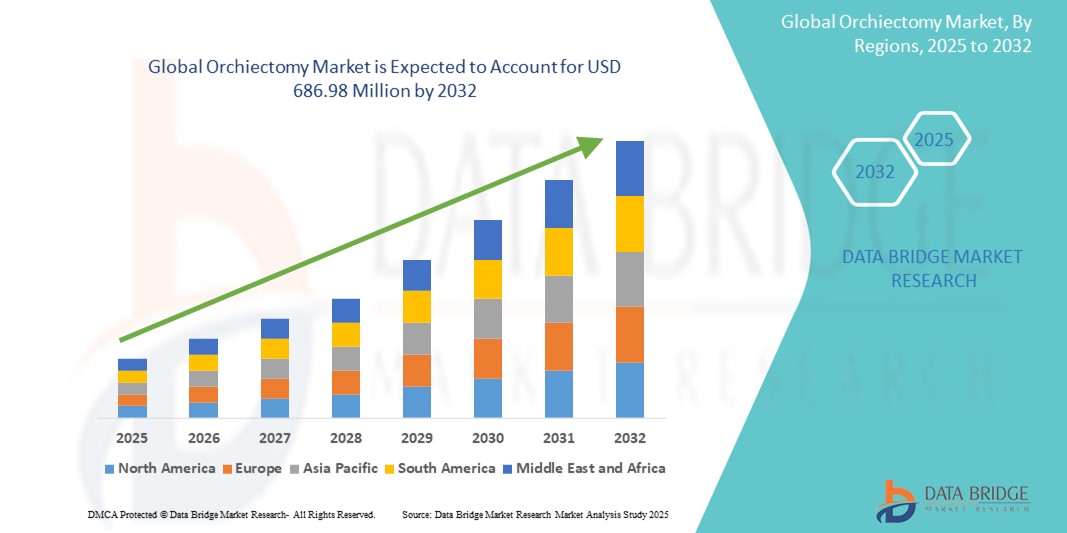
Orchiectomy Market Size
- The global orchiectomy market size was valued at USD 342.00 Million in 2024 and is expected to reach USD 686.98 Million by 2032, at a CAGR of 9.11% during the forecast period
- The market growth is largely fueled by the growing prevalence of testicular and prostate cancers, rising awareness about gender-affirming surgeries, and continuous advancements in surgical techniques, leading to increased demand for orchiectomy procedures across hospitals and specialty clinics
- Furthermore, rising patient interest in safe, effective, and personalized healthcare solutions is establishing orchiectomy as a critical component in both oncological and gender transition treatments. These converging factors are accelerating the uptake of orchiectomy solutions, thereby significantly boosting the industry's growth
Orchiectomy Market Analysis
- Orchiectomy, a surgical procedure involving the removal of one or both testicles, is increasingly recognized as a critical component of treatment for conditions such as testicular cancer, prostate cancer, and gender affirmation procedures. The market is expanding due to rising cancer incidence, improved surgical accessibility, and growing awareness around gender-affirming healthcare
- The growing demand for orchiectomy procedures is primarily driven by the increasing prevalence of testicular and prostate cancers, rising acceptance and demand for gender-affirming surgeries, and improved reimbursement frameworks in developed countries
- North America dominated the orchiectomy market with the largest revenue share of 41.6% in 2024, attributed to its advanced healthcare infrastructure, high awareness levels, and favorable insurance coverage for oncological and gender-affirming surgeries. The U.S. remains the key revenue contributor, supported by the growing number of specialty surgical centers and patient support programs
- Asia-Pacific is projected to be the fastest-growing region in the Orchiectomy market during the forecast period, registering a CAGR of 7.4% from 2025 to 2032. Factors such as rising cancer screening rates, growing access to surgical care, medical tourism, and increased awareness of gender dysphoria treatments in countries like India, Thailand, and South Korea are accelerating market expansion
- The Male to Female segment dominated the Orchiectomy market with a market share of 59.3% in 2024, driven by the increasing demand for gender-affirming procedures among transgender women and the expansion of supportive healthcare policies. This segment is further supported by growing awareness, improved access to specialized surgical centers, and broader insurance coverage, all contributing to its dominance in the market
Report Scope and Orchiectomy Market Segmentation
|
Attributes |
Orchiectomy Key Market Insights |
|
Segments Covered |
|
|
Countries Covered |
North America
Europe
Asia-Pacific
Middle East and Africa
South America
|
|
Key Market Players |
|
|
Market Opportunities |
|
|
Value Added Data Infosets |
In addition to the insights on market scenarios such as market value, growth rate, segmentation, geographical coverage, and major players, the market reports curated by the Data Bridge Market Research also include in-depth expert analysis, pricing analysis, brand share analysis, consumer survey, demography analysis, supply chain analysis, value chain analysis, raw material/consumables overview, vendor selection criteria, PESTLE Analysis, Porter Analysis, and regulatory framework. |
Orchiectomy Market Trends
“Increased Demand Driven by Gender Affirmation Surgeries and Cancer Treatment”
- A significant and accelerating trend in the global orchiectomy market is the rising number of gender affirmation procedures, particularly among the transgender population. Orchiectomy plays a crucial role in male-to-female gender transition, often serving as a precursor or alternative to hormone therapy. This growing demand for gender-affirming surgeries is expanding the patient base for orchiectomy procedures
- For instance, the World Professional Association for Transgender Health (WPATH) updated its standards of care to support broader access to gender-affirming surgical procedures, increasing global demand for orchiectomy as a medically recognized treatment pathway
- In addition, orchiectomy is a well-established treatment for testicular cancer and prostate cancer. With prostate cancer remaining one of the most diagnosed cancers in men worldwide, the procedure continues to be recommended in advanced or hormone-sensitive cases to control androgen levels
- Advances in minimally invasive surgical techniques, such as laparoscopic and robotic-assisted procedures, are making orchiectomy safer and more appealing. These innovations reduce hospital stays, postoperative pain, and recovery time, contributing to higher patient satisfaction and procedural adoption
- The availability of orchiectomy across diverse healthcare settings—including hospitals, ambulatory surgical centers, and specialty clinics—is also making the procedure more accessible. Health systems in North America and Europe, in particular, have streamlined referral pathways to provide timely access to gender-affirming and oncological surgeries
- Furthermore, increasing healthcare awareness, government support for LGBTQ+ health initiatives, and improved insurance coverage for transgender-related surgeries are all contributing to the global expansion of the orchiectomy market. These factors, combined with a rise in medical tourism for affordable gender reassignment procedures in regions like Asia-Pacific and Latin America, are fueling market growth at a robust pace
Orchiectomy Market Dynamics
Driver
“Growing Need Due to Rising Disease Prevalence and Surgical Demand”
- The increasing prevalence of testicular cancer, gender-affirming care, and chronic conditions like advanced prostate cancer is significantly driving the global demand for orchiectomy procedures
- For instance, in April 2024, the American Cancer Society reported a steady rise in testicular cancer diagnosis rates among males aged 15–44, emphasizing the need for timely surgical intervention such as orchiectomy. Such findings are expected to fuel demand for surgical solutions throughout the forecast period
- As public awareness about early cancer detection and gender-affirming surgery grows, more patients are opting for orchiectomy either as a preventive or essential treatment, offering a substantial boost to the market
- Furthermore, the growing availability of specialized surgical centers, alongside improved diagnostic screening practices, is making orchiectomy a standard, accessible procedure in many regions
- The rise in medical tourism and advancements in minimally invasive surgical techniques also contribute to the growing preference for orchiectomy in both high- and middle-income countries. Countries like Thailand and India have emerged as key destinations for affordable and high-quality gender-confirmation surgeries
Restraint/Challenge
“Concerns Regarding Post-Surgical Complications and Cost Accessibility”
- Post-surgical complications, such as hormonal imbalance, infection risks, or psychological distress, pose key challenges to the broader acceptance of orchiectomy, particularly in low-income settings where follow-up care is limited
- For instance, studies from the Icahn School of Medicine at Mount Sinai highlight the need for long-term endocrinological management in patients undergoing bilateral orchiectomy, which may not be readily available in under-resourced healthcare systems
- Addressing these concerns through better surgical protocols, post-operative counseling, and availability of hormone replacement therapy (HRT) is crucial to improving outcomes and encouraging uptake
- In addition, the relatively high cost of surgery in private institutions, especially for uninsured individuals or international patients seeking gender affirmation procedures, may act as a financial barrier
- While non-profit organizations and public health insurance in some countries help subsidize costs, the need for out-of-pocket expenses in other regions may limit accessibility to those in need
- Overcoming these barriers will require multi-pronged strategies including government reimbursement support, global health equity initiatives, and investments in affordable surgical infrastructure
Orchiectomy Market Scope
The orchiectomy market is segmented into six notable segments based on gender transition, type, indication, end-user, distribution channel, and route of administration.
- By Gender Transition
On the basis of gender transition, the orchiectomy market is segmented into male to female and female to male. The male to female segment accounted for the largest revenue share of 59.3% in 2024, driven by increasing demand for gender-affirming procedures among transgender women and wider access to supportive healthcare policies.
The female to male segment is projected to grow at the fastest CAGR of 9.4% from 2025 to 2032, owing to rising awareness and better availability of specialized services for female-to-male gender transitions.
- By Type
On the basis of type, the orchiectomy market is segmented into simple orchiectomy, subcapsular orchiectomy, inguinal orchiectomy, and others. The simple orchiectomy segment held the largest market share of 41.6% in 2024, due to its frequent use in hormone-sensitive conditions and gender-affirming surgeries.
The Inguinal Orchiectomy segment is expected to witness the fastest CAGR of 10.1% from 2025 to 2032, fueled by increasing testicular cancer prevalence and treatment effectiveness.
- By Indication
On the basis of indication, the orchiectomy market is segmented into gender reassignment, testicular cancer, prostate cancer, and others. The gender reassignment segment dominated the market with a share of 47.8% in 2024, due to growing social acceptance and insurance coverage for transgender procedures.
The testicular cancer segment is projected to grow at the highest CAGR of 10.8% from 2025 to 2032, driven by improved screening and early diagnosis programs globally.
- By End-User
On the basis of end-user, the orchiectomy market is segmented into hospitals, specialty clinics, ambulatory surgical centers, and others. The hospitals segment accounted for the largest revenue share of 52.4% in 2024, attributed to their capability to perform complex surgeries and post-operative care.
The ambulatory surgical centers segment is projected to expand at the fastest CAGR of 8.9% from 2025 to 2032, as outpatient procedures become increasingly preferred for cost-effectiveness and convenience.
- By Distribution Channel
On the basis of distribution channel, the orchiectomy market is segmented into direct tenders, retail pharmacies, and online pharmacies. The direct tenders segment held the largest market share of 48.1% in 2024, reflecting high-volume purchases by public and private hospitals.
The online pharmacies segment is expected to register the fastest CAGR of 11.5% from 2025 to 2032, due to rising digital adoption and ease of ordering medications post-surgery.
- By Route of Administration
On the basis of route of administration, the orchiectomy market is segmented into oral, injectable, and others. The injectable segment dominated with a revenue share of 57.6% in 2024, as injectable hormone suppressants and antibiotics are widely used post-surgery.
The oral segment is projected to grow at the fastest CAGR of 9.1% from 2025 to 2032, driven by increasing prescription of oral hormone modulators for ongoing patient care.
Orchiectomy Market Regional Analysis
- North America dominated the orchiectomy market with the largest revenue share of 41.6% in 2024, driven by the rising prevalence of testicular cancer, increased access to surgical treatments, and growing awareness around male reproductive health
- The availability of specialized urological centers and favorable reimbursement policies also contribute to the market's strong position in this region
- Patients in the region benefit from advanced healthcare infrastructure, increasing awareness of early cancer detection, and supportive gender-affirming healthcare services. The U.S., in particular, sees a notable rise in orchiectomy procedures both for oncological and gender-affirming indications
U.S. Orchiectomy Market Insight
The U.S. orchiectomy market captured the largest revenue share of 85.1% in 2024 within North America, supported by the country's leading role in gender reassignment surgeries and oncological procedures. Growing public awareness, access to advanced robotic-assisted surgeries, and support from public and private insurance providers continue to propel the market forward. Moreover, strong academic and research institutions further support innovation in surgical techniques and postoperative care.
Europe Orchiectomy Market Insight
The Europe orchiectomy market is projected to expand at a substantial CAGR during the forecast period, driven by progressive healthcare policies, rising testicular cancer incidence, and increasing acceptance of gender-affirming surgeries. Countries such as Germany, the U.K., and the Netherlands have established treatment protocols, making them key contributors to market growth. Favorable healthcare reimbursement structures and access to specialized clinics are key enablers in the region.
U.K. Orchiectomy Market Insight
The U.K. orchiectomy market is anticipated to grow at a noteworthy CAGR during the forecast period. The increasing demand for gender-affirming procedures, combined with rising cancer screening rates and public health initiatives, is contributing to market growth. The National Health Service (NHS) and expanding private sector offerings enhance access to orchiectomy procedures across diverse patient populations.
Germany Orchiectomy Market Insight
The Germany orchiectomy market is expected to expand at a considerable CAGR during the forecast period, supported by well-developed surgical infrastructure and a strong emphasis on precision, privacy, and patient care. Germany is at the forefront of robotic-assisted surgeries and advanced urological treatments, making it a preferred destination for both domestic and international patients seeking high-quality orchiectomy procedures.
Asia-Pacific Orchiectomy Market Insight
The Asia-Pacific orchiectomy market is poised to grow at the fastest CAGR of 7.4% from 2025 to 2032, driven by rising medical tourism, increasing awareness around testicular and prostate health, and improving surgical capabilities across the region. Countries like Thailand, India, and South Korea are emerging as key medical tourism hubs, offering affordable and high-quality orchiectomy procedures, particularly for transgender individuals seeking gender-confirming care.
Japan Orchiectomy Market Insight
The Japan orchiectomy market is gaining momentum due to the country’s advanced healthcare infrastructure, aging population, and early adoption of minimally invasive surgical techniques. With a cultural emphasis on privacy and precision, Japan sees steady demand for orchiectomy both for cancer-related cases and elective gender-affirming procedures. Strong hospital networks and high-quality postoperative care ensure favorable patient outcomes.
China Orchiectomy Market Insight
The China orchiectomy market accounted for the largest revenue share in Asia Pacific in 2024, attributed to the country’s large population base, rapid urbanization, and expanding access to advanced surgical services. The Chinese government’s investment in healthcare modernization and public health campaigns supporting male reproductive health are major drivers. Additionally, the rise of private surgical centers offering affordable orchiectomy options is boosting access across both urban and semi-urban regions.
Orchiectomy Market Share
The orchiectomy industry is primarily led by well-established companies, including:
- Phuket.Net (Thailand)
- Rumer Cosmetic Surgery (U.S.)
- Bupa (U.K.)
- Icahn School of Medicine at Mount Sinai (U.S.)
- Sava Perovic Foundation (U.S.)
- Transgender Surgery Institute (U.S.)
- WIH International Hospital (Thailand)
- Yeson Voice Centre (South Korea)
Latest Developments in Global Orchiectomy Market
- In January 2024, the Icahn School of Medicine at Mount Sinai (U.S.) launched a dedicated multidisciplinary gender-affirming care center, expanding access to orchiectomy and related surgeries. This development supports rising demand for transgender healthcare and aligns with a broader movement toward comprehensive, inclusive medical services
- In November 2023, Yeson Voice Center (South Korea), a prominent gender-affirming surgical facility, reported a significant uptick in international patients seeking orchiectomy and related procedures, driven by the center's minimally invasive techniques and strong post-operative outcomes
- In September 2023, WIH International Hospital (Thailand) expanded its surgical unit to include advanced orchiectomy procedures for both medical and gender-affirming indications. The facility is now positioning itself as a regional hub for high-quality, cost-effective urological surgeries
- In August 2023, the Transgender Surgery Institute (U.S.) announced the adoption of enhanced recovery after surgery (ERAS) protocols specifically tailored to orchiectomy, which have resulted in reduced hospital stays and improved patient satisfaction

- Interactive Data Analysis Dashboard
- Company Analysis Dashboard for high growth potential opportunities
- Research Analyst Access for customization & queries
- Competitor Analysis with Interactive dashboard
- Latest News, Updates & Trend analysis
- Harness the Power of Benchmark Analysis for Comprehensive Competitor Tracking
Data collection and base year analysis are done using data collection modules with large sample sizes. The stage includes obtaining market information or related data through various sources and strategies. It includes examining and planning all the data acquired from the past in advance. It likewise envelops the examination of information inconsistencies seen across different information sources. The market data is analysed and estimated using market statistical and coherent models. Also, market share analysis and key trend analysis are the major success factors in the market report. To know more, please request an analyst call or drop down your inquiry.
The key research methodology used by DBMR research team is data triangulation which involves data mining, analysis of the impact of data variables on the market and primary (industry expert) validation. Data models include Vendor Positioning Grid, Market Time Line Analysis, Market Overview and Guide, Company Positioning Grid, Patent Analysis, Pricing Analysis, Company Market Share Analysis, Standards of Measurement, Global versus Regional and Vendor Share Analysis. To know more about the research methodology, drop in an inquiry to speak to our industry experts.
Data Bridge Market Research is a leader in advanced formative research. We take pride in servicing our existing and new customers with data and analysis that match and suits their goal. The report can be customized to include price trend analysis of target brands understanding the market for additional countries (ask for the list of countries), clinical trial results data, literature review, refurbished market and product base analysis. Market analysis of target competitors can be analyzed from technology-based analysis to market portfolio strategies. We can add as many competitors that you require data about in the format and data style you are looking for. Our team of analysts can also provide you data in crude raw excel files pivot tables (Fact book) or can assist you in creating presentations from the data sets available in the report.













