


Global Organ Preservation Market
Market Size in USD Million
CAGR :
% 
 USD
294.78 Million
USD
544.80 Million
2025
2033
USD
294.78 Million
USD
544.80 Million
2025
2033
 Forecast Period Forecast Period |
2026 –2033 |
 Market Size (Base Year) Market Size (Base Year) |
USD 294.78 Million |
 Market Size (Forecast Year) Market Size (Forecast Year) |
USD 544.80 Million |
 CAGR CAGR |
% |
| Major Markets Players |
|
Organ Preservation Market Size
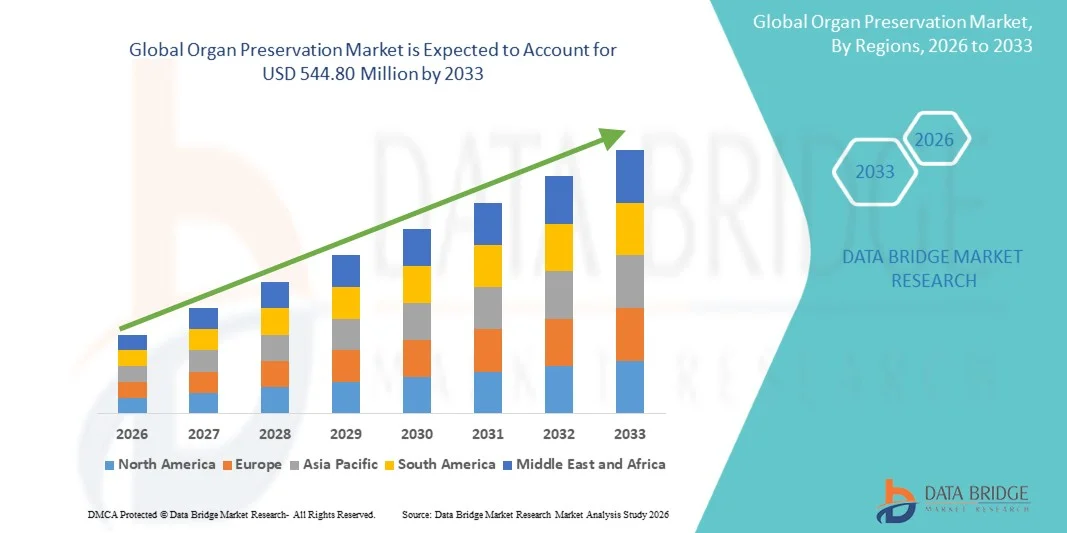
- The global organ preservation market size was valued at USD 294.78 million in 2025 and is expected to reach USD 544.80 million by 2033, at a CAGR of 7.98% during the forecast period
- The market growth is largely fueled by the increasing number of organ transplants worldwide, advancements in organ storage and preservation solutions, and the adoption of innovative preservation technologies such as hypothermic and normothermic perfusion
- Furthermore, rising awareness among healthcare providers and patients about improving organ viability and transplantation success rates is driving the demand for effective preservation solutions. These converging factors are accelerating the uptake of organ preservation products, thereby significantly boosting the industry's growth
Organ Preservation Market Analysis
- Organ preservation solutions, encompassing cold storage, perfusion systems, and preservation solutions for organs such as kidneys, livers, hearts, and lungs, are increasingly vital components of modern transplantation protocols due to their ability to extend organ viability, improve transplant outcomes, and enable global organ sharing
- The escalating demand for organ preservation products is primarily fueled by the rising number of organ transplant procedures worldwide, advancements in preservation technologies, and increasing awareness among healthcare providers of the importance of maintaining organ quality prior to transplantation
- North America dominated the organ preservation market with the largest revenue share of 38.7% in 2025, characterized by a well-established organ transplant infrastructure, high healthcare expenditure, and the presence of key industry players, with the U.S. witnessing substantial growth in advanced perfusion systems and preservation solutions, driven by innovations in machine perfusion and hypothermic storage technologies
- Asia-Pacific is expected to be the fastest growing region in the organ preservation market during the forecast period due to increasing organ transplant procedures, rising healthcare investments, and growing government initiatives to improve organ donation programs
- Static Cold Storage (SCS) segment dominated the organ preservation market with a market share of 45.6% in 2025, driven by their proven efficacy, ease of use, and widespread adoption in both hospital-based and organ transportation settings
Scope and Organ Preservation Market Segmentation
|
Attributes |
Organ Preservation Key Market Insights |
|
Segments Covered |
|
|
Countries Covered |
North America
Europe
Asia-Pacific
Middle East and Africa
South America
|
|
Key Market Players |
|
|
Market Opportunities |
|
|
Value Added Data Infosets |
In addition to the insights on market scenarios such as market value, growth rate, segmentation, geographical coverage, and major players, the market reports curated by the Data Bridge Market Research also include in-depth expert analysis, patient epidemiology, pipeline analysis, pricing analysis, and regulatory framework |
Organ Preservation Market Trends
“Advancements in Machine Perfusion and Normothermic Preservation”
- A significant and accelerating trend in the global organ preservation market is the adoption of advanced machine perfusion and normothermic preservation technologies, which extend organ viability and improve transplant success rates
- For instance, the OrganOx metra system enables continuous normothermic perfusion of livers, maintaining organ function for extended periods and allowing real-time assessment prior to transplantation
- Machine perfusion systems offer the ability to monitor organ health, reduce ischemic injury, and optimize preservation solutions, providing more intelligent and targeted organ management
- These technologies facilitate centralized control over organ storage and transport conditions, enabling hospitals and transplant centers to maintain optimal organ quality consistently
- This trend towards more advanced, data-driven, and organ-specific preservation methods is fundamentally reshaping transplant protocols. Consequently, companies such as TransMedics are developing AI-enabled perfusion platforms with features such as real-time organ monitoring and automated perfusion adjustments
- The demand for organ preservation solutions that offer machine perfusion and normothermic preservation capabilities is growing rapidly across both hospital and transplant logistics sectors, as stakeholders increasingly prioritize organ viability and transplantation outcomes
- Integration of IoT and remote monitoring technologies in organ preservation systems is allowing real-time tracking of organ condition during transport, improving success rates and reducing organ wastage
Organ Preservation Market Dynamics
Driver
“Increasing Organ Transplant Procedures and Rising Healthcare Investments”
- The growing number of organ transplant procedures worldwide, combined with increasing investments in healthcare infrastructure, is a significant driver for the heightened demand for organ preservation solutions
- For instance, in March 2025, XVIVO Perfusion announced an expansion of its perfusion system portfolio, focusing on enabling more widespread adoption of advanced organ preservation technologies
- As hospitals and transplant centers seek to improve transplant outcomes and reduce organ discard rates, organ preservation solutions provide essential functionality such as cold storage, machine perfusion, and viability assessment
- Furthermore, government initiatives promoting organ donation and funding for transplant programs are accelerating the adoption of advanced preservation technologies in emerging and developed markets
- The ability to transport organs over longer distances while maintaining viability, along with growing awareness of preservation best practices among healthcare professionals, further drives market growth
- Technological advancements enabling multi-organ preservation platforms are supporting simultaneous preservation of multiple organs, increasing operational efficiency for transplant centers
- Expansion of public-private partnerships and funding for research in organ preservation is creating opportunities for innovative solutions and broader market adoption
Restraint/Challenge
“High Costs and Regulatory Compliance Challenges”
- The relatively high cost of advanced organ preservation systems, including machine perfusion devices and specialized solutions, poses a significant challenge to broader market adoption, especially in developing regions
- For instance, expensive perfusion platforms such as OrganOx metra or TransMedics OCS systems may limit procurement by smaller hospitals or transplant centers with budget constraints
- Strict regulatory requirements for medical devices, including FDA and CE approvals for organ preservation equipment and solutions, can delay product launches and increase compliance costs
- Additionally, variability in reimbursement policies for organ preservation technologies across regions can affect adoption rates, limiting market penetration in certain countries
- While some cost-effective cold storage solutions are available, the perceived premium for advanced machine perfusion or normothermic systems can still hinder widespread adoption
- Overcoming these challenges through cost reduction, streamlined regulatory approvals, and demonstration of clinical and economic benefits will be vital for sustained market growth
- Limited awareness and training among medical staff regarding advanced organ preservation techniques can restrict adoption and optimal utilization of these technologies
- Logistical challenges, such as maintaining cold chain integrity during long-distance organ transport, continue to pose operational hurdles for market expansion
Organ Preservation Market Scope
The market is segmented on the basis of preservation solution, technique, organ type, donation type, and end user.
- By Preservation Solution
On the basis of preservation solution, the market is segmented into Citrate, Collins, Viaspan, Renograf, University of Wisconsin (UW) Solution, Custodial Histidine-Tryptophan-Ketoglutarate (HTK), Perfadex, Hypothermosol, Human BioSystem (HBS) Solution, Lifor, Sirna Transport Solution, and Others. The University of Wisconsin (UW) solution segment dominated the market with the largest revenue share in 2025, owing to its widespread clinical adoption and proven efficacy in preserving a variety of organs including liver, kidney, and pancreas. Healthcare providers prefer UW solution for its ability to minimize cellular damage during cold storage and extend organ viability. Its compatibility with both static cold storage and machine perfusion techniques further strengthens its position as the preferred choice in transplantation centers globally. Additionally, UW solution benefits from strong supplier presence and extensive regulatory approvals, which support its dominance in developed and emerging markets. The trust built over decades of clinical outcomes reinforces its continued preference among transplant professionals.
The HTK (Custodial Histidine-Tryptophan-Ketoglutarate) solution segment is expected to witness the fastest growth rate from 2026 to 2033, driven by its cost-effectiveness and increasing adoption in emerging economies. HTK is gaining traction due to its suitability for cardiac and liver preservation and ease of use in high-volume transplant centers. The solution’s lower viscosity facilitates better perfusion of organs during retrieval and transport, enhancing organ viability. Moreover, rising awareness of its benefits among transplant surgeons and hospitals is supporting market expansion. Growing initiatives in Asia-Pacific and Latin America to improve organ donation and transplantation infrastructure further fuel HTK solution adoption.
- By Technique
On the basis of technique, the market is segmented into static cold storage (scs), hypothermic machine perfusion, and normothermic machine perfusion. The Static Cold Storage (SCS) segment dominated the market in 2025 with the largest revenue of 45.6% due to its simplicity, cost-effectiveness, and long-standing use in organ transplantation. Hospitals and organ banks widely rely on SCS for kidney, liver, and pancreas preservation due to its proven efficacy and minimal operational requirements. SCS remains preferred in regions with limited access to high-cost perfusion systems, maintaining its dominance in both developed and emerging markets. Its compatibility with various preservation solutions such as UW and HTK strengthens its market position. The widespread training of healthcare staff in SCS methods also contributes to its sustained preference.
The Normothermic Machine Perfusion segment is projected to witness the fastest growth from 2026 to 2033, driven by its ability to maintain organs at near-physiological conditions, thereby improving post-transplant outcomes. This technique enables real-time monitoring of organ viability and functionality, reducing discard rates and enabling long-distance organ transport. Increasing investments in advanced organ preservation technologies and the growing number of high-risk or marginal donor organs are further propelling adoption. Hospitals in North America and Europe are increasingly implementing normothermic perfusion to optimize transplant success rates. Technological integration with AI and IoT-enabled monitoring platforms also enhances clinical decision-making, driving its rapid uptake
- By Organ Type
On the basis of organ type, the market is segmented into kidneys, liver, lung, heart, and others. The kidney segment dominated the market in 2025, accounting for the largest revenue share due to the high prevalence of end-stage renal disease and the greater number of kidney transplant procedures performed globally. Kidneys are frequently preserved using both SCS and perfusion techniques, with established protocols enhancing transplantation success rates. Growing awareness about renal transplantation and advancements in preservation solutions further reinforce dominance. The robust donor network and well-developed infrastructure in North America and Europe contribute to higher adoption rates of kidney preservation solutions.
The liver segment is expected to witness the fastest growth rate from 2026 to 2033, driven by the increasing incidence of liver failure, rising number of liver transplants, and adoption of advanced perfusion techniques such as normothermic machine perfusion. Liver preservation requires sophisticated solutions due to the organ’s sensitivity to ischemic damage, which is driving demand for specialized solutions such as machine perfusion and UW solution. Expansion of liver transplant programs in Asia-Pacific and growing collaborations between transplant centers and organ banks are further accelerating segment growth. Technological advancements enabling longer preservation times also support faster market adoption.
- By Donation Type
On the basis of donation type, the market is segmented into living organ donation and deceased organ donation. The deceased organ donation segment dominated the market in 2025, primarily due to the higher volume of organ retrievals from deceased donors, which require advanced preservation solutions for extended transport and storage. Organ banks and hospitals increasingly rely on preservation techniques such as hypothermic and normothermic perfusion to maintain organ viability. Regulatory frameworks and government initiatives promoting deceased organ donation also support market dominance. Preservation solutions designed for deceased donors ensure organs remain transplantable over longer distances, facilitating international organ sharing programs.
The living organ donation segment is expected to witness the fastest growth from 2026 to 2033, fueled by rising awareness about living donor programs and advancements in minimally invasive surgical techniques. The ability to preserve organs such as kidneys and liver segments for living donor transplantation enhances patient outcomes and reduces dependency on deceased donor availability. Expanding living donor programs in Asia-Pacific, Latin America, and Europe further drive adoption. Customized preservation protocols and specialized storage solutions for living donations support this rapid growth trajectory.
- By End User
On the basis of end user, the market is segmented into organ banks, hospitals and clinics, and others. The hospitals and clinics segment dominated the market in 2025 due to their direct involvement in organ retrieval, transplantation, and storage processes, accounting for the largest revenue share. Hospitals invest heavily in advanced preservation solutions, perfusion systems, and cold storage infrastructure to ensure transplant success. The segment benefits from high adoption of both traditional and advanced techniques, along with trained personnel managing organ viability. Strong presence in developed markets and growing transplant volumes reinforce hospitals’ dominance in the organ preservation market.
The organ banks segment is projected to witness the fastest growth from 2026 to 2033, driven by increasing establishment of centralized organ banks, expansion of regional organ sharing networks, and rising demand for long-term organ storage solutions. Organ banks are increasingly adopting advanced preservation solutions and perfusion systems to maintain organ quality and extend viability. Growth in government-supported organ banking initiatives in emerging markets, particularly in Asia-Pacific and Latin America, is fueling segment growth. Integration of digital tracking and monitoring systems for organ transport also supports faster adoption and operational efficiency.
Organ Preservation Market Regional Analysis
- North America dominated the organ preservation market with the largest revenue share of 38.7% in 2025, characterized by a well-established organ transplant infrastructure, high healthcare expenditure, and the presence of key industry players
- Hospitals and transplant centers in the region prioritize advanced preservation solutions and perfusion technologies to improve organ viability and transplantation success rates
- This widespread adoption is further supported by strong government initiatives promoting organ donation, robust regulatory frameworks, and the presence of key industry players developing innovative organ preservation systems
U.S. Organ Preservation Market Insight
The U.S. organ preservation market captured the largest revenue share of 42% in 2025 within North America, driven by the country’s well-established organ transplant infrastructure and high prevalence of end-stage organ failure. Hospitals and transplant centers are increasingly adopting advanced preservation solutions such as hypothermic and normothermic perfusion systems to improve organ viability and post-transplant outcomes. Growing awareness among healthcare professionals about minimizing organ discard rates, along with robust investments in research and development, further propels the market. Government initiatives promoting organ donation, coupled with regulatory support, reinforce the adoption of innovative organ preservation technologies. Additionally, integration of AI-enabled monitoring and IoT-based organ tracking systems is enhancing operational efficiency in organ storage and transport.
Europe Organ Preservation Market Insight
The Europe organ preservation market is projected to expand at a substantial CAGR throughout the forecast period, primarily driven by increasing organ transplant procedures and stringent healthcare regulations. Rising awareness about organ donation and government-backed initiatives supporting organ banks are fostering the adoption of advanced preservation solutions. European transplant centers are increasingly incorporating machine perfusion and normothermic preservation techniques to improve outcomes. The region is witnessing strong growth across hospitals and organ banks, with preservation solutions being integrated into both new facilities and upgrades of existing storage infrastructure. The presence of key industry players and collaborative research initiatives further support market expansion.
U.K. Organ Preservation Market Insight
The U.K. organ preservation market is anticipated to grow at a noteworthy CAGR during the forecast period, driven by the growing demand for improved organ viability and transplantation success rates. Concerns about organ shortages and the need to reduce discard rates are encouraging healthcare institutions to adopt advanced preservation solutions. Additionally, the U.K.’s focus on healthcare innovation and digitalization supports the implementation of AI-assisted perfusion systems and remote organ monitoring. Collaboration between hospitals, transplant centers, and organ banks is facilitating wider adoption. The increasing number of liver and kidney transplant procedures further stimulates market growth.
Germany Organ Preservation Market Insight
The Germany organ preservation market is expected to expand at a considerable CAGR during the forecast period, fueled by a high number of transplant surgeries and growing awareness of advanced preservation technologies. Hospitals and organ banks in Germany are increasingly adopting machine perfusion and normothermic preservation systems to enhance organ viability and reduce ischemic damage. Germany’s strong healthcare infrastructure and focus on technological innovation promote market adoption. Integration of organ preservation solutions with digital tracking and monitoring systems is becoming increasingly common, supporting efficient organ transport. Sustainability-focused healthcare policies and government-backed transplant initiatives further boost market growth.
Asia-Pacific Organ Preservation Market Insight
The Asia-Pacific organ preservation market is poised to grow at the fastest CAGR of 22% during the forecast period of 2026 to 2033, driven by increasing organ transplant procedures, rising healthcare investments, and expanding organ donation programs in countries such as China, Japan, and India. The growing number of hospitals and transplant centers equipped with advanced preservation technologies is driving adoption. Furthermore, government initiatives promoting organ donation and public awareness campaigns are enhancing acceptance of preservation solutions. APAC’s emergence as a hub for medical device manufacturing is improving the availability and affordability of organ preservation systems, expanding access across hospitals and organ banks.
Japan Organ Preservation Market Insight
The Japan organ preservation market is gaining momentum due to the country’s advanced healthcare infrastructure, aging population, and growing demand for organ transplants. The adoption of hypothermic and normothermic machine perfusion systems is increasing to improve organ viability and transplantation success rates. Integration of digital monitoring systems and AI-enabled organ viability assessment tools is supporting clinical decision-making. Japan’s focus on healthcare innovation, combined with government programs promoting organ donation, is driving market growth. Increasing awareness among hospitals and transplant centers about reducing organ discard rates further fuels demand.
India Organ Preservation Market Insight
The India organ preservation market accounted for the largest market revenue share in Asia-Pacific in 2025, attributed to the country’s expanding healthcare infrastructure, rising number of transplant procedures, and growing awareness of organ donation. Hospitals and organ banks are increasingly investing in advanced preservation solutions, including machine perfusion and normothermic preservation technologies. The push towards smart hospitals and transplant networks, along with government initiatives to improve organ donation rates, is propelling market growth. Affordable preservation solutions and increasing domestic manufacturing capabilities also enhance adoption. Furthermore, rising public awareness campaigns and training programs for medical staff are strengthening the market in India.
Organ Preservation Market Share
The Organ Preservation industry is primarily led by well-established companies, including:
- Paragonix Technologies, Inc. (U.S.)
- XVIVO Perfusion AB (Sweden)
- Bridge to Life Ltd. (U.S.)
- TransMedics, Inc. (U.S.)
- Essential Pharmaceuticals, LLC (U.S.)
- Preservation Solutions, Inc. (U.S.)
- Waters Medical Systems, LLC (U.S.)
- Vascular Perfusion Solutions, Inc. (U.S.)
- Organ Recovery Systems, Inc. (U.S.)
- BioLife Solutions, Inc. (U.S.)
- Lifeline Scientific, Inc. (U.S.)
- Shanghai Genext Medical Technology Co., Ltd. (China)
- Carnamedica S.P. (Poland)
- Transplant Biomedicals S.L. (Spain)
- Institut Georges Lopez (France)
- Global Transplant Solutions (U.S.)
- Lifebank USA (U.S.)
- OrganOx Limited (U.K.)
- Dr. Franz Köhler Chemie GmbH (Germany)
What are the Recent Developments in Global Organ Preservation Market?
- In April 2025, Vanderbilt University Hospital performed Tennessee’s first successful kidney transplant using the advanced Paragonix KidneyVault™ Renal Perfusion System, demonstrating clinical adoption of novel organ preservation technology that aims to expand the donor pool and improve transplant outcomes
- In March 2025, Paragonix Technologies was named to Fast Company’s Annual List of the World’s Most Innovative Companies, ranking #6 in healthcare, highlighting the growing recognition of innovation in organ preservation technology and its impact on transplant medicine
- In January 2025, Paragonix Technologies announced the world’s first‑in‑human use of its FDA‑cleared KidneyVault™ Portable Renal Perfusion System, marking a significant advancement in kidney preservation technology by enabling continuous monitoring and perfusion of donor kidneys during transport, and thus potentially increasing the utilization of donor organs across greater distances
- In June 2024, Paragonix Technologies launched the PancreasPak™ Organ Preservation System the first FDA‑cleared device specifically designed for preserving donor pancreases during transport addressing a historically underserved organ type and broadening the scope of preservable organs
- In August 2023, TransMedics Group, Inc. completed the acquisition of warm perfusion EVOSS™ and cold perfusion LifeCradle® technologies from Bridge to Life Ltd., expanding its portfolio of organ perfusion systems for heart and lung transplantation and strengthening its position in advanced organ care technologies
SKU-
Get online access to the report on the World's First Market Intelligence Cloud

- Interactive Data Analysis Dashboard
- Company Analysis Dashboard for high growth potential opportunities
- Research Analyst Access for customization & queries
- Competitor Analysis with Interactive dashboard
- Latest News, Updates & Trend analysis
- Harness the Power of Benchmark Analysis for Comprehensive Competitor Tracking
Research Methodology
Data collection and base year analysis are done using data collection modules with large sample sizes. The stage includes obtaining market information or related data through various sources and strategies. It includes examining and planning all the data acquired from the past in advance. It likewise envelops the examination of information inconsistencies seen across different information sources. The market data is analysed and estimated using market statistical and coherent models. Also, market share analysis and key trend analysis are the major success factors in the market report. To know more, please request an analyst call or drop down your inquiry.
The key research methodology used by DBMR research team is data triangulation which involves data mining, analysis of the impact of data variables on the market and primary (industry expert) validation. Data models include Vendor Positioning Grid, Market Time Line Analysis, Market Overview and Guide, Company Positioning Grid, Patent Analysis, Pricing Analysis, Company Market Share Analysis, Standards of Measurement, Global versus Regional and Vendor Share Analysis. To know more about the research methodology, drop in an inquiry to speak to our industry experts.
Customization Available
Data Bridge Market Research is a leader in advanced formative research. We take pride in servicing our existing and new customers with data and analysis that match and suits their goal. The report can be customized to include price trend analysis of target brands understanding the market for additional countries (ask for the list of countries), clinical trial results data, literature review, refurbished market and product base analysis. Market analysis of target competitors can be analyzed from technology-based analysis to market portfolio strategies. We can add as many competitors that you require data about in the format and data style you are looking for. Our team of analysts can also provide you data in crude raw excel files pivot tables (Fact book) or can assist you in creating presentations from the data sets available in the report.












