


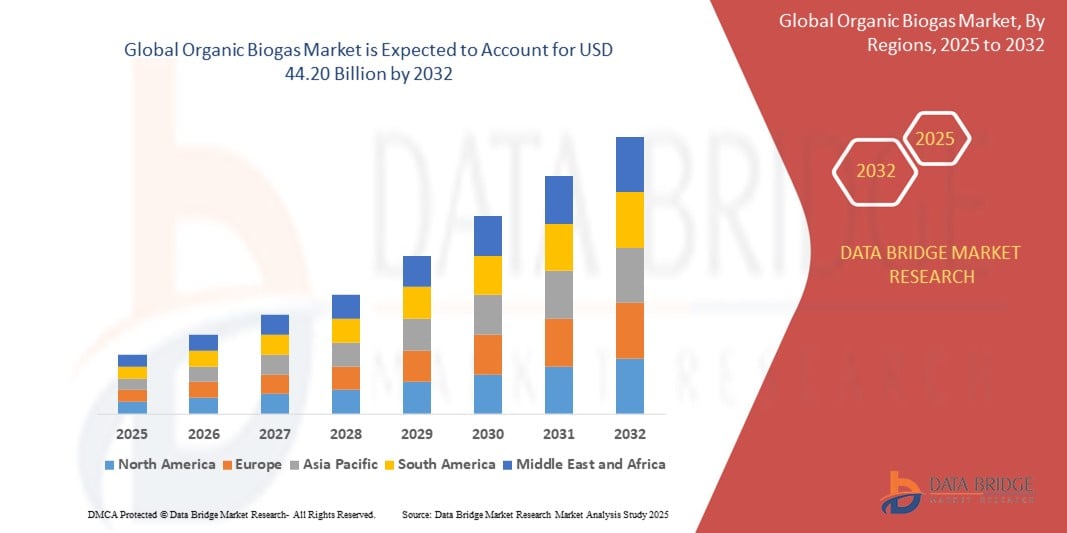
Organic Biogas Market Size
- The global organic biogas market size was valued at USD 26.91 billion in 2024 and is expected to reach USD 44.20 billion by 2032, at a CAGR of 6.4% during the forecast period
- The market growth is primarily driven by increasing demand for renewable energy sources, supportive government policies promoting sustainable energy, and growing awareness of environmental concerns related to waste management and greenhouse gas emissions
- The rising adoption of organic biogas as an eco-friendly alternative to fossil fuels, coupled with advancements in biogas production technologies, is significantly boosting the industry's expansion
Organic Biogas Market Analysis
- Organic biogas, derived from organic waste materials through anaerobic digestion, is increasingly vital in addressing global energy demands and reducing environmental impact in applications such as cooking, electricity generation, and clean mobility
- The escalating demand for organic biogas is fueled by the global shift toward renewable energy, stringent regulations on waste disposal, and the need for sustainable fuel alternatives in both developed and developing regions
- Asia-Pacific dominated the organic biogas market with the largest revenue share of 42.5% in 2024, driven by large-scale agricultural activities, government incentives for renewable energy, and high adoption rates in countries such as China and India
- North America is expected to be the fastest-growing region during the forecast period due to increasing investments in renewable energy infrastructure, supportive regulatory frameworks, and growing awareness of biogas as a sustainable energy source
- The agricultural waste segment dominated a significant market revenue share of 38.5% in 2024, driven by the abundant availability of organic waste from farming activities and its established utilization practices in biogas production
Report Scope and Organic Biogas Market Segmentation
|
Attributes |
Organic Biogas Key Market Insights |
|
Segments Covered |
|
|
Countries Covered |
North America
Europe
Asia-Pacific
Middle East and Africa
South America
|
|
Key Market Players |
|
|
Market Opportunities |
|
|
Value Added Data Infosets |
In addition to the insights on market scenarios such as market value, growth rate, segmentation, geographical coverage, and major players, the market reports curated by the Data Bridge Market Research also include import export analysis, production capacity overview, production consumption analysis, price trend analysis, climate change scenario, supply chain analysis, value chain analysis, raw material/consumables overview, vendor selection criteria, PESTLE Analysis, Porter Analysis, and regulatory framework. |
Organic Biogas Market Trends
Increasing Integration of Advanced Anaerobic Digestion Technologies and IoT
- The global organic biogas market is experiencing a significant trend toward the integration of advanced anaerobic digestion technologies and Internet of Things (IoT) solutions
- These technologies enhance the efficiency of biogas production by optimizing the digestion process, monitoring feedstock quality, and improving gas yield through real-time data analysis
- IoT-enabled biogas plants allow for remote monitoring and predictive maintenance, identifying potential system inefficiencies or equipment failures before they disrupt production
- For instance, companies are deploying IoT-based platforms to analyze feedstock composition, such as poultry and livestock waste or agricultural residues, to maximize methane output and optimize plant operations under varying conditions
- This trend is increasing the appeal of biogas systems for both small-scale rural plants and large-scale industrial facilities, driving cost efficiencies and scalability
- Advanced algorithms can process data on feedstock variability, temperature, and microbial activity, enabling precise control over the anaerobic digestion process to boost overall productivity
Organic Biogas Market Dynamics
Driver
Rising Demand for Renewable Energy and Sustainable Waste Management
- Growing global demand for renewable energy sources, driven by the need to reduce greenhouse gas emissions, is a key driver for the organic biogas market
- Biogas systems convert organic waste, such as poultry and livestock manure, agricultural residues, and landfill gas, into renewable energy for applications such as electricity generation, heating, cooking, combined heat and power (CHP), and clean mobility
- Government policies, particularly in the Asia-Pacific region, which dominates the market, are promoting biogas adoption through subsidies, feed-in tariffs, and renewable energy targets, such as India’s SATAT initiative aiming for 5,000 compressed biogas plants by 2025
- The proliferation of IoT and advancements in biogas upgrading technologies are enabling faster and more reliable biogas production, supporting applications such as biomethane for grid injection and vehicle fuel
- Industries and municipalities are increasingly adopting biogas systems as standard solutions to meet sustainability goals and manage organic waste effectively, enhancing the market’s growth trajectory
Restraint/Challenge
High Initial Investment and Feedstock Supply Challenges
- The high capital costs associated with setting up biogas plants, including digesters, gas storage systems, and upgrading technologies, pose a significant barrier to market adoption, particularly in emerging markets
- Integrating biogas systems into existing waste management or energy infrastructure can be complex and costly, requiring specialized equipment and expertise
- In addition, inconsistent feedstock supply, such as seasonal variations in agricultural waste or poultry and livestock manure, creates operational challenges, impacting production reliability and efficiency
- Poor waste segregation in developing nations can lead to contamination, reducing biogas yield by 10–20%, further complicating operations
- These factors can deter investment and slow market growth, especially in regions with limited financial resources or underdeveloped waste management systems
Organic Biogas market Scope
The market is segmented on the basis of source, and application.
- By Source
On the basis of source, the global organic biogas market is segmented into poultry and livestock, agriculture waste, landfill gas, and others. The agricultural waste segment dominated a significant market revenue share of 38.5% in 2024, driven by the abundant availability of organic waste from farming activities and its established utilization practices in biogas production. The critical need for sustainable waste management and energy recovery from these large volumes of waste further fuels its dominance.
The landfill gas segment is anticipated to witness robust growth. This is due to increasing efforts to capture and utilize methane emissions from municipal solid waste landfills, converting a significant environmental concern into a valuable energy source. Government initiatives and regulations promoting waste-to-energy solutions also contribute to this growth.
- By Application
On the basis of application, the global organic biogas market is segmented into cooking, clean mobility, electricity generation, heating, combined heat and power, and others. The electricity generation segment is expected to hold the largest market revenue share, primarily driven by the continuous global demand for electricity and the increasing focus on renewable energy sources to reduce reliance on fossil fuels. The established infrastructure for converting biogas to electricity and supportive government policies for grid integration further solidify its leading position.
The clean mobility segment is anticipated to witness the fastest growth rate from 2025 to 2032. This growth is propelled by the rising demand for sustainable transportation fuels, particularly compressed biomethane (CBG) and liquefied biomethane (LBG), as alternatives to conventional fossil fuels. Stringent environmental regulations aimed at reducing vehicular emissions and increasing investments in biogas upgrading facilities accelerate the adoption of biogas in the transportation sector.
Organic Biogas Market Regional Analysis
- Asia-Pacific dominated the organic biogas market with the largest revenue share of 42.5% in 2024, driven by large-scale agricultural activities, government incentives for renewable energy, and high adoption rates in countries such as China and India
- Consumers and industries prioritize organic biogas for its sustainability, cost-effectiveness, and ability to reduce greenhouse gas emissions, particularly in regions with abundant organic waste resources
- Growth is fueled by advancements in biogas production technologies, such as anaerobic digestion systems, and rising adoption across various applications, including cooking, clean mobility, electricity generation, heating, and combined heat and power (CHP)
Japan Organic Biogas Market Insight
Japan’s organic biogas market is expected to witness rapid growth, driven by strong consumer and industry preference for sustainable energy solutions and advanced biogas production technologies. The presence of major agricultural and waste management industries accelerates the adoption of biogas for electricity generation and heating. Government policies promoting clean energy and the integration of biogas in CHP systems further support market penetration.
China Organic Biogas Market Insight
China holds the largest share of the Asia-Pacific organic biogas market, propelled by rapid urbanization, increasing energy demand, and a growing focus on sustainable waste management. The country’s abundant agricultural waste and landfill gas resources, combined with government support for renewable energy, drive the adoption of organic biogas for cooking, heating, and clean mobility. Strong domestic manufacturing capabilities and competitive pricing enhance market accessibility.
U.S. Organic Biogas Market Insight
The U.S. smart lock market captured the largest revenue share of 81% in 2024 within North America, fueled by increasing investments in renewable energy and growing awareness of sustainable waste management. The demand for organic biogas is supported by government incentives promoting clean energy and the rising adoption of biogas for electricity generation and heating. The integration of biogas systems in agricultural and landfill operations, along with a strong focus on reducing carbon footprints, further accelerates market growth.
Europe Organic Biogas Market Insight
The Europe organic biogas market is experiencing significant growth, driven by stringent environmental regulations and a strong emphasis on renewable energy adoption. Consumers and industries seek biogas solutions for sustainable energy production and waste management. Countries such as Germany and France are leading in biogas production from agricultural waste and landfill gas, with applications in heating and combined heat and power systems gaining traction.
U.K. Organic Biogas Market Insight
The U.K. market for organic biogas is expected to witness rapid growth, fueled by increasing demand for renewable energy sources and government initiatives promoting sustainable waste management. The focus on reducing landfill waste and utilizing poultry, livestock, and agricultural waste for biogas production drives market expansion. Applications in clean mobility and electricity generation are gaining popularity, supported by consumer awareness of environmental benefits.
Germany Organic Biogas Market Insight
Germany is expected to witness significant growth in the organic biogas market, attributed to its advanced renewable energy infrastructure and strong focus on sustainability. German industries and consumers prefer biogas systems that utilize agricultural waste and landfill gas to generate electricity and heat, contributing to energy efficiency and reduced emissions. The integration of biogas in CHP systems and government support for green energy solutions drive sustained market growth.
Organic Biogas Market Share
The organic biogas industry is primarily led by well-established companies, including:
- EnviTec Biogas AG (Germany)
- DMT Environmental Technology (Netherlands)
- Weltec Biopower GmbH (Germany)
- Schmack Biogas GmbH (Germany)
- Air Liquide (France)
- PlanET Biogas Global GmbH (Germany)
- Xergi A/S (Denmark)
- Greenlane Renewables (Canada)
- Biofrigas Sweden AB (Sweden)
- Scandinavian Biogas Fuels International AB (Sweden)
- BTS Biogas Srl (Italy)
- Anaergia Inc. (Canada)
- Biokraft International AB (Sweden)
- Gasum Oy (Finland)
- Bright Biomethane (Netherlands)
- EverGen Infrastructure Corp. (Canada)
- StormFisher (Canada)
- VERBIO Vereinigte BioEnergie AG (Germany)
- Hitachi Zosen Inova AG (Switzerland)
What are the Recent Developments in Global Organic Biogas Market?
- In June 2025, Orege officially launched its Orege Green Gas Solution, a cutting-edge pre-treatment system aimed at boosting biogas production from organic waste. Based on Orege’s proprietary SLG® technology, the compact, mobile, and chemical-free unit enhances sludge quality before anaerobic digestion—improving energy yield and operational efficiency. Municipal wastewater plants can achieve up to 40% more biogas output without upfront investment, thanks to a flexible service model. This innovation reflects Orege’s commitment to sustainable energy and circular economy principles, offering a practical alternative to costly thermal hydrolysis systems
- In March 2025, Low Carbon and Agrivert launched a strategic Joint Venture (JV) named Beacon, combining their expertise to accelerate the development of biogas and biomethane projects across Europe. Beacon aims to deliver a portfolio of utility-scale renewable energy plants by 2030, leveraging Low Carbon’s track record in large-scale clean energy and Agrivert’s 30+ years of experience in anaerobic digestion technologies. The collaboration strengthens financial resilience, expands product offerings, and enhances geographic reach—supporting the EU’s REPowerEU goal of producing 35 billion cubic meters of biomethane annually and advancing the transition to net-zero
- In January 2025, Glanua acquired Marches Biogas, a UK-based engineering and services firm renowned for its expertise in anaerobic digestion (AD) and biogas production. This strategic move bolsters Glanua’s position as a leader in designing, constructing, and operating AD plants, while significantly expanding its footprint in the bioresource sector. With Marches Biogas’s proven track record—over 30 AD plants built and deep experience in biomass treatment—Glanua now offers enhanced solutions for transforming organic waste into renewable energy. The acquisition aligns with Glanua’s sustainability goals and supports its ambition to grow its business across the UK and Europe
- In April 2023, Nature Energy, a leading Danish biogas producer, partnered with Nordion Energi, an energy infrastructure specialist, to accelerate the integration of large-scale biogas production into Sweden’s gas grid. The collaboration combines Nature Energy’s experience in developing and operating biogas plants with Nordion Energi’s capabilities in managing energy infrastructure. Their joint ambition is to connect new biogas facilities to the grid in southwestern Sweden by 2030, supporting the transition to renewable energy and reducing carbon emissions. This initiative reflects a shared commitment to sustainability and the circular economy, with biogas already making up 37.5% of the region’s gas supply
- In February 2023, Shell plc completed the acquisition of Nature Energy Biogas A/S, Europe’s largest producer of renewable natural gas (RNG). Though the financial terms were not officially disclosed, reports estimate the deal at around $2 billion USD. With this move, Shell gained access to 14 industrial-scale biomethane plants, a robust pipeline of 30+ new projects across Europe and North America, and Nature Energy’s in-house expertise in RNG plant design and operation. The acquisition strengthens Shell’s global RNG value chain, supporting its strategy to expand low-carbon energy offerings and transition its LNG customer base toward BioLNG

- Interactive Data Analysis Dashboard
- Company Analysis Dashboard for high growth potential opportunities
- Research Analyst Access for customization & queries
- Competitor Analysis with Interactive dashboard
- Latest News, Updates & Trend analysis
- Harness the Power of Benchmark Analysis for Comprehensive Competitor Tracking
Global Organic Biogas Market, Supply Chain Analysis and Ecosystem Framework
To support market growth and help clients navigate the impact of geopolitical shifts, DBMR has integrated in-depth supply chain analysis into its Global Organic Biogas Market research reports. This addition empowers clients to respond effectively to global changes affecting their industries. The supply chain analysis section includes detailed insights such as Global Organic Biogas Market consumption and production by country, price trend analysis, the impact of tariffs and geopolitical developments, and import and export trends by country and HSN code. It also highlights major suppliers with data on production capacity and company profiles, as well as key importers and exporters. In addition to research, DBMR offers specialized supply chain consulting services backed by over a decade of experience, providing solutions like supplier discovery, supplier risk assessment, price trend analysis, impact evaluation of inflation and trade route changes, and comprehensive market trend analysis.
Data collection and base year analysis are done using data collection modules with large sample sizes. The stage includes obtaining market information or related data through various sources and strategies. It includes examining and planning all the data acquired from the past in advance. It likewise envelops the examination of information inconsistencies seen across different information sources. The market data is analysed and estimated using market statistical and coherent models. Also, market share analysis and key trend analysis are the major success factors in the market report. To know more, please request an analyst call or drop down your inquiry.
The key research methodology used by DBMR research team is data triangulation which involves data mining, analysis of the impact of data variables on the market and primary (industry expert) validation. Data models include Vendor Positioning Grid, Market Time Line Analysis, Market Overview and Guide, Company Positioning Grid, Patent Analysis, Pricing Analysis, Company Market Share Analysis, Standards of Measurement, Global versus Regional and Vendor Share Analysis. To know more about the research methodology, drop in an inquiry to speak to our industry experts.
Data Bridge Market Research is a leader in advanced formative research. We take pride in servicing our existing and new customers with data and analysis that match and suits their goal. The report can be customized to include price trend analysis of target brands understanding the market for additional countries (ask for the list of countries), clinical trial results data, literature review, refurbished market and product base analysis. Market analysis of target competitors can be analyzed from technology-based analysis to market portfolio strategies. We can add as many competitors that you require data about in the format and data style you are looking for. Our team of analysts can also provide you data in crude raw excel files pivot tables (Fact book) or can assist you in creating presentations from the data sets available in the report.













