


What is the Organic Dyes Size and Growth Rate?
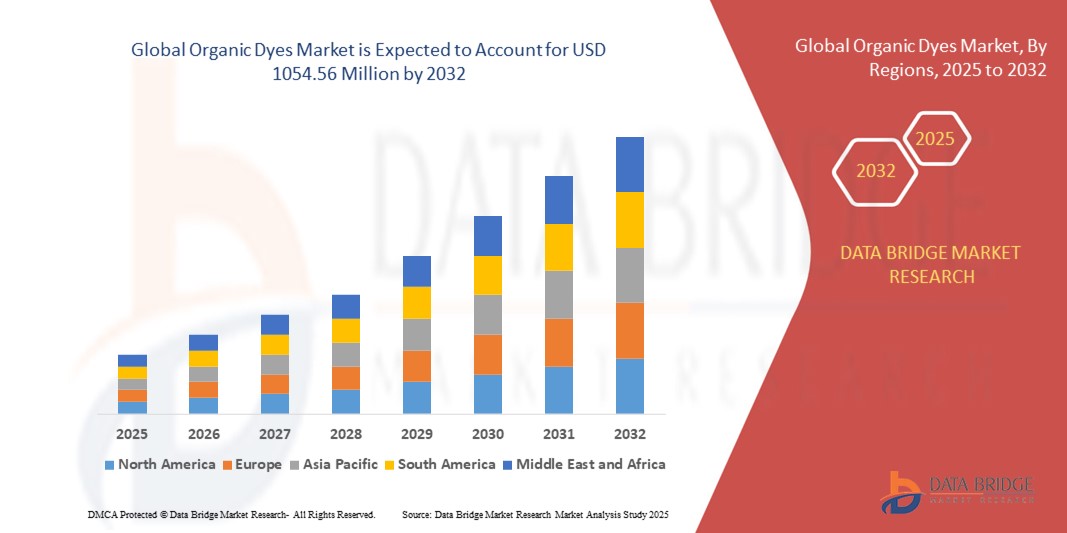
- As per Data Bridge Market Research Analysis the global organic dyes market size was valued at USD 681.96 million in 2024 and is expected to reach USD 1054.56 million by 2032, at a CAGR of 5.60% during the forecast period
- The market growth is primarily driven by increasing demand for eco-friendly and sustainable dyeing solutions, rising adoption in textile and paint industries, and growing consumer preference for vibrant and durable colors
- Growing awareness of environmental sustainability and the shift toward bio-based and natural dyes are further propelling the demand for organic dyes across various applications
Market Size & Forecast
- Global Market Value (2024): USD 681.96 million
- Expected Market Value (2032): USD 1054.56 million
- Forecast CAGR (2024–2032): 5.60%
What are the Major Takeaways of Organic Dyes?
- The organic dyes market is experiencing robust growth due to rising consumer demand for sustainable and non-toxic dyeing solutions across industries such as textiles, paints, and plastics
- Increasing adoption in both high-end and mass-market applications is encouraging manufacturers to innovate with high-performance, eco-friendly, and long-lasting dye solutions
- North America dominated the organic dyes market with the largest revenue share of 39.72% in 2024, driven by a well-established textile and coatings industry and stringent regulations promoting sustainable products
- Asia-Pacific is expected to be the fastest-growing region during the forecast period, fueled by rapid industrialization, increasing textile production, and rising awareness of sustainable dyeing solutions in countries such as China, India, and Southeast Asian nations
- The acid dyes segment dominated the largest market revenue share of 43.76% in 2024, driven by their strong affinity for protein fibers such as wool, silk, and nylon, as well as their vibrant color range and excellent solubility. Their widespread use in textile dyeing, leather finishing, and printing inks has positioned acid dyes as the preferred choice in industries where brilliance and wash-fastness are critical
Report Scope and Organic Dyes Market Segmentation
|
Attributes |
Organic Dyes Key Market Insights |
|
Segments Covered |
|
|
Countries Covered |
North America
Europe
Asia-Pacific
Middle East and Africa
South America
|
|
Key Market Players |
|
|
Market Opportunities |
|
|
Value Added Data Infosets |
|
What is the Key Trend in the Organic Dyes?
Increasing Adoption of Eco-Friendly and Sustainable Dyes
- The global organic dyes market is experiencing a notable trend toward the adoption of eco-friendly and sustainable dyes
- Growing environmental awareness and stringent regulations on synthetic dyes are driving demand for organic dyes derived from natural sources such as plants, animals, and minerals
- These dyes offer biodegradability, lower toxicity, and reduced environmental impact, making them highly sought after in industries such as textiles, cosmetics, and food
- For instances, companies are innovating with plant-based dyes such as indigo and turmeric to create vibrant, sustainable colorants for apparel and packaging
- This trend enhances the appeal of organic dyes, aligning with consumer preferences for green products and supporting global sustainability goals
- Advanced extraction technologies are improving the efficiency and color consistency of organic dyes, further boosting their market adoption
Organic Dyes Market Dynamics
Driver
Rising Demand for Sustainable Textiles and Green Consumer Products
- Increasing consumer preference for sustainable and eco-friendly products, particularly in textiles and fashion, is a key driver for the global organic dyes market
- Organic dyes enhance product appeal by offering non-toxic, biodegradable alternatives to synthetic dyes, meeting consumer demand for environmentally responsible goods
- Government regulations, especially in Europe and North America, mandating reduced environmental impact in manufacturing are accelerating the adoption of organic dyes
- The rise of digital textile printing and advancements in dyeing technologies are enabling broader applications of organic dyes in textiles, paints, and coatings
- Major fashion and apparel brands are increasingly incorporating organic dyes to align with sustainability certifications and consumer expectations
Restraint/Challenge
High Production Costs and Raw Material Variability
- The high cost of producing organic dyes, due to complex extraction processes and limited availability of natural raw materials, poses a significant barrier to market growth
- Sourcing raw materials such as plants and minerals is subject to seasonal and regional variability, leading to inconsistent supply and higher costs compared to synthetic dyes
- In addition, concerns over scalability and standardization of organic dyes can limit their adoption in large-scale industrial applications
- Regulatory differences across regions regarding the use of natural dyes and their environmental impact create challenges for manufacturers operating globally
- These factors can hinder market expansion, particularly in cost-sensitive markets or regions with less developed supply chains for organic materials
How is the Organic Dyes Segmented?
The market is segmented on the basis of product, source, and application.
- By Product
On the basis of product, the global organic dyes market is segmented into acid, basic, reactive, direct, disperse, sulphur, and others. The acid dyes segment dominated the largest market revenue share of 43.76% in 2024, driven by their strong affinity for protein fibers such as wool, silk, and nylon, as well as their vibrant color range and excellent solubility. Their widespread use in textile dyeing, leather finishing, and printing inks has positioned acid dyes as the preferred choice in industries where brilliance and wash-fastness are critical. In addition, growing demand from fashion and apparel manufacturers for eco-friendly, high-performance dyes is bolstering this segment’s dominance.
The reactive dyes segment is expected to register the fastest growth rate from 2025 to 2032, owing to their superior wash-fastness, chemical bonding with fibers, and compatibility with cellulose-based materials such as cotton. Increasing use in the textile industry, especially in Asia-Pacific, is supported by advancements in low-salt and high-fixation dye technologies that reduce water consumption and environmental impact. Their versatility in batch dyeing, continuous dyeing, and printing applications makes them a key growth driver for the industry.
- By Source
On the basis of source, the global organic dyes market is categorized into animal, plant, and minerals. The plant-based dyes segment accounted for the highest revenue share in 2024, supported by rising consumer preference for sustainable, non-toxic, and biodegradable colorants. These dyes, derived from sources such as indigo, turmeric, madder, and cochineal substitutes, are increasingly being adopted by textile, cosmetic, and food manufacturers responding to clean-label and eco-conscious trends. The demand from premium and niche product segments, particularly in North America, is accelerating adoption.
The mineral-based dyes segment is anticipated to grow at the fastest CAGR from 2025 to 2032, propelled by their stability, lightfastness, and applications in high-performance coatings, plastics, and construction materials. Advances in mineral pigment processing and the development of hybrid organic-mineral blends are expanding their role in industrial applications while meeting environmental compliance requirements.
- By Application
On the basis of application, the global organic dyes market is segmented into paints and coatings, textiles, plastics, printing inks, and others. The textiles segment held the largest revenue share in 2024, attributed to the global expansion of the apparel and home furnishing industries, as well as growing consumer demand for vibrant, durable, and eco-friendly fabrics. Organic dyes play a vital role in achieving high-quality finishes, consistent color reproduction, and compliance with environmental standards such as OEKO-TEX and GOTS. The integration of natural dyes in sustainable fashion and the growth of technical textiles further reinforce this segment’s dominance.
The paints and coatings segment is projected to grow at the fastest rate from 2025 to 2032, fueled by increasing construction activities, automotive production, and demand for protective and decorative coatings. Organic dyes are increasingly favored in paints for their strong tinting strength, wide color palette, and lower environmental footprint compared to synthetic pigments. In Asia-Pacific, rapid urbanization and infrastructure development are significantly boosting demand for colored coatings across residential, commercial, and industrial sectors.
Which Region Holds the Largest Share of the How is Organic Dyes Segmented?
- North America dominated the organic dyes market with the largest revenue share of 39.72% in 2024, driven by a well-established textile and coatings industry and stringent regulations promoting sustainable products
- Consumers prioritize organic dyes for their biodegradability, reduced environmental impact, and safety in applications such as textiles, paints, and coatings
- Growth is supported by advancements in dye technology, including high-performance reactive and plant-based dyes, alongside rising adoption in both industrial and consumer segments
U.S. Organic Dyes Market Insight
The U.S. organic dyes market captured the largest revenue share of 76.4% in 2024 within North America, fueled by strong demand in textiles, printing inks, and cosmetics, coupled with growing consumer awareness of environmental and health benefits of organic dyes. The trend toward sustainable product customization and stringent regulations promoting non-toxic materials further boost market expansion. Manufacturers’ increasing integration of organic dyes in industrial processes complements aftermarket sales, creating a robust product ecosystem.
Europe Organic Dyes Market Insight
The Europe organic dyes market is expected to witness significant growth, supported by regulatory emphasis on sustainability and environmental safety. Consumers seek dyes that offer vibrant colors and eco-friendly properties for applications in textiles and printing inks. Growth is prominent in both industrial applications and consumer-driven demand, with countries such as Germany and France showing significant uptake due to rising environmental concerns and urban industrial needs.
U.K. Organic Dyes Market Insight
The U.K. market for organic dyes is expected to witness rapid growth, driven by demand for sustainable and non-toxic dyes in textiles and personal care products. Increased interest in eco-friendly aesthetics and rising awareness of the harmful effects of synthetic dyes encourage adoption. Evolving environmental regulations influence consumer choices, balancing vibrant coloration with compliance to safety standards.
Germany Organic Dyes Market Insight
Germany is expected to witness rapid growth in the organic dyes market, attributed to its advanced industrial sector and high consumer focus on sustainability and eco-efficiency. German industries prefer technologically advanced dyes, such as reactive and plant-based options, that reduce environmental impact and enhance product durability. The integration of these dyes in premium textiles and aftermarket applications supports sustained market growth.
Asia-Pacific Organic Dyes Market Insight
The Asia-Pacific region is expected to witness the fastest growth rate in the global organic dyes market, driven by expanding textile and apparel industries and rising disposable incomes in countries such as China, India, and Japan. Increasing awareness of eco-friendly dyes, coupled with demand for vibrant and sustainable solutions in textiles, paints, and coatings, boosts market growth. Government initiatives promoting sustainable practices and environmental regulations further encourage the use of advanced organic dyes.
Japan Organic Dyes Market Insight
Japan’s organic dyes market is expected to witness rapid growth due to strong consumer preference for high-quality, eco-friendly dyes that enhance product safety and sustainability. The presence of major textile and cosmetic manufacturers, along with the integration of organic dyes in industrial applications, accelerates market penetration. Rising interest in sustainable customization in consumer products also contributes to growth.
China Organic Dyes Market Insight
China holds the largest share of the Asia-Pacific organic dyes market, propelled by rapid industrialization, rising consumer demand for sustainable products, and increasing applications in textiles and printing inks. The country’s growing middle class and focus on green manufacturing support the adoption of advanced organic dyes. Strong domestic production capabilities and competitive pricing enhance market accessibility.
Which are the Top Companies in Organic Dyes?
The organic dyes industry is primarily led by well-established companies, including:
- Altana Ag (Germany)
- Rockwood Holdings (U.S.)
- Dupont De Nemours & Co. (U.S.)
- Clariant AG (Switzerland)
- DIC Corporation (Japan)
- Clariant International Ltd. (Switzerland)
- LANXESS AG (Germany)
- Cabot Corp. (U.S.)
- Huntsman International LLC. (U.S.)
- BASF SE (Germany)
What are the Recent Developments in Global Organic Dyes Market?
- In May 2024, AMA Herbal launched Bio Indigo PreR, a biochemically modified, pre-reduced natural indigo in liquid form, offering a cost-effective and sustainable alternative for textile dyeing. This innovative product significantly reduces energy consumption and CO₂ emissions compared to conventional synthetic indigo. Designed for ease of use in industrial applications, Bio Indigo PreR maintains the vibrant color quality of natural indigo while supporting eco-friendly production practices. Its liquid format simplifies handling and application, making it a practical solution for manufacturers aiming to align with green chemistry and sustainable fashion goals
- In May 2023, DyStar launched Eco-Advanced Indigo Dyeing, a sustainable innovation designed to reduce water usage by up to 90% and energy consumption by up to 30% during textile production. This versatile dyeing technology is applicable not only to traditional indigo processes, but also to sulfur dyes and colored denim, offering manufacturers a cleaner, more efficient alternative. By integrating advanced sensor and process control, the solution helps reduce effluent loads and supports consistent product quality. DyStar’s initiative reflects its commitment to environmental stewardship and sustainable innovation in the textile industry
- In March 2023, DayGlo Color Corp. introduced Elara Luxe™, a pioneering line of plant-based fluorescent pigments crafted specifically for the cosmetics and personal care industry. Made from natural rice protein, these pigments are biodegradable, non-GMO, and certified vegan, kosher, and halal, aligning with the growing demand for clean beauty products free from microplastics and harmful ingredients. Elara Luxe includes seven vivid shades that deliver intense color without compromising sustainability. Suitable for makeup, soaps, nail polish, and temporary hair color, this innovation redefines cosmetic colorants through a fusion of nature and high-performance technology

- Interactive Data Analysis Dashboard
- Company Analysis Dashboard for high growth potential opportunities
- Research Analyst Access for customization & queries
- Competitor Analysis with Interactive dashboard
- Latest News, Updates & Trend analysis
- Harness the Power of Benchmark Analysis for Comprehensive Competitor Tracking
Global Organic Dyes Market, Supply Chain Analysis and Ecosystem Framework
To support market growth and help clients navigate the impact of geopolitical shifts, DBMR has integrated in-depth supply chain analysis into its Global Organic Dyes Market research reports. This addition empowers clients to respond effectively to global changes affecting their industries. The supply chain analysis section includes detailed insights such as Global Organic Dyes Market consumption and production by country, price trend analysis, the impact of tariffs and geopolitical developments, and import and export trends by country and HSN code. It also highlights major suppliers with data on production capacity and company profiles, as well as key importers and exporters. In addition to research, DBMR offers specialized supply chain consulting services backed by over a decade of experience, providing solutions like supplier discovery, supplier risk assessment, price trend analysis, impact evaluation of inflation and trade route changes, and comprehensive market trend analysis.
Data collection and base year analysis are done using data collection modules with large sample sizes. The stage includes obtaining market information or related data through various sources and strategies. It includes examining and planning all the data acquired from the past in advance. It likewise envelops the examination of information inconsistencies seen across different information sources. The market data is analysed and estimated using market statistical and coherent models. Also, market share analysis and key trend analysis are the major success factors in the market report. To know more, please request an analyst call or drop down your inquiry.
The key research methodology used by DBMR research team is data triangulation which involves data mining, analysis of the impact of data variables on the market and primary (industry expert) validation. Data models include Vendor Positioning Grid, Market Time Line Analysis, Market Overview and Guide, Company Positioning Grid, Patent Analysis, Pricing Analysis, Company Market Share Analysis, Standards of Measurement, Global versus Regional and Vendor Share Analysis. To know more about the research methodology, drop in an inquiry to speak to our industry experts.
Data Bridge Market Research is a leader in advanced formative research. We take pride in servicing our existing and new customers with data and analysis that match and suits their goal. The report can be customized to include price trend analysis of target brands understanding the market for additional countries (ask for the list of countries), clinical trial results data, literature review, refurbished market and product base analysis. Market analysis of target competitors can be analyzed from technology-based analysis to market portfolio strategies. We can add as many competitors that you require data about in the format and data style you are looking for. Our team of analysts can also provide you data in crude raw excel files pivot tables (Fact book) or can assist you in creating presentations from the data sets available in the report.













