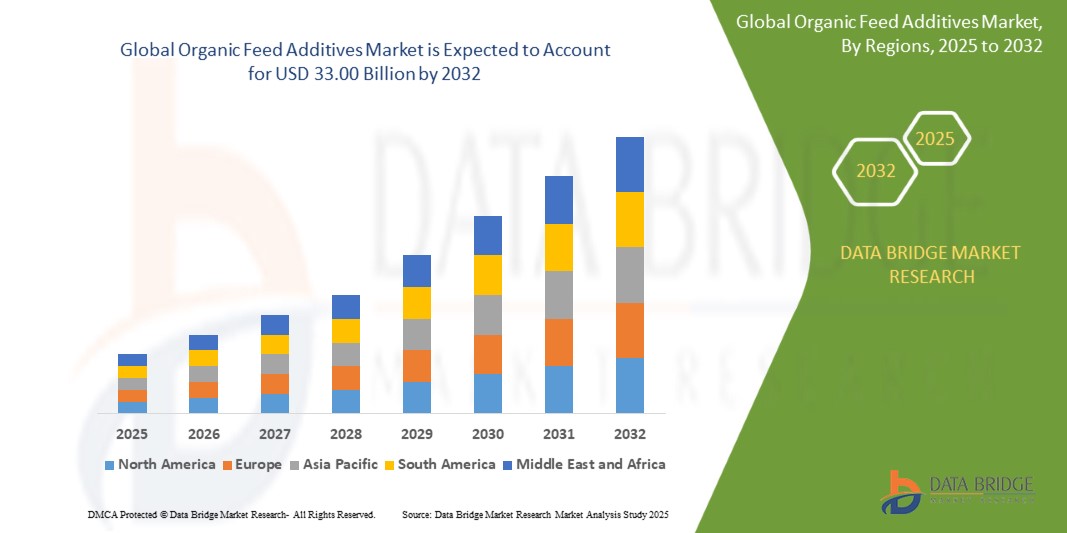
What is the Global Organic Feed Additives Market Size and Growth Rate?
- The global organic feed additives market size was valued at USD 16.23 billion in 2024 and is expected to reach USD 33.00 billion by 2032, at a CAGR of 8.20% during the forecast period
- The market growth is primarily driven by the increasing focus on sustainable livestock farming, rising consumer demand for chemical-free animal products, and technological advancements in feed formulation that enhance animal health and productivity
- Moreover, growing awareness about the benefits of organic feed, including improved immunity, better nutrient absorption, and eco-friendly production practices, is encouraging farmers and feed manufacturers to adopt organic feed additives, thereby accelerating industry expansion
What are the Major Takeaways of Organic Feed Additives Market?
- Organic Feed Additives are becoming an essential component of modern animal nutrition, offering natural solutions to improve livestock health, growth performance, and feed efficiency, particularly in poultry, dairy, and aquaculture sectors
- The rising demand is fueled by increased consumer preference for organic and clean-label animal products, stricter regulatory standards for conventional feed, and the growing trend of sustainable and environmentally conscious farming practices
- Asia-Pacific dominated the organic feed additives market with the largest revenue share of 39.47% in 2024, driven by rising demand for natural and sustainable feed solutions, increasing livestock production, and growing consumer preference for organic animal products
- Europe organic feed additives market is poised to grow at the fastest CAGR of 7.73% during 2025–2032, driven by increasing consumer demand for organic meat, dairy, and aquaculture products, stringent environmental regulations, and expanding adoption of sustainable farming practices
- The Amino Acids segment dominated the market with the largest revenue share of 32.5% in 2024, driven by its critical role in supporting livestock growth, feed efficiency, and overall health
Report Scope and Organic Feed Additives Market Segmentation
|
Attributes |
Organic Feed Additives Key Market Insights |
|
Segments Covered |
|
|
Countries Covered |
North America
Europe
Asia-Pacific
Middle East and Africa
South America
|
|
Key Market Players |
|
|
Market Opportunities |
|
|
Value Added Data Infosets |
In addition to the insights on market scenarios such as market value, growth rate, segmentation, geographical coverage, and major players, the market reports curated by the Data Bridge Market Research also include in-depth expert analysis, pricing analysis, brand share analysis, consumer survey, demography analysis, supply chain analysis, value chain analysis, raw material/consumables overview, vendor selection criteria, PESTLE Analysis, Porter Analysis, and regulatory framework. |
What is the Key Trend in the Organic Feed Additives Market?
Growing Adoption of Natural and Sustainable Solutions
- A major trend in the global organic feed additives market is the increasing shift toward natural, sustainable, and eco-friendly feed solutions that enhance livestock health and productivity while minimizing environmental impact
- For instance, LOOV Organic and Adisseo are introducing innovative organic feed additives derived from plant extracts, probiotics, and natural enzymes, supporting sustainable animal nutrition practices
- Organic Feed Additives now integrate functional benefits such as gut health improvement, immune support, and growth promotion, enabling farmers to optimize livestock performance while reducing reliance on antibiotics and synthetic chemicals
- The rising focus on sustainable agriculture and regulatory frameworks favoring organic products is driving adoption across poultry, cattle, swine, and aquaculture sectors
- Companies such as Cargill, DSM, and Novozymes are investing in R&D to develop more efficient, natural feed solutions that align with consumer demand for cleaner, traceable animal products
- The growing emphasis on eco-conscious farming and enhanced livestock productivity is fundamentally reshaping livestock nutrition practices globally
What are the Key Drivers of Organic Feed Additives Market?
- The rising demand for sustainable and safe animal products, along with stricter regulations limiting synthetic additives, is a significant driver for organic feed additives adoption
- For instance, in 2024, Novozymes expanded its enzyme-based feed solutions portfolio to support antibiotic-free livestock production, reflecting a trend toward natural feed enhancement
- Consumers increasingly prefer organic and chemical-free dairy, meat, and poultry products, prompting manufacturers to integrate organic feed additives into livestock nutrition
- The growing awareness of livestock welfare and improved feed efficiency has led to increased use of probiotics, prebiotics, and herbal extracts, which improve health outcomes and productivity
- The convenience of ready-to-use feed supplements, combined with enhanced livestock performance and reduced environmental impact, further propels adoption among commercial and small-scale farmers
Which Factor is Challenging the Growth of the Organic Feed Additives Market?
- Higher costs of organic feed additives compared to conventional products pose a significant challenge, especially in price-sensitive markets
- For instance, smaller farms in developing regions face difficulty accessing premium organic feed solutions due to cost constraints and limited supply chains
- In addition, standardization and quality control remain concerns, as variations in active ingredient concentrations can affect efficacy and livestock performance
- Limited awareness and expertise regarding optimal organic feed formulations can slow adoption, requiring farmer education and technical support
- Addressing these challenges through cost-effective production, regulatory harmonization, and better farmer outreach will be essential for sustained market growth
- Despite these barriers, increasing consumer demand for sustainable and safe animal products is expected to accelerate global adoption of organic feed additives
How is the Organic Feed Additives Market Segmented?
The market is segmented on the basis of type, livestock, and form.
• By Type
On the basis of type, the organic feed additives market is segmented into Amino Acids, Vitamins, Minerals, Acidifiers, Antioxidants, Pre & Probiotics, Flavors & Sweeteners, and Others. The Amino Acids segment dominated the market with the largest revenue share of 32.5% in 2024, driven by its critical role in supporting livestock growth, feed efficiency, and overall health. Livestock producers increasingly rely on amino acid supplementation to optimize performance, reduce feed costs, and meet regulatory standards for sustainable animal nutrition.
The Pre & Probiotics segment is anticipated to witness the fastest CAGR of 9.8% from 2025 to 2032, fueled by rising awareness of gut health in livestock and the benefits of natural alternatives to antibiotics. Enhanced demand for immune support and improved feed digestibility through prebiotics and probiotics is further propelling this segment, particularly in poultry and swine applications, reflecting the trend toward sustainable and health-focused feed solutions.
• By Livestock
On the basis of livestock, the market is segmented into Ruminants, Swine, Poultry, Aquaculture, and Others. The Poultry segment held the largest revenue share of 38% in 2024, owing to the widespread adoption of organic feed additives in broiler and layer operations to improve growth performance, egg quality, and overall flock health.
The Ruminants segment is expected to witness the fastest CAGR of 10.2% from 2025 to 2032, driven by the increasing need for enhanced feed efficiency, milk production, and sustainable cattle farming practices. The rising preference for natural feed solutions that improve digestion, immunity, and nutrient absorption in ruminants is boosting adoption, particularly in developed regions with stringent regulations on synthetic additives. The increasing global demand for dairy and meat products further supports growth across both segments, reflecting the focus on productivity, animal welfare, and sustainable livestock management.
• By Form
On the basis of form, the market is segmented into Dry and Liquid. The Dry segment dominated the Organic Feed Additives market with the largest revenue share of 57% in 2024, owing to its longer shelf life, easier storage, and convenient incorporation into compound feed formulations. Dry additives are widely preferred in commercial feed mills and large-scale livestock operations due to their stability and compatibility with multiple feed types.
The Liquid segment is expected to witness the fastest CAGR of 8.5% from 2025 to 2032, driven by growing interest in customizable, easy-to-administer solutions for livestock nutrition and the incorporation of functional additives such as vitamins, minerals, and probiotics directly into drinking water. The flexibility, rapid absorption, and ability to target specific nutritional requirements make liquid feed additives increasingly popular among farmers seeking enhanced livestock performance and health outcomes.
Which Region Holds the Largest Share of the Organic Feed Additives Market?
- Asia-Pacific dominated the organic feed additives market with the largest revenue share of 39.47% in 2024, driven by rising demand for natural and sustainable feed solutions, increasing livestock production, and growing consumer preference for organic animal products
- Producers and feed manufacturers in the region highly value the benefits of organic feed additives in improving livestock health, productivity, and product quality, which further supports market adoption
- This strong growth is also aided by increasing government initiatives to promote sustainable livestock farming, rising disposable incomes, and an expanding middle class, making organic feed additives a preferred solution across multiple livestock applications
China Organic Feed Additives Market Insight
The China organic feed additives market captured the largest revenue share of 36% in Asia-Pacific in 2024, fueled by rapid urbanization, the growth of commercial livestock operations, and increasing consumer awareness of health and nutrition. The government’s push for organic and sustainable farming practices, combined with the expansion of feed manufacturing infrastructure, is significantly boosting market adoption. Moreover, domestic production capabilities and cost-effective solutions are enhancing accessibility for farmers, strengthening market growth across ruminants, poultry, and aquaculture sectors.
Japan Organic Feed Additives Market Insight
The Japan organic feed additives market is witnessing steady growth due to the country’s advanced agricultural practices, high standards for food safety, and focus on livestock health. Rising demand for premium animal products, including dairy, meat, and aquaculture, is driving the adoption of organic feed additives. Furthermore, technological advancements in feed supplementation, along with a strong emphasis on sustainability, are supporting market expansion in both commercial and small-scale livestock operations.
Europe Organic Feed Additives Market Insight
Europe organic feed additives market is poised to grow at the fastest CAGR of 7.73% during 2025–2032, driven by increasing consumer demand for organic meat, dairy, and aquaculture products, stringent environmental regulations, and expanding adoption of sustainable farming practices. Countries such as Germany, France, and the U.K. are witnessing rapid growth due to heightened awareness regarding animal health, food safety, and eco-friendly solutions. Advanced feed formulations, research investments, and innovation in natural additives are supporting the accelerated adoption of organic feed additives across diverse livestock sectors in the region.
U.K. Organic Feed Additives Market Insight
The U.K. organic feed additives market is anticipated to expand at a noteworthy CAGR, supported by the rising focus on sustainable livestock farming and consumer preference for organic animal products. Farmers are increasingly adopting organic feed additives to improve livestock health, feed efficiency, and overall product quality, while government incentives and policies promoting organic farming continue to drive market growth.
Germany Organic Feed Additives Market Insight
The Germany organic feed additives market is expected to witness considerable growth due to rising concerns about animal welfare, environmental sustainability, and regulatory compliance. German farmers are adopting organic feed solutions to improve productivity, ensure high-quality meat and dairy outputs, and align with eco-friendly practices. Technological innovation and integration with precision livestock farming systems are further propelling market expansion.
Which are the Top Companies in Organic Feed Additives Market?
The organic feed additives industry is primarily led by well-established companies, including:
- Cargill, Incorporated (U.S.)
- ADM (U.S.)
- Ajinomoto Co., Inc. (Japan)
- Evonik Industries (Germany)
- DuPont (U.S.)
- Novozymes (Denmark)
- DSM (Netherlands)
- Adisseo (China)
- Hansen Holding (Denmark)
- Kemin Industries, Inc. (U.S.)
- Evonik Industries AG (Germany)
- Chr. Hansen Holding A/S (Denmark)
- Bluestar Adisseo (France)
- BASF SE (Germany)
- Invivo NSA (France)
- Nutreco (Netherlands)
- Kemin (U.S.)
- Conagra Brands Inc (U.S.)
- Ardent Mills LLC. (U.S.)
- Spectrum Essentials (U.S.)
- Flour Farm's; Let's Do an Organic (U.S.)
- Bob's Red Mill (U.S.)
What are the Recent Developments in Global Organic Feed Additives Market?
- In August 2024, Volac, a U.K.-based additives company, launched its latest website for the additives division, showcasing technical support services and evidence-based products designed to enhance the sustainability and efficiency of livestock production systems globally, underlining the company’s commitment to innovative and eco-friendly solutions
- In August 2023, Adisseo, a Chinese animal nutrition conglomerate, announced plans to expand its operations by constructing a new powder methionine plant in Fujian province, China, with an investment of approximately USD 680 million, expected to be operational by 2027, highlighting its strategic approach to meeting growing market demand
- In February 2021, the DLG Group, in collaboration with Alltech, acquired Finland-based Karki-Agri, strengthening their capacity to provide field-proven and innovative animal nutrition solutions and reinforcing their position in the global market
- In February 2021, Investment Partners, through its IK IX Fund, acquired the majority of shares from the founders of Innovad, a supplier of animal health and nutrition solutions, signaling a strategic expansion to enhance its product portfolio and market reach
- In November 2020, Evonik acquired the Porocel Group for USD 210 million, integrating its employees and production facilities into Evonik’s Smart Materials division, which bolstered the company’s sales and earnings for 2020 and strengthened its footprint in the animal nutrition sector

- Interactive Data Analysis Dashboard
- Company Analysis Dashboard for high growth potential opportunities
- Research Analyst Access for customization & queries
- Competitor Analysis with Interactive dashboard
- Latest News, Updates & Trend analysis
- Harness the Power of Benchmark Analysis for Comprehensive Competitor Tracking
Data collection and base year analysis are done using data collection modules with large sample sizes. The stage includes obtaining market information or related data through various sources and strategies. It includes examining and planning all the data acquired from the past in advance. It likewise envelops the examination of information inconsistencies seen across different information sources. The market data is analysed and estimated using market statistical and coherent models. Also, market share analysis and key trend analysis are the major success factors in the market report. To know more, please request an analyst call or drop down your inquiry.
The key research methodology used by DBMR research team is data triangulation which involves data mining, analysis of the impact of data variables on the market and primary (industry expert) validation. Data models include Vendor Positioning Grid, Market Time Line Analysis, Market Overview and Guide, Company Positioning Grid, Patent Analysis, Pricing Analysis, Company Market Share Analysis, Standards of Measurement, Global versus Regional and Vendor Share Analysis. To know more about the research methodology, drop in an inquiry to speak to our industry experts.
Data Bridge Market Research is a leader in advanced formative research. We take pride in servicing our existing and new customers with data and analysis that match and suits their goal. The report can be customized to include price trend analysis of target brands understanding the market for additional countries (ask for the list of countries), clinical trial results data, literature review, refurbished market and product base analysis. Market analysis of target competitors can be analyzed from technology-based analysis to market portfolio strategies. We can add as many competitors that you require data about in the format and data style you are looking for. Our team of analysts can also provide you data in crude raw excel files pivot tables (Fact book) or can assist you in creating presentations from the data sets available in the report.