What is the Global Organic Saffron Market Size and Growth Rate?
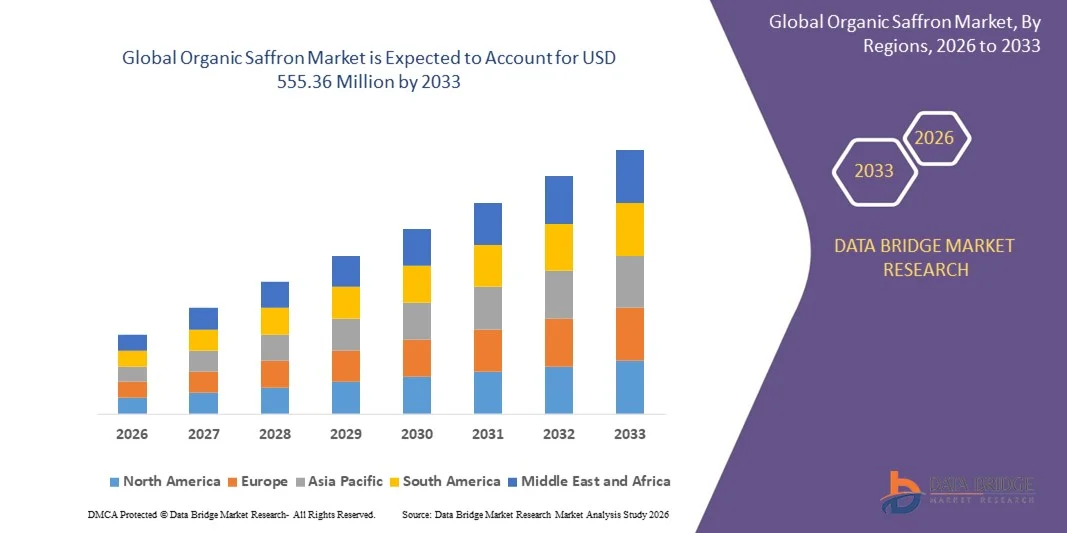
- As per Data Bridge Market Research Analysis the global organic saffron market size was valued at USD 348.44 million in 2025 and is expected to reach USD 555.36 million by 2033, at a CAGR of 6.00% during the forecast period
- Rising popularity of organic saffron around the world and increased acceptance by the cosmetic industry are the major factors fostering the growth of organic saffron market
- Growing consumer health consciousness especially in the developing economies, rising application of organic saffron by food and additives industry as seasoning agents or flavouring agents and increasing personal disposable income are some other indirect organic saffron market growth determinants
Market Size & Forecast
- Global Market Value (2025): USD 348.44 Billion
- Expected Market Value (2033): USD 555.36 Billion
- Forecast CAGR (2026–2033): 6.00%
What are the Major Takeaways of Organic Saffron Market?
- Growing penetration of e-commerce platforms, increased focus of the manufacturers on product innovations and shifting consumer lifestyle will also create lucrative and remunerative organic saffron market growth opportunities in the long run
- On the flip side, high costs of organic saffron as compared to traditional saffron will pose a major challenge to the growth of organic saffron market in the long run. Low rate of cultivation promotes adulteration and this will further derail the organic saffron market growth rate
- Europe dominated the organic saffron market with a 41.6% revenue share in 2025, driven by strong consumer preference for organic, premium, and sustainably sourced food ingredients across countries such as Spain, Italy, France, and Germany
- Asia-Pacific is projected to register the fastest CAGR of 11.2% from 2026 to 2033, driven by expanding middle-class populations, rising health awareness, and growing demand for organic and functional food ingredients across India, China, Japan, and Southeast Asia
- The Thread segment dominated the market with a 48.6% share in 2025, as saffron threads are considered the purest and most authentic form, widely preferred for culinary, medicinal, and premium retail applications
Report Scope and Organic Saffron Market Segmentation
|
Attributes |
Organic Saffron Key Market Insights |
|
Segments Covered |
|
|
Countries Covered |
North America
Europe
Asia-Pacific
Middle East and Africa
South America
|
|
Key Market Players |
|
|
Market Opportunities |
|
|
Value Added Data Infosets |
In addition to the insights on market scenarios such as market value, growth rate, segmentation, geographical coverage, and major players, the market reports curated by the Data Bridge Market Research also include in-depth expert analysis, pricing analysis, brand share analysis, consumer survey, demography analysis, supply chain analysis, value chain analysis, raw material/consumables overview, vendor selection criteria, PESTLE Analysis, Porter Analysis, and regulatory framework. |
What is the Key Trend in the Organic Saffron Market?
Rising Shift Toward Certified, Traceable, and Premium-Grade Organic Saffron
- The organic saffron market is witnessing increasing demand for certified organic, pesticide-free, and sustainably cultivated saffron, driven by growing health awareness and clean-label food preferences
- Producers are focusing on advanced cultivation techniques, improved harvesting practices, and controlled drying methods to preserve aroma, color strength (crocin), and flavor quality
- Rising preference for traceable sourcing, geographical indication (GI) tags, and transparent supply chains is strengthening consumer trust and premium pricing
- For instance, organic saffron producers in Iran, Spain, and India are adopting blockchain traceability, ISO certifications, and organic farming standards to enhance export competitiveness
- Growing use of organic saffron in functional foods, nutraceuticals, cosmetics, and herbal formulations is expanding application scope beyond traditional culinary uses
- As consumers increasingly prioritize authenticity, purity, and wellness benefits, Organic Saffron will remain a high-value premium spice segment globally
What are the Key Drivers of Organic Saffron Market?
- Rising consumer demand for natural, organic, and chemical-free food ingredients across Europe, North America, and Asia-Pacific
- For instance, during 2024–2025, several global food and nutraceutical brands increased sourcing of certified organic saffron to support clean-label product launches
- Growing adoption of organic saffron in dietary supplements, immunity boosters, mood-enhancing formulations, and cosmetic products
- Expansion of e-commerce platforms and direct-to-consumer channels is improving global accessibility and brand visibility
- Increasing awareness of saffron’s antioxidant, anti-inflammatory, and mental wellness benefits is driving premium consumption
- Supported by rising disposable income, wellness trends, and organic food regulations, the organic saffron market is expected to witness steady long-term growth
Which Factor is Challenging the Growth of the Organic Saffron Market?
- High production costs, labor-intensive harvesting, and limited yield per hectare restrict large-scale organic saffron cultivation
- For instance, climatic variability and water availability during 2024–2025 impacted organic saffron output in key producing regions
- Risk of adulteration and counterfeit products affects consumer trust and pricing stability
- Limited availability of certified organic farmland and skilled labor constrains supply expansion
- Price sensitivity in emerging markets restricts mass adoption compared to conventional saffron
- To overcome these challenges, companies are investing in farmer training programs, quality testing, certification, and branding strategies to strengthen global adoption of organic saffron
How is the Organic Saffron Market Segmented?
The market is segmented on the basis of form, application, and distribution channel.
- By Form
On the basis of form, the organic saffron market is segmented into thread, powder, and liquid. The Thread segment dominated the market with a 48.6% share in 2025, as saffron threads are considered the purest and most authentic form, widely preferred for culinary, medicinal, and premium retail applications. Consumers associate threads with higher quality, stronger aroma, and better crocin and safranal content, which drives strong demand across households, hotels, and specialty food brands. In addition, regulatory bodies and quality-conscious buyers favor thread saffron due to its lower risk of adulteration.
The Powder segment is expected to grow at the fastest CAGR from 2026 to 2033, driven by rising usage in processed foods, beverages, nutraceuticals, and cosmetic formulations. Powdered saffron offers ease of blending, consistent dosing, and compatibility with large-scale manufacturing, making it increasingly attractive for industrial and pharmaceutical applications.
- By Application
On the basis of application, the organic saffron market is segmented into food and beverages, pharmaceutical, personal care and cosmetics, textile, and others. The Food and Beverages segment dominated the market with a 44.2% share in 2025, supported by extensive use of organic saffron in traditional cuisines, gourmet foods, bakery products, dairy, beverages, and functional foods. Growing preference for natural colorants, flavor enhancers, and clean-label ingredients continues to strengthen demand in this segment.
The Pharmaceutical segment is projected to register the fastest CAGR from 2026 to 2033, driven by increasing scientific validation of saffron’s antioxidant, antidepressant, anti-inflammatory, and immunity-enhancing properties. Rising incorporation of organic saffron in dietary supplements, herbal medicines, and wellness formulations is accelerating growth. Meanwhile, personal care and cosmetics applications are expanding steadily due to saffron’s skin-brightening and anti-aging benefits.
- By Distribution Channel
On the basis of distribution channel, the organic saffron market is segmented into store-based distribution channels and non-store-based distribution channels. The Store-based distribution channel dominated the market with a 56.1% share in 2025, driven by strong consumer trust in physical retail formats such as specialty spice stores, organic food outlets, supermarkets, and pharmacies. These channels allow buyers to verify product authenticity, certifications, and origin, which is critical for high-value products such as organic saffron.
The Non-store-based distribution channel is expected to grow at the fastest CAGR from 2026 to 2033, fueled by rapid expansion of e-commerce platforms, direct-to-consumer brand websites, and global online marketplaces. Increased digital literacy, wider product accessibility, transparent sourcing information, and competitive pricing are encouraging consumers to purchase organic saffron online, especially in North America, Europe, and Asia-Pacific.
Which Region Holds the Largest Share of the Organic Saffron Market?
- Europe dominated the organic saffron market with a 41.6% revenue share in 2025, driven by strong consumer preference for organic, premium, and sustainably sourced food ingredients across countries such as Spain, Italy, France, and Germany. High demand for organic spices in gourmet cuisine, functional foods, pharmaceuticals, and natural cosmetics continues to support regional growth
- Stringent food safety regulations, strong certification frameworks, and high awareness regarding product traceability and authenticity further strengthen Europe’s leadership in the organic saffron market
- Presence of established organic food brands, advanced distribution networks, and rising demand for clean-label and plant-based products reinforce long-term market dominance across the region
Spain Organic Saffron Market Insight
Spain is a major contributor to the European market, supported by its long-standing heritage in saffron cultivation, processing, and export. Strong demand from food manufacturers, gourmet restaurants, and pharmaceutical companies drives steady consumption. Spain’s focus on quality certification, origin labeling, and premium packaging strengthens its position in global organic saffron trade.
France Organic Saffron Market Insight
France demonstrates steady growth due to rising use of organic saffron in gourmet cuisine, nutraceuticals, and natural cosmetic formulations. High consumer spending on premium organic products, coupled with strong demand from specialty food brands and wellness companies, continues to expand market adoption.
Asia-Pacific Organic Saffron Market
Asia-Pacific is projected to register the fastest CAGR of 11.2% from 2026 to 2033, driven by expanding middle-class populations, rising health awareness, and growing demand for organic and functional food ingredients across India, China, Japan, and Southeast Asia. Increasing use of saffron in traditional medicine, dietary supplements, and premium food products significantly supports regional growth.
India Organic Saffron Market Insight
India is emerging as a key growth hub, supported by increasing cultivation of organic saffron in regions such as Kashmir, rising domestic consumption, and growing exports. Strong demand from pharmaceuticals, Ayurveda, food processing, and wellness industries continues to accelerate market expansion.
China Organic Saffron Market Insight
China’s market growth is driven by rising use of saffron in traditional medicine, health supplements, and premium food products. Increasing disposable income, expanding e-commerce platforms, and growing awareness of organic certifications are boosting consumption across urban markets.
Japan Organic Saffron Market Insight
Japan shows stable growth supported by demand for high-quality, traceable organic ingredients in functional foods, beverages, and cosmetics. Strong consumer focus on purity, safety, and premium quality reinforces long-term adoption of organic saffron products.
Which are the Top Companies in Organic Saffron Market?
The organic saffron industry is primarily led by well-established companies, including:
- Mehr Saffron (Iran)
- Rowhani Saffron Co. (Iran)
- Frontier Co-op (U.S.)
- Great American Spice Company (U.S.)
- HEA & Co Spanish (Spain)
- Iran Saffron (Iran)
- Organic Spices Inc. (U.S.)
- Valgosa S.L. (Spain)
- Epicure Garden (U.S.)
- ALPEN FOOD GROUP B.V. (Netherlands)
- Tatva (India)
- Noor Brand Saffron (India)
- Gohar Saffron Co. (Iran)
- SMEServ (Iran)
- Royal Saffron (U.A.E.)
- Damon Enterprises (India)
- Golden Pars Maha (Iran)
- Shahri Food Products (Iran)
- Linkage International Shipping & Forwarding LLC. (U.A.E.)
- Esfahan Pishro (Iran)
- BSIbio (U.K.)
- London Bio Packaging (U.K.)
- Taj Agro International (TajPharma Group) (India)
What are the Recent Developments in Global Organic Saffron Market?
- In June 2022, SoulTree, a premium Ayurvedic beauty brand, introduced its Advanced Kumkumadi range, marking India’s first certified skincare line formulated with 100% pure, organic Mogra saffron, comprising eight products including facial oils, creams, cleansers, and masks tailored for different skin types and rooted in traditional Ayurvedic formulations, strengthening the brand’s positioning in the high-end organic and Ayurvedic skincare segment

- Interactive Data Analysis Dashboard
- Company Analysis Dashboard for high growth potential opportunities
- Research Analyst Access for customization & queries
- Competitor Analysis with Interactive dashboard
- Latest News, Updates & Trend analysis
- Harness the Power of Benchmark Analysis for Comprehensive Competitor Tracking
Data collection and base year analysis are done using data collection modules with large sample sizes. The stage includes obtaining market information or related data through various sources and strategies. It includes examining and planning all the data acquired from the past in advance. It likewise envelops the examination of information inconsistencies seen across different information sources. The market data is analysed and estimated using market statistical and coherent models. Also, market share analysis and key trend analysis are the major success factors in the market report. To know more, please request an analyst call or drop down your inquiry.
The key research methodology used by DBMR research team is data triangulation which involves data mining, analysis of the impact of data variables on the market and primary (industry expert) validation. Data models include Vendor Positioning Grid, Market Time Line Analysis, Market Overview and Guide, Company Positioning Grid, Patent Analysis, Pricing Analysis, Company Market Share Analysis, Standards of Measurement, Global versus Regional and Vendor Share Analysis. To know more about the research methodology, drop in an inquiry to speak to our industry experts.
Data Bridge Market Research is a leader in advanced formative research. We take pride in servicing our existing and new customers with data and analysis that match and suits their goal. The report can be customized to include price trend analysis of target brands understanding the market for additional countries (ask for the list of countries), clinical trial results data, literature review, refurbished market and product base analysis. Market analysis of target competitors can be analyzed from technology-based analysis to market portfolio strategies. We can add as many competitors that you require data about in the format and data style you are looking for. Our team of analysts can also provide you data in crude raw excel files pivot tables (Fact book) or can assist you in creating presentations from the data sets available in the report.