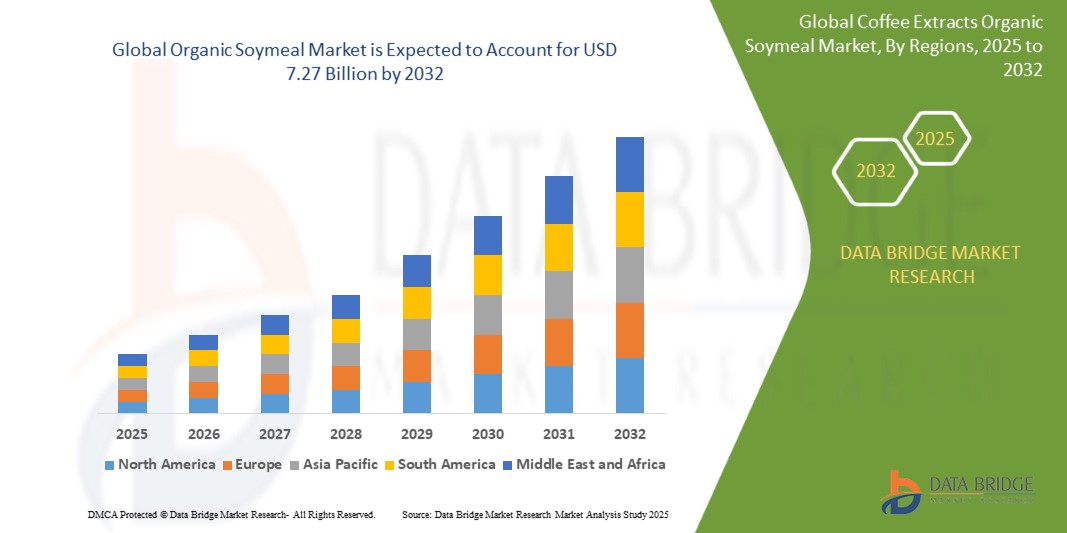
Organic Soymeal Market Size
- The global organic soymeal market size was valued at USD 4.77 billion in 2024 and is expected to reach USD 7.27 billion by 2032, at a CAGR of 5.4% during the forecast period
- The market growth is largely fueled by rising consumer demand for organic and non-GMO feed ingredients, increasing awareness about animal nutrition, and the growing adoption of sustainable and eco-friendly farming practices
- Expansion of the livestock sector, coupled with the need for high-protein, safe, and quality feed alternatives, is further supporting market growth
Organic Soymeal Market Analysis
- The global organic soymeal market is witnessing steady growth, driven by rising preference for organic and non-GMO livestock feed and growing adoption among dairy, poultry, and aquaculture producers
- Improved awareness regarding feed quality, animal health, and sustainable farming practices is encouraging farmers to incorporate organic soymeal into daily feed routines
- North America dominated the organic soymeal market with the largest revenue share of 38.5% in 2024, driven by increasing demand for high-quality, non-GMO feed in the livestock and aquaculture sectors
- Asia-Pacific region is expected to witness the highest growth rate in the global organic soymeal market, driven by rapid urbanization, rising disposable incomes, growing demand for organic animal products, and expanding production capacity for organic soymeal in countries such as China, Japan, and India
- The Animal Feed segment held the largest market revenue share in 2024, driven by rising demand for high-protein, non-GMO feed in dairy, poultry, and aquaculture sectors. Organic soymeal offers improved livestock nutrition, better growth rates, and aligns with consumer demand for natural and chemical-free animal products
Report Scope and Organic Soymeal Market Segmentation
|
Attributes |
Organic Soymeal Key Market Insights |
|
Segments Covered |
|
|
Countries Covered |
North America
Europe
Asia-Pacific
Middle East and Africa
South America
|
|
Key Market Players |
|
|
Market Opportunities |
|
|
Value Added Data Infosets |
In addition to the insights on market scenarios such as market value, growth rate, segmentation, geographical coverage, and major players, the market reports curated by the Data Bridge Market Research also include import export analysis, production capacity overview, production consumption analysis, price trend analysis, climate change scenario, supply chain analysis, value chain analysis, raw material/consumables overview, vendor selection criteria, PESTLE Analysis, Porter Analysis, and regulatory framework. |
Organic Soymeal Market Trends
Growing Adoption of Organic Feed in Livestock Nutrition
- The increasing preference for organic soymeal is transforming the livestock feed landscape by providing a safe, non-GMO protein source. This shift enables farmers to produce healthier animal-derived products while adhering to organic and sustainable farming practices, resulting in improved product quality and consumer trust
- The high demand for organic feed in dairy, poultry, and aquaculture is accelerating adoption across farms of all sizes. Organic soymeal is particularly valued where chemical-free and sustainable nutrition is prioritized, supporting better animal health and productivity. The trend is further bolstered by government and certification programs promoting organic farming
- The affordability and accessibility of certified organic soymeal are making it suitable for routine inclusion in livestock diets, leading to enhanced nutrition and feed efficiency. Farmers benefit from a reliable, high-quality protein source without compromising on regulatory compliance or consumer preferences
- For instance, in 2023, several dairy and poultry farms in Europe reported higher milk and egg quality after incorporating organic soymeal into feed rations, improving both animal health and marketability of their products
- While organic soymeal adoption is accelerating improvements in livestock nutrition, sustained growth depends on consistent supply, certification standards, and farmer awareness. Manufacturers must focus on scaling production, ensuring quality, and offering localized solutions to fully capitalize on this expanding demand
Organic Soymeal Market Dynamics
Driver
Rising Consumer Demand for Organic and Non-GMO Animal Products
- The growing awareness of food safety and chemical-free animal products is pushing farmers to prioritize organic soymeal as a key feed component. Increasing consumer preference for organic milk, meat, and eggs is driving consistent demand for high-quality feed inputs. This trend is encouraging large-scale adoption across commercial livestock farms and dairy operations globally
- Farmers recognize the nutritional benefits and improved feed efficiency provided by organic soymeal, motivating regular adoption in livestock diets. This is supported by evolving regulations, organic certification programs, and sustainable farming practices that incentivize the use of non-GMO protein sources. Regular integration into feed routines enhances livestock health and output quality
- Government initiatives and industry programs have strengthened organic feed infrastructure and promoted best practices. From subsidies on certified feed to national organic farming campaigns, supportive frameworks are helping farmers adopt organic soymeal effectively. Such measures also improve farmer confidence and ensure compliance with international organic standards
- For instance, in 2022, several EU member states incentivized the use of organic protein feed in commercial livestock operations, boosting demand for certified soymeal across the region. These programs enhanced feed accessibility, supported organic certification compliance, and increased overall livestock product quality
- While consumer awareness and institutional support are driving growth, there remains a need to improve supply chain consistency, reduce costs, and integrate organic feed into routine livestock management to ensure sustained adoption. Industry collaboration and investment in local production facilities are essential to meet rising demand
Restraint/Challenge
High Cost of Organic Soymeal and Supply Chain Constraints
- The higher price of certified organic soymeal compared to conventional soymeal makes it less accessible for small-scale farmers and underfunded livestock operations. Cost remains a major limiting factor for widespread adoption, especially in developing regions where profit margins are tight. Affordability challenges continue to slow market penetration
- In many regions, limited availability of organic soymeal and lack of local production infrastructure restrict access for farmers. Logistical challenges in transporting certified feed further hinder consistent supply, particularly in remote and rural areas. These barriers can force farmers to rely on conventional feed alternatives despite awareness of organic benefits
- Market penetration is also affected by seasonal fluctuations in organic soy production, impacting feed quality and pricing stability. Farmers may face sudden shortages or price spikes, leading to inconsistent adoption and challenges in planning feed rations for livestock. This volatility can also affect long-term supply contracts and farmer trust
- For instance, in 2023, reports from South American livestock cooperatives highlighted supply inconsistencies, with smallholder farmers facing difficulty sourcing certified organic soymeal for routine feed. Delays and irregular availability negatively impacted herd nutrition and production outputs
- While organic feed technologies and farming practices continue to advance, addressing cost, supply chain, and accessibility challenges is critical. Stakeholders must focus on scaling production, improving distribution networks, and providing affordable solutions to unlock long-term market potential. Collaborative initiatives and investment in processing facilities can ensure a steady and reliable supply of organic soymeal
Organic Soymeal Market Scope
The market is segmented on the basis of application, form, source, and distribution channel.
• By Application
On the basis of application, the organic soymeal market is segmented into Animal Feed, Food Processing, Nutraceuticals, and Pet Food. The Animal Feed segment held the largest market revenue share in 2024, driven by rising demand for high-protein, non-GMO feed in dairy, poultry, and aquaculture sectors. Organic soymeal offers improved livestock nutrition, better growth rates, and aligns with consumer demand for natural and chemical-free animal products.
The Food Processing segment is expected to witness the fastest growth rate from 2025 to 2032, fueled by growing use of organic soymeal in bakery, confectionery, and plant-based food products. Its nutritional benefits, functional properties, and consumer preference for clean-label ingredients make it an attractive choice for food manufacturers.
• By Form
On the basis of form, the market is segmented into Powder, Granules, and Flakes. The Powder segment held the largest market revenue share in 2024, due to its ease of incorporation into animal feed and food products, uniform nutrient distribution, and longer shelf life.
The Granules segment is expected to witness the fastest growth rate from 2025 to 2032, driven by increasing adoption in feed mills and pet food applications. Granulated organic soymeal provides convenient handling, minimal dust generation, and efficient feed blending.
• By Source
On the basis of source, the market is segmented into Whole Soybeans, Isolated Soy Protein, and Fermented Soy Products. Whole Soybeans dominated the market in 2024, owing to their widespread availability, cost-effectiveness, and balanced protein content suitable for both livestock and human consumption.
The Isolated Soy Protein segment is expected to witness the fastest growth rate from 2025 to 2032, fueled by demand in specialized food processing, nutraceuticals, and high-protein applications where concentrated protein content is required.
• By Distribution Channel
On the basis of distribution channel, the market is segmented into Online Retail, Supermarkets, and Specialty Stores. Online Retail held the largest market revenue share in 2024, driven by convenience, wider product availability, and growing e-commerce adoption among both B2B and B2C customers.
The Specialty Stores segment is expected to witness the fastest growth rate from 2025 to 2032, fueled by increasing consumer preference for certified organic products, personalized service, and assurance of product authenticity.
Organic Soymeal Market Regional Analysis
- North America dominated the organic soymeal market with the largest revenue share of 38.5% in 2024, driven by increasing demand for high-quality, non-GMO feed in the livestock and aquaculture sectors
- Consumers and producers highly value certified organic products, sustainable farming practices, and the traceability offered by organic soymeal
- This widespread adoption is further supported by strong regulatory frameworks, advanced supply chains, and growing awareness about sustainable and chemical-free animal feed
U.S. Organic Soymeal Market Insight
The U.S. organic soymeal market captured the largest revenue share in 2024 within North America, fueled by rapid adoption of organic feed in commercial dairy, poultry, and aquaculture operations. Producers are increasingly prioritizing organic soymeal to meet consumer demand for chemical-free animal products. Government incentives, organic certification programs, and growing retail and export opportunities for organic livestock products further drive market expansion.
Europe Organic Soymeal Market Insight
The Europe organic soymeal market is expected to witness the fastest growth rate from 2025 to 2032, primarily driven by stringent food safety regulations, rising consumer preference for organic and non-GMO animal products, and sustainability initiatives in agriculture. Increased urbanization and higher disposable incomes are fostering the adoption of organic soymeal, particularly in dairy and poultry farming.
U.K. Organic Soymeal Market Insight
The U.K. organic soymeal market iis expected to witness the fastest growth rate from 2025 to 2032, driven by rising consumer awareness about food safety, chemical-free animal feed, and organic farming practices. Growing concerns regarding animal health and sustainable nutrition are encouraging livestock farmers to switch to certified organic soymeal. In addition, government support and retail demand for organic animal products are expected to continue stimulating market growth.
Germany Organic Soymeal Market Insight
The Germany organic soymeal market is expected to witness the fastest growth rate from 2025 to 2032, fueled by increasing adoption of sustainable farming practices, high consumer awareness of chemical-free livestock products, and robust infrastructure for organic feed production. Integration of organic soymeal into commercial livestock feed, coupled with eco-conscious initiatives, is becoming increasingly prevalent across the region.
Asia-Pacific Organic Soymeal Market Insight
The Asia-Pacific organic soymeal market is expected to witness the fastest growth rate from 2025 to 2032, driven by rising urbanization, technological advancements in feed production, and growing consumer preference for organic and non-GMO animal products in countries such as China, Japan, and India. Increasing livestock production, government support for organic farming, and expanding manufacturing capacity for organic soymeal are accelerating adoption across the region.
Japan Organic Soymeal Market Insight
The Japan organic soymeal market is expected to witness the fastest growth rate from 2025 to 2032 due to the country’s high standards for food safety, increasing adoption of organic feed in poultry and dairy farms, and a growing demand for chemical-free livestock products. Integration of organic soymeal into commercial feed systems, along with government support for sustainable agriculture, is fueling market growth.
China Organic Soymeal Market Insight
The China organic soymeal market accounted for the largest market revenue share in Asia-Pacific in 2024, attributed to rapid urbanization, expansion of the middle class, and growing consumer awareness regarding food safety. China is a leading market for organic livestock feed, and organic soymeal is increasingly used in dairy, poultry, and aquaculture applications. The push toward sustainable farming, government incentives, and a strong domestic manufacturing base are key factors driving market growth in China.
Organic Soymeal Market Share
The Organic Soymeal industry is primarily led by well-established companies, including:
- Cargill, Incorporated (U.S.)
- Archer Daniels Midland Company (U.S.)
- Bunge Limited (U.S.)
- Wilmar International Limited (Singapore)
- Shandong Yuwang Industrial Co., Ltd. (China)
- Olam International Limited (Singapore)
- Hunan Jiangnan Organic Food Co., Ltd. (China)
- AgProcessing Inc. (U.S.)
- Fuji Oil Holdings Inc. (Japan)
- Cereal Docks S.p.A. (Italy)
- CHS Inc. (U.S.)
- AAK AB (Sweden)
- Zeelandia Group (Netherlands)
- SunOpta Inc. (Canada)
- Novastell Inc. (U.S.)

- Interactive Data Analysis Dashboard
- Company Analysis Dashboard for high growth potential opportunities
- Research Analyst Access for customization & queries
- Competitor Analysis with Interactive dashboard
- Latest News, Updates & Trend analysis
- Harness the Power of Benchmark Analysis for Comprehensive Competitor Tracking
Data collection and base year analysis are done using data collection modules with large sample sizes. The stage includes obtaining market information or related data through various sources and strategies. It includes examining and planning all the data acquired from the past in advance. It likewise envelops the examination of information inconsistencies seen across different information sources. The market data is analysed and estimated using market statistical and coherent models. Also, market share analysis and key trend analysis are the major success factors in the market report. To know more, please request an analyst call or drop down your inquiry.
The key research methodology used by DBMR research team is data triangulation which involves data mining, analysis of the impact of data variables on the market and primary (industry expert) validation. Data models include Vendor Positioning Grid, Market Time Line Analysis, Market Overview and Guide, Company Positioning Grid, Patent Analysis, Pricing Analysis, Company Market Share Analysis, Standards of Measurement, Global versus Regional and Vendor Share Analysis. To know more about the research methodology, drop in an inquiry to speak to our industry experts.
Data Bridge Market Research is a leader in advanced formative research. We take pride in servicing our existing and new customers with data and analysis that match and suits their goal. The report can be customized to include price trend analysis of target brands understanding the market for additional countries (ask for the list of countries), clinical trial results data, literature review, refurbished market and product base analysis. Market analysis of target competitors can be analyzed from technology-based analysis to market portfolio strategies. We can add as many competitors that you require data about in the format and data style you are looking for. Our team of analysts can also provide you data in crude raw excel files pivot tables (Fact book) or can assist you in creating presentations from the data sets available in the report.