


What is the Orthopedic Extension Devices Market Size and Growth Rate?
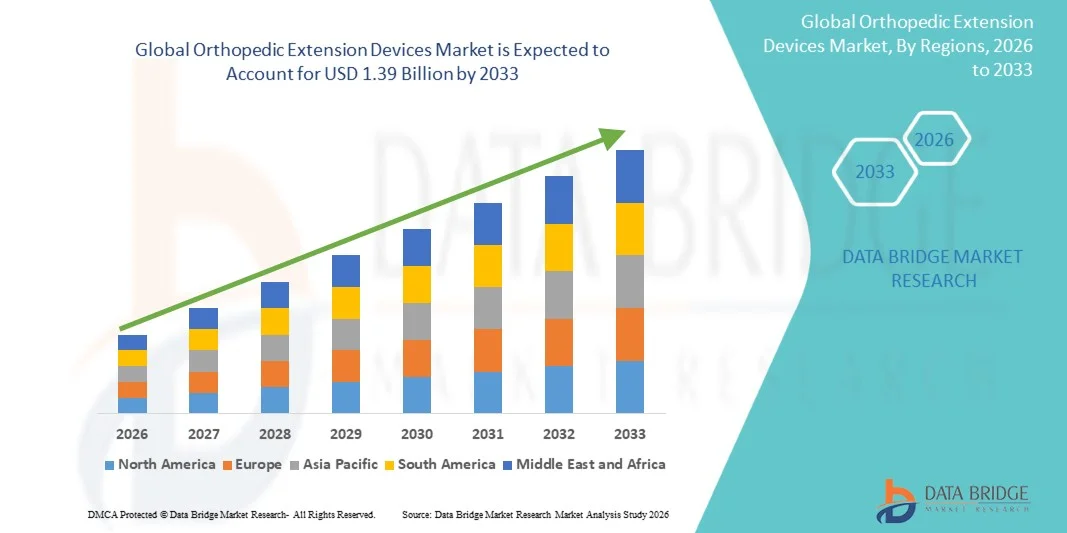
- As per Data Bridge Market Research analysis, the orthopedic extension devices market was valued at USD 1.01 billion in 2025 and is projected to reach USD 1.39 billion by 2033, growing at a CAGR of 4.10% from 2026 to 2033.
- The market is experiencing consistent growth driven by increasing cases of injuries and trauma that require surgical procedures, rising demand for non-invasive and effective solutions in orthopedic treatment, and continuous technological advancements in orthopedic instrumentation.
- The increasing incidence of falls, serious injuries, road accidents, and bone injuries, combined with the need for fracture management, correction of bone deformities, traction for healing fractures, and post-surgical recovery, is supporting the adoption of orthopedic extension devices across hospitals, clinics, and ambulatory surgical centers. The launch of new products and increasing product approvals are also expected to contribute to market growth.
Market Size & Forecast
- Global Market Value (2025): USD 1.01 Billion
- Expected Market Value (2033): USD 1.39 Billion
- Forecast CAGR (2026–2033): 4.10%
- Leading Region in 2025: North America
- Fastest Growing Region: Asia Pacific
What are the Major Takeaways of the Orthopedic Extension Devices Market?
- North America dominated the orthopedic extension devices market with a 43.0% share in 2025, supported by high healthcare spending, a well-developed hospital network, and established procurement and reimbursement channels that accelerated device adoption.
- Asia-Pacific is expected to be the fastest-growing region at a CAGR of 4.2% from 2026 to 2033, fueled by increasing cases of falls, serious injuries, and road accidents, coupled with improving healthcare infrastructure and facility expansions by leading players.
- The knee surgery segment led the market with a 30.35% share in 2025, driven by the increasing prevalence of osteoarthritis and growing demand for knee-related orthopedic procedures.
- Hip surgery is the fastest-growing product type, projected to register a CAGR of 5.5%, reflecting the surge in prevalence of hip disorders, trauma, and age-related musculoskeletal conditions.
- The titanium segment dominated the material category with a 35% revenue share in 2025, led by its established use in orthopedic applications and favorable properties including strength, durability, and biocompatibility.
- Hospitals accounted for 55.60% of the market share in 2025, preferred by sophisticated healthcare infrastructure, high orthopedic surgical volumes, and the availability of specialized operating rooms.
- The carbon fiber segment is the fastest-growing material category, with a CAGR of 6.0%, driven by its lightweight characteristics and radiolucent properties, which can be beneficial during orthopedic procedures requiring fluoroscopic imaging
Report Scope and Orthopedic Extension Devices Market Segmentation
|
Attributes |
Orthopedic Extension Devices Key Market Insights |
|
Segments Covered |
|
|
Countries Covered |
North America
Europe
Asia-Pacific
Middle East and Africa
South America
|
|
Key Market Players |
|
|
Market Opportunities |
|
|
Value Added Data Infosets |
In addition to the insights on market scenarios such as market value, growth rate, segmentation, geographical coverage, and major players, the market reports curated by the Data Bridge Market Research also include in-depth expert analysis, patient epidemiology, pipeline analysis, pricing analysis, and regulatory framework. |
What is the Key Trend in the Orthopedic Extension Devices Market?
- Orthopedic extension devices are increasingly being used to improve patient positioning, traction, surgical access, and operating-room efficiency during orthopedic procedures, particularly hip, knee, spine, and arm surgeries.
- For instance, in January 2024, SchureMed introduced the Áristos Orthopedic Extension, developed with orthopedic surgeons to provide a lightweight, modular solution for lower-extremity procedures, including hip replacement through the direct anterior approach, while improving patient positioning and operating-room workflow.
- The growing incidence of falls, serious injuries, road accidents, and bone injuries is increasing demand for extension systems that provide controlled traction and stabilization during complex orthopedic procedures.
- Manufacturers are increasingly focusing on new product launches and technological advancements to improve the functionality, flexibility, and clinical utility of orthopedic extension devices across surgical applications.
- Hospitals and ambulatory surgical centers are increasingly adopting advanced orthopedic surgical equipment as healthcare infrastructure expands and the number of orthopedic procedures continues to increase globally.
- For instance, in May 2025, researchers from Gachon University and Ajou University developed and evaluated a new surgical table for pelvic fracture surgery, demonstrating improved C-arm imaging and operational efficiency and highlighting the trend toward specialized positioning systems for complex orthopedic trauma procedures.
- As orthopedic procedures, trauma cases, and surgical technology adoption continue to increase, demand for specialized extension devices that improve surgical positioning and procedural efficiency is expected to accelerate, reinforcing these systems as an important component of modern orthopedic operating rooms.
What are the Key Drivers of the Orthopedic Extension Devices Market?
- The increasing incidence of injuries and trauma requiring surgical procedures has significantly increased demand for orthopedic extension devices that facilitate patient positioning, traction, stabilization, and access during orthopedic interventions.
- For instance, in September 2025, researchers published a clinical study in Frontiers in Surgery evaluating an anterior minimally invasive clamping technique combined with a lower-extremity axial bone traction device for irreducible intertrochanteric fractures, demonstrating continued clinical use of traction devices in complex fracture management
- The rising prevalence of osteoarthritis and age-related orthopedic conditions is increasing demand for hip and knee procedures, supporting the utilization of extension devices during joint replacement and other orthopedic surgeries.
- Increasing healthcare expenditure and expansion of healthcare facilities, particularly across emerging economies, are improving access to orthopedic procedures and supporting adoption of advanced orthopedic equipment.
- For instance, in June 2025, researchers evaluated C-Flex Traction as an alternative to conventional traction tables in 52 geriatric patients with pertrochanteric fractures, assessing positioning duration, operative time, blood loss, fluoroscopy time, reduction accuracy, and postoperative recovery.
- With orthopedic trauma, surgical volumes, and healthcare infrastructure continuing to expand, orthopedic extension devices will remain important supporting equipment for efficient positioning and traction during orthopedic surgical procedures.
Which Factors are Challenging the Growth of the Orthopedic Extension Devices Market?
- High costs of orthopedic extension devices can restrict adoption, particularly among healthcare facilities with limited budgets and in price-sensitive markets where capital expenditure remains a major consideration.
- For instance, in July 2024, a study published in Scientific Reports found that conventional 3.5-mm or thicker Steinmann pins used for skeletal traction are highly invasive and can cause serious complications, including pin-tract infection and iatrogenic calcaneal fractures, highlighting safety concerns associated with traction-based orthopedic devices
- Product recalls caused by defective goods or manufacturing faults can reduce acceptance among surgeons and patients while increasing replacement expenses and negatively affecting manufacturers' revenues.
- Complex size-fitting requirements, device composition, and potential negative impacts associated with defective products can further challenge adoption and create concerns regarding device reliability and patient safety.
- Increasing regulatory and quality requirements require manufacturers to maintain strict compliance with good manufacturing practices and regulatory guidelines, potentially increasing production and quality-control costs.
- For instance, in August 2024, a study published in Injury reported that traditional cutaneous traction methods using adhesive tape, plaster, and rubber bandages had complication rates of up to 11%, including pressure sores, skin sloughing, and compressive neuropathies, demonstrating the clinical risks that can limit adoption of conventional traction systems.
- As manufacturers face increasing pressure to maintain product quality while controlling device costs, recalls, manufacturing defects, and affordability constraints are expected to remain important challenges to broader adoption of orthopedic extension devices.
How is the Orthopedic Extension Devices Market Segmented?
The orthopedic extension devices market is segmented on the basis of product type, material, and end user.
- By Product Type
On the basis of product type, the orthopedic extension devices market is segmented into hip surgery, knee surgery, spine surgery, arm surgery, and others. The knee surgery segment dominated the market with an estimated 30.35% share in 2025, owing to the increasing prevalence of osteoarthritis and growing demand for knee-related orthopedic procedures. Approximately 46% of people develop knee osteoarthritis during their lifetime after age 40, highlighting the substantial patient pool requiring knee interventions. Knee procedures require accurate positioning and controlled extension during surgery, supporting demand for specialized orthopedic extension devices. Increasing numbers of joint replacement procedures are further strengthening the segment. Rising healthcare expenditure and improvements in orthopedic surgical infrastructure are also supporting adoption.
The hip surgery segment is expected to be the fastest-growing product type at a CAGR of 5.5% during 2026–2033, supported by the increasing prevalence of hip disorders, trauma, and age-related musculoskeletal conditions. Hip procedures frequently require specialized positioning and traction systems to provide surgeons with appropriate surgical access. The growing elderly population is increasing the incidence of hip-related orthopedic conditions and associated surgical interventions. Increasing adoption of minimally invasive hip procedures is also supporting demand for specialized operating-table accessories. Improvements in orthopedic surgical techniques are creating additional opportunities for extension-device manufacturers.
- By Material
On the basis of material, the orthopedic extension devices market is segmented into titanium, stainless steel, carbon fiber, polymer composites, and aluminum alloys. Titanium dominated the market with an estimated share of 35% share in 2025, based on its established use in orthopedic applications and favorable properties including strength, durability, and biocompatibility. Titanium is particularly important in orthopedic equipment where mechanical strength and long-term reliability are required. Its favorable strength-to-weight characteristics can also support development of lighter surgical components. Continued innovation in orthopedic materials is encouraging manufacturers to evaluate advanced material combinations.
The carbon fiber segment is expected to be the fastest-growing material category at a CAGR of 6.0% during 2026–2033, supported by its lightweight characteristics and radiolucent properties, which can be beneficial during orthopedic procedures requiring fluoroscopic imaging. Carbon-fiber components can reduce interference with imaging systems compared with conventional metallic components. Their high strength-to-weight ratio also provides opportunities for lighter surgical equipment. Increasing use of intraoperative imaging in trauma and orthopedic procedures can support demand for radiolucent materials. Manufacturers are increasingly exploring advanced composites for specialized surgical applications.
- By End User
On the basis of end user, the orthopedic extension devices market is segmented into hospitals, ambulatory surgical centers, specialty clinics, and others. The hospitals segment dominated the market with an estimated 55.60% share in 2025, supported by sophisticated healthcare infrastructure, high orthopedic surgical volumes, and the availability of specialized operating rooms. Hospitals perform a large proportion of complex trauma, joint replacement, and reconstructive orthopedic procedures. The need for specialized positioning and traction equipment is particularly high during complex orthopedic surgeries. Increasing investments in hospital infrastructure are further supporting adoption of advanced surgical equipment. The concentration of orthopedic specialists and surgical facilities in hospitals reinforces their dominant position.
The ambulatory surgical centers segment is expected to be the fastest-growing end-user category at a CAGR of 5.0% during 2026–2033, driven by increasing adoption of outpatient orthopedic procedures, shorter hospital stays, and growing demand for cost-efficient surgical care. ASCs are increasingly used for selected orthopedic procedures that do not require prolonged inpatient hospitalization. Their growing infrastructure and focus on efficient surgical workflows can support demand for compact and adaptable extension systems. Increasing preference for minimally invasive procedures is further supporting the expansion of ambulatory orthopedic care. The segment is also benefiting from healthcare providers' efforts to reduce treatment costs and improve operating-room utilization
Which Region Holds the Largest Share of the Orthopedic Extension Devices Market?
- North America dominated the orthopedic extension devices market with a 43.0% share in 2025, supported by high healthcare spending, a well-developed hospital network, and established procurement and reimbursement channels that accelerated device adoption.
- ·The region also benefits from sophisticated surgical infrastructure, increasing cases of major trauma, and high demand for orthopedic procedures, while nearly 1 million knee and hip arthroplasties were performed in the U.S. in 2021. Increasing adoption of advanced orthopedic technologies and continued investment in healthcare facilities are expected to strengthen North America’s leadership in the global market.
U.S. Orthopedic Extension Devices Market Insight
The U.S. orthopedic extension devices market is witnessing strong growth due to the country’s high volume of orthopedic procedures, advanced healthcare infrastructure, and increasing demand for trauma and joint-replacement surgeries. The U.S. performs approximately 1 million knee and hip arthroplasties annually, demonstrating the substantial volume of orthopedic procedures requiring specialized surgical equipment. In addition, the country’s well-established hospital network and availability of advanced orthopedic technologies are supporting demand for extension devices. Increasing cases of trauma and age-related musculoskeletal disorders are further contributing to market expansion. The presence of major orthopedic-device manufacturers and sophisticated surgical facilities continues to strengthen the U.S. market.
Asia-Pacific Orthopedic Extension Devices Market Insight
The Asia-Pacific orthopedic extension devices market is expected to witness rapid growth, driven by increasing healthcare expenditure, expanding healthcare infrastructure, rising orthopedic procedures, and growing incidence of trauma and musculoskeletal disorders across countries such as China, India, and Japan. China, India, and Japan are among the major countries contributing to orthopedic-device demand in the region, supported by expanding healthcare facilities and increasing access to orthopedic treatment. Growing numbers of falls, serious injuries, and road accidents are creating additional demand for orthopedic surgical interventions. In addition, increasing investments in healthcare infrastructure and facility expansion by leading market players are supporting regional adoption.
Japan Orthopedic Extension Devices Market Insight
The Japan orthopedic extension devices market is witnessing consistent growth due to the country’s rapidly aging population and increasing prevalence of age-related orthopedic conditions. Japan has one of the world's oldest populations, with people aged 65 years and above accounting for approximately 29% of the population in 2024, increasing the need for orthopedic and musculoskeletal healthcare. Growing demand for hip and knee procedures among older adults is supporting utilization of specialized surgical positioning and extension equipment. Japan also has sophisticated healthcare infrastructure and advanced medical-device capabilities that facilitate adoption of innovative orthopedic technologies. Increasing focus on minimally invasive and precision orthopedic procedures is further supporting demand.
China Orthopedic Extension Devices Market Insight
The China orthopedic extension devices market is growing rapidly, driven by increasing orthopedic procedures, expanding healthcare infrastructure, and rising adoption of advanced surgical technologies. China has experienced a significant increase in its aging population, with people aged 60 years and above accounting for 22.0% of the population in 2023, increasing demand for healthcare services associated with age-related musculoskeletal conditions. Growing adoption of joint replacement and other orthopedic procedures is supporting demand for specialized surgical equipment. In addition, improvements in hospital infrastructure and increasing adoption of advanced orthopedic technologies are creating opportunities for extension-device manufacturers. Rising healthcare investment and improving access to orthopedic treatment are further supporting market development.
U.K. Orthopedic Extension Devices Market Insight
The U.K. orthopedic extension devices market is experiencing steady growth, supported by an established healthcare system, increasing orthopedic procedures, and continued demand for specialized surgical equipment. According to NHS England, over 115,000 hip replacement procedures and more than 120,000 knee replacement procedures were recorded in England in 2023–24, demonstrating substantial demand for orthopedic surgery. The country's advanced hospital infrastructure provides a strong environment for adoption of specialized positioning and extension equipment. Increasing demand for efficient orthopedic surgery and shorter recovery pathways is further supporting adoption of advanced surgical technologies. The U.K.’s strong clinical research environment and established medical-device sector are also contributing to continued development of orthopedic technologies.
Germany Orthopedic Extension Devices Market Insight
The Germany orthopedic extension devices market is expanding steadily due to the country’s strong healthcare infrastructure, advanced medical-device industry, and substantial demand for orthopedic and trauma procedures. Germany has a large aging population, with people aged 65 years and over representing approximately 22% of the population, contributing to demand for treatment of age-related musculoskeletal conditions. The country's established orthopedic healthcare system supports adoption of specialized surgical equipment for hip, knee, spine, and trauma procedures. Germany also has strong medical-device research and manufacturing capabilities, encouraging development and adoption of advanced orthopedic technologies. Increasing demand for minimally invasive and precision surgical procedures is further supporting the use of specialized orthopedic equipment
Which are the Top Companies in Orthopedic Extension Devices Market?
The orthopedic extension devices industry is primarily led by well-established companies, including:
- STERIS (U.S.)
- CONMED Corporation (U.S.)
- Stryker (U.S.)
- Smith & Nephew (U.K.)
- Getinge AB (Sweden)
- SchureMed (U.S.)
- CONDOR MedTec GmbH (Germany)
- Merivaara Corp. (Finland)
- Mizuho OSI (U.S.)
- Mediland Enterprise Corporation (Taiwan)
- Ningbo Techart Medical Equipment Co.,Ltd. (China)
- Schaerer Medical AG (Switzerland)
- SCHMITZ medical GmbH (Germany)
- SKYTRON, LLC (U.S.)
- ikai S.p.A. (Italy)
- OPT SURGISYSTEMS S.R.L. (Italy)
- St. Francis Medical Equipment Co., Ltd. (Taiwan)
- TECHNOMED INDIA (India)
- Alliance Impex (India)
What are Latest Developments in Orthopedic Extension Devices Market?
- In January 2024, SchureMed introduced the Áristos Orthopedic Extension, a new orthopedic extension developed in collaboration with orthopedic surgeons to transform general surgical tables into orthopedic fracture tables. The system features a lightweight design and intuitive controls and is intended for lower-extremity procedures, including hip, knee, and trauma surgery. The launch highlights the industry’s movement toward modular orthopedic extension systems that can improve surgical positioning, operating-room efficiency, and procedure flexibility.
- In May 2021, Arbutus Medical launched the SteriTrak skeletal-traction kit, designed to make the application of skeletal traction for damage-control orthopedic surgery safer, faster, and more accessible. The company stated that the kit provides sterile tools that allow temporary traction to be applied in approximately one minute, addressing the need for rapid fracture stabilization in emergency settings. The launch demonstrates increasing development of portable and procedure-specific traction systems designed to simplify orthopedic trauma care.

- Interactive Data Analysis Dashboard
- Company Analysis Dashboard for high growth potential opportunities
- Research Analyst Access for customization & queries
- Competitor Analysis with Interactive dashboard
- Latest News, Updates & Trend analysis
- Harness the Power of Benchmark Analysis for Comprehensive Competitor Tracking
Data collection and base year analysis are done using data collection modules with large sample sizes. The stage includes obtaining market information or related data through various sources and strategies. It includes examining and planning all the data acquired from the past in advance. It likewise envelops the examination of information inconsistencies seen across different information sources. The market data is analysed and estimated using market statistical and coherent models. Also, market share analysis and key trend analysis are the major success factors in the market report. To know more, please request an analyst call or drop down your inquiry.
The key research methodology used by DBMR research team is data triangulation which involves data mining, analysis of the impact of data variables on the market and primary (industry expert) validation. Data models include Vendor Positioning Grid, Market Time Line Analysis, Market Overview and Guide, Company Positioning Grid, Patent Analysis, Pricing Analysis, Company Market Share Analysis, Standards of Measurement, Global versus Regional and Vendor Share Analysis. To know more about the research methodology, drop in an inquiry to speak to our industry experts.
Data Bridge Market Research is a leader in advanced formative research. We take pride in servicing our existing and new customers with data and analysis that match and suits their goal. The report can be customized to include price trend analysis of target brands understanding the market for additional countries (ask for the list of countries), clinical trial results data, literature review, refurbished market and product base analysis. Market analysis of target competitors can be analyzed from technology-based analysis to market portfolio strategies. We can add as many competitors that you require data about in the format and data style you are looking for. Our team of analysts can also provide you data in crude raw excel files pivot tables (Fact book) or can assist you in creating presentations from the data sets available in the report.













