


What is the Outdoor Solar LED Market Size and Growth Rate?
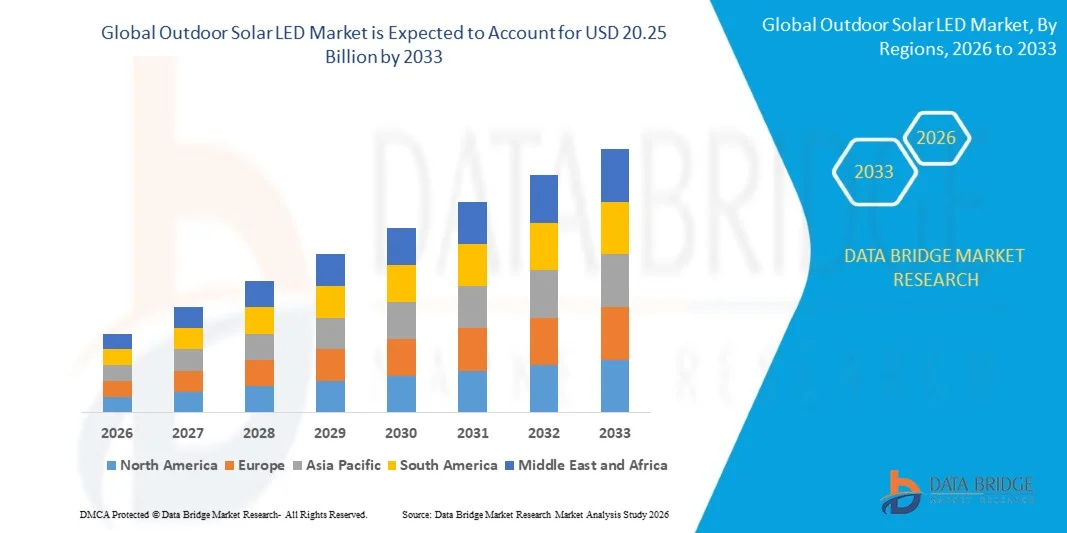
- As per Data Bridge Market Research analysis, the outdoor solar LED market was valued at USD 9.80 billion in 2025 and is projected to reach USD 20.25 billion by 2033, growing at a CAGR of 9.50% from 2026 to 2033.
- The market is experiencing consistent growth driven by rising demand for energy-efficient outdoor lighting solutions, increasing adoption of renewable energy technologies, declining costs of solar photovoltaic components, and expanding applications across streets, gardens, commercial spaces, and public infrastructure.
- The growing emphasis on reducing electricity consumption and carbon emissions, combined with government initiatives supporting solar-powered infrastructure and smart-city development, is encouraging municipalities, businesses, and residential users to adopt outdoor solar LED systems. Advancements in LED efficiency, battery storage, solar panels, and intelligent lighting controls are further improving reliability, illumination performance, and cost-effectiveness.
Market Size & Forecast
- Global Market Value (2025): USD 9.80 Billion
- Expected Market Value (2033): USD 20.25 Billion
- Forecast CAGR (2026–2033): 9.50%
- Leading Region in 2025: North America
- Fastest Growing Region: Asia Pacific
What are the Major Takeaways of the Outdoor Solar LED Market?
- North America dominated the outdoor solar LED market with the largest revenue share of 35.7% in 2025, supported by increasing government investments in solar lighting infrastructure, conversion of conventional street lights, and growing demand from commercial and public-sector applications.
- Asia-Pacific is expected to be the fastest-growing region at a CAGR of 11.3% from 2026 to 2033, fueled by rapid urbanization, expanding smart-city projects, government renewable-energy initiatives, and increasing investments in solar infrastructure across China, India, and other countries.
- The solar LED street lights segment led the market with a 54.2% share in 2025, driven by the extensive deployment across roads, highways, public spaces, and municipal infrastructure.
- Solar garden LED lights are the fastest-growing type, projected to register a CAGR of 11%, reflecting the surge in adoption in residential gardens, pathways, patios, landscaping areas, and hospitality properties.
- The led luminaire/LED module segment dominated the component category with a 34.22% revenue share in 2025, led by its central role in determining illumination efficiency and light quality
- Lithium-ion accounted for 50% of the market share in 2025, preferred by their high energy density, compact design, and suitability for standalone solar lighting.
- The lithium iron phosphate (LiFePO4) segment is the fastest-growing battery type category, with a CAGR of 9%, driven by its long cycle life, thermal stability, and safety characteristics
Report Scope and Outdoor Solar LED Market Segmentation
|
Attributes |
Outdoor Solar LED Key Market Insights |
|
Segments Covered |
|
|
Countries Covered |
North America
Europe
Asia-Pacific
Middle East and Africa
South America
|
|
Key Market Players |
|
|
Market Opportunities |
|
|
Value Added Data Infosets |
In addition to the insights on market scenarios such as market value, growth rate, segmentation, geographical coverage, and major players, the market reports curated by the Data Bridge Market Research also include in-depth expert analysis, geographically represented company-wise production and capacity, network layouts of distributors and partners, detailed and updated price trend analysis and deficit analysis of supply chain and demand. |
What is the Key Trend in the Outdoor Solar LED Market?
- Smart and connected solar lighting systems are increasingly being adopted, with manufacturers integrating IoT connectivity, motion sensors, adaptive dimming, wireless controls, and remote monitoring to improve energy efficiency and enable centralized management of outdoor lighting networks.
- For instance, in April 2024, a World Bank-backed project in Burkina Faso deployed 1,095 solar street lights equipped with IoT monitoring, including remote status dashboards, alarms, dimming control, battery-health monitoring, and energy analytics, demonstrating the growing integration of smart connectivity into solar outdoor lighting
- These intelligent systems allow municipalities and facility operators to remotely monitor lighting performance, schedule illumination, detect faults, and automatically adjust brightness according to pedestrian movement and environmental conditions.
- The integration of adaptive controls is transforming solar LED lighting from a standalone illumination solution into an intelligent infrastructure component, supporting smart-city initiatives and reducing maintenance and operating costs.
- For instance, in August 2025, Coimbatore City Corporation launched a pilot of 122 solar-powered motion-sensor streetlights across five locations, using automatic dimming from 50% to 100% brightness when movement is detected, with another 100 lights planned.
- As municipalities, commercial facilities, and infrastructure operators increasingly prioritize energy efficiency, remote asset management, and sustainable urban development, the integration of smart technologies is expected to accelerate, reinforcing connected solar LED systems as a major trend in outdoor lighting.
What are the Key Drivers of the Outdoor Solar LED Market?
- The growing emphasis on energy efficiency and renewable-energy adoption is significantly increasing demand for outdoor solar LED systems that reduce dependence on grid electricity while lowering operating costs and carbon emissions.
- For instance, in November 2025, the National Highways Authority of India (NHAI) installed 50 solar-powered LED streetlights at two accident-prone locations on the Trichy–Madurai National Highway, with an investment of USD 0.047 million; the systems use timers, sensors, and Bluetooth-enabled remote monitoring, demonstrating demand for solar lighting to reduce conventional electricity and maintenance cost
- Municipalities, commercial facilities, and residential users are increasingly replacing conventional outdoor lighting with solar-powered LED systems because they combine energy-efficient illumination with independent power generation and reduced maintenance requirements.
- Expanding urban infrastructure and government-led renewable-energy programs are further supporting deployment across streets, parks, pathways, public spaces, and rural communities, particularly where extending conventional electricity infrastructure is costly or impractical.
- For instance, in July 2025, India’s NITI Aayog highlighted Bhopal’s deployment of AI-integrated smart poles combining street lighting with environmental monitoring, surveillance, and energy optimization, demonstrating how smart-city development and energy-efficiency initiatives are driving demand for advanced outdoor LED lighting infrastructure.
- With governments and infrastructure operators increasingly prioritizing lower electricity consumption, decentralized energy systems, and sustainable public infrastructure, the demand for outdoor solar LED solutions is expected to remain strong across developed and emerging markets.
Which Factors are Challenging the Growth of the Outdoor Solar LED Market?
- High initial installation costs and battery-related expenses remain significant challenges for outdoor solar LED adoption, particularly because systems require solar panels, batteries, LED luminaires, controllers, poles, and installation infrastructure.
- For instance, in May 2025, Ahmedabad Municipal Corporation abandoned plans to install solar-powered streetlights in several public spaces after citing battery theft, limited battery life, and maintenance challenges; the decision demonstrates how security and recurring maintenance issues can restrict large-scale adoption
- The upfront investment can discourage smaller municipalities, residential users, and commercial facilities operating under constrained capital budgets, particularly in price-sensitive emerging markets.
- Battery replacement and performance degradation can further increase lifecycle costs, while extreme temperatures, insufficient sunlight, and prolonged cloudy conditions can reduce charging efficiency and nighttime operating reliability.
- For instance, in August 2025, Coimbatore City Corporation reported that its solar motion-sensor streetlights require solar-panel cleaning at least once every two months and battery replacement every three to five years, highlighting recurring maintenance requirements and component-replacement costs that can challenge long-term deployment.
- The combination of high upfront expenditure, battery replacement requirements, weather-dependent energy generation, and maintenance challenges can slow adoption, particularly among smaller organizations and in regions with limited financing availability.
How is the Outdoor Solar LED Market Segmented?
The outdoor solar LED market is segmented on the basis of type, component, battery type, end user, and distribution channel.
- By Type
On the basis of type, the outdoor solar LED market is segmented into solar LED street lights, solar garden LED lights, solar LED floodlights, solar LED area light, and solar LED spot lights. The solar LED street lights segment dominated the market with 54.2% share in 2025, owing to extensive deployment across roads, highways, public spaces, and municipal infrastructure. These systems provide independent illumination without relying entirely on conventional electricity grids. Government investments in smart-city and sustainable infrastructure projects are supporting large-scale installations. Their lower operating costs and reduced electricity consumption make them attractive to municipalities and infrastructure operators. Integration of motion sensors, remote monitoring, and intelligent dimming is further increasing their functionality.
The solar garden LED lights segment is projected to register the fastest growth at a CAGR of 11% from 2026 to 2033, supported by increasing adoption in residential gardens, pathways, patios, landscaping areas, and hospitality properties. These products can generally be installed without complex electrical wiring, improving their appeal among residential and small commercial users. Growing consumer interest in decorative and energy-efficient outdoor lighting is expanding the addressable market. Increasing availability through online channels is also improving product accessibility and encouraging purchases. Manufacturers are introducing more compact designs, improved batteries, and decorative lighting formats to address changing consumer preferences.
- By Component
On the basis of component, the market is segmented into LED luminaire/LED module, solar panel, battery pack, controller, and other components. The LED luminaire/LED module segment dominated the market with 34.22% share in 2025, supported by its central role in determining illumination efficiency and light quality. LED luminaires provide high energy efficiency and long operating life compared with conventional lighting technologies. Growing replacement of conventional outdoor lighting with LED-based systems continues to support demand. Manufacturers are also developing improved optical designs and thermal-management technologies to increase reliability. Integration with sensors and smart controllers is making LED modules more adaptable to changing lighting requirements.
The battery pack segment is expected to witness the fastest growth at a CAGR of 8.1% from 2026 to 2033, driven by the increasing requirement for reliable energy storage in standalone solar lighting systems. Batteries store electricity generated during daylight hours and supply power during nighttime operation. Improvements in lithium-based battery technology are increasing energy density, cycle life, and charging efficiency. Falling battery costs are also improving the economics of solar-powered outdoor lighting installations. Demand for longer autonomy is particularly important in municipal, commercial, and remote applications where consistent nighttime illumination is required.
- By Battery Type
On the basis of battery type, the market is segmented into lithium-ion, lead-acid, lithium iron phosphate (lifepo4), and other battery types. Lithium-ion batteries represent the dominant battery technology, accounting for 50% share of the battery-type segment in 2025, owing to their high energy density, compact design, and suitability for standalone solar lighting. Their relatively lightweight construction enables manufacturers to develop more compact lighting systems. Lithium-ion batteries also provide efficient charging and discharging for daily solar-lighting cycles. Growing demand for reliable nighttime operation is encouraging their use across residential, commercial, and public infrastructure applications. Improvements in battery-management systems are further enhancing safety and operating efficiency. As solar LED systems become more technologically advanced, lithium-ion batteries are expected to maintain their strong position within the battery ecosystem.
The lithium iron phosphate (LiFePO4) segment is expected to register the fastest growth at a CAGR of 9% from 2026 to 2033, supported by its long cycle life, thermal stability, and safety characteristics. These batteries are well suited to solar lighting because they can withstand frequent charging and discharging cycles. Their longer service life can reduce battery replacement frequency and associated maintenance requirements. Falling LiFePO4 battery costs are improving their competitiveness for larger outdoor solar LED installations. The technology is particularly attractive for applications requiring dependable multi-day autonomy and stable performance. Increasing deployment of higher-performance solar street and area lighting systems is therefore expected to accelerate adoption of LiFePO4 batteries.
- By End User
On the basis of end user, the market is segmented into residential, commercial, and industrial. The commercial segment dominated the market with a 55.8% share in 2025, driven by increasing deployment across commercial complexes, parking areas, pathways, hospitality facilities, campuses, and other outdoor spaces. Commercial organizations are adopting solar LED systems to reduce electricity consumption and operating expenditure. Standalone systems can also reduce dependence on grid infrastructure and simplify lighting installation in selected locations. Corporate sustainability objectives and increasing awareness of carbon reduction are further supporting adoption. Commercial projects can involve large numbers of lighting units, creating significant opportunities for suppliers and installers
The industrial segment is projected to experience the fastest growth at a CAGR of 6.9% from 2026 to 2033, supported by increasing installation across manufacturing facilities, warehouses, logistics sites, industrial yards, and perimeter areas. Industrial facilities require reliable outdoor illumination for security, access roads, loading areas, and operational zones. Solar LED systems can provide independent lighting where extending conventional electrical infrastructure is expensive or inconvenient. They can also provide continued illumination during selected grid interruptions. Rising energy costs and corporate sustainability initiatives are encouraging industrial operators to evaluate renewable-powered lighting. Expanding industrial infrastructure and logistics facilities across emerging markets is expected to create additional opportunities for solar LED deployment.
- By Distribution Channel
On the basis of distribution channel, the market is segmented into online, specialty lighting stores, and direct/infrastructure projects. Direct/infrastructure projects represent the dominant distribution channel, accounting for 60% share in 2025, primarily because municipalities, government agencies, commercial developers, and industrial organizations frequently purchase outdoor solar LED systems through project-based procurement. Direct procurement enables customers to specify solar-panel capacity, battery autonomy, lighting output, controls, and installation requirements. Large public infrastructure programs can involve thousands of units in a single contract. Suppliers can also provide engineering, installation, commissioning, and maintenance services through this channel. Government-funded street-lighting and rural electrification programs are particularly important sources of demand.
The online distribution channel is projected to be the fastest-growing channel at a CAGR of 10% from 2026 to 2033, supported by rising e-commerce adoption and increasing consumer access to solar lighting products. Online platforms provide residential and small commercial customers with a broad range of garden lights, spotlights, floodlights, and area-lighting products. Consumers can compare specifications, prices, designs, battery capacities, and customer reviews before purchasing. Online availability also makes solar LED products accessible in locations where specialty lighting stores have limited presence. The channel is particularly suitable for smaller products that require minimal installation and technical customization. Increasing consumer awareness of energy-efficient outdoor lighting and improving digital purchasing infrastructure are expected to further accelerate online sales.
Which Region Holds the Largest Share of the Outdoor Solar LED Market?
- North America dominated the outdoor solar LED market with the largest revenue share of 35.7% in 2025, supported by increasing government investments in solar lighting infrastructure, conversion of conventional street lights, and growing demand from commercial and public-sector applications.
- The region also benefits from expanding smart-city initiatives, replacement of conventional streetlights, favorable sustainability policies, and increasing deployment of solar-powered lighting across municipal, commercial, and residential applications. Growing emphasis on reducing electricity consumption and carbon emissions, together with technological improvements in solar panels, batteries, LED luminaires, and intelligent controls, continues to strengthen North America's position in the global market.
U.S. Outdoor Solar LED Market Insight
The U.S. outdoor solar LED market is witnessing strong growth due to rising investments in energy-efficient infrastructure, renewable-energy projects, and sustainable outdoor lighting solutions. The country's growing emphasis on reducing electricity consumption and carbon emissions, along with increasing adoption of solar-powered street, area, and security lighting, is driving demand across municipal, commercial, and residential applications. In addition, expanding smart-city initiatives and modernization of conventional street-lighting infrastructure are accelerating the deployment of solar LED systems across public spaces and transportation corridors.
Asia-Pacific Outdoor Solar LED Market Insight
The Asia-Pacific outdoor solar LED market is expected to witness rapid growth, driven by increasing urbanization, expanding infrastructure development, and rising investments in renewable-energy-powered lighting across countries such as China, India, and Japan. Growing government support for solar energy, increasing demand for energy-efficient lighting, and expanding smart-city programs are supporting regional market expansion. In addition, the region's strong solar manufacturing ecosystem, rising electrification requirements, and growing deployment of standalone lighting systems in rural and remote areas are accelerating adoption across municipal, commercial, and residential sectors.
Japan Outdoor Solar LED Market Insight
The Japan outdoor solar LED market is witnessing consistent growth due to rising investments in renewable-energy infrastructure, energy-efficient lighting, and resilient urban development. Municipalities, commercial facilities, parks, and residential users are increasingly adopting solar LED systems to reduce electricity consumption and provide reliable outdoor illumination. Moreover, increasing integration of motion sensors, intelligent controls, and high-efficiency batteries, together with Japan's focus on disaster-resilient and sustainable infrastructure, is further contributing to market growth.
China Outdoor Solar LED Market Insight
The China outdoor solar LED market is growing rapidly, driven by extensive urbanization, expanding infrastructure projects, and strong government emphasis on renewable energy and energy-efficient technologies. Growing deployment of solar-powered streetlights across roads, highways, parks, industrial areas, and rural communities is significantly boosting market demand. In addition, China's large solar-panel and LED manufacturing ecosystem, increasing smart-city investments, and growing focus on reducing carbon emissions are positioning the country as one of the largest and fastest-expanding markets for outdoor solar LED systems globally.
U.K. Outdoor Solar LED Market Insight
The U.K. outdoor solar LED market is experiencing steady growth, supported by rising adoption of renewable-energy technologies, energy-efficient public infrastructure, and sustainable outdoor lighting solutions. Increasing investments in smart-city initiatives and efforts by local authorities to reduce energy consumption and operating costs are contributing to market growth. Furthermore, growing deployment of solar LED systems in parks, pathways, residential developments, commercial properties, and public spaces, combined with improvements in battery storage and intelligent lighting controls, is strengthening demand across the U.K.
Germany Outdoor Solar LED Market Insight
The Germany outdoor solar LED market is expanding steadily due to the country's strong focus on renewable energy, energy efficiency, and sustainable infrastructure development. Municipalities, commercial facilities, industrial sites, and residential users are increasingly utilizing solar LED systems for streets, parking areas, pathways, and security lighting applications. Continuous advancements in photovoltaic efficiency, battery storage, LED technology, and smart lighting controls, along with Germany's commitment to reducing carbon emissions and increasing renewable-energy utilization, are further driving market growth.
Which are the Top Companies in Outdoor Solar LED Market?
The outdoor solar LED industry is primarily led by well-established companies, including:
- Signify Holding (Netherlands)
- Solar Electric Power Company (U.S.)
- LEDVANCE GmbH (Germany)
- Bajaj Electricals Limited (India)
- Fonroche Lighting (France)
- avells India Limited (India)
- Wipro Enterprises Limited (India)
- Polycab India Limited (India)
- Solar Illuminations (U.S.)
- Orient Electric Limited (India)
- Jaquar & Company Private Limited (India)
- TRILUX GmbH & Co. KG (Germany)
- SOLTECH LLC (U.S.)
- Zumtobel Lighting GmbH (Austria)
- Acuity Brands Lighting, Inc. (U.S.)
- Current Lighting Solutions, LLC (U.S.)
- Schréder (Belgium)
- Inventronics Inc. (China)
- Sunna Design (France)
What are Latest Developments in Outdoor Solar LED Market?
- In September 2025, Signify launched the SunStay Pro gen2 and SunStay Pro gen2 mini, a new generation of modular and connected solar streetlights designed for applications including bike paths, campuses, and pedestrian areas. The systems incorporate motion-sensing technology, light-on-demand functionality, and forward-triggering features to adjust illumination according to surrounding activity. The mini version also uses an aluminum housing containing 80% recycled material and offers off-grid and hybrid operating options.
- In August 2024, Signify expanded its SunStay Pro solar streetlighting offering with an all-in-one system integrating an LED luminaire, solar panel, and Lithium Iron Phosphate battery, alongside off-grid and hybrid charging options. The system also incorporated radar-based motion sensing, automatic light-level adjustment, wireless connectivity, and mesh-network control of neighboring streetlights. Its design was intended to simplify installation and improve serviceability while enabling municipalities to deploy solar lighting in locations without reliable grid access
- In March 2023, India’s Ministry of New and Renewable Energy reported that 272,000 solar streetlights had been installed under the Atal Jyoti Yojana (AJAY), demonstrating continued large-scale government deployment of solar-powered outdoor lighting. More than 135,000 systems had been installed under AJAY Phase I, while more than 137,000 had been installed under Phase II. The program targets public-use lighting to improve safety and security, particularly in remote, rural, and semi-urban areas.
- In March 2022, India’s Ministry of New and Renewable Energy highlighted the continued implementation of the Atal Jyoti Yojana Phase II, which provides solar streetlights for remote, rural, and semi-urban areas. The government also reported progress under the Street Light National Programme, which promotes smart and energy-efficient LED street lighting. The combined initiatives demonstrate India's broader effort to improve outdoor lighting efficiency while expanding access to solar-powered illumination.
- In November 2021, Servotech Power Systems launched a new range of solar streetlights comprising integrated and 2-in-1 variants for roads, highways, parks, parking areas, airports, and security installations. The products offered luminous efficacy of more than 105 lm/W, a stated life expectancy of more than 50,000 hours, and IP66 protection for outdoor environments. The systems incorporated high-efficiency solar panels, LED lighting, dusk-to-dawn sensors, intelligent controllers, and motion sensors to regulate light output according to movement and scheduled operation.

- Interactive Data Analysis Dashboard
- Company Analysis Dashboard for high growth potential opportunities
- Research Analyst Access for customization & queries
- Competitor Analysis with Interactive dashboard
- Latest News, Updates & Trend analysis
- Harness the Power of Benchmark Analysis for Comprehensive Competitor Tracking
Global Outdoor Solar Led Market, Supply Chain Analysis and Ecosystem Framework
To support market growth and help clients navigate the impact of geopolitical shifts, DBMR has integrated in-depth supply chain analysis into its Global Outdoor Solar Led Market research reports. This addition empowers clients to respond effectively to global changes affecting their industries. The supply chain analysis section includes detailed insights such as Global Outdoor Solar Led Market consumption and production by country, price trend analysis, the impact of tariffs and geopolitical developments, and import and export trends by country and HSN code. It also highlights major suppliers with data on production capacity and company profiles, as well as key importers and exporters. In addition to research, DBMR offers specialized supply chain consulting services backed by over a decade of experience, providing solutions like supplier discovery, supplier risk assessment, price trend analysis, impact evaluation of inflation and trade route changes, and comprehensive market trend analysis.
Data collection and base year analysis are done using data collection modules with large sample sizes. The stage includes obtaining market information or related data through various sources and strategies. It includes examining and planning all the data acquired from the past in advance. It likewise envelops the examination of information inconsistencies seen across different information sources. The market data is analysed and estimated using market statistical and coherent models. Also, market share analysis and key trend analysis are the major success factors in the market report. To know more, please request an analyst call or drop down your inquiry.
The key research methodology used by DBMR research team is data triangulation which involves data mining, analysis of the impact of data variables on the market and primary (industry expert) validation. Data models include Vendor Positioning Grid, Market Time Line Analysis, Market Overview and Guide, Company Positioning Grid, Patent Analysis, Pricing Analysis, Company Market Share Analysis, Standards of Measurement, Global versus Regional and Vendor Share Analysis. To know more about the research methodology, drop in an inquiry to speak to our industry experts.
Data Bridge Market Research is a leader in advanced formative research. We take pride in servicing our existing and new customers with data and analysis that match and suits their goal. The report can be customized to include price trend analysis of target brands understanding the market for additional countries (ask for the list of countries), clinical trial results data, literature review, refurbished market and product base analysis. Market analysis of target competitors can be analyzed from technology-based analysis to market portfolio strategies. We can add as many competitors that you require data about in the format and data style you are looking for. Our team of analysts can also provide you data in crude raw excel files pivot tables (Fact book) or can assist you in creating presentations from the data sets available in the report.













