


What is the Oxygen Conservers Market Size and Growth Rate?
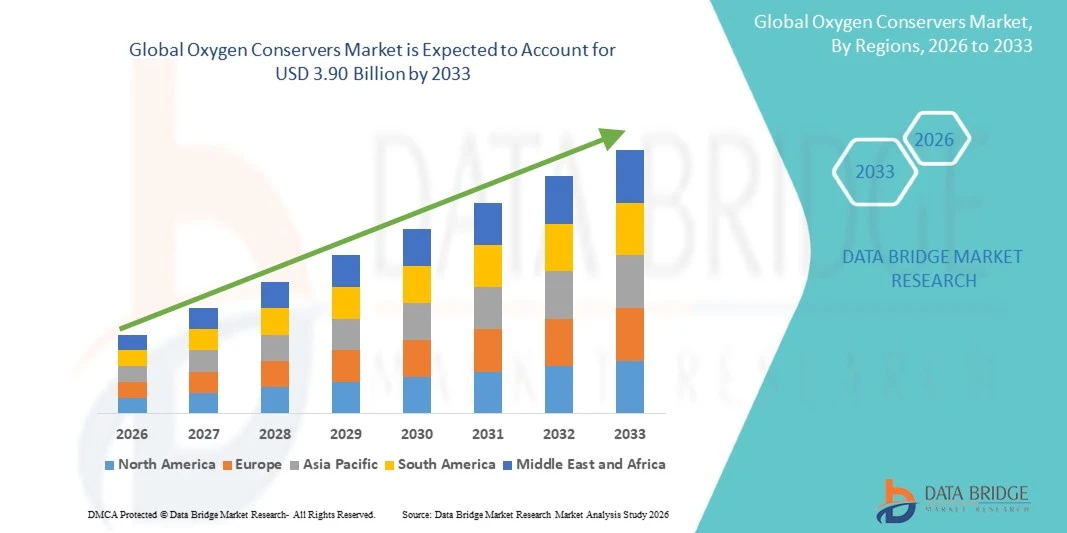
- As per Data Bridge Market Research analysis, the oxygen conservers market was valued at USD 1.68 Billion in 2025 and is projected to reach USD 3.90 Billion by 2033, growing at a CAGR of 11.10% from 2026 to 2033.
- The market is expanding as the global burden of chronic obstructive pulmonary disease (COPD), asthma, and other respiratory disorders continues to rise, increasing the population of patients dependent on long-term supplemental oxygen therapy. The growing use of oxygen therapy in both clinical and home-based settings is further supporting demand for oxygen-conserving devices.
- Growing preference for portable, lightweight, and efficient oxygen delivery solutions that extend cylinder life and support patient mobility is driving sustained replacement and first-time adoption of electronic and pulse-dose oxygen conservers. This trend is particularly evident across homecare, ambulatory care, and long-term oxygen therapy applications, where convenience and improved oxygen utilization are key considerations.
Market Size & Forecast
- Global Market Value (2025): USD 1.68 Billion
- Expected Market Value (2033): USD 3.90 Billion
- Forecast CAGR (2026–2033): 11.10%
- Leading Region in 2025: North America
- Fastest Growing Region: Asia-Pacific
What are the Major Takeaways of the Oxygen Conservers Market?
- North America dominated the global oxygen conservers market with the largest revenue share of 37.90% in 2025, supported by a high prevalence of COPD, favorable reimbursement policies for home oxygen therapy, and the presence of established device manufacturers.
- Asia-Pacific is expected to be the fastest-growing region, registering a CAGR of 13.60% from 2026 to 2033, driven by rising respiratory disease burden, expanding home healthcare infrastructure, and increasing healthcare access in China, India, and Japan.
- The electronic/pulse-dose oxygen conservers segment led the market with a 46.80% share by product type in 2025, owing to its precision oxygen delivery synchronized to patient breathing patterns and its widespread integration into portable oxygen systems.
- The liquid oxygen conserving devices segment is projected to register the fastest growth, at a CAGR of 10.20%, supported by rising adoption among high-flow oxygen patients who require conserving technology compatible with liquid oxygen reservoirs.
- The homecare settings segment accounted for the largest share by end user, at 44.60% in 2025, reflecting the ongoing shift of long-term respiratory therapy from institutional to home-based care.
- Direct tender and institutional sales represented the leading distribution channel with a 41.30% share in 2025, driven by large-volume procurement contracts between device manufacturers and hospital systems, government health programs, and durable medical equipment providers.
- The hospitals segment is expected to register the fastest CAGR of 11.90% among end users, supported by rising adoption of conserving technology to manage institutional oxygen costs amid broader supply-chain and sustainability pressures.
Report Scope and Oxygen Conservers Market Segmentation
|
Attributes |
Oxygen Conservers Key Market Insights |
|
Segments Covered |
|
|
Countries Covered |
North America
Europe
Asia-Pacific
Middle East and Africa
South America
|
|
Key Market Players |
|
|
Market Opportunities |
|
|
Value Added Data Infosets |
In addition to the insights on market scenarios such as market value, growth rate, segmentation, geographical coverage, and major players, the market reports curated by the Data Bridge Market Research also include in-depth expert analysis, patient epidemiology, pipeline analysis, pricing analysis, and regulatory framework. |
What is the Key Trend in the Oxygen Conservers Market?
- Manufacturers are increasingly integrating smart sensors and breath-detection algorithms into conserving devices to improve delivery accuracy and reduce oxygen wastage compared with legacy pneumatic designs.
- In February 2024, OxyNov announced the Canadian market rollout of its FreeO₂ automated oxygen-delivery system, following its introduction in several hospitals in Quebec. The system continuously adjusts oxygen flow based on the patient's oxygen saturation, reflecting the broader shift toward automated and sensor-based oxygen therapy.
- Consolidation among durable medical equipment and respiratory device manufacturers is reshaping the competitive landscape as companies seek to broaden their respiratory therapy portfolios.
- In February 2023, React Health acquired the respiratory product line/assets of Invacare, including stationary and portable oxygen concentrators, HomeFill equipment and cylinders, oxygen analyzers, and related accessories. The acquisition expanded React Health's respiratory-care portfolio and strengthened its offering for patients receiving respiratory therapy in the home setting.
- Device makers are pursuing strategic partnerships to expand distribution reach and combine complementary respiratory therapy technologies for patients requiring supplemental oxygen alongside other home health equipment.
- In September 2022, Responsive Respiratory entered into a partnership agreement with Boost Oxygen to distribute Boost Oxygen products through the homecare market. The partnership was intended to expand distribution and provide homecare providers with access to portable supplemental oxygen products.
- Companies are expanding their respiratory therapy portfolios through targeted acquisitions of complementary device makers to strengthen their position across the broader oxygen therapy continuum.
What are the Key Drivers of the Oxygen Conservers Market?
- The rising global prevalence of COPD, asthma, and other chronic respiratory conditions is steadily increasing the population of patients requiring long-term supplemental oxygen therapy, directly expanding demand for conserving devices.
- Growing geriatric populations worldwide are increasing the incidence of respiratory and cardiopulmonary conditions that require supplemental oxygen, supporting long-term demand growth for conserving technology. Favorable reimbursement frameworks for home oxygen therapy in the U.S. and parts of Europe continue to support patient access to conserving devices, encouraging replacement demand and new patient starts alike.
- For instance, in December 2025, Medline Industries expanded its homecare respiratory product distribution network, improving access to oxygen conserving devices for patients transitioning from hospital to home-based care settings.
- For instance, in October 2025, CAIRE Inc. continued to expand its portable oxygen concentrator and conserving device portfolio, targeting improved battery life and reduced device weight to support increasingly mobile patient lifestyles.
- Rising patient preference for portable and lightweight oxygen systems that support mobility and independence is accelerating the shift from continuous-flow to pulse-dose conserving technology across homecare channels.
What Factors are Challenging the Growth of the Oxygen Conservers Market?
- Strict regulatory and conformity-assessment requirements in major markets, including FDA 510(k) requirements in the U.S. and EU Medical Device Regulation requirements in Europe, can increase product development, testing, documentation, and market-entry timelines for new oxygen-conserving technologies.
- High equipment and ownership costs can limit adoption of advanced electronic and smart oxygen-conserving devices in resource-constrained markets, where affordability, financing, equipment availability, and maintenance capabilities remain important barriers.
- For instance, in February 2025, the World Health Organization (WHO) published guidance emphasizing costing and financing in national medical oxygen scale-up planning, highlighting the importance of sustainable financing for oxygen access. Source: World Health Organization (WHO).
- Underdiagnosis and misdiagnosis of respiratory conditions in primary care settings can delay appropriate assessment and referral for oxygen therapy, limiting the identification of patients who may require long-term or ambulatory oxygen support.
- For instance, in May 2025, the Victorian Department of Health updated its COPD referral criteria to support appropriate specialist assessment for patients with uncertain diagnoses and moderate or severe COPD. Source: Victorian Department of Health.
- Variability in triggering sensitivity and oxygen-delivery performance among conserving devices can create concerns about maintaining adequate oxygenation, particularly during sleep or changes in breathing patterns.
How is the Oxygen Conservers Market Segmented?
The oxygen conservers market is segmented on the basis of product type, technology, end user, and distribution channel.
- By Product Type
On the basis of product type, the global oxygen conservers market is segmented into pneumatic oxygen conservers, electronic/pulse-dose oxygen conservers, and liquid oxygen conserving devices. The electronic/pulse-dose oxygen conservers segment led the market with a 46.80% share in 2025, supported by its ability to deliver oxygen precisely synchronized to a patient's inhalation pattern, reducing wastage compared with continuous-flow and basic pneumatic designs, and its widespread integration into modern portable oxygen concentrator systems.
The liquid oxygen conserving devices segment is projected to register the fastest growth, at a CAGR of 10.20% from 2026 to 2033, supported by rising adoption among high-flow-requirement patients for whom liquid oxygen systems remain the preferred long-duration therapy option, and continued innovation in lightweight, portable liquid oxygen reservoirs compatible with conserving technology.
- By Technology
On the basis of technology, the global oxygen conservers market is segmented into demand pulse-dose delivery, continuous flow with conserving function, smart sensor-based delivery. The demand pulse-dose delivery segment led the market with a 62.54% share in 2025, supported by its ability to deliver oxygen in response to inhalation, improve oxygen utilization, extend cylinder duration, and support patient mobility across homecare and ambulatory settings.
The smart sensor-based delivery segment is projected to register the fastest growth, at a CAGR of 11.34% from 2026 to 2033, supported by increasing adoption of sensor-enabled oxygen delivery, automated flow adjustment, improved delivery precision, and growing demand for intelligent and connected respiratory-care technologies.
- By End User
On the basis of end user, the global oxygen conservers market is segmented into hospitals, clinics, nursing homes & long-term care facilities, and homecare settings. The homecare settings segment accounted for the largest share of 44.60% in 2025, reflecting the ongoing broader shift of long-term respiratory therapy from institutional settings to home-based care, supported by favorable reimbursement policies and patient preference for independent living.
The hospitals segment is expected to register the fastest CAGR of 11.90%, as institutions increasingly adopt conserving technology to manage rising oxygen procurement costs and improve supply-chain resilience following periods of medical oxygen supply pressure.
- By Distribution Channel
On the basis of distribution channel, the global oxygen conservers market is segmented into direct tender/institutional sales, retail pharmacies & medical supply stores, and online platforms. Direct tender and institutional sales represented the leading channel with a 41.30% share in 2025, supported by large-volume procurement contracts between device manufacturers and hospital systems, government health programs, and durable medical equipment providers.
Online platforms are expected to grow at the fastest pace, registering a CAGR of 14.10%, as homecare patients and caregivers increasingly research and purchase durable medical equipment directly through e-commerce channels, a trend accelerated by the broader expansion of direct-to-consumer medical device distribution.
Which Region Holds the Largest Share of the Oxygen Conservers Market?
- North America dominated the global oxygen conservers market and accounted for the largest revenue share of 37.90% in 2025, supported by a high prevalence of COPD and other chronic respiratory diseases, favorable reimbursement policies for home oxygen therapy, and the presence of established device manufacturers and distribution networks.
- The region also benefits from strong awareness of hypoxemia management among clinicians, well-developed homecare infrastructure, and continued investment in product innovation by leading domestic manufacturers, all of which reinforce North America's leadership position in the global market.
U.S. Oxygen Conservers Market Insight
The U.S. oxygen conservers market is supported by a large population requiring long-term oxygen therapy, particularly patients with COPD and other chronic respiratory diseases. Rising adoption of home-based and ambulatory oxygen therapy is increasing demand for portable and oxygen-efficient delivery systems. Electronic and pulse-dose conserving devices are gaining attention because they can extend oxygen cylinder duration while supporting patient mobility. Established healthcare infrastructure, reimbursement coverage, and the presence of major respiratory device manufacturers further support market development. However, regulatory requirements and device costs can influence adoption.
Canada Oxygen Conservers Market Insight
Canada’s oxygen conservers market is driven by increasing demand for home oxygen therapy and portable respiratory-care solutions. The country’s publicly funded healthcare system supports access to oxygen therapy for eligible patients, while the growing preference for home-based care encourages the use of lightweight and oxygen-efficient devices. Manufacturers are increasingly focusing on automated and sensor-based oxygen-delivery technologies. Adoption is also supported by Canada’s aging population and respiratory disease burden. However, geographic dispersion, healthcare access differences, and equipment costs can create challenges, particularly for patients in remote and rural communities.
Asia-Pacific Oxygen Conservers Market Insight
The Asia-Pacific oxygen conservers market is expanding as respiratory diseases, aging populations, healthcare expenditure, and demand for home-based care increase across the region. Countries are strengthening respiratory-care infrastructure, creating opportunities for portable and oxygen-conserving technologies. Japan, South Korea, China, India, and Australia represent important markets due to their established or rapidly developing healthcare systems. Demand is also supported by increasing awareness of long-term oxygen therapy and patient mobility. However, affordability, uneven healthcare infrastructure, limited reimbursement, and differences in medical-device regulations continue to influence adoption across developing markets.
China Oxygen Conservers Market Insight
China’s oxygen conservers market is benefiting from the country’s large aging population, rising prevalence of chronic respiratory diseases, and continued expansion of home-based healthcare. Growing healthcare expenditure and improvements in respiratory-care infrastructure are creating opportunities for portable oxygen-delivery and conserving technologies. Domestic medical-device manufacturers are also expanding their respiratory product portfolios, supporting local availability and potentially improving affordability. Demand is particularly relevant among patients requiring long-term oxygen therapy outside hospitals. Nevertheless, price sensitivity, regulatory requirements, and variations in healthcare access between urban and rural areas remain important market considerations.
India Oxygen Conservers Market Insight
India’s oxygen conservers market is developing alongside increasing awareness of respiratory diseases, expanding home healthcare, and growing demand for portable oxygen therapy. The large patient population with COPD, asthma, and other respiratory conditions creates substantial potential for oxygen-conserving technologies. Increasing healthcare expenditure and the expansion of medical-device distribution networks are supporting market accessibility. Lightweight electronic and pulse-dose devices may gain adoption among patients seeking greater mobility and longer cylinder duration. However, relatively high device costs, limited reimbursement, uneven healthcare infrastructure, and affordability concerns continue to constrain widespread adoption.
Which are the Top Companies in Oxygen Conservers Market?
The oxygen conservers industry is primarily led by well-established companies, including:
- Invacare Corporation (U.S.)
- React Health (U.S.)
- Precision Medical, Inc. (U.S.)
- Drive DeVilbiss Healthcare (U.S.)
- CAIRE Inc. (Chart Industries) (U.S.)
- Inogen, Inc. (U.S.)
- Medline Industries, LP (U.S.)
- Sunset Healthcare Solutions (U.S.)
- GCE Group (Sweden)
- Essex Industries, Inc. (U.S.)
- Teleflex Incorporated (U.S.)
- OxyNov Inc. (Canada)
- HERSILL (Spain)
- Air Liquide (France)
- Medicap Homecare GmbH (Germany)
- Kröber Medizintechnik GmbH (Germany)
- Compass Health Brands (U.S.)
- GF HEALTH PRODUCTS, INC. (U.S.)
- Medtronic (Ireland)
What are Latest Developments in Oxygen Conservers Market?
- In December 2025, Medline Industries expanded its homecare respiratory product distribution network, improving access to oxygen conserving devices for patients transitioning from hospital to home-based care settings.
- In October 2025, CAIRE Inc. continued to expand its portable oxygen concentrator and conserving device portfolio, targeting improved battery life and reduced device weight to support increasingly mobile patient lifestyles.
- In February 2023, React Health acquired the respiratory product line of Invacare, including portable and stationary oxygen concentrators and HomeFill equipment, strengthening its respiratory therapy portfolio for the homecare market.
- In September 2023, Inogen, Inc. acquired Physio-Assist SAS, expanding its respiratory portfolio beyond portable oxygen concentrators into complementary airway clearance and respiratory therapy technologies.
- In February 2024, OxyNov announced the Canadian market rollout of its FreeO₂ automated oxygen-delivery system, which continuously adjusts oxygen flow based on patients’ oxygen saturation, highlighting the growing adoption of automated and sensor-based oxygen therapy technologies.
- In September 2022, Responsive Respiratory entered into a partnership agreement with Boost Oxygen to broaden access to supplemental and conserving oxygen delivery solutions for homecare patients.

- Interactive Data Analysis Dashboard
- Company Analysis Dashboard for high growth potential opportunities
- Research Analyst Access for customization & queries
- Competitor Analysis with Interactive dashboard
- Latest News, Updates & Trend analysis
- Harness the Power of Benchmark Analysis for Comprehensive Competitor Tracking
Data collection and base year analysis are done using data collection modules with large sample sizes. The stage includes obtaining market information or related data through various sources and strategies. It includes examining and planning all the data acquired from the past in advance. It likewise envelops the examination of information inconsistencies seen across different information sources. The market data is analysed and estimated using market statistical and coherent models. Also, market share analysis and key trend analysis are the major success factors in the market report. To know more, please request an analyst call or drop down your inquiry.
The key research methodology used by DBMR research team is data triangulation which involves data mining, analysis of the impact of data variables on the market and primary (industry expert) validation. Data models include Vendor Positioning Grid, Market Time Line Analysis, Market Overview and Guide, Company Positioning Grid, Patent Analysis, Pricing Analysis, Company Market Share Analysis, Standards of Measurement, Global versus Regional and Vendor Share Analysis. To know more about the research methodology, drop in an inquiry to speak to our industry experts.
Data Bridge Market Research is a leader in advanced formative research. We take pride in servicing our existing and new customers with data and analysis that match and suits their goal. The report can be customized to include price trend analysis of target brands understanding the market for additional countries (ask for the list of countries), clinical trial results data, literature review, refurbished market and product base analysis. Market analysis of target competitors can be analyzed from technology-based analysis to market portfolio strategies. We can add as many competitors that you require data about in the format and data style you are looking for. Our team of analysts can also provide you data in crude raw excel files pivot tables (Fact book) or can assist you in creating presentations from the data sets available in the report.













