


What is the Packaged Apple Juice Market Size and Growth Rate?
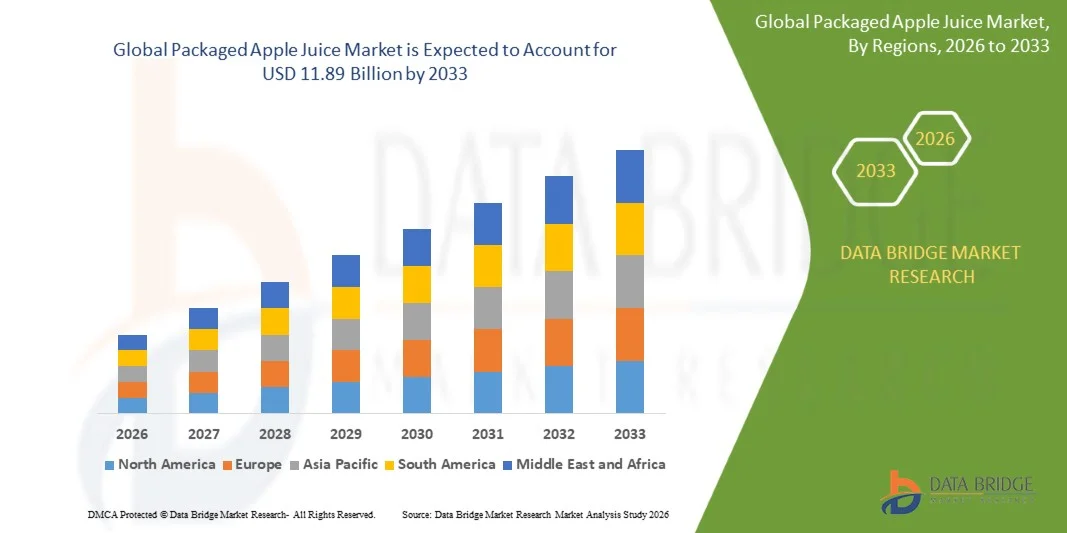
- As per Data Bridge Market Research Analysis the global packaged apple juice market size was valued at USD 7.88 billion in 2025 and is expected to reach USD 11.89 billion by 2033, at a CAGR of 5.28% during the forecast period
- The market growth is largely fueled by the increasing consumer preference for convenient and ready-to-drink beverages, along with rising awareness regarding the health benefits of fruit-based drinks, leading to higher consumption across both urban and semi-urban populations
- Furthermore, growing demand for natural, clean-label, and preservative-free products is establishing packaged apple juice as a preferred choice among health-conscious consumers. These converging factors are accelerating product adoption across retail and food service channels, thereby significantly boosting the industry’s growth
Market Size & Forecast
- Global Market Value (2025): USD 7.88 billion
- Expected Market Value (2033): USD 11.89 billion
- Forecast CAGR (2026–2033): 5.28%
What are the Major Takeaways of Packaged Apple Juice Market?
- Packaged apple juice, offering a convenient and shelf-stable fruit beverage option, is increasingly becoming a staple in daily consumption across households and commercial establishments due to its nutritional value, ease of availability, and diverse packaging formats suitable for different consumption needs
- The escalating demand for packaged apple juice is primarily fueled by rising health consciousness, increasing disposable incomes, and shifting consumer preferences toward natural and fruit-based beverages, along with expanding distribution networks and continuous product innovation across the global market
- North America dominated the packaged apple juice market with a share of around 43% in 2025, due to high consumption of ready-to-drink beverages and strong demand for convenient and healthy fruit-based drinks
- Asia-Pacific is expected to be the fastest growing region in the packaged apple juice market during the forecast period due to rapid urbanization, rising disposable incomes, and changing dietary preferences
- Tetra packs segment dominated the market with a market share of 49.1% in 2025, due to their convenience, lightweight nature, and extended shelf life without refrigeration. Tetra packs are widely preferred for their portability and suitability for on-the-go consumption, especially among urban consumers and school-going children. Their ability to preserve taste and nutritional value while ensuring product safety makes them a popular choice among manufacturers and consumers
Report Scope and Packaged Apple Juice Market Segmentation
|
Attributes |
Packaged Apple Juice Key Market Insights |
|
Segments Covered |
|
|
Countries Covered |
North America
Europe
Asia-Pacific
Middle East and Africa
South America
|
|
Key Market Players |
|
|
Market Opportunities |
|
|
Value Added Data Infosets |
In addition to the insights on market scenarios such as market value, growth rate, segmentation, geographical coverage, and major players, the market reports curated by the Data Bridge Market Research also include in-depth expert analysis, pricing analysis, brand share analysis, consumer survey, demography analysis, supply chain analysis, value chain analysis, raw material/consumables overview, vendor selection criteria, PESTLE Analysis, Porter Analysis, and regulatory framework. |
What is the Key Trend in the Packaged Apple Juice Market?
Rising Demand for Organic and Clean-Label Packaged Apple Juice
- A significant trend in the packaged apple juice market is the growing demand for organic and clean-label products, driven by increasing consumer awareness regarding health, nutrition, and the avoidance of artificial additives and preservatives. This shift is positioning organic apple juice as a preferred beverage choice among health-conscious consumers seeking natural and minimally processed products
- For instance, Tropicana Products has expanded its portfolio with clean-label and no-added-sugar juice offerings to cater to evolving consumer preferences. Such initiatives are strengthening brand positioning and encouraging wider adoption of healthier packaged juice alternatives across retail channels
- Consumers are increasingly scrutinizing product labels and favoring beverages made from natural ingredients, which is driving manufacturers to reformulate existing products and introduce organic variants. This is accelerating the transition toward transparency and cleaner ingredient sourcing within the industry
- The rising influence of wellness trends and preventive healthcare practices is further supporting the demand for apple juice products that align with natural and functional beverage categories. This trend is contributing to premiumization and higher value generation in the market
- Retailers and e-commerce platforms are expanding their organic beverage sections, improving accessibility and visibility of clean-label apple juice products. This increased availability is encouraging trial and repeat purchases among a broader consumer base
- The market is witnessing a steady transformation toward healthier beverage consumption patterns where organic and clean-label apple juice is gaining traction. This trend is reinforcing long-term growth by aligning product offerings with evolving dietary preferences and sustainability expectations
Packaged Apple Juice Market Dynamics
Driver
Increasing Consumer Preference for Convenient and Ready-to-Drink Beverages
- The increasing demand for convenient and ready-to-drink beverages is a major driver of the packaged apple juice market, as consumers seek quick and accessible refreshment options that fit into fast-paced lifestyles. Packaged apple juice offers ease of consumption, portability, and extended shelf life, making it suitable for both household and on-the-go consumption
- For instance, The Coca-Cola Company, through its Minute Maid brand, offers packaged apple juice in multiple convenient formats such as small cartons and bottles to cater to diverse consumer needs. These offerings enhance product accessibility and support higher consumption across different age groups and usage occasions
- Urbanization and increasing working populations are contributing to the growing reliance on packaged beverages that require minimal preparation. This is strengthening the demand for apple juice as a quick and nutritious drink option
- The expansion of modern retail formats and online grocery platforms is improving product availability and encouraging impulse purchases of ready-to-drink beverages. This widespread distribution is supporting consistent market growth
- The sustained preference for convenient beverage solutions continues to strengthen this driver, positioning packaged apple juice as a staple product in the global ready-to-drink beverage market and supporting long-term industry expansion
Restraint/Challenge
Fluctuating Raw Material Prices and Supply Chain Constraints
- The packaged apple juice market faces challenges due to fluctuating raw material prices, particularly apples, which are influenced by seasonal variations, climate conditions, and agricultural uncertainties. These fluctuations impact production costs and create pricing pressures for manufacturers across the value chain
- For instance, U.S. Department of Agriculture has reported variations in apple production due to changing weather conditions, affecting the availability and pricing of raw materials for juice manufacturers. Such volatility creates uncertainty in procurement and cost management strategies for industry players
- Supply chain disruptions, including transportation delays and storage limitations, further add to operational challenges and affect timely product distribution. These issues can lead to inconsistencies in product availability across markets
- The dependence on agricultural output makes the market vulnerable to external factors such as extreme weather events and pest infestations. This increases the risk associated with maintaining stable production volumes
- The ongoing instability in raw material supply and pricing continues to pose a significant challenge for the market. These factors collectively impact profitability and require strategic interventions to maintain balance between cost efficiency and product availability
How is the Packaged Apple Juice Market Segmented?
The market is segmented on the basis of nature, packaging type, and distribution channel.
• By Nature
On the basis of nature, the packaged apple juice market is segmented into organic and conventional. The conventional segment dominated the market with the largest market revenue share in 2025, driven by its wide availability, lower price point, and strong presence across mass retail channels. Consumers continue to prefer conventional apple juice due to its affordability and consistent taste profile, making it a staple beverage in households. Large-scale production and established supply chains further support the dominance of this segment, enabling manufacturers to meet high-volume demand efficiently. In addition, extensive brand penetration and promotional strategies in supermarkets and convenience stores contribute to sustained consumption of conventional packaged apple juice.
The organic segment is anticipated to witness the fastest growth rate from 2026 to 2033, fueled by increasing consumer awareness regarding health, wellness, and chemical-free food products. Rising concerns over pesticide residues and artificial additives are encouraging consumers to shift toward organic alternatives. Organic apple juice is gaining traction among health-conscious individuals and families seeking natural and clean-label beverages. Growth in organic farming practices and certifications is further supporting product availability, while premium positioning and expanding distribution in online and specialty stores are accelerating segment growth.
• By Packaging Type
On the basis of packaging type, the packaged apple juice market is segmented into glass bottles, plastic bottles, tetra packs, and cans. The tetra packs segment dominated the market with the largest market revenue share of 49.1% in 2025, driven by their convenience, lightweight nature, and extended shelf life without refrigeration. Tetra packs are widely preferred for their portability and suitability for on-the-go consumption, especially among urban consumers and school-going children. Their ability to preserve taste and nutritional value while ensuring product safety makes them a popular choice among manufacturers and consumers. In addition, cost-effective transportation and storage advantages further strengthen the dominance of this segment in the global market.
The glass bottles segment is anticipated to witness the fastest growth rate from 2026 to 2033, fueled by increasing demand for premium and environmentally sustainable packaging solutions. Glass packaging is perceived as a healthier and non-reactive option that preserves the original taste and quality of apple juice. Consumers are increasingly associating glass bottles with high-quality and organic beverage offerings, particularly in premium and specialty segments. Moreover, growing environmental concerns and preference for recyclable packaging materials are encouraging manufacturers to adopt glass packaging, thereby supporting segment growth.
• By Distribution Channel
On the basis of distribution channel, the packaged apple juice market is segmented into supermarkets/hypermarkets, convenience stores, online retail, and food service. The supermarkets/hypermarkets segment dominated the market with the largest market revenue share in 2025, driven by the wide variety of brands, attractive discounts, and the ability for consumers to physically evaluate products before purchase. These retail formats offer strong visibility and accessibility, making them a primary purchasing point for packaged apple juice. Bulk purchasing options and promotional campaigns further enhance consumer preference for supermarkets and hypermarkets. In addition, organized retail expansion in urban areas continues to support segment dominance.
The online retail segment is anticipated to witness the fastest growth rate from 2026 to 2033, fueled by the increasing penetration of e-commerce platforms and changing consumer buying behavior. Consumers are increasingly opting for online channels due to convenience, doorstep delivery, and access to a wide range of products and brands. Subscription models and frequent discounts on online platforms are further encouraging repeat purchases of packaged apple juice. In addition, the growing adoption of digital payment systems and smartphone usage is accelerating the shift toward online retail channels, supporting rapid segment growth.
Which Region Holds the Largest Share of the Packaged Apple Juice Market?
- North America dominated the packaged apple juice market with the largest revenue share of around 43% in 2025, driven by high consumption of ready-to-drink beverages and strong demand for convenient and healthy fruit-based drinks
- Consumers in the region increasingly prefer packaged apple juice due to its nutritional value, longer shelf life, and availability in diverse packaging formats suitable for on-the-go consumption
- This widespread adoption is further supported by high disposable incomes, established retail infrastructure, and the presence of leading beverage manufacturers, reinforcing the market’s strong position across households and food service sectors
U.S. Packaged Apple Juice Market Insight
The U.S. packaged apple juice market captured the largest revenue share in 2025 within North America, fueled by high consumer preference for fruit-based beverages and strong demand for convenient packaged drinks. Consumers are increasingly inclined toward healthier beverage options, driving consistent consumption of apple juice across age groups. The expansion of product variants, including organic and low-sugar options, is further supporting market growth. In addition, the strong presence of supermarkets, online retail platforms, and established distribution networks continues to enhance product accessibility and market penetration.
Europe Packaged Apple Juice Market Insight
The Europe packaged apple juice market is projected to expand at a substantial CAGR throughout the forecast period, primarily driven by increasing demand for natural and clean-label beverages. Rising consumer awareness regarding health and nutrition is encouraging the shift toward fruit-based drinks with minimal additives. The region is witnessing steady growth across both retail and food service channels, supported by strong consumption patterns and established juice processing industries. Moreover, sustainability trends and demand for eco-friendly packaging solutions are further contributing to market expansion.
U.K. Packaged Apple Juice Market Insight
The U.K. packaged apple juice market is anticipated to grow at a noteworthy CAGR during the forecast period, driven by increasing consumer inclination toward convenient and healthy beverage options. The rising demand for organic and premium juice products is influencing purchasing behavior across the region. Consumers are also favoring products with reduced sugar content and natural ingredients, aligning with evolving health trends. The strong retail presence and growth of online grocery platforms are expected to further support market growth.
Germany Packaged Apple Juice Market Insight
The Germany packaged apple juice market is expected to expand at a considerable CAGR during the forecast period, fueled by strong domestic apple production and well-established juice processing capabilities. Consumers in Germany show a high preference for natural and preservative-free beverages, supporting steady demand for packaged apple juice. The country’s focus on sustainability and recyclable packaging is encouraging manufacturers to adopt eco-friendly solutions. In addition, increasing demand from both households and food service sectors is driving consistent market expansion.
Asia-Pacific Packaged Apple Juice Market Insight
The Asia-Pacific packaged apple juice market is poised to grow at the fastest CAGR during the forecast period of 2026 to 2033, driven by rapid urbanization, rising disposable incomes, and changing dietary preferences. The growing popularity of packaged beverages among younger populations and working professionals is significantly contributing to demand. Expansion of retail infrastructure and increasing penetration of e-commerce platforms are further enhancing product accessibility. Moreover, the region’s growing food processing industry and increasing awareness of health and wellness are supporting strong market growth.
Japan Packaged Apple Juice Market Insight
The Japan packaged apple juice market is gaining momentum due to increasing demand for convenient and high-quality fruit beverages. Consumers in Japan prioritize product quality, taste, and packaging innovation, which is encouraging manufacturers to introduce premium juice variants. The rising trend of health-conscious consumption is also supporting demand for natural and additive-free beverages. Furthermore, the presence of advanced retail systems and vending machine distribution channels is contributing to steady market growth.
China Packaged Apple Juice Market Insight
The China packaged apple juice market accounted for the largest market revenue share in Asia Pacific in 2025, attributed to the country’s large population base, increasing urbanization, and expanding middle-class population. Rising consumer preference for packaged and hygienic beverages is driving strong demand for apple juice products. China’s well-developed food processing industry and availability of raw materials further support large-scale production. In addition, growing online retail channels and increasing brand competition are accelerating market expansion across the country.
Which are the Top Companies in Packaged Apple Juice Market?
The packaged apple juice industry is primarily led by well-established companies, including:
- The Coca-Cola Company (U.S.)
- PepsiCo (U.S.)
- Nestlé (Switzerland)
- Dr Pepper Snapple Group (U.S.)
- Del Monte Foods (U.S.)
- Britvic plc (U.K.)
- The Kraft Heinz Company (U.S.)
- Parle Agro (India)
- Dabur India Ltd (India)
- Lassonde Industries Inc (Canada)
- Unilever (U.K.)
- Dole Food Company (U.S.)
- Ocean Spray (U.S.)
- Tropicana Products (U.S.)
- Minute Maid (U.S.)
What are Latest Developments in Packaged Apple Juice Market?
- In January 2025, the relaunch of the Odwalla brand through a partnership between Grupo Jumex and Full Sail IP Partners significantly strengthened the presence of premium and clean-label offerings in the packaged apple juice market. This development is enhancing brand competition by reintroducing a well-established name with a refreshed product portfolio focused on natural ingredients, while also expanding distribution reach and attracting health-conscious consumers seeking high-quality juice products
- In September 2024, the merger between SPC, The Original Juice Co, and Nature One Dairy created a large-scale integrated beverage entity, improving production capacity and operational efficiency in juice processing. This consolidation is strengthening the packaged apple juice market by enabling cost optimization, expanding product innovation capabilities, and improving supply chain resilience across domestic and export markets
- In July 2024, Tropicana Brands Group expanded its product portfolio by introducing new variants of apple juice with reduced sugar content and clean-label positioning. This development is influencing market dynamics by addressing growing consumer demand for healthier beverage options, enhancing brand differentiation, and reinforcing the shift toward functional and better-for-you packaged juice products
- In May 2024, Britvic plc strengthened its juice segment through strategic investments in product reformulation and packaging innovation, particularly focusing on sustainable packaging formats. This initiative is driving market growth by improving product appeal, aligning with environmental regulations, and supporting increased adoption of packaged apple juice among environmentally conscious consumers
- In March 2024, The Coca-Cola Company enhanced its juice portfolio by focusing on premiumization and expanding its range of fruit-based beverages, including apple juice offerings under its existing brands. This development is impacting the market by leveraging strong global distribution networks, increasing product visibility, and accelerating consumption through wider availability across retail and food service channels

- Interactive Data Analysis Dashboard
- Company Analysis Dashboard for high growth potential opportunities
- Research Analyst Access for customization & queries
- Competitor Analysis with Interactive dashboard
- Latest News, Updates & Trend analysis
- Harness the Power of Benchmark Analysis for Comprehensive Competitor Tracking
Global Packaged Apple Juice Market, Supply Chain Analysis and Ecosystem Framework
To support market growth and help clients navigate the impact of geopolitical shifts, DBMR has integrated in-depth supply chain analysis into its Global Packaged Apple Juice Market research reports. This addition empowers clients to respond effectively to global changes affecting their industries. The supply chain analysis section includes detailed insights such as Global Packaged Apple Juice Market consumption and production by country, price trend analysis, the impact of tariffs and geopolitical developments, and import and export trends by country and HSN code. It also highlights major suppliers with data on production capacity and company profiles, as well as key importers and exporters. In addition to research, DBMR offers specialized supply chain consulting services backed by over a decade of experience, providing solutions like supplier discovery, supplier risk assessment, price trend analysis, impact evaluation of inflation and trade route changes, and comprehensive market trend analysis.
Data collection and base year analysis are done using data collection modules with large sample sizes. The stage includes obtaining market information or related data through various sources and strategies. It includes examining and planning all the data acquired from the past in advance. It likewise envelops the examination of information inconsistencies seen across different information sources. The market data is analysed and estimated using market statistical and coherent models. Also, market share analysis and key trend analysis are the major success factors in the market report. To know more, please request an analyst call or drop down your inquiry.
The key research methodology used by DBMR research team is data triangulation which involves data mining, analysis of the impact of data variables on the market and primary (industry expert) validation. Data models include Vendor Positioning Grid, Market Time Line Analysis, Market Overview and Guide, Company Positioning Grid, Patent Analysis, Pricing Analysis, Company Market Share Analysis, Standards of Measurement, Global versus Regional and Vendor Share Analysis. To know more about the research methodology, drop in an inquiry to speak to our industry experts.
Data Bridge Market Research is a leader in advanced formative research. We take pride in servicing our existing and new customers with data and analysis that match and suits their goal. The report can be customized to include price trend analysis of target brands understanding the market for additional countries (ask for the list of countries), clinical trial results data, literature review, refurbished market and product base analysis. Market analysis of target competitors can be analyzed from technology-based analysis to market portfolio strategies. We can add as many competitors that you require data about in the format and data style you are looking for. Our team of analysts can also provide you data in crude raw excel files pivot tables (Fact book) or can assist you in creating presentations from the data sets available in the report.













