


What is the Packaging Labels Market Size and Growth Rate?
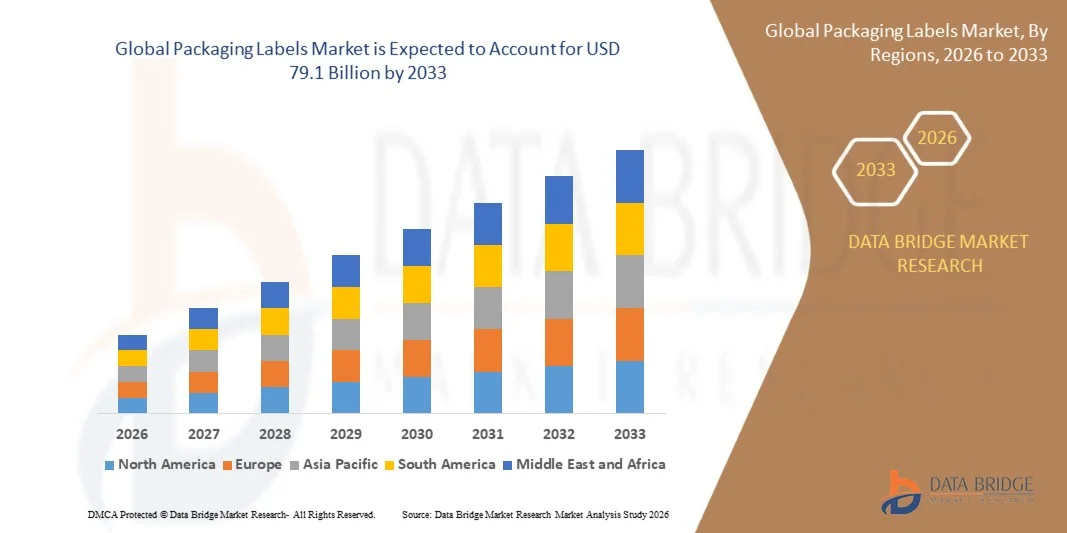
- As per Data Bridge Market Research analysis, the packaging labels market was valued at USD 56.2 billion in 2025 and is projected to reach USD 79.1 billion by 2033, growing at a CAGR of 4.40% from 2026 to 2033.
- The market is experiencing consistent growth driven by rising demand for packaged food and beverages, increasing adoption of convenient and sustainable packaging solutions, and expanding use of labels across consumer goods, pharmaceuticals, personal care, and industrial products. The growing emphasis on product identification, branding, traceability, regulatory compliance, and attractive packaging designs is further supporting the demand for advanced packaging labels.
- The increasing consumption of packaged products, combined with the growing demand for premium packaging, product authentication, and efficient supply-chain identification, is encouraging manufacturers to adopt pressure-sensitive labels, shrink sleeve labels, glue-applied labels, and other labeling solutions. Advancements in digital printing, smart labeling, and sustainable label materials are further enabling brands to improve customization, visual appeal, operational efficiency, and environmental performance.
Market Size & Forecast
- Global Market Value (2025): USD 56.2 Billion
- Expected Market Value (2033): USD 79.1 Billion
- Forecast CAGR (2026–2033): 4.40%
- Leading Region in 2025: North America
- Fastest Growing Region: Asia Pacific
What are the Major Takeaways of the Packaging Labels Market?
- North America dominated the packaging labels market with the largest revenue share of 31.1% in 2025, supported by strong demand for packaged food and beverages, pharmaceuticals, personal care products, and consumer goods, along with increasing requirements for product identification, traceability, and regulatory compliance.
- Asia-Pacific is expected to be the fastest-growing region from 2026 to 2033, driven by rising consumption of packaged products, expanding food and beverage manufacturing, rapid growth of e-commerce, increasing pharmaceutical production, and growing adoption of modern labeling technologies across China, India, Japan, and South Korea.
- Plastic labels led the material segment with a 45.9% revenue share in 2025, supported by their durability, moisture resistance, flexibility, and suitability for a wide range of packaging formats across food and beverages, personal care, household products, and industrial applications.
- Pressure-sensitive labels dominated the label type segment with a 40.9% revenue share in 2025, driven by their ease of application, high-quality printing capabilities, design flexibility, and extensive use across consumer products, pharmaceuticals, food and beverages, and personal care products.
- The food and beverages segment accounted for the largest share of the packaging labels market in 2025, supported by increasing consumption of packaged foods, ready-to-eat products, beverages, and processed foods, along with the need for branding, nutritional information, barcodes, product identification, and regulatory information.
- Digital printing is expected to be among the fastest-growing printing technologies during the forecast period, driven by increasing demand for customized labels, shorter production runs, variable-data printing, faster turnaround times, and cost-effective production for multiple product variants.
- Sustainable and smart labeling solutions are gaining increasing adoption, supported by growing demand for recyclable and lightweight materials, reduced packaging waste, QR-code-enabled product information, RFID-based tracking, and technologies that improve product authentication and supply-chain traceability.
Report Scope and Packaging Labels Market Segmentation
|
Attributes |
Packaging Labels Key Market Insights |
|
Segments Covered |
|
|
Countries Covered |
North America
Europe
Asia-Pacific
Middle East and Africa
South America
|
|
Key Market Players |
|
|
Market Opportunities |
|
|
Value Added Data Infosets |
In addition to the insights on market scenarios such as market value, growth rate, segmentation, geographical coverage, and major players, the market reports curated by the Data Bridge Market Research also include import export analysis, production capacity overview, production consumption analysis, price trend analysis, climate change scenario, supply chain analysis, value chain analysis, raw material/consumables overview, vendor selection criteria, PESTLE Analysis, Porter Analysis, and regulatory framework. |
What is the Key Trend in the Packaging Labels Market?
- Packaging labels are increasingly evolving toward sustainable, recyclable, connected, and digitally enabled solutions as brands seek to improve packaging circularity, product traceability, consumer engagement, and supply-chain visibility.
- For instance, in April 2025, Avery Dennison highlighted the growing role of pressure-sensitive labels in packaging circularity, noting that label design and material selection can support improved recycling outcomes and help consumer-goods brands advance recyclable packaging objectives.
- The integration of RFID, QR codes, and other digital identification technologies is becoming a major trend as manufacturers and retailers seek to improve product authentication, inventory visibility, traceability, and consumer engagement.
- For instance, in October 2025, Walmart and Avery Dennison announced an RFID-enabled solution for fresh-food categories, including meat, bakery, and deli, allowing products to receive digital identities that support faster inventory tracking, freshness management, and reduced food waste.
- Sustainable label materials and recyclable adhesive technologies are also gaining momentum as packaging producers seek to improve compatibility with existing recycling systems while maintaining label performance and visual appeal.
- For instance, in September 2025, Avery Dennison announced that its AD CleanFlake technology received RecyClass Technology Approval for compatibility with the PET recycling stream, following its earlier approval for HDPE applications.
- Digital printing and variable-data labeling are gaining importance as brands increasingly require customized packaging, short production runs, individualized product information, barcodes, and QR codes.
- For instance, in July 2025, Mondi expanded its digital printing capabilities for customized packaging, enabling consecutive barcodes, customized designs, and individualized QR codes to be printed directly onto packaging for high-volume logistics applications.
- Connected packaging is becoming increasingly important as brands use labels as a bridge between physical products and digital information, supporting supply-chain transparency, authentication, inventory management, and direct consumer interaction.
What are the Key Drivers of the Packaging Labels Market?
- The rapid expansion of packaged food and beverages, pharmaceuticals, personal care products, household products, and consumer goods is significantly increasing demand for labels used for branding, product identification, regulatory information, barcodes, and traceability.
- The increasing focus on packaging sustainability is encouraging manufacturers to develop recyclable labels, lightweight materials, clean-release adhesives, and label constructions that improve the compatibility of packaging with recycling processes.
- For instance, in February 2025, Avery Dennison reported results from a semi-industrial recycling trial showing that its tested filmic label solutions could be released from HDPE packaging during recycling, supporting the development of label solutions designed for improved recyclability.
- The expansion of e-commerce, organized retail, and automated logistics is increasing demand for labels that support barcode identification, inventory management, product tracking, shipping, and supply-chain operations.
- For instance, in May 2026, Avery Dennison announced recyclable thermal paper label constructions designed for logistics, shipping, e-commerce, and retail applications, with certifications focused on maintaining the recyclability of corrugated packaging
- The growing need for product transparency and digital consumer engagement is encouraging companies to integrate QR codes, RFID, and other digital identification technologies into labels, allowing products to carry more information without substantially increasing physical packaging complexity.
What Factors are Challenging the Growth of the Packaging Labels Market?
- Packaging labels can involve significant material and production complexity because manufacturers must balance print quality, adhesion, durability, appearance, recyclability, and compatibility with different packaging substrates.
- The transition toward sustainable labels can also create technical challenges because adhesives, inks, facestocks, and liners must work together while meeting recycling requirements and maintaining reliable performance during packaging production and distribution.
- Compatibility challenges between labels and packaging materials can increase development and testing requirements, particularly for plastic packaging where the label, adhesive, container material, and recycling process must operate together without reducing the quality of recovered material.
- For instance, in August 2025, Avery Dennison described a collaboration in Indonesia involving a transition from wet-glue labels to pressure-sensitive labels for PET bottles, addressing recycling contamination and the need to maintain packaging appearance while improving recyclability.
- The increasing need for recyclable materials, smart labeling technologies, advanced printing equipment, and specialized adhesives can increase investment requirements for manufacturers and converters, particularly when they need to adapt existing production lines to new labeling technologies.
- The combination of raw-material considerations, recycling compatibility, sustainability requirements, and the technical complexity of integrating digital identification technologies can therefore create challenges for companies seeking to transition toward next-generation packaging labels.
How is the Packaging Labels Market Segmented?
The packaging labels market is segmented on the basis of label type, material, printing technology, application, and end user.
- By Label Type
On the basis of label type, the packaging labels market is segmented into pressure-sensitive labels, glue-applied labels, shrink sleeve labels, stretch sleeve labels, in-mold labels, and other labels. The pressure-sensitive labels segment dominated the market with a 40.9% share in 2025, owing to their versatility, ease of application, strong adhesion, and compatibility with a wide range of packaging materials. Pressure-sensitive labels are extensively used across food and beverages, pharmaceuticals, personal care, household products, and consumer goods. Their ability to support high-quality graphics, barcodes, variable information, and promotional designs further supports adoption. The growing demand for convenient and visually appealing packaging is also increasing the use of pressure-sensitive labels.
The shrink sleeve labels segment is projected to register the fastest growth at a CAGR of 5.8% from 2026 to 2033, driven by increasing demand for full-body branding, tamper-evident packaging, and attractive designs for irregularly shaped containers. Shrink sleeve labels provide a large printable surface and enable brands to achieve 360-degree graphics without significantly changing the container design. Increasing adoption across beverages, personal care, household products, and specialty consumer goods is supporting demand. Advances in recyclable sleeve materials and printing technologies are further creating opportunities for segment growth.
- By Material
On the basis of material, the packaging labels market is segmented into paper, plastic, metal, and other materials. The plastic segment dominated the market with a 45.9% share in 2025, supported by its durability, flexibility, moisture resistance, and suitability for demanding packaging applications. Plastic labels are widely used for bottles, containers, personal care products, household products, chemicals, and other products exposed to moisture or abrasion. The availability of polypropylene, polyethylene, polyester, and other film-based materials further supports their application across different packaging formats. Growing demand for durable and premium packaging is contributing to segment growth.
The paper segment is projected to register the fastest growth at a CAGR of 5.1% from 2026 to 2033, driven by increasing demand for recyclable, lightweight, and fiber-based labeling solutions. Paper labels are widely used across food and beverages, pharmaceuticals, retail, personal care, and household products. Improvements in coatings, adhesives, print quality, and moisture resistance are expanding their use across applications that traditionally relied more heavily on plastic labels. Growing emphasis on packaging waste reduction and recyclable materials is further supporting demand for paper-based labels.
- By Printing Technology
On the basis of printing technology, the packaging labels market is segmented into flexography, digital printing, gravure, offset, and other printing technologies. The flexography segment dominated the market with a 41.6% share in 2025, supported by its high-speed production capabilities, cost efficiency, and suitability for large-volume label manufacturing. Flexographic printing can accommodate a broad range of substrates and is widely suitable for food and beverages, personal care, household products, and industrial packaging. Its ability to provide consistent print quality during high-volume production further supports adoption.
The digital printing segment is projected to register the fastest growth at a CAGR of 6.3% from 2026 to 2033, driven by increasing demand for customized labels, short production runs, variable-data printing, and faster turnaround times. Digital printing enables manufacturers to produce multiple designs without extensive plate preparation and provides greater flexibility for seasonal products, promotional campaigns, and product personalization. The growing number of product variants and increasing demand for targeted packaging are further supporting adoption. Integration of QR codes, barcodes, serialized information, and other variable data is also expanding the application of digital label printing.
- By Application
On the basis of application, the packaging labels market is segmented into food and beverages, pharmaceuticals, personal care and cosmetics, household products, chemicals, logistics and transportation, and other applications. The food and beverages segment dominated the market with a 36.0% share in 2025, driven by the extensive use of labels across packaged foods, processed foods, ready-to-eat products, dairy products, beverages, and other consumer food products. Labels provide essential information including ingredients, nutritional information, expiration dates, barcodes, storage instructions, and branding. Rising consumption of packaged and convenience-oriented food products is further supporting demand.
The pharmaceuticals segment is projected to register the fastest growth at a CAGR of 6.0% from 2026 to 2033, driven by increasing pharmaceutical production and the growing need for accurate product identification, dosage information, batch numbers, expiration dates, and traceability. Pharmaceutical packaging requires highly reliable labels that maintain readability throughout distribution and storage. Increasing adoption of serialization, authentication, and track-and-trace technologies is creating additional demand for advanced labeling solutions. Growth in pharmaceutical manufacturing and healthcare product consumption is further supporting the segment.
- By End User
On the basis of end user, the packaging labels market is segmented into FMCG, healthcare, retail, industrial, and other end users. The FMCG segment dominated the market with a 42.3% share in 2025, driven by extensive label consumption across food and beverages, personal care, household products, and other fast-moving consumer goods. Labels are essential for branding, product identification, regulatory information, barcodes, promotional messaging, and consumer communication. The frequent launch of new products and increasing competition for shelf visibility are encouraging FMCG manufacturers to invest in attractive and functional labeling solutions.
The healthcare segment is projected to register the fastest growth at a CAGR of 6.2% from 2026 to 2033, driven by increasing demand for pharmaceutical, medical, and healthcare products requiring accurate identification and traceability. Healthcare labels provide critical information such as product names, dosage instructions, batch numbers, expiration dates, barcodes, and handling information. Growing emphasis on product authentication and supply-chain visibility is increasing the adoption of advanced labeling technologies. Expansion of pharmaceutical manufacturing and rising consumption of healthcare products are further supporting demand.
Which Region Holds the Largest Share of the Packaging Labels Market?
- North America dominated the packaging labels market with the largest revenue share of 31.1% in 2025, supported by strong demand for packaged food and beverages, pharmaceuticals, personal care products, and consumer goods, along with increasing requirements for product identification, traceability, and regulatory compliance.
- The region also benefits from well-established packaging and labeling industries, increasing adoption of sustainable packaging solutions, advanced printing technologies, and growing demand for product identification, traceability, branding, and regulatory labeling. The expansion of e-commerce and logistics activities, along with increasing use of recyclable and smart labeling solutions, continues to strengthen North America's position in the global market.
U.S. Packaging Labels Market Insight
The U.S. packaging labels market is witnessing strong growth due to rising demand for packaged food and beverages, pharmaceuticals, personal care products, household products, and retail goods. The country's established packaging industry, strong e-commerce sector, and increasing adoption of advanced labeling technologies are driving demand for pressure-sensitive, digitally printed, RFID-enabled, and sustainable labels. In addition, growing emphasis on recyclable packaging, product traceability, barcode identification, and supply-chain visibility is supporting the adoption of advanced packaging label solutions across industries.
Asia-Pacific Packaging Labels Market Insight
The Asia-Pacific packaging labels market is expected to witness rapid growth, driven by expanding packaged food and beverage consumption, pharmaceutical production, personal care products, retail activity, and e-commerce across countries such as China, Japan, and India. Growing demand for attractive, functional, and sustainable packaging, along with increasing adoption of digital printing and pressure-sensitive labeling technologies, is supporting regional market expansion. Additionally, the continued development of organized retail, logistics infrastructure, and consumer goods manufacturing is increasing demand for product identification, branding, tracking, and regulatory labels across the region.
Japan Packaging Labels Market Insight
The Japan packaging labels market is witnessing consistent growth due to rising demand from food and beverages, pharmaceuticals, healthcare, personal care, electronics, and consumer goods industries. Manufacturers are increasingly adopting high-quality labeling solutions for product identification, branding, traceability, regulatory information, and premium packaging applications. Moreover, increasing focus on sustainable packaging materials, advanced printing technologies, and high-performance labels is further contributing to market growth in Japan.
China Packaging Labels Market Insight
The China packaging labels market is growing rapidly, driven by increasing packaged food and beverage consumption, pharmaceutical manufacturing, personal care products, consumer goods, retail, and e-commerce activities. Growing demand for branded and differentiated packaging is boosting the use of pressure-sensitive, sleeve, digital, and other advanced labeling solutions. In addition, rising investments in manufacturing, logistics, and e-commerce infrastructure, together with increasing requirements for product identification, barcodes, tracking, and regulatory information, are supporting market expansion in China.
U.K. Packaging Labels Market Insight
The U.K. packaging labels market is experiencing steady growth, supported by rising demand from food and beverage, pharmaceutical, personal care, retail, logistics, and e-commerce applications. Increasing focus on sustainable packaging, recyclable materials, and packaging circularity is encouraging the adoption of environmentally compatible label solutions. Furthermore, growing demand for digitally printed, variable-information, barcode, and tracking labels is supporting market growth across retail, logistics, and consumer goods applications.
Germany Packaging Labels Market Insight
The Germany packaging labels market is expanding steadily due to the country's strong food and beverage, pharmaceutical, automotive, chemical, industrial, and consumer goods sectors. Manufacturers are increasingly utilizing advanced packaging labels for product identification, regulatory information, branding, traceability, and logistics. Continuous developments in sustainable materials, recyclable label constructions, digital printing, and high-performance labeling solutions, along with Germany's strong manufacturing and packaging ecosystem, are further driving market growth.
Which are the Top Companies in Packaging Labels Market?
The packaging labels industry is primarily led by well-established companies, including:
- Avery Dennison Corporation (U.S.)
- CCL Industries Inc. (Canada)
- Multi-Color Corporation (U.S.)
- UPM-Kymmene Corporation (Finland)
- Mondi plc (U.K.)
- International Paper Company (U.S.)
- WestRock Company (U.S.)
- Huhtamaki Oyj (Finland)
- Sato Holdings Corporation (Japan)
- Fuji Seal International, Inc. (Japan)
- Coveris Management GmbH (Austria)
- Schreiner Group GmbH & Co. KG (Germany)
- Torraspapel Adestor (Spain)
- Constantia Flexibles Group GmbH (Austria)
- Toppan Inc. (Japan)
- Lintec Corporation (Japan)
- Brady Corporation (U.S.)
- WS Packaging Group, Inc. (U.S.)
- MCC Verstraete (Belgium)
What are Latest Developments in Packaging Labels Market?
- In January 2025, Avery Dennison introduced its Premium Labels range in India, featuring textured substrates designed for premium packaging applications across wine and spirits, food and beverages, and luxury beauty. The launch focused on improving shelf appeal, brand differentiation, and sustainability in premium packaging.
- In June 2023, UPM Raflatac highlighted the role of label materials in food packaging safety and recyclability, emphasizing that label selection can influence the recyclability and quality of the resulting recycled material. The development reflects increasing industry attention toward label solutions that support packaging circularity.
- In September 2022, Avery Dennison introduced a wide-web direct thermal linerless label platform for variable-information applications including e-commerce, food delivery, quick-service restaurants, transportation, and logistics. The linerless construction was designed to eliminate liner waste while improving labeling efficiency and productivity.
- In November 2021, Avery Dennison introduced three paper materials made from 100% recycled fibers for premium labeling applications in wine, spirits, food, and beverages. The development expanded the company's portfolio of recycled-content label materials and addressed growing demand for sustainable packaging solutions.
- In October 2021, Avery Dennison and Mucho introduced the Zero Waste Beauty inspiration envelope featuring seven sustainable label solutions for beauty and personal care brands. The initiative highlighted the growing focus on sustainable labeling materials and packaging design within the beauty sector.

- Interactive Data Analysis Dashboard
- Company Analysis Dashboard for high growth potential opportunities
- Research Analyst Access for customization & queries
- Competitor Analysis with Interactive dashboard
- Latest News, Updates & Trend analysis
- Harness the Power of Benchmark Analysis for Comprehensive Competitor Tracking
Global Packaging Labels Market, Supply Chain Analysis and Ecosystem Framework
To support market growth and help clients navigate the impact of geopolitical shifts, DBMR has integrated in-depth supply chain analysis into its Global Packaging Labels Market research reports. This addition empowers clients to respond effectively to global changes affecting their industries. The supply chain analysis section includes detailed insights such as Global Packaging Labels Market consumption and production by country, price trend analysis, the impact of tariffs and geopolitical developments, and import and export trends by country and HSN code. It also highlights major suppliers with data on production capacity and company profiles, as well as key importers and exporters. In addition to research, DBMR offers specialized supply chain consulting services backed by over a decade of experience, providing solutions like supplier discovery, supplier risk assessment, price trend analysis, impact evaluation of inflation and trade route changes, and comprehensive market trend analysis.
Data collection and base year analysis are done using data collection modules with large sample sizes. The stage includes obtaining market information or related data through various sources and strategies. It includes examining and planning all the data acquired from the past in advance. It likewise envelops the examination of information inconsistencies seen across different information sources. The market data is analysed and estimated using market statistical and coherent models. Also, market share analysis and key trend analysis are the major success factors in the market report. To know more, please request an analyst call or drop down your inquiry.
The key research methodology used by DBMR research team is data triangulation which involves data mining, analysis of the impact of data variables on the market and primary (industry expert) validation. Data models include Vendor Positioning Grid, Market Time Line Analysis, Market Overview and Guide, Company Positioning Grid, Patent Analysis, Pricing Analysis, Company Market Share Analysis, Standards of Measurement, Global versus Regional and Vendor Share Analysis. To know more about the research methodology, drop in an inquiry to speak to our industry experts.
Data Bridge Market Research is a leader in advanced formative research. We take pride in servicing our existing and new customers with data and analysis that match and suits their goal. The report can be customized to include price trend analysis of target brands understanding the market for additional countries (ask for the list of countries), clinical trial results data, literature review, refurbished market and product base analysis. Market analysis of target competitors can be analyzed from technology-based analysis to market portfolio strategies. We can add as many competitors that you require data about in the format and data style you are looking for. Our team of analysts can also provide you data in crude raw excel files pivot tables (Fact book) or can assist you in creating presentations from the data sets available in the report.













